

[2022年01月]更新のMCPA-Level-1試験資料MuleSoft学習ガイド
有効な問題最新版を試そうMCPA-Level-1テスト解釈MCPA-Level-1有効な試験ガイド
質問 21
Refer to the exhibit.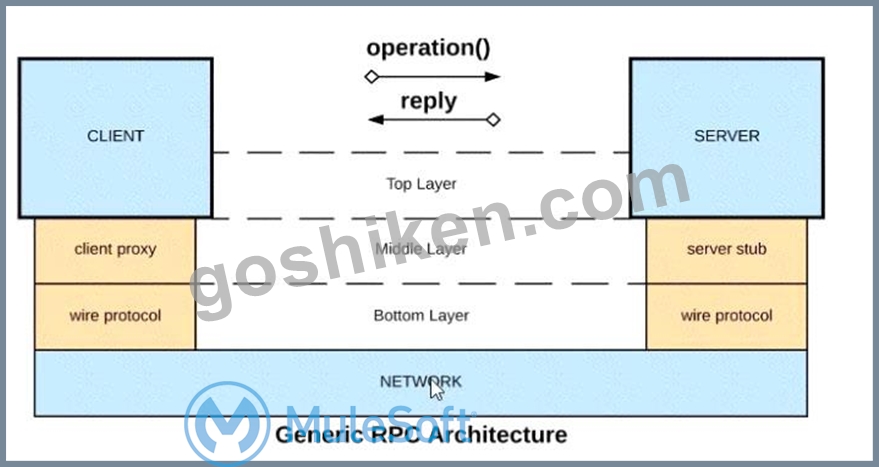
What is a valid API in the sense of API-led connectivity and application networks?
A) Java RMI over TCP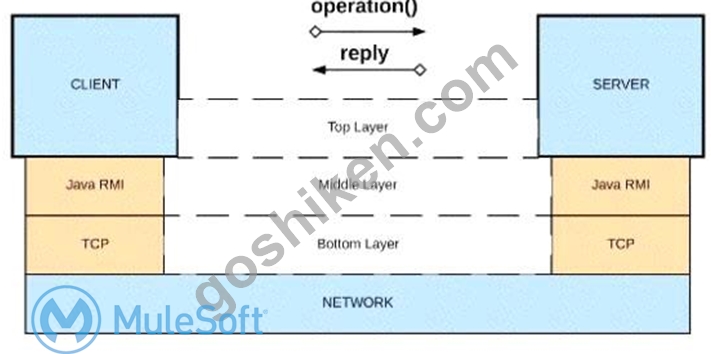
B) Java RMI over TCP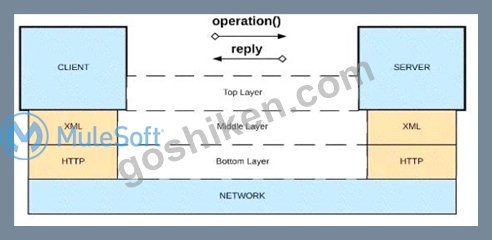
C) CORBA over HOP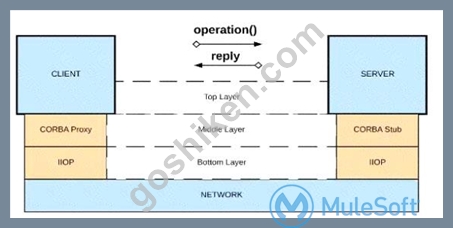
D) XML over UDP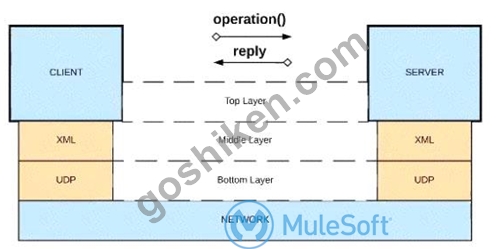
- A. Option C
- B. Option B
- C. Option A
- D. Option D
正解: D
質問 22
What do the API invocation metrics provided by Anypoint Platform provide?
- A. ROI metrics from APIs that can be directly shared with business users
- B. Proactive identification of likely future policy violations that exceed a given threat threshold
- C. Measurements of the effectiveness of the application network based on the level of reuse
- D. Data on past API invocations to help identify anomalies and usage patterns across various APIs
正解: C
解説:
Explanation/Reference: https://usermanual.wiki/Document/APAAppNetstudentManual02may2018.991784750.pdf
質問 23
What is true about API implementations when dealing with legal regulations that require all data processing to be performed within a certain jurisdiction (such as in the USA or the EU)?
- A. They must use a Jurisdiction-local external messaging system such as Active MQ rather than Anypoint MQ
- B. They must ensure ALL data is encrypted both in transit and at rest
- C. They must te deployed to Anypoint Platform runtime planes that are managed by Anypoint Platform control planes, with both planes in the same Jurisdiction
- D. They must avoid using the Object Store as it depends on services deployed ONLY to the US East region
正解: C
解説:
Correct answer: They must be deployed to Anypoint Platform runtime planes that are managed by Anypoint Platform control planes, with both planes in the same Jurisdiction.
*****************************************
>> As per legal regulations, all data processing to be performed within a certain jurisdiction. Meaning, the data in USA should reside within USA and should not go out. Same way, the data in EU should reside within EU and should not go out.
>> So, just encrypting the data in transit and at rest does not help to be compliant with the rules. We need to make sure that data does not go out too.
>> The data that we are talking here is not just about the messages that are published to Anypoint MQ. It includes the apps running, transaction states, application logs, events, metric info and any other metadata. So, just replacing Anypoint MQ with a locally hosted ActiveMQ does NOT help.
>> The data that we are talking here is not just about the key/value pairs that are stored in Object Store. It includes the messages published, apps running, transaction states, application logs, events, metric info and any other metadata. So, just avoiding using Object Store does NOT help.
>> The only option left and also the right option in the given choices is to deploy application on runtime and control planes that are both within the jurisdiction.
質問 24
What do the API invocation metrics provided by Anypoint Platform provide?
- A. Measurements of the effectiveness of the application network based on the level of reuse
- B. Data on past API invocations to help identify anomalies and usage patterns across various APIs
- C. ROI metrics from APIs that can be directly shared with business users
- D. Proactive identification of likely future policy violations that exceed a given threat threshold
正解: B
解説:
Correct answer: Data on past API invocations to help identify anomalies and usage patterns across various APIs
*****************************************
API Invocation metrics provided by Anypoint Platform:
>> Does NOT provide any Return Of Investment (ROI) related information. So the option suggesting it is OUT.
>> Does NOT provide any information w.r.t how APIs are reused, whether there is effective usage of APIs or not etc...
>> Does NOT prodive any prediction information as such to help us proactively identify any future policy violations.
So, the kind of data/information we can get from such metrics is on past API invocations to help identify anomalies and usage patterns across various APIs.
質問 25
When using CloudHub with the Shared Load Balancer, what is managed EXCLUSIVELY by the API implementation (the Mule application) and NOT by Anypoint Platform?
- A. The assignment of each HTTP request to a particular CloudHub worker
- B. The SSL certificates used by the API implementation to expose HTTPS endpoints
- C. The logging configuration that enables log entries to be visible in Runtime Manager
- D. The number of DNS entries allocated to the API implementation
正解: D
質問 26
An organization has implemented a Customer Address API to retrieve customer address information. This API has been deployed to multiple environments and has been configured to enforce client IDs everywhere.
A developer is writing a client application to allow a user to update their address. The developer has found the Customer Address API in Anypoint Exchange and wants to use it in their client application.
What step of gaining access to the API can be performed automatically by Anypoint Platform?
- A. Approve the client application request for the chosen SLA tier
- B. Request access to the appropriate API Instances deployed to multiple environments using the client application's credentials
- C. Create a new application in Anypoint Exchange for requesting access to the API
- D. Modify the client application to call the API using the client application's credentials
正解: A
解説:
Correct answer: Approve the client application request for the chosen SLA tier
*****************************************
>> Only approving the client application request for the chosen SLA tier can be automated
>> Rest of the provided options are not valid
質問 27
What condition requires using a CloudHub Dedicated Load Balancer?
- A. When cross-region load balancing is required between separate deployments of the same Mule application
- B. When API invocations across multiple CloudHub workers must be load balanced
- C. When server-side load-balanced TLS mutual authentication is required between API implementations and API clients
- D. When custom DNS names are required for API implementations deployed to customer-hosted Mule runtimes
正解: A
質問 28
An API implementation is deployed to CloudHub.
What conditions can be alerted on using the default Anypoint Platform functionality, where the alert conditions depend on the end-to-end request processing of the API implementation?
- A. When the API receives a very high number of API invocations
- B. When a particular API client invokes the API too often within a given time period
- C. When the response time of API invocations exceeds a threshold
- D. When the API is invoked by an unrecognized API client
正解: C
質問 29
An organization is implementing a Quote of the Day API that caches today's quote.
- A. When there is one deployment of the API implementation to CloudHub and anottV deployment to a customer-hosted Mule runtime that must share the cache state
- B. What scenario can use the GoudHub Object Store via the Object Store connector to persist the cache's state?
- C. When there are two CloudHub deployments of the API implementation by two Anypoint Platform business groups to the same CloudHub region that must share the cache state
- D. When there is one CloudHub deployment of the API implementation to three CloudHub workers that must share the cache state
- E. When there are three CloudHub deployments of the API implementation to three separate CloudHub regions that must share the cache state
正解: C
質問 30
What is a typical result of using a fine-grained rather than a coarse-grained API deployment model to implement a given business process?
- A. A decrease in the number of connections within the application network supporting the business process.
- B. An overall lower usage of resources because each fine-grained API consumes less resources.
- C. A higher number of discoverable API-related assets in the application network.
- D. A better response time for the end user as a result of the APIs being smaller in scope and complexity.
正解: D
質問 31
An API implementation returns three X-RateLimit-* HTTP response headers to a requesting API client. What type of information do these response headers indicate to the API client?
- A. A correlation ID that should be sent in the next request
- B. The HTTP response size
- C. The error codes that result from throttling
- D. The remaining capacity allowed by the API implementation
正解: D
解説:
Correct answer: The remaining capacity allowed by the API implementation.
*****************************************
>> Reference: https://docs.mulesoft.com/api-manager/2.x/rate-limiting-and-throttling-sla-based-policies#response-headers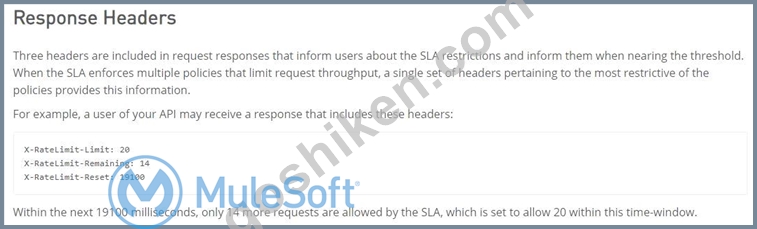
質問 32
What CANNOT be effectively enforced using an API policy in Anypoint Platform?
- A. Logging HTTP requests and responses
- B. Backend system overloading
- C. Guarding against Denial of Service attacks
- D. Maintaining tamper-proof credentials between APIs
正解: C
質問 33
What is true about automating interactions with Anypoint Platform using tools such as Anypoint Platform REST APIs, Anypoint CLI, or the Mule Maven plugin?
- A. Access to Anypoint Platform APIs and Anypoint CLI can be controlled separately through the roles and permissions in Anypoint Platform, so that specific users can get access to Anypoint CLI while others get access to the platform APIs.
- B. By default, the Anypoint CLI and Mule Maven plugin are NOT included in the Mule runtime, so are NOT available to be used by deployed Mule applications.
- C. Anypoint Platform APIs can ONLY automate interactions with CloudHub, while the Mule Maven plugin is required for deployment to customer-hosted Mule runtimes
- D. API policies can be applied to the Anypoint Platform APIs so that ONLY certain LOBs have access to specific functions.
正解: B
質問 34
Version 3.0.1 of a REST API implementation represents time values in PST time using ISO 8601 hh:mm:ss format. The API implementation needs to be changed to instead represent time values in CEST time using ISO 8601 hh:mm:ss format. When following the semver.org semantic versioning specification, what version should be assigned to the updated API implementation?
- A. 4.0.0
- B. 3.0.2
- C. 3.1.0
- D. 3.0.1
正解: A
解説:
Correct answer: 4.0.0
*****************************************
As per semver.org semantic versioning specification:
Given a version number MAJOR.MINOR.PATCH, increment the:
- MAJOR version when you make incompatible API changes.
- MINOR version when you add functionality in a backwards compatible manner.
- PATCH version when you make backwards compatible bug fixes.
As per the scenario given in the question, the API implementation is completely changing its behavior. Although the format of the time is still being maintained as hh:mm:ss and there is no change in schema w.r.t format, the API will start functioning different after this change as the times are going to come completely different.
Example: Before the change, say, time is going as 09:00:00 representing the PST. Now on, after the change, the same time will go as 18:00:00 as Central European Summer Time is 9 hours ahead of Pacific Time.
>> This may lead to some uncertain behavior on API clients depending on how they are handling the times in the API response. All the API clients need to be informed that the API functionality is going to change and will return in CEST format. So, this considered as a MAJOR change and the version of API for this new change would be 4.0.0
質問 35
Refer to the exhibit.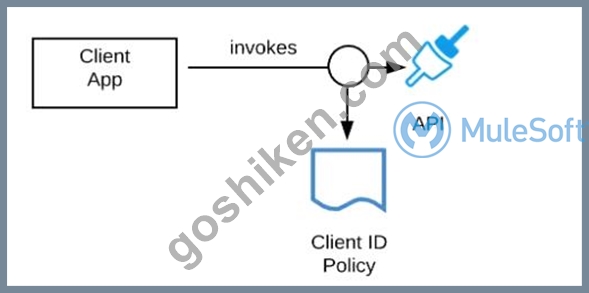
A developer is building a client application to invoke an API deployed to the STAGING environment that is governed by a client ID enforcement policy.
What is required to successfully invoke the API?
- A. The client ID and secret for the Anypoint Platform account owning the API in the STAGING environment
- B. A valid OAuth token obtained from Anypoint Platform and its associated client ID and secret
- C. The client ID and secret for the Anypoint Platform account's STAGING environment
- D. The client ID and secret obtained from Anypoint Exchange for the API instance in the STAGING environment
正解: D
解説:
Correct answer: The client ID and secret obtained from Anypoint Exchange for the API instance in the STAGING environment
*****************************************
>> We CANNOT use the client ID and secret of Anypoint Platform account or any individual environments for accessing the APIs
>> As the type of policy that is enforced on the API in question is "Client ID Enforcment Policy", OAuth token based access won't work.
Right way to access the API is to use the client ID and secret obtained from Anypoint Exchange for the API instance in a particular environment we want to work on.
References:
Managing API instance Contracts on API Manager
https://docs.mulesoft.com/api-manager/1.x/request-access-to-api-task
https://docs.mulesoft.com/exchange/to-request-access
https://docs.mulesoft.com/api-manager/2.x/policy-mule3-client-id-based-policies
質問 36
The responses to some HTTP requests can be cached depending on the HTTP verb used in the request. According to the HTTP specification, for what HTTP verbs is this safe to do?
- A. GET, OPTIONS, HEAD
- B. PUT, POST, DELETE
- C. GET, HEAD, POST
- D. GET, PUT, OPTIONS
正解: A
解説:
Correct answer: GET, OPTIONS, HEAD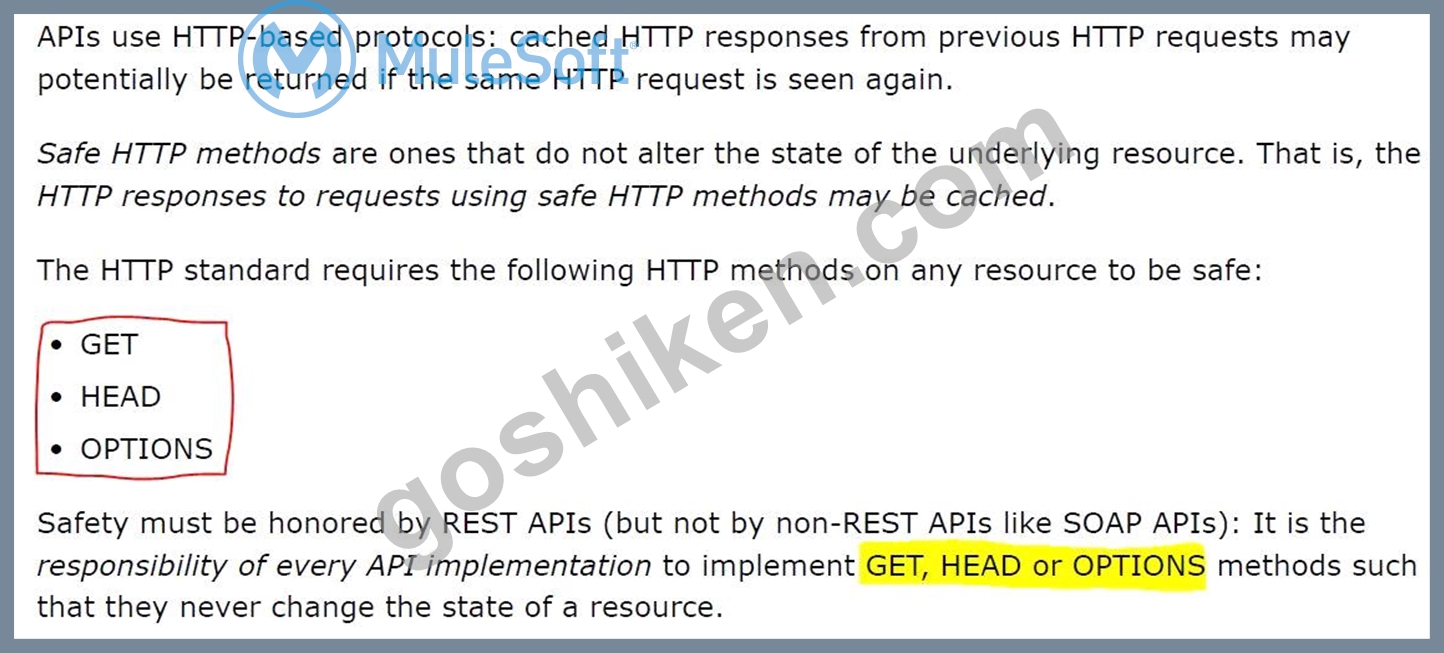
http://restcookbook.com/HTTP%20Methods/idempotency/
質問 37
An Order API must be designed that contains significant amounts of integration logic and involves the invocation of the Product API.
The power relationship between Order API and Product API is one of "Customer/Supplier", because the Product API is used heavily throughout the organization and is developed by a dedicated development team located in the office of the CTO.
What strategy should be used to deal with the API data model of the Product API within the Order API?
- A. Work with the API data types of the Product API directly when implementing the integration logic of the Order API such that the Order API uses the same (unchanged) data types as the Product API
- B. Start an organization-wide data modeling initiative that will result in an Enterprise Data Model that will then be used in both the Product API and the Order API
- C. Implement an anti-corruption layer in the Order API that transforms the Product API data model into internal data types of the Order API
- D. Convince the development team of the Product API to adopt the API data model of the Order API such that the integration logic of the Order API can work with one consistent internal data model
正解: A
質問 38
What is a key requirement when using an external Identity Provider for Client Management in Anypoint Platform?
- A. The application network must include System APIs that interact with the Identity Provider
- B. To invoke OAuth 2.0-protected APIs managed by Anypoint Platform, API clients must submit access tokens issued by that same Identity Provider
- C. Single sign-on is required to sign in to Anypoint Platform
- D. APIs managed by Anypoint Platform must be protected by SAML 2.0 policies
正解: D
質問 39
What Mule application deployment scenario requires using Anypoint Platform Private Cloud Edition or Anypoint Platform for Pivotal Cloud Foundry?
- A. When it is required that ALL APIs are private and NOT exposed to the public cloud
- B. When regulatory requirements mandate on-premises processing of EVERY data item, including meta-data
- C. When it Is required to make ALL applications highly available across multiple data centers
- D. When ALL backend systems in the application network are deployed in the organization's intranet
正解: B
質問 40
......
MCPA-Level-1試験問題と解答:https://www.goshiken.com/MuleSoft/MCPA-Level-1-mondaishu.html