

2026年最新の100%無料CAPM日本語日常練習試験には1328問があります
CAPM日本語試験資料PMI学習ガイド
質問 # 680
プロジェクト中の利害関係者の特定と関与に関する正しい記述はどれですか?
- A. プロジェクトの利害関係者は、プロジェクト憲章が完成し、要件収集中に関与するときに特定される必要があります。
- B. プロトタイプが完成したら、プロジェクトの関係者を特定して関与させ、フィードバックを提供する必要がありますが、プロジェクト中に入力を行うことは控える必要があります。
- C. プロジェクトの利害関係者は、要件抽出の段階で特定され、関与されるべきであるが、スコープ定義プロセスではそうではない。
- D. プロジェクトの成功に直接影響を与えるために、プロジェクトの関係者を特定し、プロジェクトのあらゆるフェーズに関与する必要があります。
正解:D
質問 # 681
アジャイルプロジェクトでスコープ管理を実行します。要件の定義とは何ですか
- A. バックログ i
- B. メトリクス
- C. チャーター
- D. スプリント
正解:A
解説:
In Agile and Adaptive environments, as described in the PMBOKGuide and the Agile Practice Guide, requirements are not captured in a static scope statement but are managed dynamically through a Backlog.
* Backlog (Choice D): In Agile, the Product Backlog is the primary document (an ordered list) representing the project scope. It consists of user stories, features, or requirements that need to be addressed. Requirements are " refined " and prioritized within this backlog throughout the project, rather than being finalized upfront. This aligns with the Agile principle of " responding to change over following a plan. "
* Sprint (Choice B): A Sprint is a time-boxed iteration (typically 1-4 weeks) during which a specific set of work is completed. While requirements from the backlog are selected for a Sprint Backlog, the Sprint itself is a container for work, not a definition of the requirements themselves.
* Charter (Choice C): The Project Charter (or Agile Charter) is a high-level document that authorizes the project. While it may contain a high-level vision and objectives, it does not define the detailed requirements that evolve during the project.
* Metrics (Choice A): These are measurements (such as velocity or cycle time) used to track progress and quality, but they do not define the functional or non-functional requirements of the product.
In scope management for adaptive lifecycles, the Product Backlog serves as the evolving " single source of truth " for what the team needs to build, ensuring that the most valuable requirements are always addressed first.
質問 # 682
組織プロセス資産のカテゴリーは次のうちどれですか?
- A. 従業員の能力
- B. 組織文化
- C. 組織の知識ベース
- D. 政府規格
正解:C
解説:
* According to the PMBOKGuide, Organizational Process Assets (OPAs) are the plans, processes, policies, procedures, and knowledge bases specific to and used by the performing organization. These assets influence the management of the project and are grouped into two primary categories:
* Processes, Policies, and Procedures: These are usually established by the Project Management Office (PMO) or another function outside of the project. They include things like standard templates, quality policies, and change control procedures.
* Organizational Knowledge Bases: These are the repositories used for storing and retrieving information. They include:
* Lessons learned repositories and historical information.
* Project files from previous projects (baselines, calendars, etc.).
* Financial data repositories (labor hours, costs, budgets).
* Configuration management knowledge bases (versions of software/hardware standards).
* Issue and defect management databases.
* OPAs are internal to the organization and represent a " storehouse " of experience that project managers can leverage to avoid " reinventing the wheel. "
* Analysis of Other Options:
* A. Government standards: These are Enterprise Environmental Factors (EEFs). They are external to the project and often the organization, representing " rules " that the project must follow rather than assets it can use.
* B. Organizational culture: This is an internal Enterprise Environmental Factors (EEF). While it exists within the organization, it is considered a " condition " or " constraint " the project manager must navigate, rather than a documented process or knowledge base asset.
* C. Employee capabilities: This is also an internal EEF. It refers to the existing human resources ' skills, knowledge, and specialized expertise available to the project. It is a " factor " the PM must work within.
質問 # 683
アクティビティの期間の精度を向上させるために、どのタイプの推定が使用されますか?
- A. パラメトリック
- B. What-ifシナリオ分析
- C. 類似
- D. 3点
正解:D
質問 # 684
時間、資金、リソースを含む緊急時備えを確立するとき、リスクはどのように処理されますか?
- A. 軽減中
- B. 回避
- C. 承ります
- D. 転送中
正解:A
質問 # 685
統合変更管理の実行プロセスの出力は次のうちどれですか?
- A. 成果物
- B. 組織プロセス資産の更新
- C. 変更依頼
- D. プロジェクトドキュメントの更新
正解:D
質問 # 686
実績値管理(EVM)メトリックは、実績値(EV)と実際のコスト(AC)の比率として表される予算リソースのコスト効率の測定であり、重要なEVMメトリックと見なされますか?
- A. Variance at completion (VAC)
- B. Budget at completion (BAC)
- C. Cost performance index (CPI)
- D. Cost variance (CV)
正解:C
解説:
According to the PMBOKGuide and the Standard for Project Management, the Cost Performance Index (CPI) is the specific earned value management (EVM) metric that measures the cost efficiency of budgeted resources. It is expressed as the ratio of Earned Value (EV) to Actual Cost (AC).
As per PMI standards, the CPI is considered the most critical EVM metric because it indicates the value of work completed compared to the actual amount spent. It is a primary indicator of project cost performance and is used to predict the final project cost. The formula is:
$$\text{CPI} = \frac{\text{EV}}{\text{AC}}$$
Interpretation of CPI values:
* CPI > 1.0: Indicates that the project is under budget (performing better than planned).
* CPI < 1.0: Indicates that the project is over budget (performing worse than planned).
* CPI = 1.0: Indicates that the project is exactly on budget.
The other options are incorrect based on the following PMI definitions:
* Cost Variance (CV): This is a measure of cost performance expressed as the difference between earned value and actual cost ($\text{CV} = \text{EV} - \text{AC}$). While it measures efficiency, it is an absolute value (currency), not a ratio.
* Budget at Completion (BAC): This is the total planned budget for the project. It is the sum of all budgets established for the work to be performed and serves as the baseline, not a measure of current efficiency.
* Variance at Completion (VAC): This is a projection of the amount of budget deficit or surplus, expressed as the difference between the BAC and the Estimate at Completion (EAC) ($\text{VAC} =
\text{BAC} - \text{EAC}$).
As per the PMI Lexicon of Project Management Terms, the Cost Performance Index is a fundamental component of the Control Costs process, allowing project managers to determine if corrective action is needed to bring the project back within financial constraints.
質問 # 687
適応型プロジェクト チームが初めて会議を開き、プロジェクト管理のアプローチを決定します。
プロジェクト成果物を定義した後、チームメンバーの1人がイベントが不足していると主張しました。スクラムマスターはチームにコーチングを行い、計画を完了させました。
次の要素のうち、どれを 2 つ含める必要がありますか? (2 つ選択してください)
- A. デイリースクラム
- B. スプリントバックログ
- C. スプリントの振り返り
- D. 製品バックログ
- E. 増分
正解:A、C
解説:
According to the Agile Practice Guide and the Scrum Guide, Scrum is defined by three specific categories:
Roles, Artifacts, and Events (also called Ceremonies).
* Defining " Events " : The team member correctly pointed out that the " events " are missing. In Scrum, there are five formal events for inspection and adaptation: The Sprint, Sprint Planning, Daily Scrum, Sprint Review, and Sprint Retrospective.
* Daily Scrum (Option A): A 15-minute event for the Developers to synchronize activities and create a plan for the next 24 hours.
* Sprint Retrospective (Option C): An event held at the end of the sprint to plan ways to increase quality and effectiveness by inspecting how the last Sprint went with regards to people, relationships, processes, and tools.
* Coaching the Team: The Scrum Master's role is to ensure the team understands the framework. By identifying these missing events, the team completes the " heartbeat " of the Scrum process, allowing for the empirical process control of transparency, inspection, and adaptation.
Analysis of other options:
* Option B (Increments): This is an Artifact, not an event. The Increment is a concrete stepping stone toward the Product Goal.
* Option D (Sprint backlog): This is an Artifact, not an event. It is the set of Product Backlog items selected for the Sprint, plus a plan for delivering them.
* Option E (Product backlog): This is an Artifact, not an event. It is an emergent, ordered list of what is needed to improve the product.
Per PMI standards, when a team is organizing their approach and identifies that events are missing, they must select from the timeboxed activities defined in the framework, such as the Daily Scrum and the Sprint Retrospective.
質問 # 688
提供されている図に表示される組織構造のタイプはどれですか?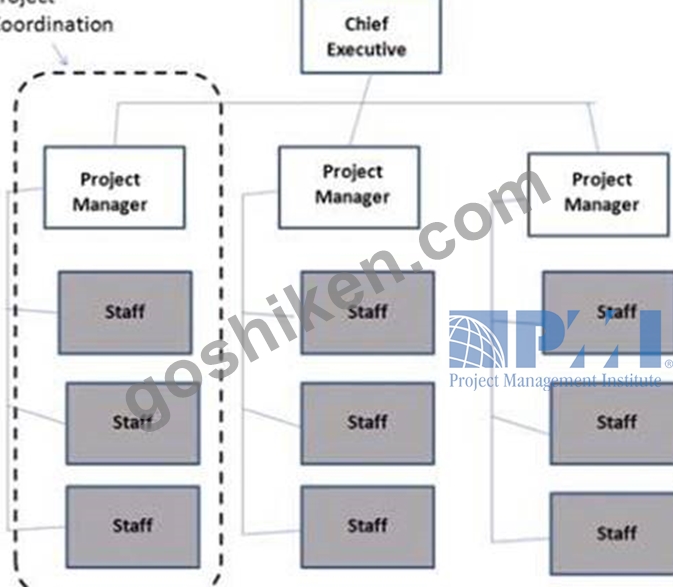
- A. バランスマトリックス
- B. 強力なマトリックス
- C. 投影
- D. 機能的
正解:C
質問 # 689
プロジェクトマネージャーは、ITプロジェクトに関してビジネスアナリストの支援を求めています。ビジネスアナリストはどのような支援を提供できますか?
- A. プロジェクトのスケジュールを管理します。
- B. プロジェクト リソースを割り当てます。
- C. 製品の機能を確認します。
- D. 製品要件を明らかにします。
正解:D
解説:
In accordance with the PMBOKGuide and the PMI Guide to Business Analysis, the roles of the Project Manager (PM) and the Business Analyst (BA) are complementary. While the PM focuses on the project ' s health (schedule, budget, and resources), the BA focuses on the product ' s health (requirements, value, and functionality).
* Why Choice A is correct:
* Primary Responsibility: The core competency of a Business Analyst is Requirements Elicitation.
This involves using techniques like interviews, workshops, and surveys to " draw out " the true needs of the stakeholders.
* Bridge to Solution: The BA helps the IT team understand what needs to be built. They transform high-level business needs into detailed functional and non-functional requirements.
* Collect Requirements Process: During this process, the BA is the lead architect for the Requirements Traceability Matrix, ensuring that every technical feature requested by IT aligns with a business objective.
Analysis of other options:
* B (Verify product functionality): This is primarily the responsibility of the Quality Control (QC) team or testers. While a BA might participate in User Acceptance Testing (UAT) to ensure requirements are met, " Verification " is a technical quality process.
* C (Manage the project schedule): This is a core Project Manager responsibility. The PM owns the schedule, tracking critical paths and deadlines. The BA may provide input on how long requirements gathering will take, but they do not manage the overall project timeline.
* D (Allocate project resources): Resource allocation is a Project Manager or Functional Manager task. It involves assigning people to tasks and managing the project budget. BAs generally do not have the authority to allocate corporate or project resources.
Key Concept: The Project Management Institute (PMI) emphasizes that the Business Analyst (Choice A) acts as the " translator " between the business world and the IT world. By focusing on eliciting accurate requirements, the BA reduces the risk of rework and ensures that the software delivered by the project manager actually solves the customer ' s problem.
質問 # 690
ルシア(プロダクトオーナー)は、最終成果物が承認され、予定通り進んでいることを確認しました。ルシアはクライアントと面談し、この朗報を伝えます。クライアントにこの朗報を伝えた後、クライアントは追加機能の要望を述べました。
最終成果物が承認されてから、ルシアはどのような文書を取得するべきでしたか?
- A. スコープ定義
- B. サインオフ
- C. プロジェクト管理計画
- D. 学んだ教訓
正解:B
質問 # 691
機会が確実に実現されるようにして、特定の上昇リスクに関連する不確実性を排除しようとするリスク管理戦略はどれですか。
- A. 強化
- B. エクスプロイト
- C. 受け入れる
- D. シェア
正解:B
解説:
According to the PMBOKGuide and the Standard for Project Management, the strategy described is Exploit. This is a specific response strategy for Opportunities (positive risks/upside risks) where the organization wants to ensure that the opportunity is realized.
As per PMI standards, the Exploit strategy is used for high-priority opportunities where the organization wants to eliminate the uncertainty associated with a particular upside risk by making the opportunity definitely happen. This is the most aggressive of the positive risk response strategies. Examples include:
* Assigning the most talented resources: Ensuring that the best staff are working on a project to reduce the time to completion or improve quality beyond the original scope.
* Using new technologies: Implementing a technological advancement to reduce cost or duration.
* Providing more than requested: Delivering a higher level of service or functionality that results in a strategic advantage.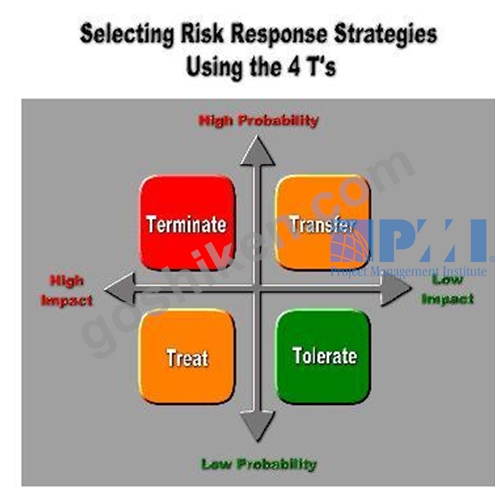
The other options are incorrect based on the following PMI definitions for opportunity responses:
* Enhance: This involves taking action to increase the probability or the positive impact of an opportunity. Unlike exploit, it does not guarantee the outcome; it simply makes it more likely.
* Share: This involves allocating some or all of the ownership of the opportunity to a third party who is best able to capture the benefit for the project (e.g., a joint venture).
* Accept: This involves being willing to take advantage of the opportunity if it arises, but not actively pursuing it. This can be passive (no action) or active (establishing a contingency reserve).
As per the PMI Lexicon of Project Management Terms, the Exploit strategy is a proactive approach to risk management that focuses on maximizing the value and benefits that can be derived from uncertain events.
質問 # 692
どのタイプの契約が、売り手と買い手の両方に、経済的インセンティブでパフォーマンスから逸脱する柔軟性を与えますか?
- A. 固定価格インセンティブ料金(FPIF)
- B. コストピウスアワード料金(CPAF)
- C. コストプラスインセンティブ料金(CPIF)
- D. 時間と材料(T&M)
正解:A
質問 # 693
PMI のタレント トライアングルで重要なスキル セットはどれですか?
- A. プロジェクトの優秀性とスコープ管理
- B. スコープ管理と事業管理
- C. 財務管理と人材管理
- D. 戦略および経営管理
正解:D
質問 # 694
プロジェクトに修正アクションが必要かどうかを判断するために、実際の結果と比較されるコントロールスコープの入力はどれですか。
- A. コストベースライン
- B. スコープベースライン
- C. スコープ管理計画
- D. 変更管理計画
正解:B
質問 # 695
......
有効な問題最新版を試そうCAPM日本語テスト解釈CAPM日本語有効な試験ガイド:https://www.goshiken.com/PMI/CAPM-JPN-mondaishu.html