

Snowflake GES-C01リアル試験問題保証付き更新された問題集
検証済み!合格できるGES-C01試験一発合格保証付き
質問 # 109
An ML engineer is planning a fine-tuning project for a
llama3.1-8b
model to summarize long customer support tickets. They are considering the impact of dataset size and max_epochs on cost and performance, as well as the behavior of the fine-tuned model for inference. Which statements about cost and performance in Snowflake Cortex Fine-tuning are true? (Select all that apply)
- A. The compute cost for fine-tuning is primarily determined by multiplying the number of input tokens in the training data by the number of epochs trained.
- B. For optimal cost efficiency, especially with smaller datasets, the
- C. For large fine-tuning jobs with substantial datasets, particularly when exceeding millions of rows, utilizing Snowpark-optimized warehouses is recommended for improved performance during the training phase.
- D. D When fine-tuning a
- E. The cost for inferencing with a fine-tuned model using the
正解:A、C、D
解説:
Option A is correct. For the
llama3.1-8b
model, the context window specifically allotted for the
prompt
during fine-tuning is 20,000 tokens, and for the
completion
is 4,000 tokens. Option B is correct. The compute cost incurred for Cortex Fine-tuning is based on the number of tokens used in training, which is calculated as 'number of input tokens number of epochs trained'. Option C is incorrect. While max_epochs can be set to a value from 1 to 10 (inclusive), the default is automatically determined by the system. Setting it to the maximum for 'optimal cost efficiency' is not universally recommended, as a higher number of epochs directly increases the compute cost, and the goal is often to select the smallest model that satisfies the need. Option D is incorrect. When using the COMPLETE function for inference with a fine-tuned model, *both* input and output tokens incur compute cost. Option E is correct. Snowpark-optimized warehouses are recommended for Snowpark workloads with large memory requirements, such as ML training use cases, particularly if the training data has more than 5 million rows. Fine-tuning is an ML training process, so this guidance applies.
質問 # 110
A global enterprise has Snowflake accounts in various regions, including a US East (Ohio) account where a critical application is deployed. They need to use AI_COMPLETE with the claude-3-5-sonnet model for real-time customer support, but this model is not natively available in US East (Ohio) for direct AI_COMPLETE usage. The Snowflake administrator considers enabling cross-region inference. Which statements accurately reflect the considerations and characteristics of cross-region inference in Snowflake Cortex?
- A. Option D
- B. Option B
- C. Option E
- D. Option A
- E. Option C
正解:B、E
解説:
Option B is correct because setting the parameter to 'ANY_REGION' enables inference requests to be CORTEX_ENABLED_CROS_ REGION processed in a different region from the default, thereby allowing access to models not natively supported in the local region. For example, claude- 3 - 5- sonnet is available in AWS US East 1 (N. Virginia), which could be accessed from US East (Ohio) via cross-region inference. Option C is 3-5 -sonnet correct as cross-region inference is explicitly not supported in U.S. SnowGov regions for either inbound or outbound inference requests. Option A is incorrect because user inputs, service generated prompts, and outputs are not stored or cached during cross-region inference. Option D is incorrect; latency depends on the cloud provider infrastructure and network status, and testing is recommended. Option E is incorrect because CORTEX_ENABLED_CROSS_REGION is an account-level parameter, not a session parameter.
質問 # 111
A data application developer is using the Snowflake Cortex COMPLETE function to power a multi-turn conversational AI application. They want to ensure responses are creative but not excessively long, adhere to a specific JSON structure, and are filtered for safety. Given the following SQL query snippet, which statements accurately describe the impact of the specified options?
- A. Including a
- B. The

- C. The

- D. Setting

- E. For a multi-turn conversation, previous user prompts and model responses should be passed in the

正解:A、B、C
解説:
Option A is incorrect because a higher temperature, such as 0.8, controls the randomness of the output by influencing which possible token is chosen at each step, resulting in more diverse and random output, not deterministic and focused. Option B is correct because the 'max_tokens' option sets the maximum number of output tokens in the response, and small values can result in truncated responses. Option C is correct because the 'guardrails: TRUE option enables Cortex Guard to filter potentially unsafe and harmful responses from a language model. Option D is correct because AI_COMPLETE Structured Outputs allows you to supply a JSON schema that completion responses must follow, and every model supported by AI_COMPLETE supports structured output. Option E is incorrect because to provide a stateful conversational experience, all previous user prompts and model responses should be passed in the 'prompt_or_history' array, but the number of tokens processed increases for each round, and costs increase proportionally. The 'COMPLETE' function is the older version of 'AI_COMPLETE'.
質問 # 112
A Gen AI Engineer is configuring a new semantic model for Cortex Analyst to process customer feedback. The goal is to ensure that when a user asks for sentiment analysis, the generated SQL queries always include an aggregation by a dimension and present the results as a percentage. The engineer plans to use custom instructions for this purpose. Which of the following details about is true and crucial for successful implementation?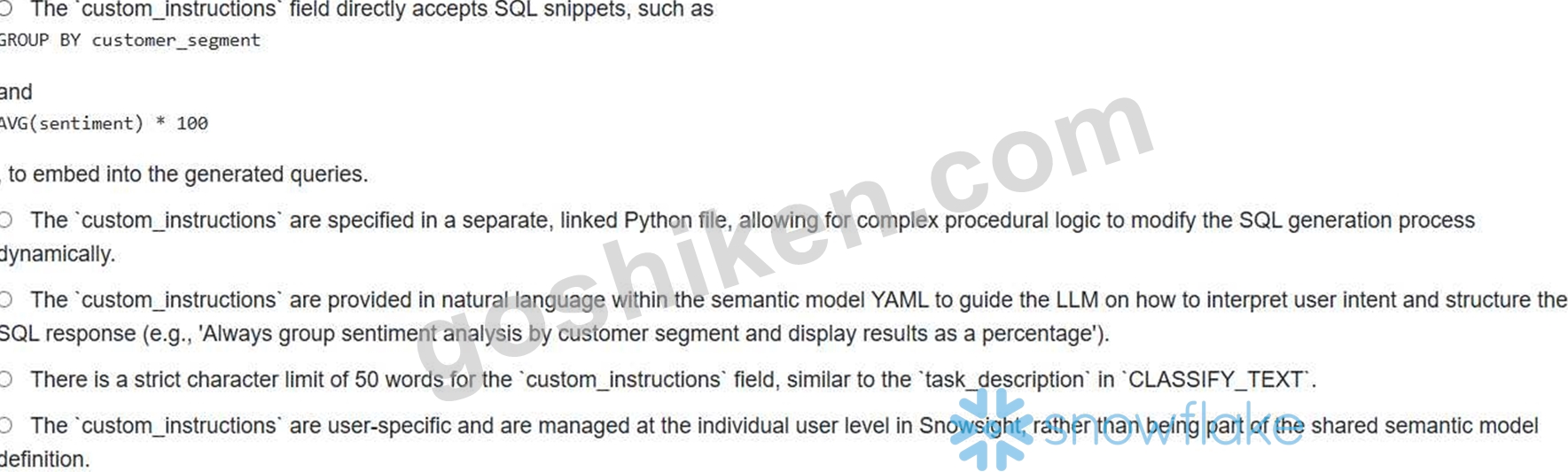
- A. Option D
- B. Option E
- C. Option B
- D. Option A
- E. Option C
正解:E
解説:
Custom instructions in Cortex Analyst provide unique business context to the LLM to control SQL query generation. These instructions are provided in natural language within the semantic model YAML. This means the engineer should describe the desired behavior (grouping by 'customer_segment' and presenting as a percentage) in plain English for the LLM to interpret and apply, making option C correct. Option A is incorrect because 'custom_instructionS guide the LLM's *generation* process, not directly inject SQL snippets. Option B is incorrect as custom instructions are part of the YAML, not a separate Python file. Option D is incorrect; while Copilot's custom instructions have a 2,000 character limit, the source does not specify such a limit for Cortex Analyst's semantic model 'custom_instructionS , and the 'task_description' for 'CLASSIFY _ TEXT is limited to about 50 words. Option E is incorrect; the 'custom_instructions' in the semantic model are part of the shared model definition, not user-specific in the way Snowflake Copilot's custom instructions are.
質問 # 113 
- A. If a user attempts to call an LLM not explicitly listed in the via the Cortex LLM Playground, Snowflake will automatically fall back to the 'snowflake-arctic' model for that request.
- B. The 'ACCOUNTADMIN' must execute the SQL command:

- C. Users with 'ds_team_role' will still be able to successfully call

- D. Enabling Cortex Guard for 'AI_COMPLETE through the 'guardrails' option automatically bypasses the 'CORTEX_MODELS_ALLOWLIST to ensure all LLMs can be used for content safety filtering.
- E. The parameter provides granular control at the database or schema level, allowing administrators to define different sets of approved models for different data contexts.
正解:B、C
解説: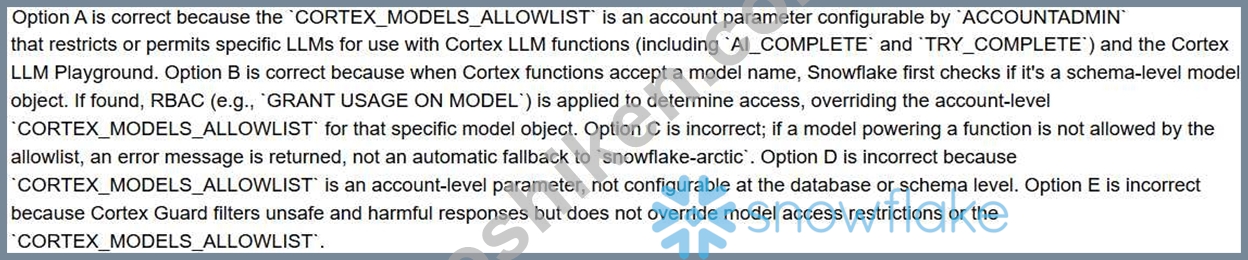
質問 # 114
An operations team at a company is implementing a robust governance framework to monitor and optimize the costs associated with their Snowflake Cortex LLM function usage. They need to identify which functions are driving the highest token consumption and overall credit usage to pinpoint areas for cost reduction. Which of the following monitoring tools or methods are appropriate for gaining these insights into Cortex LLM function costs and token consumption?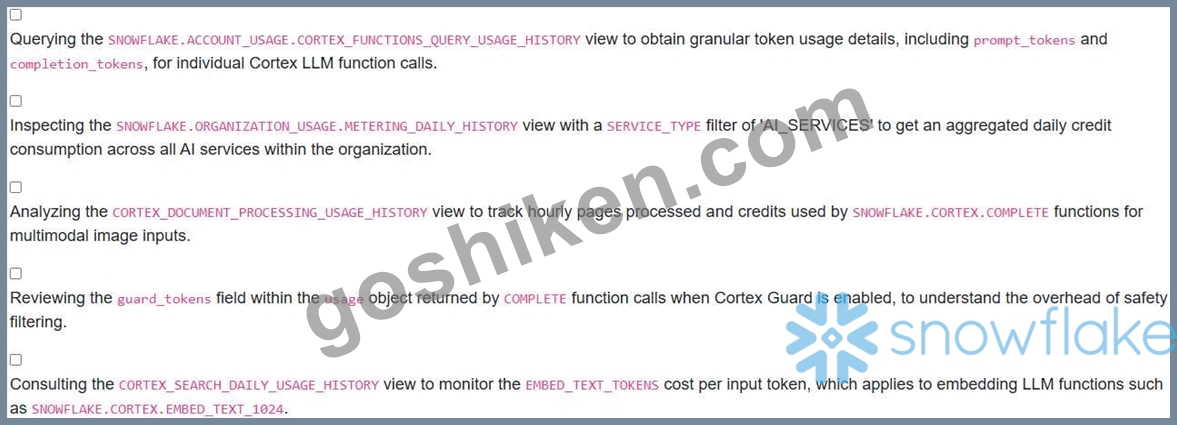
- A. Option B
- B. Option C
- C. Option A
- D. Option E
- E. Option D
正解:A、C、D、E
解説: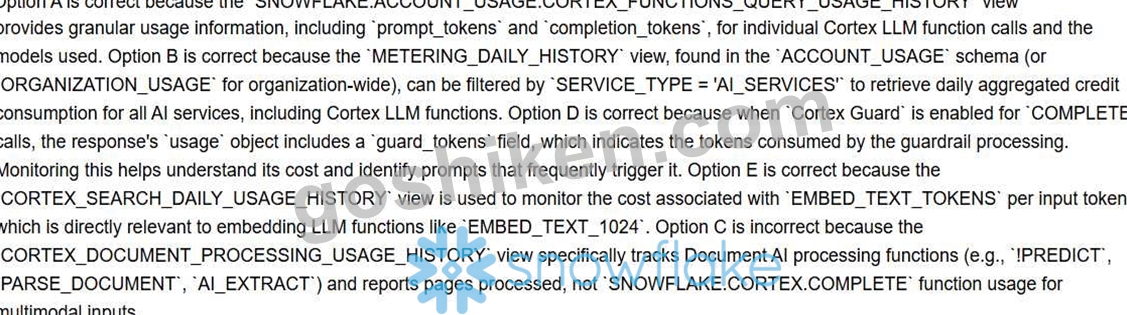
質問 # 115 
database role. Which of the following 'privileges directly related to the virtual warehouse or task execution' are required for the process invoices_task' to successfully execute the Document AI '!PREDICT' method? (Select ALL that apply.)
- A.

- B.

- C.

- D.

- E.

正解:A、B、E
解説:
For successful Document AI operations, including the '!PREDICT method, and for a Snowflake task to run, several privileges are required. The role must have USAGE on the database, 'USAGES on the schema, 'USAGE' on the virtual warehouse, and 'OPERATE' on the virtual warehouse. Since the context is an automated task, 'EXECUTE TASK ON ACCOUNT is also a mandatory privilege for the task's owning role to execute the task. Therefore: - Option B (USAGE ON WAREHOUSE) is required to use the virtual warehouse for computation. - Option C COPERATE ON WAREHOUSE) is required to manage the operational state (e.g., start/stop) of the virtual warehouse. - Option E ( ' EXECUTE TASK ON ACCOUNT) is required for the Snowflake task to execute. - Option A CUSAGE ON SCHEMA') is a general prerequisite for interacting with objects (like the model build) within that schema, but the question specifically asks for privileges 'directly related to the virtual warehouse or task execution'. While functionally necessary for the overall process, it's not a privilege the warehouse or task execution itself. - Option D (READ ON STAGE) is necessary for the '!PREDICT method to access documents from the stage, but similar to Option A, it is not a privilege 'directly related to the virtual warehouse or task execution' based on the specific wording of the question.
質問 # 116
A Snowflake administrator needs to implement a granular access control strategy for LLMs. The general policy is to restrict access to a select few models via an account-level allowlist. However, a specific data science team (using role 'DATA SCIENCE TEAM ROLE) requires access to the 'claude-3-5-sonnet' model, which should not be available to other users or globally via the allowlist. Given this scenario, which set of commands would correctly establish this access control while adhering to the specified requirements?
- A.

- B.

- C.

- D.

- E.

正解:C
解説:
Option A is correct. This sequence of commands first sets an account-level allowlist for 'mistral-large? and 'snowflake-arctic' , thereby restricting general access to other models for plain-name string lookups. The 'CALL ensures the changes are applied. It then explicitly grants the DATA SCIENCE_TEAM ROLES access to the 'claude-3-5-sonnet' model object using its dedicated application role 'SNOWFLAKE."CORTEX-MODEL-ROLE-CLAUDE-3-5-SONNET"'. This ensures 'claude-3-5-sonnet is accessible only to that specific role and not globally through the allowlist, fulfilling the granular access requirement. Option B is incorrect because 'ALTER ACCOUNT operations require the 'ACCOUNTADMIW role, not 'SYSADMIN'. Additionally, setting to 'claude-3-5-sonnet' would make it globally available, contradicting the requirement for restricted access. Option C is incorrect because model-level RBAC for base models in 'SNOWFLAKE.MODELS' is primarily applied using application roles (e.g., 'CORTEX-MODEL-ROLE'), not directly with 'GRANT USAGE ON MODEL'. Option D is incorrect. While clearing the allowlist is a valid part of a strategy, 'GRANT USAGE ON ALL MODELS IN SCHEMA SNOWFLAKE.MODELS' would grant access to 'all' models in that schema, which contradicts the requirement for 'claude-3-5-sonnet' to be exclusive to the data science team and not generally available. Option E is incorrect because SALTER ACCOUNT requires the 'ACCOUNTADMIN& role, not 'SECURITYADMIN', and setting the allowlist to 'claude-3-5-sonnet' would make it generally available, violating the isolation requirement.
質問 # 117
A data processing team is using Snowflake Document AI to extract data from incoming supplier invoices. They observe that many documents are failing to process, and successful extractions are taking longer than expected, leading to increased costs. Upon investigation, they find error messages such as
. Additionally, their 'X-LARGE virtual warehouse is constantly active, contributing to higher-than-anticipated bills. Which two of the following actions are essential steps to troubleshoot and address the root causes of these processing errors and optimize their Document AI pipeline?
- A. Scale down the virtual warehouse to 'X-SMALL' or 'SMALL' size, as larger warehouses do not increase Document AI query processing speed and incur unnecessary costs.
- B. Implement a pre-processing step to split documents exceeding 125 pages or 50 MB into smaller, compliant files before loading to the stage.
- C. Increase the 'max_tokens' parameter within the '!PREDICT' function options to accommodate longer document responses from the model.
- D. Configure the internal stage used for storing invoices with 'ENCRYPTION = (TYPE = 'SNOWFLAKE SSE')'.
- E. Redefine extraction questions to be more generic and encompassing, reducing the number of distinct questions needed per document.
正解:B、D
解説:
The error messages 'Document has too many pages. Actual: 130. Maximum: 125.' and File exceeds maximum size. Actual: 54096026 bytes. Maximum: 50000000 bytes: directly indicate that the documents do not meet Document AI's input requirements, which specify a maximum of 125 pages and 50 MB file size. Therefore, implementing a pre-processing step to split or resize these documents is an essential solution (Option B). The error 'cannot identify image file < io.ByteslO object at Ox...>' is a known issue that occurs when an internal stage used for Document AI is not configured with encryption. Correctly configuring the stage with this encryption type is crucial for resolving this processing error (Option D). Option A, while addressing cost optimization, is not a root cause of the 'processing errors' themselves, although it is a best practice for cost governance as larger warehouses do not increase Document AI query processing speed. Option C is incorrect; best practices for question optimization suggest being specific, not generic. Option E is incorrect as 'max_tokenS relates to the length of the model's output, not the input document's size or page limits.
質問 # 118
An enterprise is deploying a new RAG application using Snowflake Cortex Search on a large dataset of customer support tickets. The operations team is concerned about managing compute costs and ensuring efficient index refreshes for the Cortex Search Service, which needs to be updated hourly. Which of the following considerations and configurations are relevant for optimizing cost and performance of the Cortex Search Service in this scenario?
- A. The

- B. CHANGE_TRACKING
- C. The primary cost driver for Cortex Search is the number of search queries executed against the service, with the volume of indexed data (GBImonth) having a minimal impact on overall billing.
- D. For optimal performance and cost efficiency, Snowflake recommends using a dedicated warehouse of size no larger than MEDIUM for each Cortex Search Service.
- E. For embedding text, selecting a model like
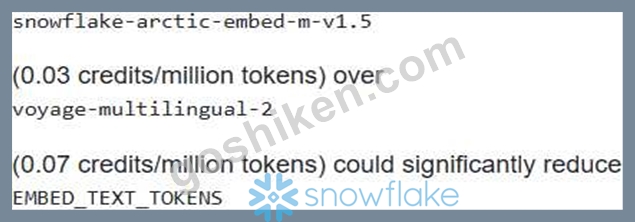
正解:A、B、D、E
解説:
Option A is correct because a Cortex Search Service requires a virtual warehouse to refresh the service, which runs queries against base objects when they are initialized and refreshed, incurring compute costs. Option B is correct because the cost of embedding models varies. For example, 'snowflake-arctic-embed-m-vl .5 costs 0.03 credits per million tokens, while 'voyage-multilingual-2 costs 0.07 credits per million tokens. Choosing a more cost-effective model like 'snowflake-arctic-embed-m-vl for English-only data can reduce token costs. Option C is correct because Snowflake recommends using a dedicated warehouse of size no larger than MEDIUM for each Cortex Search Service to achieve optimal performance. Option D is correct because change tracking is required for the Cortex Search Service to be able to detect and process updates to the base table, enabling incremental refreshes that are more efficient than full re-indexing. Option E is incorrect because Cortex Search Services incur costs based on virtual warehouse compute for refreshes, 'EMBED TEXT TOKENS' cost per input token, and a charge of 6.3 Credits per GB/mo of indexed data. The volume of indexed data has a significant impact, not minimal.
質問 # 119
A financial services company uses Snowflake Cortex's AI_COMPLETE for sentiment analysis on customer call transcripts, which contain personally identifiable information (PII). They also fine-tune a llama3.1-70b model with proprietary financial data. Which of the following statements accurately describe Snowflake's Gen AI principles regarding data privacy, model usage, and governance in this scenario?
- A. Customer Data (inputs and outputs) for AI_COMPLETE, including PII, are guaranteed not to be available to other customers or used to train models made available to others.
- B. Enabling Cortex Guard for AI_COMPLETE automatically anonymizes all PII within the prompt before it reaches the LLM, regardless of the model chosen, to ensure privacy.
- C. The fine-tuned llama3.1-70b model, including the proprietary training data used, is exclusively owned by the financial institution and is not shared with other Snowflake customers.
- D. Snowflake's metadata fields, such as table and column names, should not contain personal, sensitive, or export-controlled data when using Snowflake AI services, to maintain data governance.
- E. When using Cortex Analyst with Snowflake-hosted LLMs, metadata and prompts are transmitted outside Snowflake's governance boundary for processing, incurring additional cross-cloud data transfer costs.
正解:A、C、D
解説:
Option A is correct because Snowflake's trust and safety principles explicitly state that Usage and Customer Data (inputs and outputs of Snowflake AI Features) are NOT available to other customers and are NOT used to train, re-train, or fine-tune Models made available to others. Option B is correct because fine-tuned models built using your data can only be used by you, ensuring exclusivity. Option C is correct as customers should ensure no personal, sensitive, or regulated data is entered as metadata when using the Snowflake service. Option D is incorrect because Cortex Guard filters unsafe and harmful responses from the LLM; it does not automatically anonymize PII in the prompt before it reaches the LLM. Option E is incorrect because when Cortex Analyst is powered by Snowflake-hosted LLMs, data (including metadata or prompts) stays within Snowflake's governance boundary.
質問 # 120
A business user frequently asks Cortex Analyst questions that require filtering on specific product names, such as "What were the sales for 'iced tea' last month?" The 'product' dimension has many distinct values (high cardinality), and Cortex Analyst sometimes struggles to accurately identify the exact literal product name, leading to less precise SQL queries. The Gen AI Specialist wants to enhance Cortex Analyst's ability to find these literal values for the 'product' dimension. To improve Cortex Analyst's literal search capability for the high-cardinality 'product' dimension, which of the following is the most appropriate and recommended approach to configure in the semantic model?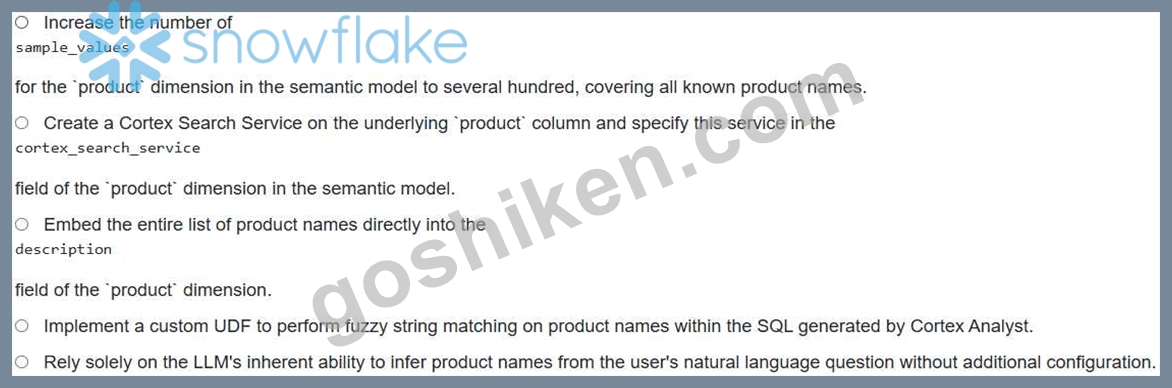
- A. Option D
- B. Option B
- C. Option E
- D. Option C
- E. Option A
正解:B
解説:
Cortex Analyst offers solutions to improve literal usage, including semantic search over sample values in the semantic model and semantic search using Cortex Search Services. For dimensions with high cardinality (many distinct values), creating a Cortex Search Service on the underlying column and specifying it in the field of the dimension within the semantic model is the recommended approach. This allows for high-quality "fuzzy" search to find literal values needed for Cortex Analyst's SQL queries. Option A is less effective for high-cardinality dimensions because only a fixed-size set of sample values is presented to the LLM, regardless of how many are provided. Option C is not the intended use for the 'description' field and could exceed context window limits. Option D, while a possible technical solution, bypasses the integrated and optimized Cortex Search functionality designed for this purpose. Option E is explicitly contradicted by the scenario, which indicates the LLM struggles, and the available solutions are designed to address this limitation.
質問 # 121
A data engineer is tasked with defining a semantic model for Cortex Analyst to enable natural language queries over sales dat a. They are creating a YAML file to describe the logical structure. Which of the following statements correctly describe the configuration of this semantic model? (Select all that apply)
- A. To ensure high accuracy for specific common questions, 'verified_querieS can be included, where the 'sqr field must reference the underlying physical table and column names (ee.g., not the logical names defined in the semantic model.
- B. The 'tables' section must define logical tables that directly map to Snowflake physical tables or views, with 'base_table' specifying the fully qualified name (database, schema, table).
- C. Dimensions such as 'product_category' can include a configuration, which can specify an optional 'literal_column' that, if omitted, defaults to the search index column.
- D. A 'metric' like 'total_revenue' can be defined using an 'expr' that references other logical columns, such as 'sum(profity from a logical 'sales_data' table, within the semantic model.
- E. The 'VARIANT data type is a supported data type for columns defined as 'dimensions' or 'facts' within the semantic model, allowing flexible storage of complex attributes.
正解:B、C、D
解説:
Option A is correct. A logical table, a foundational concept of Snowflake's semantic model, represents either a physical database table or a view and its 'base_table' field specifies the fully qualified name of the underlying physical table. Option B is correct. Dimensions can specify a block to integrate with Cortex Search, and the 'literal_column' field within this block is optional and defaults to the search index. Option C is incorrect. The 'VARIANT, 'OBJECT, GEOGRAPHY' , and 'ARRAY' data types are explicitly not supported for dimensions, time dimensions, or facts within a semantic model. Option D is incorrect. Verified queries must use the names of the logical tables and columns as defined in the semantic model, not those in the underlying physical dataset. For example, sales_data' for a logical table named 'sales_data'. Option E is correct. Metrics can be defined using an SQL expression ('expr') that can reference logical columns (facts, dimensions, or time dimensions) within the same logical table or from another logical table in the semantic model.
質問 # 122
A developer has successfully created a Cortex Search Service named transcript _ search service within cortex_search_db. services based on customer support transcripts. They now need to query this service to find support tickets related to 'internet issues' specifically from the 'North America' region, and they only want the single most relevant result. Which of the following SQL commands correctly performs this query?
- A. Option D
- B. Option E
- C. Option C
- D. Option A
- E. Option B
正解:D
解説:
Option A is the correct syntax for querying a Cortex Search Service using the SEARCH PREVIEW function, as demonstrated in the sources. It correctly specifies the service name, query, columns to retrieve, filter condition using the operator, and the limit, all within a JSON @eq string. Options B, C, D, and E use incorrect function names, parameter formats, or JSON structures for the SEARCH PREVIEW function as defined in the provided documentation.
質問 # 123
A data analyst is setting up a new Cortex Analyst-powered conversational app for business users. They want to understand how the "Suggested Questions" feature behaves under different semantic model configurations to ensure an optimal user experience. Which of the following statements accurately describe the behavior of the "Suggested Questions" feature in Cortex Analyst based on the semantic model configuration?
- A. Setting the

- B. If multiple verified queries in a VQR are marked with

- C. If the semantic model does not include a Verified Query Repository (VQR), Cortex Analyst will always return a blank list of suggested questions.
- D. In the absence of a VQR, Cortex Analyst uses underlying Large Language Models (LLMs) to generate up to three suggested questions, which are guaranteed to be answerable.
- E. When a semantic model contains a VQR, Cortex Analyst prioritizes returning up to five suggested questions from the VQR that are semantically similar to the user's input.
正解:B、E
解説:
Cortex Analyst's 'Suggested Questions' feature operates in different modes. If a semantic model does not include a Verified Query Repository (VQR), Cortex Analyst uses Large Language Models (LLMs) to generate up to three suggested questions, which may not always be answerable. Therefore, option A is incorrect because it returns a blank list, and option D is incorrect because the LLM-generated questions are not guaranteed to be answerable. When a semantic model has a VQR defined, Cortex Analyst suggests up to five questions from the VQR based on their similarity to the user's input, making option B correct. Furthermore, in Customizable Mode, if verified queries in the VQR are marked with
, Cortex Analyst will return all of these flagged questions, regardless of their quantity or similarity to user input, making option E correct and option C incorrect.
質問 # 124
An AI developer is building a Snowflake data pipeline to prepare unstructured data for a RAG application. The pipeline involves extracting text, splitting it into chunks, generating embeddings, and then indexing for Cortex Search. Considering the role of helper functions like SNOWFLAKE.CORTEX.SPLIT_TEXT_RECURSIVE_CHARACTER
, which of the following statements accurately describes its typical operational placement and interaction within this Gen AI pipeline?
- A. It replaces the need for
- B. The function's recursive nature enables it to automatically detect and correct factual inconsistencies or 'hallucinations' present in the original large text documents before they are embedded.
- C. Its output, consisting of smaller text chunks, serves as the direct input for text embedding functions that then convert these chunks into vector representations for semantic indexing.
- D. It is a post-processing step for LLM-generated responses, used to break down long answers into digestible paragraphs for user display in chat interfaces.
- E. It is typically applied after an embedding function (e.g.,
正解:C
解説:
Option B is correct.
is a helper function used to divide large text documents into smaller chunks. These smaller text chunks are then processed by embedding functions, such as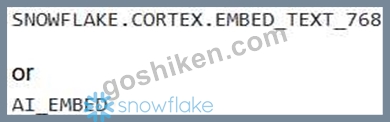
, to create vector embeddings that are subsequently used for indexing and semantic search in RAG applications. Option A is incorrect because text splitting (chunking) happens *before* embedding generation, not after, as it prepares the raw text for vectorization. Option C is incorrect; COUNT_TOKENS is a separate helper function specifically designed to return the token count of input text. SPLIT_TEXT_RECURSIVE_CHARACTER does not implicitly provide token counts for its output chunks. Option D is incorrect; the function's purpose is text splitting, not hallucination detection or correction, which pertains to LLM output quality. Option E is incorrect; while LLM responses might be formatted, the primary role of SPLIT_TEXT_RECURSIVE_CHARACTER is in preparing input documents for RAG, not post-processing LLM outputs for display.
質問 # 125
A data analyst is working with a table named ARTICLE_CONTENT that contains a column (VARCHAR) storing lengthy English articles. They need to generate a concise summary for each article. The analyst plans to use the SNOWFLAKE. CORTEX. SUMMARIZE function. Which of the following accurately describes the syntax and the expected data type of the result for a single article summary?
- A. The query

- B. The query

- C. The query

- D. The query

- E. The query

正解:D
解説:
Option B is correct. The 'SNOWFLAKE.CORTEX.SUMMARIZE function takes a single string argument, which is the English- language input text to be summarized. It returns a string containing a summary of the original text. Options A, C, D, and E describe incorrect syntax, return types, or additional arguments not supported by the 'SUMMARIZE' function.
質問 # 126
An AI developer is testing a new RAG application in Snowflake. The application uses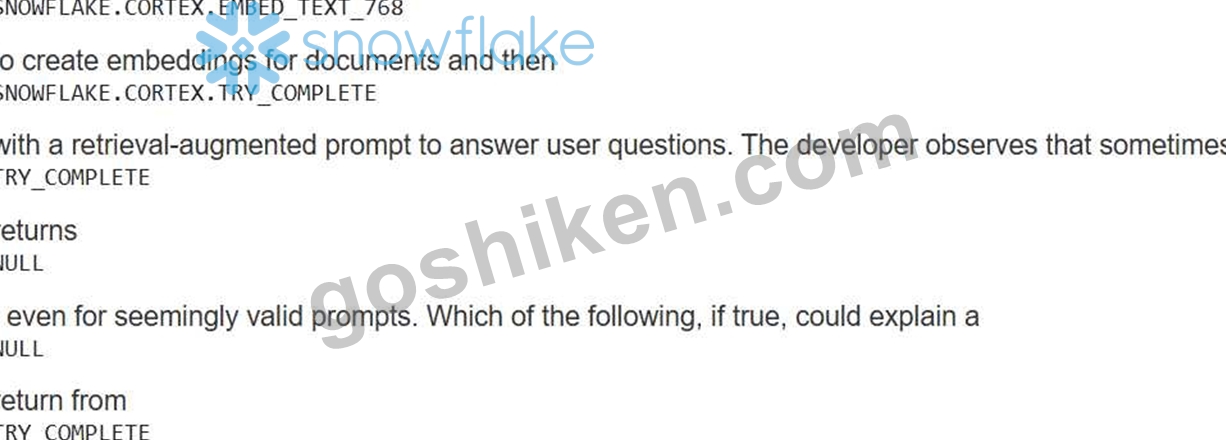
in this scenario?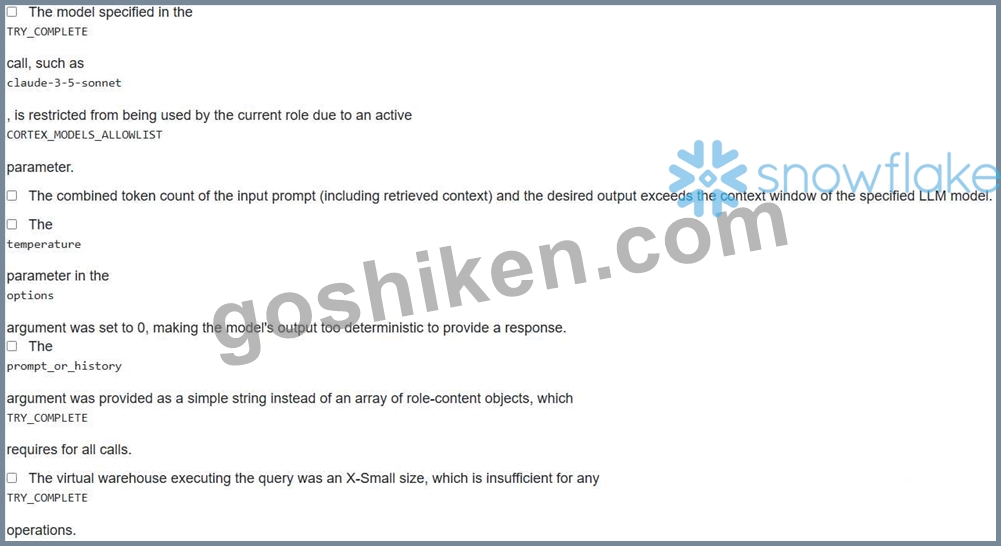
- A. Option D
- B. Option B
- C. Option E
- D. Option C
- E. Option A
正解:B、E
解説:
Option A is correct. If access to a specific model is restricted by the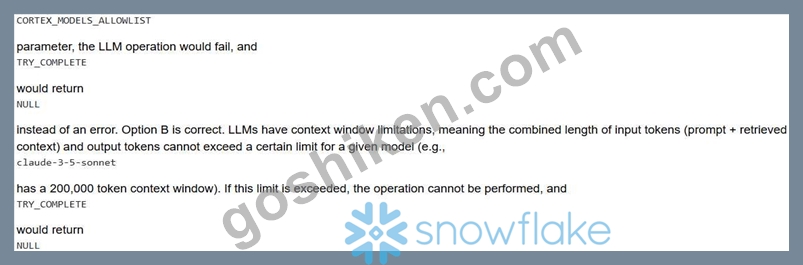
Option C is incorrect; setting 'temperature' to 0 makes the output more deterministic and focused, which generally improves adherence to instructions and is recommended for consistent results, not causes failures. Option D is incorrect. The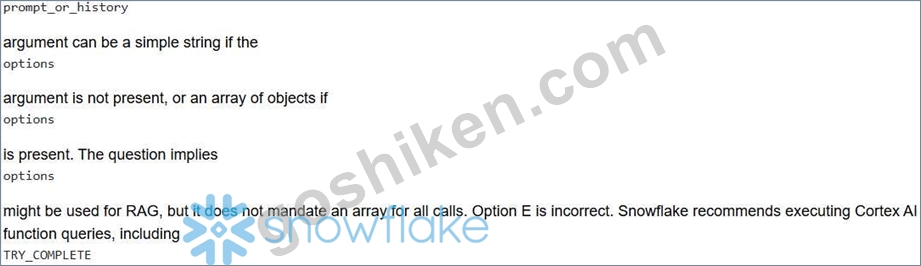
, with smaller warehouses (no larger than MEDIUM), meaning an X-Small warehouse is generally sufficient for executing the function itself, though it might impact performance for very large datasets if used for other operations.
質問 # 127
A development team is building an AI-powered data pipeline in Snowflake. The pipeline involves extracting text from documents, generating embeddings using
,and then performing similarity searches using
to find related documents. They plan to manage this pipeline using Snowflake tasks and want to integrate with a Python application for some custom processing. Considering this scenario, which of the following statements about implementing this pipeline are true?
- A.

- B. To generate document embeddings, the
- C. When using Snowflake tasks to automate the embedding generation and similarity search,
- D. If the team wants to use the Snowpark Python library to call

- E. Snowflake
正解:A
解説:
Option A is incorrect. Snowflake recommends executing queries that call Cortex AI SQL functions like EMBED_TEXT_768 with a smaller warehouse (no larger than MEDIUM), as larger warehouses do not increase performance. Snowpark-optimized warehouses are recommended for workloads with large memory requirements or specific CPU architectures, typically for ML training, not for general Cortex AI function calls. Option B is incorrect. The Snowpark Python library explicitly states that it does not support the VECTOR_COSINE_SIMILARITY function, meaning it does not 'fully support all vector similarity functions'. Option C is incorrect. The VECTOR data type is not supported as clustering keys. Option D is correct. After generating embeddings (e.g., storing them in a VECTOR column like issue vec ), vector similarity functions can be effectively used in SQL queries with ORDER BY and LIMIT clauses to retrieve the most similar results, as demonstrated with VECTOR_COSINE_SIMILARITY in a RAG example. This pattem applies to VECTOR_INNER_PRODUCT as well. Option E is incorrect. The VECTOR data type is not supported for use with dynamic tables. Additionally, Snowflake Cortex functions (including EMBED_TEXT_768 ) do not support dynamic tables.
質問 # 128
......
今すぐダウンロード!リアルSnowflake GES-C01試験問題集テストエンジン試験問題:https://www.goshiken.com/Snowflake/GES-C01-mondaishu.html
無料GES-C01サンプル問題には100%カバー率リアル試験問題:https://drive.google.com/open?id=1KCFMCwTYBw5kEQ1I0KqFpz68UUMwPmWY