

合格させるVMware 5V0-23.20にはGoShiken提供の試験問題集で2023年06月更新
完全版最新の5V0-23.20問題集、100%カバー率問題と解答があなたをリアル試験で合格させる
VMware 5V0-23.20 認定試験の出題範囲:
| トピック | 出題範囲 |
|---|---|
| トピック 1 |
|
| トピック 2 |
|
| トピック 3 |
|
| トピック 4 |
|
| トピック 5 |
|
| トピック 6 |
|
| トピック 7 |
|
| トピック 8 |
|
VMware 5V0-23.20 認定試験は、VMware vSphere with Tanzuに関するITプロフェッショナルのスキルと経験を検証する重要なものです。この認定試験は、VMwareテクノロジーを導入または維持する組織にとって高く評価されており、仮想化およびクラウドコンピューティングの分野での魅力的なキャリア機会につながる可能性があります。適切な準備とトレーニングを行えば、誰でもこの難しい試験に合格し、認定されたVMware vSphere with Tanzuスペシャリストになることができます。
質問 # 54
A developer is trying to deploy a Kubernetes Application into a namespace within a Supervisor Cluster The deployment must utilize the latest assets that have been pushed into the Registry Service.
What should the developer add to the YAML file to ensure that the deployment is successful?
- A. image: <image registry url>/<namespace name>/<image name>:latest
- B. template: <image registry url>/<namespace name>/<image name> : latest
- C. template: /<namespace name>/<image name>:latest
- D. image: /<namespace>/<image name>:latest
正解:A
解説:
* Create an example pod spec with the details about the private registry.
* apiVersion: v1
* kind: Pod
* metadata:
* name: <workload-name>
* namespace: <kubernetes-namespace>
* spec:
* containers:
* - name: private-reg-container
* image: <Registry-IP-Address>/<vsphere-namespace>/<image-name>:<version>
* imagePullSecrets:
* - name: <registry-secret-name>
* Replace <workload-name> with the name of the pod workload.
* Replace <kubernetes-namespace> with the Kubernetes namespace in the cluster where the pod will be created. This must be the same Kubernetes namespace where the Registry Service image pull secret is stored in the Tanzu Kubernetes cluster (such as the default namespace).
* Replace <Registry-IP-Address> with the IP address for the embedded Harbor Registry instance running on the Supervisor Cluster.
* Replace <vsphere-namespace> with the vSphere Namespace where the target Tanzu Kubernetes is provisioned.
* Replace <image-name> with an image name of your choice.
* Replace <version> with an appropriate version of the image, such as "latest".
* Replace <registry-secret-name> with the name of the Registry Service image pull secret that you created previously.
質問 # 55
Which kubectl command should be used to change the active vSphere namespace to namespace-01?
- A. kubectl get ns namespace-01
- B. kubectl config change-context namespace-01
- C. kubectl describe ns namespace-01
- D. kubectl config use-context namespace-01
正解:D
解説:
A context element in a kubeconfig file is used to group access parameters under a convenient name. Each context has three parameters: cluster, namespace, and user. By default, the kubectl command-line tool uses parameters from the current context to communicate with the cluster.
To choose the current context:
kubectl config use-context ctx001
質問 # 56
Which object helps maintain copies of a vSphere pod?
- A. ReplicaSets
- B. Namespaces
- C. Network Policies
- D. Persistent Volume
正解:D
質問 # 57
What is the proper way to delete a Persistent Volume Claim?
- A. By unmounting the volume from the VM and deleting it from the vSphere datastore
- B. By using the kubectl delete persistentvolumeclaim command
- C. By using the kubectl remove pvc command
- D. Through the SPBM policy engine using the vSphere Client
正解:B
質問 # 58
Which command will show the Tanzu Kubernetes cluster versions available in the vSphere content library?
- A. kubect1 get rc,services
- B. kubect1 get contentlibrary
- C. kubect1 get tanzukubernetesreleases
- D. kubect1 get tanzuimages
正解:C
解説:
Explanation
* kubectl get tanzukubernetesreleases
List available Tanzu Kubernetes releases.
* kubectl get tkr
Short form version of the preceding command.
* kubectl get tkr v1.17.8---vmware.1-tkg.1.5417466 -o yaml
Provides details on the named Tanzu Kubernetes release.
VMware Tanzu distributes Kubernetes software versions as Tanzu Kubernetes releases. To consume these releases, you configure a vSphere Content Library and synchronize the available releases. You can do so using a subscription-based model, or on-demand. If you want to provision Tanzu Kubernetes in an internet restricted environment, you can create a local library and manually import the releases.
Text Description automatically generated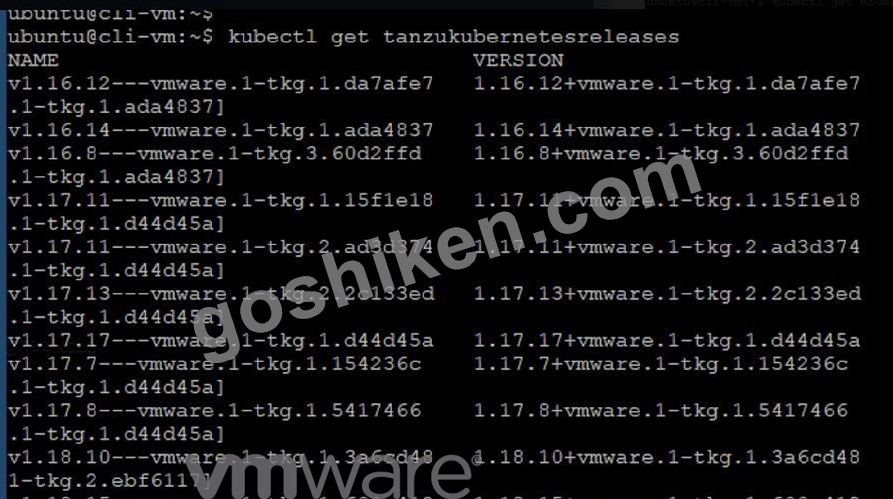
質問 # 59
How do Tanzu Kubemetes clusters communicate with Storage Policy Based Management to request PersistentVolumes?
- A. Directly with vCenter Server and the underlying ESXi hosts
- B. Through a proxy VM
- C. Directlywith the vCenter Server
- D. Through the Supervisor Cluster
正解:B
質問 # 60
Which two functions are provided by the NSX Container Rug-in (NCP)? (Choose two.)
- A. Implements Kubernetes Ingress with an NSX-T layer 7 load balancer
- B. Integrates with container-based PaaS such as Docker
- C. Implements Kubernetes Ingress with an NSX-T layer 4 load balancer
- D. Configures Overlay Transport Zones
- E. Creates an NSX-T logical topology for a Kubernetes cluster and a separate logical network for each Kubernetes namespace
正解:A、E
質問 # 61
Which object helps maintain copies of a vSphere pod?
- A. ReplicaSets
- B. Namespaces
- C. Network Policies
- D. Persistent Volume
正解:A
解説: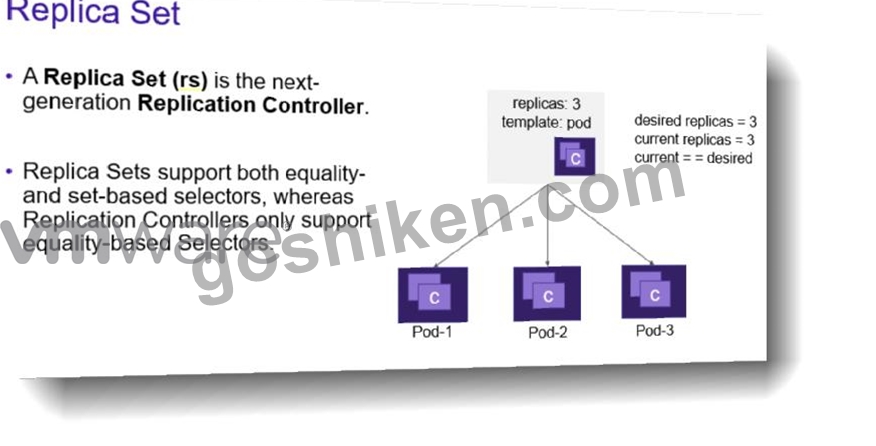
A ReplicaSet declares how the functionality of a pod is made scalable and resilient through redundancy. The ReplicaSet ensures that a specified number of pods is kept running. Example: Deploy a ReplicaSet. * The ReplicaSet name is nginx-replica-demo. * Two replicas are expected to be running. * The ReplicaSet applies to pods with label nginx.
For more information about Kubernetes replica sets, see https://kubernetes.io/docs/concepts/workloads/controllers/replicaset/
質問 # 62
Which statement describes the characteristics of vSphere with Tanzu using vSphere Distributed Switch network topology?
- A. vCenter Server is attached to all workload networks.
- B. Supervisor Cluster control plane VMs are attached to the primary workload network.
- C. Supervisor Cluster control plane VMs are attached to primary and non-primary workload networks.
- D. Load balancer appliance is attached to all workload networks.
正解:C
質問 # 63
Which three elements should be configured by a vSphere administrator after creating vSphere Namespace? (Choose three.)
- A. Namespace name
- B. NSX Segment
- C. License
- D. Storage Policy
- E. Capacity and Usage limits
- F. Permissions
正解:D、E、F
解説:
Creating a Namespace
A vSphere administrator configures permissions and storage before a namespace can be used:
* Assign edit or view permissions to users. Users must be present in a configured single sign-on (SSO) identity source.
* Must assign a VM storage policy to the namespace.
* Can define resource limits (optional).
* Must add a content library to enable the Tanzu Kubernetes Grid Service.
質問 # 64
Where is a storage policy applied to enable Persistent Volumes?
- A. Cluster
- B. Datastore
- C. Virtual Machine
- D. Namespace
正解:D
解説:
Explanation
The vSphere administrator defines and assigns VM storage policies to a namespace:
* VM storage policies are translated into Kubernetes storage classes.
* Developers can access all assigned VM storage policies in the form of storage classes.
* Developers cannot manage storage classes.
Developers can list the available storage classes in their namespace by running the kubectl describe ns
<namespace-name> command.
質問 # 65
Which command would be used to deploy a Tanzu Kubernetes cluster?
- A. kubectl create -f CLUSTER-NAME.yaml
- B. kubectl create cluster -f CLUSTER-NAME.yaml
- C. kubectl apply cluster CLUSTER-NAME.yaml
- D. kubectl apply -f CLUSTER-NAME.yaml
正解:D
質問 # 66
How is information found about all Kubernetes Persistent Volumes in a vSphere environment?
- A. Using: kubectl get persistentvolumes
- B. Accessing the FCD folder on a Datastore
- C. Navigating to the Cloud Native Storage view in vCenter Server
- D. Using: esxcli storage cloud native get
正解:C
解説:
Explanation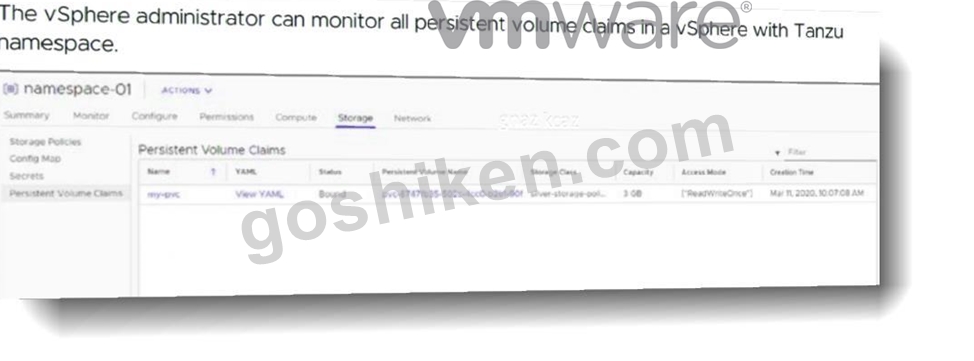
This is the textbook answer, I know kubectl does give you some information.
質問 # 67
Which two capabilities are associated with vSphere Pod? (Choose two.)
- A. Compatibility with Windows and Linux kernels
- B. Compatibility with vSphere performance charts
- C. Compatibility with vSphere vMotion
- D. Compatibility with NSX-V Datacenter
- E. Compatibility with vSphere HA and DRS
正解:D、E
質問 # 68
Kubernetes object types are going to be limited by an administrator within a vSphere with Tanzu namespace.
Which three Kubernetes object types may be limited? (Choose three.)
- A. Number of Ingress frontends
- B. Number of Persistent Volume Claims
- C. Number of Pods
- D. Number of Load Balancer Services
- E. Number of Operators
- F. Number of DaemonSets
正解:B、C、D
解説:
Explanation
https://docs.vmware.com/en/VMware-vSphere/7.0/vmware-vsphere-with-tanzu/GUID-1238AFD8-232C-4EFC-B Resource Name Description configmaps The total number of ConfigMaps that can exist in the namespace.
persistentvolumeclaims The total number of PersistentVolumeClaims that can exist in the namespace.
pods The total number of Pods in a non-terminal state that can exist in the namespace. A pod is in a terminal state if .status.phase in (Failed, Succeeded) is true.
replicationcontrollers The total number of ReplicationControllers that can exist in the namespace.
resourcequotas The total number of ResourceQuotas that can exist in the namespace.
services The total number of Services that can exist in the namespace.
services.loadbalancers The total number of Services of type LoadBalancer that can exist in the namespace.
services.nodeports The total number of Services of type NodePort that can exist in the namespace.
secrets The total number of Secrets that can exist in the namespace.
質問 # 69
The virtualization team supports many development teams on a Supervisor cluster. For a specific development team, they would like to limit persistent volumes that can be created on Tanzu Kubernetes clusters to only an NFS based storage array.
Which action should be taken to accomplish this goal?
- A. Disconnect non-NFS datastores from the ESXi hosts that make up the Supervisor cluster.
- B. Use kubectl to create a storage class in the Supervisor cluster.
- C. Set a resource quota limiting the number of PVCs for that development team.
- D. Add a storage policy to that development team's Supervisor Namespace containing only the NFS datastore
正解:C
質問 # 70
How is the storage selected for the Harbor pods when the embedded Harbor image registry is enabled?
- A. An administrator selects a specific datastore as part of enablement.
- B. An administrator selects a VM storage policy as part of enablement.
- C. vCenter Server automatically chooses a VM storage policy.
- D. vCenter Server automatically selects a local ESXi host datastore.
正解:C
質問 # 71
On which network are TKG clusters deployed in vSphere with Tanzu when using the vSphere networking stack?
- A. Edge
- B. Backend
- C. Frontend
- D. Workload
正解:D
解説:
Explanation
The Workload Network, such as TKGS-VLAN1000, is where the Tanzu Kubernetes clusters run.
A workload network is a network construct that is used by supervisor control plane VMs and vSphere namespaces:
* The workload network is supported by a vSphere Distributed Switch port group.
* An IP range is defined to allocate an IP address for VMs attached to the workload network.
* A primary workload network must be selected.
* The supervisor control plane VMs attach to the primary workload networks port group.
A workload network can be used by multiple namespaces. A namespace can be assigned only one workload network.
質問 # 72
Why would an organization set up private image registries?
- A. Role-based access control can be assigned by integrating the image registry with user identity management.
- B. DevOps engineers are able to store virtual machine images in a central location.
- C. Open source registry server projects enable organizations to modify them as necessary.
- D. Public image registries lack enterprise support.
正解:A
解説:
Explanation
VMware created Harbor in 2014. Harbor was shared with the community through an open-source license in 2016 and donated to the Cloud Native Computing Foundation (CNCF) in 2018.
Harbor is integrated into VMware products: vSphere Integrated Containers, Tanzu Kubernetes Grid Integrated Edition, and vSphere with Tanzu. The embedded Harbor for vSphere with Tanzu includes the following features: * Identity integration and role-based access control
* Graphical user interface
* Auditing of operations
* Management with labels
質問 # 73
A developer is connecting to a Tanzu Kubernetes Cluster using the kubectl vsphere login command Which information must be specified, in addition to both the name of the cluster and the Supervisor Cluster Control Wane IP?
- A. The name of the Supervisor Namespace and the Token ID for the SSO credentials
- B. The name of the Supervisor Namespace and the SSO Username
- C. The path to the existing kubeconfig file and the Token D for the SSO credentials
- D. The path to the existing kubeconfig file and the SSO Username
正解:B
解説:
To connect to the Supervisor Cluster, run the following command.
kubectl vsphere login --server=SUPERVISOR-CLUSTER-CONTROL-PLANE-IP
--tanzu-kubernetes-cluster-name TANZU-KUBERNETES-CLUSTER-NAME
--tanzu-kubernetes-cluster-namespace SUPERVISOR-NAMESPACE-WHERE-THE-CLUSTER-IS-DEPLOYED
--vsphere-username VCENTER-SSO-USER-NAME
For example:
kubectl vsphere login --server=10.92.42.137
--tanzu-kubernetes-cluster-name tanzu-kubernetes-cluster-01
--tanzu-kubernetes-cluster-namespace tanzu-ns-1
--vsphere-username [email protected]
質問 # 74
To which network are HA Proxy virtual server IP addresses issued when using the vSphere networking stack default configuration?
- A. vMotion
- B. Overlay
- C. Primary workload
- D. Management
正解:C
解説:
The HAProxy virtual IP range where external services and DevOps users connect. In this configuration, HAProxy is deployed with two virtual NICs (Default configuration), one connected to the management network, and a second one connected to the Primary Workload Network. You must plan for allocating Virtual IPs on a separate subnet from the Primary Workload Network.
https://docs.vmware.com/en/VMware-vSphere/7.0/vmware-vsphere-with-tanzu/GUID-1F885AAE-92FF-41E6-BF04-0F0FD4173BD9.html
質問 # 75
Which is a valid version change for a Tanzu Kubernetes cluster running Kubernetes version 1.16.7?
- A. Downgrade one patch version (e.g.. 1.16.5)
- B. Upgrade two minor versions (e.g., 1.18.0)
- C. Upgrade one major version (e.g.. 2.0.1)
- D. Upgrade one minor version (e.g.. 1.17.0)
正解:D
解説:
Be aware of the following constraints when upgrading your cluster.
You can upgrade a cluster up to one minor version of Kubernetes from its current version. If necessary, you can perform subsequent upgrades to move the version forward.
Upgrading your version of Kubernetes is a one-way operation. You cannot subsequently downgrade the Kubernetes version, or undo an upgrade.
質問 # 76
How is information found about all Kubernetes Persistent Volumes in a vSphere environment?
- A. Using: kubectl get persistentvolumes
- B. Accessing the FCD folder on a Datastore
- C. Navigating to the Cloud Native Storage view in vCenter Server
- D. Using: esxcli storage cloud native get
正解:C
解説: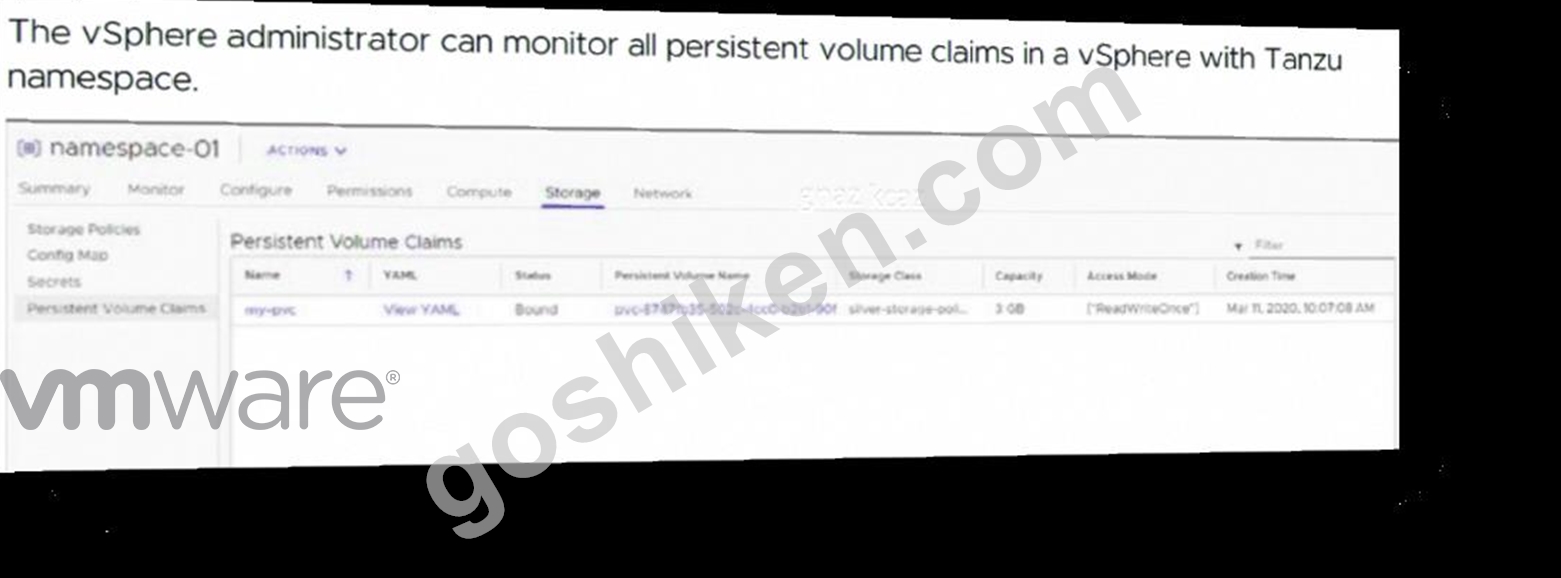
This is the textbook answer, I know kubectl does give you some information.
質問 # 77
......
最新5V0-23.20試験問題集有効で最新の問題集:https://www.goshiken.com/VMware/5V0-23.20-mondaishu.html
検証済み5V0-23.20試験解答合格確定させる:https://drive.google.com/open?id=1dhmhZ8ND_mXCyNuA_eRBedagLNreegJ8