

更新された2026年08月合格させるCTAL-TA_V4.0試験リアル練習テスト問題
無料ダウンロードISQI CTAL-TA_V4.0リアル試験問題
質問 # 26
The test basis for your latest project contains the activity diagram that is shown below. The business architect has confirmed that this model has been reviewed and approved by the stakeholders.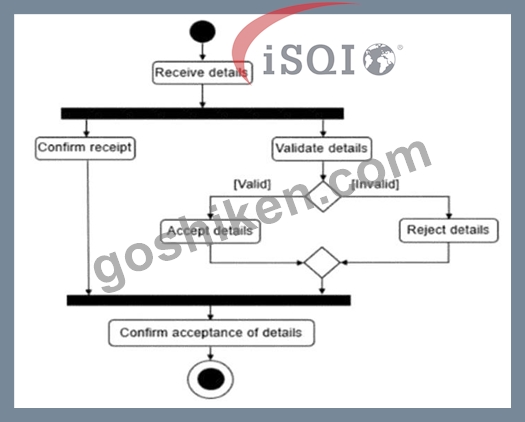
Which of the following conclusions is correct?
- A. The diagram contains at least one defect because it contains an internal inconsistency
- B. The diagram is correct because it has been reviewed and approved by the stakeholders
- C. The diagram may contain a defect but this cannot be confirmed until the results of the tests created from it are known
- D. The diagram may contain a defect but this cannot be confirmed until test cases have been designed from it
正解:A
解説:
The correct answer is D . The diagram contains an internal inconsistency that can be identified directly from the model, without waiting for test design or execution. The activity diagram shows Receive details , then splits into parallel activities: Confirm receipt and Validate details . The validation path then branches into
[Valid] Accept details and [Invalid] Reject details . However, after either acceptance or rejection, the flow rejoins and continues to Confirm acceptance of details . That means the model allows rejected details to proceed into an activity that confirms acceptance, which is logically inconsistent.
CTAL-TA v4.0 states that scenario-based testing uses workflow models such as activity diagrams, use cases, flowcharts, BPMN diagrams, sequence diagrams, and collaboration diagrams to derive scenarios through the test item. The syllabus also emphasizes that modeling and test analysis can reveal defects in the test basis, including workflow-related defects, before dynamic test execution begins.
Option A is wrong because the inconsistency is visible statically; test execution is not needed to confirm it.
Option B is also wrong because formal test cases are not required before recognizing the contradiction.
Option C is dangerous and incorrect: stakeholder approval does not prove technical or logical correctness.
The issue is a structural workflow defect in the model itself. Reference: CTAL-TA v4.0, Scenario-Based Testing and Test Analysis of the Test Basis .
For the first process, when 'Something is needed', which option contains the MOST appropriate keywords for action and verification?
Required Goods / Check PR
Enter Required Goods I Check PR Created
Enter Details of Required Goods / Is PR Created?
Required Goods Entry I PR Creation Check
質問 # 27
You are working on a project to replace an old sales and merchandising system with a new system that will be based on modern platforms. The old system is still in production but is poorly documented and expensive to maintain. The new version will be developed using modern technology. The main requirements for the system are that it shall:
* Load sales data, sent electronically from the stores each evening, into a central database.
* Produce actual sales reports for the merchandisers, whose job is to manage stock levels in stores.
* Produce sales forecast reports based on a combination of sales history and forecasting parameters. The parameters will be entered by the merchandisers into a browser-based front end and the reports will be produced overnight. The users will be able to see the reports next day, on screen or in print, by requesting this through the browser.
Requirements 1 and 2 are satisfied by the existing system and will be rewritten with no significant changes.
Requirement 3 is new and has been clearly specified.
The entry of forecasting parameters and of requests to see the reports will be low volume, but the Merchandising Manager is concerned about usability because the forecasting parameters are complex.
Which test charter would be BEST for the initial exploratory testing of requirement 3?
- A. Explore the report request entry features With their requirements specification To discover any usability issues
- B. Explore the forecasting parameter entry features With their requirements specification To discover any performance issues
- C. Explore the forecasting parameter entry features With their requirements specification To discover any usability issues
- D. Explore the actual sales report production features With examples of the current reports To discover any adverse impact of requirement 3 on requirement 2
正解:C
解説:
The correct answer is C . CTAL-TA v4.0 describes a session-based exploratory test charter as a focused mission, commonly structured as Explore [target] With [resources] To discover [information] . The charter should focus the tester's limited exploratory effort on the highest-value area, using suitable resources and a clear discovery objective. The syllabus includes test charters supporting session-based testing under test analysis and design.
Here, the relevant new functionality is Requirement 3 , especially the entry of complex forecasting parameters through a browser-based front end. The Merchandising Manager's explicit concern is usability , not functional correctness of the existing actual sales reports and not performance. The scenario also states that entry of forecasting parameters and report requests will be low volume , which weakens performance as the initial exploratory objective.
Option A targets report request entry, but the problem statement says the complexity and concern are around forecasting parameters , not the act of requesting a report. Option B targets Requirement 2, the existing actual sales report production, rather than the new Requirement 3 functionality. Option D uses the right target but the wrong objective: performance is not the main stated risk for this initial exploratory session. Reference:
CTAL-TA v4.0, Section 3.4.1 Test Charters Supporting Session-Based Testing and Section 4.2 Usability Testing .
質問 # 28
A written specification describes the rules for granting membership of your company's sports facility, whether it must be paid for if granted and whether free transport to and from the facility will be provided.
These actions depend upon employment status (permanent, temporary or probationary), the result of a medical exam (passed, failed or not taken) and whether the person is classed as a local resident. The best decision table that could be created from this specification is shown below.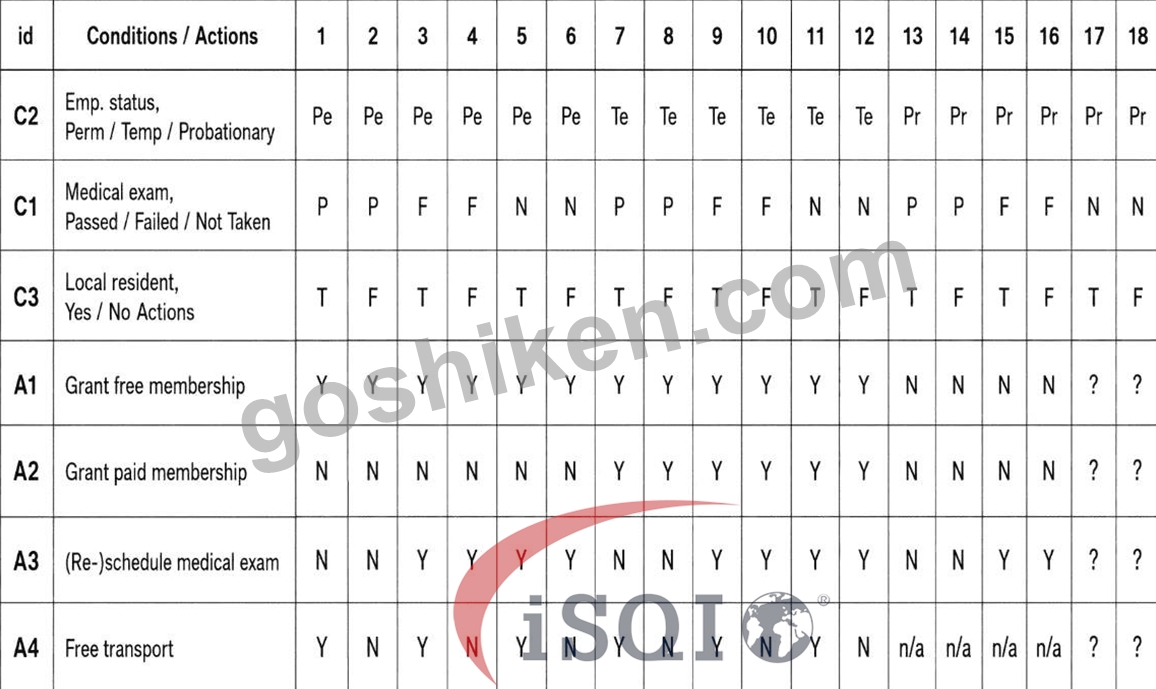
Which of the following conclusions is correct?
- A. The decision table has been drawn correctly and the specification must therefore be defective
- B. The specification may be correct because the table does not have the correct number of rule columns
- C. The specification cannot be evaluated this way because a model cannot convey meaning as well as can text
- D. The specification cannot be evaluated this way because the model type used is not appropriate
正解:A
解説:
The correct answer is A because the decision table has the correct structural completeness, but it exposes missing rules in the written specification. There are three condition dimensions: employment status has three values, medical exam has three values, and local residency has two values. Therefore, the complete decision table requires 3 × 3 × 2 = 18 rule columns , and the table contains exactly 18 rules. The unresolved entries appear in rules 17 and 18 , where the person is probationary , the medical exam is not taken , and local residency is either yes or no . Since all action cells for these two combinations are marked with question marks, the model has revealed that the specification does not define the required behavior for those cases.
CTAL-TA v4.0 places decision table testing under rule-based test techniques and states that it is used when behavior is determined by combinations of conditions, such as business rules. It is especially useful for finding omissions, inconsistencies, ambiguities, and gaps in rule specifications. Option B is wrong because the table has the correct number of columns. Option C is wrong because models are deliberately used to clarify text-based specifications. Option D is wrong because a decision table is the correct model type for condition-action business rules. Reference: CTAL-TA v4.0, Section 3.3.1 Decision Table Testing .
質問 # 29
You have been appointed to be a TA in the development of a road traffic control application, which will be installed at busy road junctions to control the operation of traffic signal lights according to sensors that detect traffic volume on the various approaches to the junction. The project is still in the early stages of test planning, but it is already clear that despite a tight schedule its safety-critical nature demands careful and thorough testing.
You have been asked to decide whether automated test design would deliver benefits. Which characteristic of automated test design is MOST important for the development of this system?
- A. Creating the model will expose defects in the test basis early in the project
- B. Less maintenance effort for the testware after the system has gone live
- C. Testware can be generated in various output formats, e.g. for use by different tools
- D. Testware generated by tools usually contains fewer mistakes than testware created manually
正解:A
質問 # 30
A Customer Relationship Management (CRM) system will be developed for a company that runs a chain of hotels. These are some of the requirements relating to staff in the call center.
* R1. High. An operator shall be able to find and see the details of a customer's booking. The data that may be used for the search include customer name, customer registration number (in the company's loyalty enrolment scheme) and booking reference.
* R2. High. An operator shall be able to amend a customer's booking. The data that may be amended include check-in and check-out dates, hotel, room type and tariff (with / without breakfast).
* R3. High. Before a booking amendment is accepted, the system shall display to the operator any difference in price with respect to the original booking. The operator shall confirm that the customer accepts the revised price and then the system shall record the accepted amendment.
* R4. Medium. Details of the amended booking shall be sent to the customer (see requirements for original customer booking for details).
* R5. High. Details of the extra amount payable shall be sent to the billing system for customer invoicing (see requirements for invoicing of the original customer booking for details).
You have been asked to review these requirements using this checklist:
* Specific - does each requirement deal with only a single aspect of the solution?
* Clear - is each requirement expressed in an unambiguous way with no possibility of interpretation or uncertainty about its meaning?
* Complete - does the set of requirements cover all of the stakeholders' reasonable needs?
* Unique - does each requirement address something that no other requirement also covers?
Assume that the other requirements referred to by R4 and R5 have been reviewed with a satisfactory outcome.
Considering these five requirements, to which checklist items would you answer 'No'?
- A. 2 and 3
- B. 3 and 4
- C. 1 and 4
- D. 1 and 2
正解:A
解説:
The correct answer is D . The two checklist items that should be answered No are Clear and Complete .
CTAL-TA v4.0 places requirements review and defect prevention under the Test Analyst's static testing responsibilities. It also identifies perspective-based reading and checklist-based review as techniques for finding defects in the test basis before test design and execution. The official sample-answer material confirms that checklist items should support detection of defects such as ambiguity, incompleteness, and inconsistency, rather than merely restating requirements.
The requirements are not fully clear because several phrases leave room for interpretation. For example, R1 says customer name may be used for searching, but it does not clarify what happens if multiple bookings match. R3 says "any difference in price" and "original booking," which may be ambiguous if multiple amendments occur. The requirements are also not fully complete because R5 only addresses an "extra amount payable." It does not cover the reasonable business case where the amendment reduces the price and a refund, credit, or billing adjustment is needed.
The requirements are broadly specific enough for this review because each requirement addresses a distinct call-center function. They are also unique because no requirement duplicates another: search, amend, price confirmation, customer notification, and billing interface are separate concerns. Reference: CTAL-TA v4.0, Software Defect Prevention , reviews, checklist-based review, and perspective-based reading.
質問 # 31
You are assigned to an Agile team as a Test Analyst. In most ways, the team seems to be working well.
Iteration planning goes smoothly because the user stories are good quality. Most defects that are found by testing are fixed in the same iteration and those that do go live are not causing significant dissatisfaction amongst stakeholders. However, the team is unhappy because the Defect Removal Efficiency rate, measured for each iteration, is less than 80%.
What would be the MOST effective contribution by you as a TA, to improve the situation?
- A. Participating in root cause analysis
- B. Defect data collection and evaluation
- C. Participating in retrospectives
- D. Reviewing requirements
正解:B
解説:
The correct answer is D . The problem described is not obviously poor requirements quality, poor Agile discipline, or severe stakeholder dissatisfaction. The visible issue is a defect metric : Defect Removal Efficiency is below 80% for each iteration. The most effective Test Analyst contribution is therefore to improve the collection, classification, interpretation, and evaluation of defect data before the team acts on the metric. CTAL-TA v4.0 states that test results provide feedback that helps the TA improve defect detection effectiveness, and that measures such as defect detection percentage require careful boundaries, escaped- defect counting rules, and exclusion criteria. A low value indicates ineffective defect detection, so the TA should analyze the reasons and propose focused improvements.
This scenario strongly suggests that the team may be reacting to a headline metric without understanding what is being counted. For example, escaped defects may be minor, duplicates may be counted inconsistently, defects may belong to earlier work, or the iteration boundary may distort the figure. CTAL-TA also warns that defect metrics are not always easy to read because failed tests and defects can have many-to-many relationships and severities may differ.
Option B , root cause analysis, is useful after credible defect classification exists, but it is premature as the primary action. Options A and C are too generic. Reference: CTAL-TA v4.0, Sections 5.3.1 Analyzing Test Results to Improve Defect Detection and 5.3.2 Supporting Root Cause Analysis with Defect Classification .
質問 # 32
You are developing test cases for an application which performs complex calculations and have decided to model these calculations on a spreadsheet, to determine expected results from inputs.
Which solution to the test oracle problem BEST describes the approach you are using?
- A. Property-based testing
- B. Metamorphic testing
- C. A pseudo-oracle
- D. Deterministic testing
正解:C
解説:
The correct answer is D . A spreadsheet model used to calculate expected results is best classified as a pseudo- oracle when it has been developed independently from the test object and is used to produce expected outcomes for comparison with the system under test. CTAL-TA v4.0 explains that a test oracle is needed to determine expected results in dynamic testing, and that the test oracle problem occurs when a cost-effective oracle is not readily available because of factors such as data-related complexity, non-determinism, probabilistic behavior, or ambiguous requirements. The syllabus identifies pseudo-oracles as independently developed systems that fulfill the same specification as the test object, including simplified versions of the test object.
Here, the application performs complex calculations, and the spreadsheet is being used as an independent calculation model to determine expected results from the same inputs. That is the classic pseudo-oracle pattern. Option A is wrong because property-based testing verifies general input/output properties rather than exact expected calculation results. Option B is wrong because metamorphic testing checks relations between source and follow-up test cases, not a full expected result from a spreadsheet. Option C is not the named CTAL-TA oracle solution being used here. Reference: CTAL-TA v4.0, Section 1.3.4 Determining Test Oracles .
質問 # 33
You are testing the functional correctness of an application which allows the driver of a car to control if the air that enters the passenger compartment is fresh or recycled. The car may be ordered in various configurations:
* Engine Size, can be: 1500cc, 1900cc, 2200cc, 2500cc
* Gearbox type, can be: automatic, manual 5-speed, manual 6-speed
* Cruise control, can be: yes or no
* Electric sunroof, can be: yes or no
It is expected that the most popular configuration will have a 1900cc engine and a manual 5-speed gearbox with cruise control and no electric sunroof. In order to achieve full BASE CHOICE coverage, how many configurations must be tested?
- A. 0
- B. 1
- C. 2
- D. 3
正解:A
解説:
The correct answer is D . CTAL-TA v4.0 defines base choice coverage as a combinatorial coverage criterion where a base value is selected for each parameter, forming one base coverage item. Then, additional coverage items are created by replacing one base value at a time with each non-base value while all other parameters remain at their base values.
The base configuration is explicitly given: 1900cc engine , manual 5-speed gearbox , cruise control = yes , and electric sunroof = no . That gives the first test configuration. Then each non-base value must be tested once while the other values remain fixed at the base configuration. Engine Size has four values, so there are 3 non-base engine values: 1500cc, 2200cc, and 2500cc. Gearbox type has three values, so there are 2 non-base gearbox values: automatic and manual 6-speed. Cruise control has one non-base value: no. Electric sunroof has one non-base value: yes.
Total configurations = 1 base + 3 + 2 + 1 + 1 = 8 . Option A , 48, is exhaustive testing: 4 × 3 × 2 × 2. Options B and C do not match the base choice formula. Reference: CTAL-TA v4.0, Section 3.1.2 Combinatorial Testing .
質問 # 34
You have been appointed to be a TA in the development of a road traffic control application, which will be installed at busy road junctions to control the operation of traffic signal lights according to sensors that detect traffic volume on the various approaches to the junction. The project is still in the early stages of test planning, but it is already clear that despite a tight schedule its safety-critical nature demands careful and thorough testing.
You have been asked to decide whether automated test design would deliver benefits. Which characteristic of automated test design is MOST important for the development of this system?
- A. Creating the model will expose defects in the test basis early in the project
- B. Less maintenance effort for the testware after the system has gone live
- C. Testware can be generated in various output formats, e.g. for use by different tools
- D. Testware generated by tools usually contains fewer mistakes than testware created manually
正解:A
解説:
The correct answer is B . In this scenario, the system is safety-critical , the schedule is tight, and the project is still in early test planning. The dominant benefit of automated test design is therefore not convenience, formatting, or later maintenance; it is early defect prevention through modeling . CTAL-TA v4.0 states that when automating test design, the Test Analyst creates a test model and automatically generates testware from that model. It lists defect prevention as a key benefit because modeling for testing is an effective way of evaluating the quality of the test basis.
For a traffic-control system, incorrect or incomplete rules for sensor inputs, signal phases, priority handling, state transitions, or timing constraints could create dangerous behavior. Creating a model early forces the team to formalize those rules and exposes omissions, contradictions, unreachable states, ambiguous transitions, and missing guard conditions before implementation defects propagate. CTAL-TA's sample-exam answer guidance also confirms that early modeling of test conditions from the testing perspective is effective quality control of the test basis and helps prevent defects in later SDLC work products.
Option A is true but secondary. Option C is operationally useful but not safety-critical. Option D is a valid benefit, but post-release maintenance is less important than preventing specification defects early. Reference:
CTAL-TA v4.0, Sections 3.5.2 and 5.2.1 .
質問 # 35
As an experienced Test Analyst, you have been asked to collaborate in usability test sessions for a new shopping cart application. In which way would you BEST contribute to this activity?
- A. Assisting users in verifying that the correct prices have been displayed for items selected
- B. Designing various purchasing scenarios for use during the usability test sessions
- C. Executing purchasing scenarios during the sessions to ensure that accessibility has been addressed
- D. Filling out a WAMMI questionnaire after completion of the usability test sessions
正解:B
解説:
The correct answer is C because the Test Analyst's strongest contribution to usability test sessions is to help design realistic, representative scenarios that users will attempt during the session. CTAL-TA v4.0 states that usability test sessions involve future users or representatives attempting predefined tasks to determine whether those tasks can be completed effectively, efficiently, and satisfactorily. It further specifies that the Test Analyst may contribute by designing scenarios for usability sessions according to personas, user groups, or operational profiles.
For a shopping cart application, appropriate scenarios could include finding a product, adding multiple items, applying a discount code, changing quantities, selecting delivery options, abandoning and resuming a cart, and completing checkout. These scenarios expose usability barriers in the user journey rather than merely validating functional output.
Option A is too narrow: WAMMI is a questionnaire used to measure user satisfaction, and the Test Analyst may help design or evaluate questionnaires, but simply filling one out is not the best contribution. Option B incorrectly shifts the activity from user-centered usability evaluation to tester execution, and accessibility is only one aspect of usability. Option D is functional correctness testing, not usability testing. Reference:
CTAL-TA v4.0, Section 4.2 Usability Testing .
質問 # 36
You are working on a project to build an application that will handle insurance claims. The main requirements for the system are that it shall:
* Allow users to enter details of claims that have been submitted by insured customers.
* Take each claim through a workflow that will allow an assessor to approve the request, reject it or request clarification from the claimant.
* Send approved requests to the accounts payable system for payment.
The solution is being developed according to the company's standard V-model methodology. The requirements are clearly documented and include a business process model. Operational profiles have been created to guide performance testing.
A risk-based approach to testing is used; frequency of use and role of the user are major factors in feature risk assessment.
System testing has almost finished but a major change to the approval workflow is just about to be delivered.
A standard regression test pack has not yet been established, but ad-hoc regression testing has already been performed on earlier builds.
As a TA. you have updated the list of product risks and must now decide the scope of the regression testing.
Which pair of techniques will be MOST effective for selecting the regression tests?
a) History-based, driven by the results of the regression tests run so far b) Risk-based, driven by the updated list of product risks and its traceability to the tests c) Operational profile-based, driven by the likely patterns of use of the relevant transactions d) Requirement traceability matrix-based, driven by the links from affected requirements to related tests e) Impact analysis, driven by consultation with technical stakeholders to identify what might be affected.
- A. b) and c)
- B. c) and d)
- C. b) and e)
- D. a) and e)
正解:C
解説:
The correct answer is B : risk-based selection and impact analysis . The scenario says a risk-based approach is already used and that the Test Analyst has updated the list of product risks. CTAL-TA v4.0 states that risk- based regression test selection uses traceability from the regression suite to a risk register; when a change is made and the risk register is updated, the Test Analyst adjusts the regression suite to cover the highest risk levels. That directly matches technique b .
The second required technique is impact analysis because the change is a major modification to the approval workflow. The TA must understand which workflow states, transitions, claims data, interfaces, assessor actions, clarification paths, rejection paths, approval paths, and accounts payable handoff could be affected.
CTAL-TA states that impact analysis can be used for regression test selection when the TA knows which tests interact with changed configuration items, and that regression scope must be reviewed every cycle because it may be impossible to execute all regression tests.
Option a is weak because prior regression was ad hoc and no standard regression pack exists, so history is unreliable. Option c helps performance or usage-flow prioritization but is not as directly targeted as updated product risk plus impact analysis. Option d is useful, but technical impact analysis is stronger for a major workflow change.
質問 # 37
You are a TA in the development of a road traffic control application, which will be installed at busy road junctions, to control the operation of traffic signal lights according to sensors that detect traffic volume. This safety-critical project is still in the early stages of test planning and the project schedule is tight.
The Test Manager has asked you if crowd testing should be included in the project's test strategy. You do NOT think it should. Which limitation of crowd testing MOST influences your view?
- A. Coordinating with testers in various locations and time zones, with cultural differences and language barriers, can be challenging
- B. Testing quality can vary significantly depending on the skills of individual testers
- C. Ensuring comprehensive test documentation and managing a large number of findings can be challenging
- D. Sharing software with external testers poses data security and confidentiality risks
正解:B
解説:
The correct answer is A . Crowd testing can provide scale, diversity of devices, and real-world variety, but its major weakness for a safety-critical road traffic control system is the variability of tester skill and therefore the variability of test quality. CTAL-TA v4.0 discusses crowd testing as a technique that may be useful in some contexts but has limitations, including variability in tester capability, control, coordination, documentation, and confidentiality. For a safety-critical system, the decisive factor is not geographical inconvenience or volume of findings; it is the need for controlled, rigorous, repeatable, competent testing against safety-relevant behavior.
Traffic signal control software must be tested using disciplined techniques, traceable test conditions, formal models, carefully selected scenarios, and controlled environments. Incorrect behavior could cause accidents, traffic conflict, or unsafe signal timing. Crowd testers are unlikely to have the necessary domain knowledge, safety-testing discipline, access to representative simulation rigs, or ability to produce the evidence expected for a safety-critical project.
Option B is a real crowd-testing limitation, but coordination overhead is not the strongest objection here.
Option C may matter, but the question gives no special confidentiality driver. Option D is relevant, but documentation burden is secondary to the unacceptable variability in testing quality. Reference: CTAL-TA v4.
0, Section 3.5.1 Crowd Testing .
質問 # 38
You are working on an Agile project to develop a web-based online dating service that will allow members of the service to enter their profile, meet people who would be a good match for them, arrange social events with those people and to block people with whom they do not want contact.
The features for member profile entry have been delivered and tested. The current iteration will deliver profile matching. The regression tests for profile entry will be the acceptance criteria for its user stories. These tests have not been automated yet so you have decided to perform regression testing on the basis of a checklist.
Which checklist would be BEST in these circumstances?
- A. A do-confirm checklist whose items are the acceptance criteria of the user stories for profile entry
- B. A do-confirm checklist whose items are the acceptance tests of the user stories for profile entry
- C. A read-do checklist whose items are the acceptance criteria of the user stories for profile entry
- D. A read-do checklist whose items are the acceptance tests of the user stories for profile entry
正解:D
解説:
The correct answer is A . CTAL-TA v4.0 describes checklist-based testing as an experience-based technique in which checklist items guide the tester and help avoid missing important checks. It distinguishes checklist use from fully scripted testing, but the checklist must still be concrete enough to support the objective of the test session.
Here, the goal is regression testing for profile entry. The scenario says the regression tests for profile entry will be the acceptance criteria for its user stories , but those tests have not been automated yet. Since the team needs to manually perform regression testing now, the best checklist is a read-do checklist built from the acceptance tests of the user stories. A read-do checklist is appropriate when the tester should read each item and perform it as an action. That fits manual regression execution: run this acceptance test, check the result, then proceed to the next item.
Option B is weaker because acceptance criteria are statements of expected behavior, not necessarily executable test actions. Option C is less suitable because a do-confirm checklist is used when tasks are performed from memory or normal workflow and then checked afterward; regression testing needs active, item-by-item execution. Option D combines both weaknesses: acceptance criteria instead of acceptance tests, and do-confirm instead of read-do. Reference: CTAL-TA v4.0, Section 3.4.2 Checklists Supporting Experience-Based Test Techniques .
質問 # 39
The following activity diagram, drawn in Business Process Modeling Notation (BPMN), shows the process of raising a Purchase Request (PR), getting it authorized and raising a Purchase Order from it.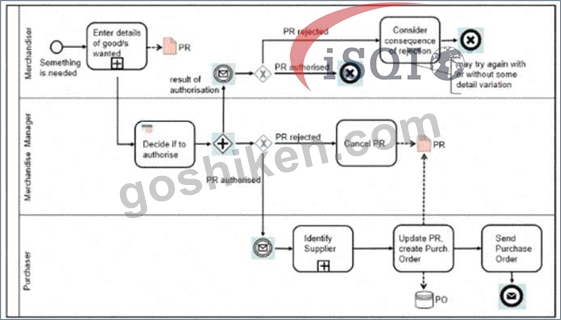
What is the minimum quantity of test cases that will be needed to cover all scenarios?
- A. 0
- B. 1
- C. 2
- D. 3
正解:D
解説:
The correct answer is B , because the BPMN model contains two executable end-to-end scenarios . CTAL- TA v4.0 classifies scenario-based testing as a behavior-based technique where the Test Analyst creates a scenario model from action sequences that form workflows through the test item. The syllabus specifically mentions activity diagrams and BPMN-style workflow models as scenario-model sources, and states that test cases are designed to cover the identified scenarios.
In the diagram, the process starts when something is needed and the merchandiser enters the details of goods wanted. The manager then decides whether to authorize the PR. From that decision, there are only two real scenario outcomes. The first is the authorized scenario : the PR is authorized, the supplier is identified, the PR is updated and a Purchase Order is created, and the Purchase Order is sent. The second is the rejected scenario : the PR is rejected, the PR is cancelled, and the merchandiser considers the consequence of rejection.
The notification/result-of-authorization flow does not create separate scenarios; it is part of the same authorized or rejected process path. The note saying the merchandiser may try again is not a modeled loop because no BPMN flow returns to the start. CTAL-TA states that when the scenario model has no loops, each scenario can be tested with a separate test case. Therefore, the minimum quantity is 2 test cases .
質問 # 40
How is a Test Analyst involved in an Incremental SDLC model?
- A. In all increments, the Test Analyst performs the test activities in a dynamic and adaptive way
- B. In each increment, the Test Analyst performs the test activities cyclically
- C. In each increment, the Test Analyst always performs the same test activities
- D. In all increments, the Test Analyst organises the test activities in the same way
正解:C
解説:
The correct answer is C . CTAL-TA v4.0 states that incremental development models divide the software into smaller, manageable increments, and each increment is developed and tested independently. Therefore, the Test Analyst performs the same core activities for each increment: test analysis, test design, test implementation, test execution, and test management support. The official CTAL-TA sample exam answer explanation confirms the same point: each increment is developed and tested independently, so the Test Analyst performs the same test activities for each increment.
Option A is not the best answer because "dynamic and adaptive" describes the Test Analyst's role more naturally in iterative or Agile contexts, where product evolution and feedback cycles drive adaptation. Option B is wrong because CTAL-TA explicitly notes that although the same activities are performed, the TA's work may be organized differently for each increment. Option D is wrong because incremental development is not necessarily cyclical; the official sample answer specifically rejects the idea that incremental development must be cyclical.
So the exam-safe distinction is: same activities in each increment, but not necessarily the same organization, timing, or cyclic structure . Reference: CTAL-TA v4.0, Section 1.1 Testing in the Software Development Lifecycle .
質問 # 41
A simple drinks machine is described in the following state transition diagram: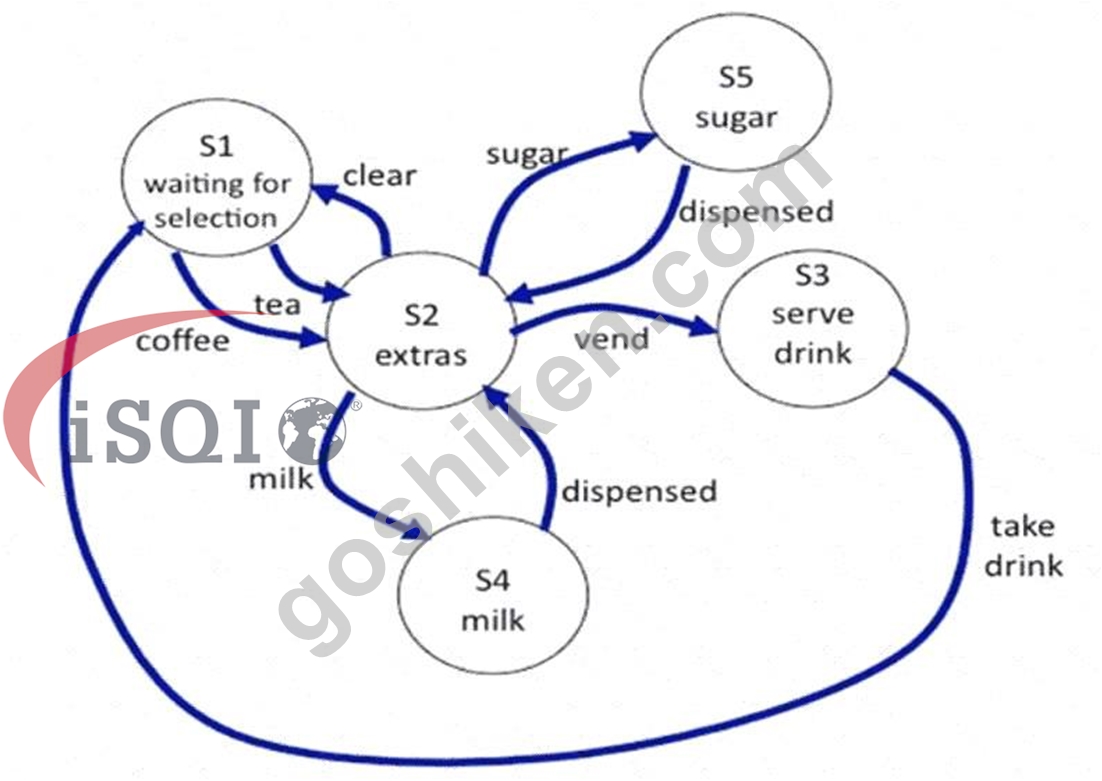
How many test cases will be needed for Chow's 1-switch coverage?
- A. 0
- B. 1
- C. 2
- D. 3
正解:A
解説:
The correct answer is C , because Chow's 1-switch coverage requires every valid sequence of two consecutive transitions to be covered. CTAL-TA v4.0 states that N-switch coverage applies to valid sequences of N+1 consecutive transitions , and specifically defines a 1-switch as a pair of incoming and outgoing transitions at a state.
Count the possible incoming-transition/outgoing-transition pairs at each state:
* S1 has 2 incoming transitions: clear, take drink, and 2 outgoing transitions: coffee, tea.
So, 2 × 2 = 4 1-switches.
* S2 has 4 incoming transitions: coffee, tea, dispensed from sugar, dispensed from milk, and 4 outgoing transitions: clear, sugar, milk, vend.
So, 4 × 4 = 16 1-switches.
* S3 has 1 incoming transition and 1 outgoing transition: 1 × 1 = 1 .
* S4 has 1 incoming transition and 1 outgoing transition: 1 × 1 = 1 .
* S5 has 1 incoming transition and 1 outgoing transition: 1 × 1 = 1 .
Total = 4 + 16 + 1 + 1 + 1 = 23 .
Therefore, the minimum quantity needed for full Chow's 1-switch coverage is 23 . Reference: CTAL-TA v4.
0, Section 3.2.2 State Transition Testing , N-switch coverage.
質問 # 42
You are working on a project to replace an old sales and merchandising system with a new system that will be based on modern platforms. The old system is still in production but is poorly documented and expensive to maintain. The new version will be developed using modern technology. The main requirements for the system are that it shall:
* Load sales data, sent electronically from the stores each evening, into a central database.
* Produce actual sales reports for the merchandisers, whose job is to manage stock levels in stores.
* Produce sales forecast reports, based on a combination of sales history and forecasting parameters. The parameters will be entered by the merchandisers into a browser-based front end and the reports will be produced overnight. The users will be able to see the reports next day, on screen or in print, by requesting this through the browser.
Requirements 1 and 2 are satisfied by the existing system and will be rewritten with no significant functional changes. Requirement 3 is new and has been clearly specified. Because of the poor test basis you have decided to perform experience-based functional correctness testing for requirements 1 and 2 with the support of checklists. Which would be the BEST items to include in the checklist for testing Requirement 2?
a) Does the sales quantity in the database for any one product in a particular store, equal the sales data input for that product / store?
b) Does the total sales value in the report for all products in a particular store, equal the sales data input for that store?
c) Does the sales quantity in the report for any one product in a particular store, equal the sales data input for that product / store?
d) Does successful login allow access to the report parameter entry features?
e) Does the total sales value in the database for all products in a particular store, equal the sales data input for that store?
- A. b) and c)
- B. b) and d)
- C. a) and c)
- D. d) and e)
正解:A
解説:
The correct answer is C because Requirement 2 is specifically about producing actual sales reports for merchandisers. CTAL-TA v4.0 states that checklist-based testing helps the Test Analyst cover known essential aspects of a test item, prevents overlooking critical areas, and supports experience-based testing when documentation is weak or changing. It also states that checklist items should be clear, specific, relevant, actionable, measurable, and answerable with yes, no, or not applicable.
Checklist item b is relevant because it verifies that the report total sales value for a store matches the sales input for that store. Checklist item c is also relevant because it verifies that the report shows the correct sales quantity for a specific product/store combination. These two checks directly test the functional correctness of the actual sales reports .
Item a is not the best fit because it checks data in the database , which belongs more directly to Requirement
1, loading sales data into the central database. Item d belongs to Requirement 3, because report parameter entry is part of the new sales forecast reporting feature. Item e again checks database content rather than report output. Reference: CTAL-TA v4.0, Section 3.4.2 Checklists Supporting Experience-Based Test Techniques and Section 4.1 Functional Testing .
質問 # 43
......
CTAL-TA_V4.0問題集100パー合格保証には最新のサンプル:https://www.goshiken.com/ISQI/CTAL-TA_V4.0-mondaishu.html