

2024年最新のGoShiken BCS BAPv5問題集と試験テストエンジン
BCS BAPv5問題集にはリアル試験問題解答
質問 # 39
Bluesky Travel is an independent travel agency specialising in luxury bespoke holidays, which is introducing a new booking process. So far, the following key changes have been made:
1) The new Commercial Off The Shelf (COTS) software package for making bookings has been installed and is working
2) Data is being migrated from the old computer system to the COTS software package
3) The IT department has documented the configuration of the COTS system
4) The legal department has confirmed that the new COTS system is compliant with company policies.
In taking a holistic approach, which of the following areas of the POPII Model have NOT yet been addressed by the changes identified?
- A. Process and people
- B. Organisation and information.
- C. People and technology
- D. Organisation and process.
正解:D
解説:
Explanation
The elements of the POPII model that have not yet been addressed by the changes identified are organisation and process. This is because there is no mention of how the new booking process will affect the organisational structure, roles, responsibilities, and culture of the company, or how the new COTS software package will integrate with the existing business processes and workflows. These elements are important to consider when introducing a new system or technology, as they may require changes or adaptations to ensure alignment and compatibility. Option A is the correct answer.
References:
POPIT Model Business Analysis Technique - Knowledge Train
POPIT Model - GSU
質問 # 40
Alana has identified several issues in a process redesign project she is working on. including the following
1) The suggested changes to the business structure will affect our relationships with suppliers.
2) The proposed electronic data sharing with our suppliers will raise legal accessibility issues.
Which TWO elements of POPIT consider these issues?
- A. Information and technology
- B. People
- C. Processes
- D. Organisation
- E. Procedures
正解:A、D
解説:
Explanation
POPIT is a technique for taking a holistic view when investigating a business situation or problem. It helps to ensure that all aspects and dimensions of a business situation or problem are considered and addressed. POPIT consists of four elements: People, Processes, Organisation and Information and technology. Therefore, options C and D are correct answers, as they are the elements of POPIT that consider these issues respectively. Option C considers issue 1: The suggested changes to the business structure will affect our relationships with suppliers. Organisation is the element that describes how an organisation is structured and governed internally and externally. It helps to identify who are involved in decision making and authority within an organisation and how an organisation relates to its stakeholders outside its boundaries. Issue 1 relates to organisation, as it involves changes to the business structure that will affect how the organisation interacts with its suppliers, who are external stakeholders. Option D considers issue 2: The proposed electronic data sharing with our suppliers will raise legal accessibility issues. Information and technology is the element that describes how information and data are created, stored, accessed, used and communicated within an organisation using technology systems and tools. It helps to identify what information and data are needed and available for an organisation to perform its activities and processes effectively and efficiently using appropriate technology systems and tools. Issue 2 relates to information and technology, as it involves electronic data sharing with suppliers using technology systems that will raise legal accessibility issues regarding information security and privacy. Option A does not consider any issue in this scenario. People is the element that describes who are involved in performing or supporting the activities and processes within an organisation. It helps to identify what skills, knowledge, attitudes and behaviours are required and exhibited by people within an organisation to perform their roles and responsibilities effectively and efficiently. There is no issue in this scenario that relates to people. Option B does not consider any issue in this scenario. Processes is the element that describes what activities and tasks are performed within an organisation to achieve its objectives and outcomes. It helps to identify how activities and tasks are sequenced, coordinated, controlled and measured within an organisation to ensure quality and consistency. There is no issue in this scenario that relates to processes. Option E is not a valid element of POPIT. Procedures is not an element of POPIT, but a term that refers to the detailed steps or instructions for performing a specific activity or task within a process.
References: BCS Practitioner Certificate in BAP Specimen, page 50.
質問 # 41
On joining a new company. Sara spent time reviewing the company's organisation chart She was particularly interested in the sponsor of the project she is joining What is Sara LIKELY to have learnt about the sponsor from this? Select the TWO that apply
- A. Their span of control
- B. The scope of their responsibilities
- C. Their position in the company hierarchy
- D. Their preferred management style
- E. The culture within their team
正解:A、C
解説:
Explanation
An organisation chart is a diagram that shows the structure and relationships of an organisation. It helps to identify who are the members, roles, levels and units of an organisation and how they are connected or related.
Therefore, options A and B are correct answers, as they are the information that Sara is likely to have learnt about the sponsor from the organisation chart. Option A is a correct answer, as their position in the company hierarchy is the information that Sara is likely to have learnt about the sponsor from the organisation chart.
Their position in the company hierarchy is the level or rank of the sponsor within the organisation's structure.
It helps to indicate their authority, status and influence within the organisation. Option B is a correct answer, as their span of control is the information that Sara is likely to have learnt about the sponsor from the organisation chart. Their span of control is the number of people or units that report directly to the sponsor within the organisation's structure. It helps to indicate their responsibility, workload and management style within the organisation. Option C is not a correct answer, as their culture within their team is not the information that Sara is likely to have learnt about the sponsor from the organisation chart. Their culture within their team is the shared values, beliefs, norms and behaviours of the sponsor and their team members within the organisation. It helps to indicate their motivation, satisfaction and performance within the organisation. Option D is not a correct answer, as their scope of responsibilities is not the information that Sara is likely to have learnt about the sponsor from the organisation chart. Their scope of responsibilities is the range or extent of tasks or activities that the sponsor has to perform or oversee within the organisation. It helps to indicate their objectives, outcomes and deliverables within the organisation. Option E is not a correct answer, as their preferred management style is not the information that Sara is likely to have learnt about the sponsor from the organisation chart. Their preferred management style is the way or approach that the sponsor uses to lead or direct their team members within the organisation. It helps to indicate their communication, delegation and feedback skills within the organisation.
References: BCS Practitioner Certificate in BAP Specimen, page 31.
質問 # 42
A company is reviewing its critical success factors and key performance indicators So far. it has key performance indicators for the following The time to deliver orders for products Consumer satisfaction with products Wastage in product production The qualifications of production employees Which area of Kaplan and Norton's balanced business scorecard has NOT been considered?
- A. Financial
- B. Customer
- C. Internal business process
- D. Learning and growth
正解:A
解説:
Explanation
Kaplan and Norton's balanced business scorecard is a strategic management tool that helps organisations to measure their performance across four perspectives: financial, customer, internal business process and learning and growth. The financial perspective focuses on how the organisation creates value for its shareholders and stakeholders. It includes measures such as revenue, profit, return on investment and cash flow. The customer perspective focuses on how the organisation meets the needs and expectations of its customers. It includes measures such as customer satisfaction, loyalty, retention and market share. The internal business process perspective focuses on how the organisation delivers its products and services to its customers. It includes measures such as quality, efficiency, productivity and innovation. The learning and growth perspective focuses on how the organisation develops its capabilities and competencies to achieve its goals. It includes measures such as employee skills, knowledge, motivation and empowerment. Therefore, option D is the correct answer, as financial measures have not been considered in the given list of key performance indicators. Option A is not correct, as learning and growth measures have been considered in the qualifications of production employees.
Option B is not correct, as internal business process measures have been considered in the time to deliver orders for products and wastage in product production. Option C is not correct, as customer measures have been considered in consumer satisfaction with products.
References: BCS Practitioner Certificate in BAP Specimen, page 17.
質問 # 43
The customer journey map below was created for Eyes 4'U. a chain of high street opticians This shows the journey of a person who is 67 years old and retired with a limited pension and active social life What are the MOST LIKELY statements to be in Box F and Box 6?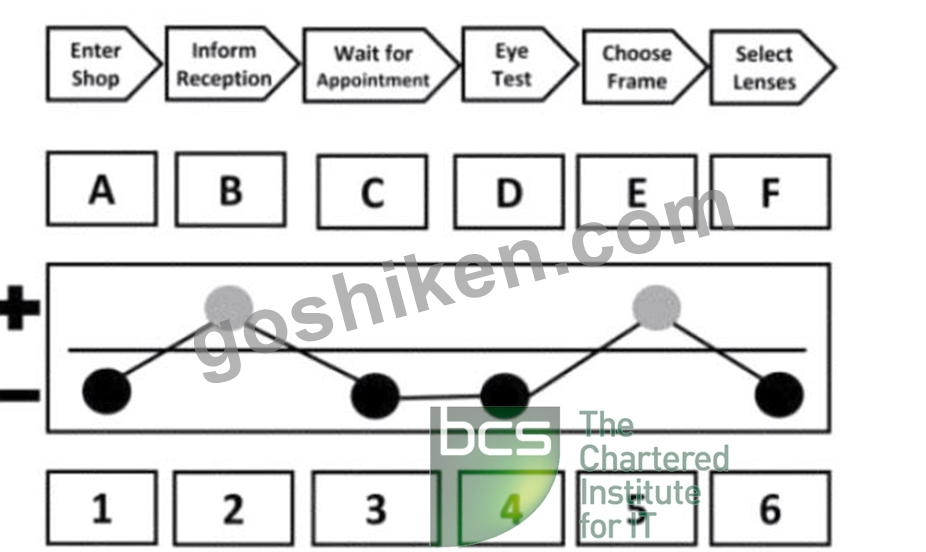
- A. F concern at cost 6 provide clearer information on options and pricing
- B. F: worry about choosing the wrong frame 6: introduce virtual frame selection technology
- C. F provide clearer information on options and pricing 6 concern at cost
- D. F pleased appointment ending 6 provide clearer information on options and pricing
正解:A
解説:
Explanation
A customer journey map is a visual representation of the steps and emotions that a customer goes through when interacting with a product or service. It helps to identify the pain points and opportunities for improvement in the customer experience. A customer journey map typically consists of the following elements: stages, actions, thoughts, feelings, touchpoints and opportunities. Therefore, option A is the correct answer, as it matches the elements of the customer journey map for Box F and Box 6. Box F represents the feeling of the customer at the stage of choosing a frame. The feeling is concern at cost, as the customer is worried about the price of the frames and lenses. Box 6 represents the opportunity for improvement at the stage of selecting lenses. The opportunity is to provide clearer information on options and pricing, as this would help the customer to make an informed decision and reduce their anxiety. Option B is not a correct answer, as it does not match the elements of the customer journey map for Box F and Box 6. Box F represents the feeling of the customer, not an opportunity for improvement. Box 6 represents an opportunity for improvement, not a feeling of the customer. Option C is not a correct answer, as it does not match the elements of the customer journey map for Box F and Box 6. Box F represents the feeling of the customer, not an opportunity for improvement. Box 6 represents an opportunity for improvement, not a feeling of the customer.
Option D is not a correct answer, as it does not match the elements of the customer journey map for Box F and Box 6. Box F represents the feeling of the customer, not an opportunity for improvement. Box 6 represents an opportunity for improvement, not a feeling of the customer.
References: BCS Practitioner Certificate in BAP Specimen, page 23.
質問 # 44
At a recent Board Meeting the Directors of an office fitting company ratified the company's mission as:
To meet or undercut all our competitors' prices'
Which of the following is MOST LIKELY to be the company's vision?
- A. To increase the company's market share.
- B. To be the premier office fitting company
- C. To offer the best value office fitting service
- D. To reduce the cost of office fitting by 5%.
正解:C
解説:
Explanation
A vision statement is a concise and inspiring statement of what the organisation aspires to be in the future. It should reflect the organisation's core values and purpose, and provide direction and motivation for its stakeholders. A vision statement should not be too specific or focused on the current state of the organisation, but rather on the desired future state. Therefore, option A is the best choice, as it expresses a clear and aspirational vision that aligns with the company's mission of meeting or undercutting all its competitors' prices. Option B is too narrow and does not capture the essence of the organisation's purpose. Option C is too vague and does not indicate how the organisation will achieve its goal. Option D is too generic and does not differentiate the organisation from its competitors.
References: BCS Practitioner Certificate in BAP Specimen, page 13.
質問 # 45
A business analyst and a project manager are producing a business case for an initiative, which aims to improve the cyber defences of a large financial services provider They met recently to review progress and made the following notes for the next draft
1. The benefits of cyber security will be hard to describe in quantitative terms, so we will need to describe these qualitatively.
2 We need to make it clear that we have fully explored the solution market, and we have considered a range of approaches to meeting the objectives of this project.
3. The threat posed to the organisation from cyber attack, and therefore the justification for this project, needs to be clearly articulated Which THREE sections of a business case will cover these points'?
- A. Risk assessment
- B. Analysis of costs and benefits
- C. Description of the current situation
- D. Options considered
- E. Recommendations
正解:B、C、D
解説:
Explanation
A business case is a document that provides the rationale and justification for a proposed business change or solution. It helps to evaluate the benefits, costs, risks and impacts of different options and recommend the best one for further development and implementation. A business case typically consists of several sections, such as executive summary, description of the current situation, description of the desired situation, options considered, analysis of costs and benefits, risk assessment and recommendations. Therefore, options A, B and C are correct answers, as they cover the sections of a business case that will address the points noted by the business analyst and the project manager. Options considered is the section where different approaches or solutions to meet the objectives of the project are identified and described. It helps to show that a range of alternatives have been explored and evaluated. Analysis of costs and benefits is the section where the financial implications of each option are estimated and compared. It helps to show the expected value and return on investment of each option. Description of the current situation is the section where the problem or opportunity that motivates the project is clearly defined and articulated. It helps to show the justification and urgency for the project. Option D is not a correct answer, as recommendations is not a section of a business case that will address any of the points noted by the business analyst and the project manager. Recommendations is the section where the preferred option is selected and proposed based on the analysis and evaluation of other sections. Option E is not a correct answer, as risk assessment is not a section of a business case that will address any of the points noted by the business analyst and the project manager. Risk assessment is the section where the uncertainties and potential negative consequences of each option are identified and analysed. It helps to show how risks can be avoided, reduced or managed.
References: BCS Practitioner Certificate in BAP Specimen, page 30.
質問 # 46
A business analyst has been carrying out investigations into a problem situation However, it is clear to the business analyst that, even after a number of interviews with individual stakeholders, some stakeholder s views still conflict.
Which investigation technique SHOULD be used to resolve the conflict and gain a consensus?
- A. Questionnaire
- B. Workshop
- C. Observation
- D. Scenario analysis.
正解:B
解説:
Explanation
A workshop is a technique for conducting group discussions and activities with stakeholders to elicit, analyse, validate and prioritise their views and needs. It helps to facilitate effective communication and collaboration among stakeholders and resolve conflicts or issues. Therefore, option D is the correct answer, as a workshop would help the business analyst to resolve the conflict and gain a consensus among stakeholders who have different views after individual interviews. A workshop would help to bring together the conflicting stakeholders in one place and time and enable them to share and compare their views openly and constructively. A workshop would help to identify and address the sources and reasons of the conflict and find common ground and mutual understanding among stakeholders. A workshop would help to generate and evaluate different options or solutions that satisfy all or most of the stakeholder views and agree on the best one for further development and implementation. Option A is not a correct answer, as scenario analysis is not a technique for resolving conflict and gaining consensus among stakeholders who have different views after individual interviews. Scenario analysis is a technique for exploring how different scenarios or situations could affect the outcomes or impacts of an organisation or project. It helps to test the feasibility and desirability of different options or solutions under various circumstances or assumptions. Option B is not a correct answer, as questionnaire is not a technique for resolving conflict and gaining consensus among stakeholders who have different views after individual interviews. Questionnaire is a technique for collecting information from stakeholders by asking them predefined questions in written form. It helps to elicit quantitative or qualitative data from a large number of stakeholders in an efficient and consistent way. Option C is not a correct answer, as observation is not a technique for resolving conflict and gaining consensus among stakeholders who have different views after individual interviews. Observation is a technique for gathering information from stakeholders by watching them perform their tasks or activities in their natural environment. It helps to analyse how stakeholders work in practice and identify their implicit or tacit needs.
References: BCS Practitioner Certificate in BAP Specimen, page 42.
質問 # 47
A large consultancy organization has assigned its BA. Girby, to a client called MetalCor, a manufacture of component for washing machines and fridge freezers. The management team of MetalCor need some help in understanding the problems they are experiencing with their production line. Recently. Reproduction has dipped to a record low and more parts are being return as fully.
Production line staff blame each other and the more staff Girby speaker to, the more issue she identifies. She having difficulty keeping track of the arising themes and how they relate to each other.
Which of the following would enable Girby to model the arising themes and how they relate to each other?
- A. Mind map
- B. Rich picture.
- C. Business activity model
- D. Business process model
正解:A
解説:
Explanation
A mind map is a technique for organising and visualising information in a hierarchical and associative way. It helps to generate, structure and classify ideas and concepts and show how they are related or connected.
Therefore, option A is the correct answer, as a mind map would enable Girby to model the arising themes and how they relate to each other. A mind map would help to identify the main theme or problem (declining production) and the sub-themes or causes (staff blaming each other, more parts being faulty etc.) and arrange them in a tree-like structure. A mind map would help to use colours, symbols, images and keywords to represent and emphasise the themes and their relationships. A mind map would help to analyse and evaluate the themes and their relationships and identify any patterns or gaps that may exist. Option B is not a correct answer, as a business activity model is not a technique for modelling the arising themes and how they relate to each other. A business activity model is a technique for modelling business activities within an organisation or project at a high level of abstraction. It helps to understand what an organisation does, how it does it, who does it, where it does it and why it does it. Option C is not a correct answer, as a rich picture is not a technique for modelling the arising themes and how they relate to each other. A rich picture is a technique for drawing a holistic view of a complex situation or problem using informal symbols and images. It helps to capture the main elements and aspects of a situation or problem and how they interact or influence each other. Option D is not a correct answer, as a business process model is not a technique for modelling the arising themes and how they relate to each other. A business process model is a technique for modelling business processes within an organisation or project at a low level of abstraction. It helps to understand how business processes are performed or delivered in terms of inputs, outputs, activities, tasks, roles, rules, events etc.
References: BCS Practitioner Certificate in BAP Specimen, page 36.
質問 # 48
A Business Analyst is reviewing the stakeholder management strategy for a high profile I Human Resources (HR) protect.
Following an organizational restructure, Harvey's role has changed from Director of Operations to Director of HR and he has Inherited sponsorship of the project. Harvey was previously involved in the project, but had little interest because his focus was on the Operational Projects that he sponsored.
Which of the following sets of stakeholder management strategies represent appropriate approaches for Harvey; firstly for when the project started and secondly now that his role has changed?
- A. Keep watch; Constant active management
- B. Ignore; Constant active management
- C. Ignore; Keep informed.
- D. Keep on side; Constant active management
正解:B
解説:
Explanation
The stakeholder management strategy depends on the power and interest of the stakeholder in the project.
Harvey's role has changed from Director of Operations to Director of HR, which means his power and interest in the HR project have also changed. When he was Director of Operations, he had low power and low interest in the HR project, so he could be ignored as a stakeholder. Now that he is Director of HR and the sponsor of the project, he has high power and high interest in the project, so he needs constant active management as a stakeholder. Option B is the correct answer.
References:
Stakeholder Analysis using the Power Interest Grid - ProjectManagement.com Power Interest Grid: How to Use, Benefits, Examples - KnowledgeHut
質問 # 49
John has been working on a business case for opening up the overseas market to new products He has been asked to document the risks What SHOULD he do to ensure they are appropriately recorded? Select the TWO that apply
- A. Provide justification or each countermeasure identified
- B. Identify an owner for each risk
- C. Create a RAID log
- D. Impact assessment of each countermeasure identified
- E. Document the source of each risk
正解:B、E
解説:
Explanation
A risk is an uncertain event or condition that, if it occurs, has a positive or negative effect on one or more project objectives. To ensure that risks are appropriately recorded, they should be documented in a consistent and structured way, such as using a RAID log (Risks, Assumptions, Issues and Dependencies). A RAID log should include information such as the risk description, impact, probability, source, owner, mitigation actions, status and date. Therefore, options B and C are essential for recording risks, as they help to identify where the risk originates from and who is responsible for managing it. Option A is not relevant to recording risks, as it is the name of the tool used to document them. Option D and E are not relevant to recording risks, as they relate to the countermeasures or actions taken to address them, not the risks themselves.
References: BCS Practitioner Certificate in BAP Specimen, page 14.
質問 # 50
BuildCo is small building company with the stall. The owner to reduce time spent on administration by simplifying the company's paperwork. This paperwork includes provides quotes and invoices, as well as managing orders and receipts for building materials.
Most of the paperwork is completed manually and copies are stored in filing cabinets. However, quotes and invoices are produced on a word processor and the stored on a computer, with printed copies also stored in the filing cabinets. The owner is not sure that all the current paperwork is necessary.
Which investigation technique would be MOST effective in establishing the need for item of paperwork?
- A. Questionnaire
- B. Document Analysis
- C. Workshop
- D. Interviews
正解:B
解説:
Explanation
Document analysis is a technique for collecting information from existing documents within an organisation or project. It helps to understand the current situation or problem and identify any gaps or issues that may exist.
Therefore, option D is the correct answer, as document analysis would be the most effective technique in establishing the need for each item of paperwork. Document analysis would help to review the content and purpose of each item of paperwork and compare it with the organisation's objectives and requirements.
Document analysis would help to evaluate the usefulness and relevance of each item of paperwork and identify any duplication or redundancy that may exist. Document analysis would help to recommend any changes or improvements to each item of paperwork and justify them with evidence and rationale. Option A is not a correct answer, as questionnaire is not the most effective technique in establishing the need for each item of paperwork. Questionnaire is a technique for collecting information from stakeholders by asking them predefined questions in written form. It helps to elicit quantitative or qualitative data from a large number of stakeholders in an efficient and consistent way. Questionnaire would not be the most effective technique in establishing the need for each item of paperwork, as it may not provide enough detail or explanation for each item of paperwork and may be influenced by stakeholder bias or preference. Option B is not a correct answer, as workshop is not the most effective technique in establishing the need for each item of paperwork.
Workshop is a technique for conducting group discussions and activities with stakeholders to elicit, analyse, validate and prioritise their views and needs. It helps to facilitate effective communication and collaboration among stakeholders and resolve conflicts or issues. Workshop would not be the most effective technique in establishing the need for each item of paperwork, as it may not be practical or feasible to involve all relevant stakeholders in a workshop and may be affected by stakeholder dynamics or politics. Option C is not a correct answer, as interviews are not the most effective technique in establishing the need for each item of paperwork.
Interviews are a technique for collecting information from stakeholders by asking them open-ended questions in verbal form. It helps to elicit rich and detailed information from individual stakeholders in an interactive and flexible way. Interviews would not be the most effective technique in establishing the need for each item of paperwork, as it may be time-consuming and costly to interview all relevant stakeholders and may be subject to stakeholder interpretation or opinion.
References: BCS Practitioner Certificate in BAP Specimen, page 35.
質問 # 51
A business analyst is reviewing the stakeholder management strategy for a high profile Human Resources (HR) project Following an organisational restructure, Harvey's role has changed from Director of Operations to Director of HR and he has inherited sponsorship of the project Harvey was previously involved in the project, but had little interest because his focus was on the Operational Projects that he sponsored.
Which of the following sets of stakeholder management strategies represent appropriate approaches for Harvey; firstly, for when the project started and secondly now that his role has changed?
- A. Keep informed; Constant active management
- B. Constant active management, keep informed
- C. Ignore, Constant active management
- D. Watch, Constant active management
正解:D
解説:
Explanation
A stakeholder management strategy is a plan for how to engage and communicate with stakeholders based on their level of interest and influence in the organisation or project. A stakeholder management strategy can vary depending on the stakeholder's position on the power/interest grid, which has four quadrants: high power, high interest; high power, low interest; low power, high interest; and low power, low interest. Therefore, option C is the correct answer, as it represents appropriate stakeholder management strategies for Harvey based on his position on the grid before and after his role change. Watch means to monitor the stakeholder's level of interest and influence and keep them informed of relevant developments. This is suitable for when Harvey was in the low power, low interest quadrant, as he had little authority or concern over the project. Constant active management means to involve the stakeholder closely in the project and seek their input and feedback regularly. This is suitable for when Harvey moved to the high power, high interest quadrant, as he became the sponsor and owner of the project. Option A is not a correct answer, as keep informed means to provide the stakeholder with sufficient information and updates to maintain their interest and support. This is more suitable for when Harvey was in the low power, high interest quadrant, not the low power, low interest quadrant. Option B is not a correct answer, as ignore means to disregard the stakeholder's views and needs and exclude them from communication. This is not a good strategy for any stakeholder, especially one who has some power or influence over the project. Option D is not a correct answer, as constant active management means to involve the stakeholder closely in the project and seek their input and feedback regularly. This is more suitable for when Harvey was in the high power, high interest quadrant, not the low power, low interest quadrant.
References: BCS Practitioner Certificate in BAP Specimen, page 21.
質問 # 52
A Business Analyst and a project Manager are producing a business case for an initiative, which aims to improve the cyber defense of a large financial services provider.
They met recently to review progress, and made the following notes for the next draft:
The benefits of cyber will be describes in quantitative terms, so we will need to describe these Qualitatively.
We need to make it clear that we have fully explored the solution market, and we have considered a range of approaches to meeting the objectives of this project.
The threat posed to the organization from cyber attack, and therefore the justification for the project, needs to be clearly articulated.
Which of the following sets of elements of a business case will cover ALL of these points?
- A. Description of the current situation. analysis of costs and benefits, options considered
- B. Recommendations, risk assessment, options considered
- C. Impact assessment, analysis of costs and benefits, recommendations
- D. Description of the current situation, impact assessment, risk assessment
正解:A
解説:
Explanation
A business case is a formal written proposal that details the costs and benefits of a proposed business change or solution. It helps to justify and secure the approval and funding for a proposed business change or solution.
A business case typically consists of several elements, such as description of the current situation, analysis of costs and benefits, options considered, recommendations, impact assessment, risk assessment etc. Therefore, option A is the correct answer, as it identifies which set of elements of a business case will cover all of these points respectively. Description of the current situation is an element that describes the problem or opportunity that exists in the current state and the need or rationale for a change or solution. It helps to explain what is wrong or missing in the current state and what are the objectives and outcomes of a change or solution. This element will cover the point that the threat posed to the organisation from cyber attack, and therefore the justification for the project, needs to be clearly articulated. Analysis of costs and benefits is an element that evaluates the financial and non-financial impacts of a proposed change or solution. It helps to compare and contrast the costs and benefits of different options or solutions and determine their feasibility and desirability.
This element will cover the point that the benefits of cyber will be described in quantitative terms, so we will need to describe these qualitatively. Options considered is an element that identifies and describes the alternative ways of addressing a problem or opportunity. It helps to explore and analyse the pros and cons of different options or solutions and select the best one based on criteria and evidence. This element will cover the point that we need to make it clear that we have fully explored the solution market, and we have considered a range of approaches to meeting the objectives of this project. Option B is not a correct answer, as it does not identify which set of elements of a business case will cover all of these points respectively. Impact assessment is an element that assesses the effects or consequences of a proposed change or solution on people, processes, organisation and technology. It helps to identify who or what will be affected by a proposed change or solution and how they will be affected. This element will not cover any of these points. Recommendations is an element that proposes and justifies the preferred option or solution for addressing a problem or opportunity. It helps to persuade and convince decision makers or influencers to approve and fund a proposed change or solution. This element will not cover any of these points. Option C is not a correct answer, as it does not identify which set of elements of a business case will cover all of these points respectively.
Recommendations is an element that proposes and justifies the preferred option or solution for addressing a problem or opportunity. It helps to persuade and convince decision makers or influencers to approve and fund a proposed change or solution. This element will not cover any of these points. Risk assessment is an element that identifies and evaluates the uncertainties or threats that may affect a proposed change or solution. It helps to estimate the likelihood and impact of risks and plan how to avoid or mitigate them. This element will not cover any of these points. Option D is not a correct answer, as it does not identify which set of elements of a business case will cover all of these points respectively. Description of the current situation is an element that describes the problem or opportunity that exists in the current state and the need or rationale for a change or solution. It helps to explain what is wrong or missing in the current state and what are the objectives and outcomes of a change or solution. This element will cover the point that the threat posed to the organisation from cyber attack, and therefore the justification for the project, needs to be clearly articulated. Impact assessment is an element that assesses the effects or consequences of a proposed change or solution on people, processes, organisation and technology. It helps to identify who or what will be affected by a proposed change or solution and how they will be affected. This element will not cover any of these points. Risk assessment is an element that identifies and evaluates the uncertainties or threats that may affect a proposed change or solution. It helps to estimate the likelihood and impact of risks and plan how to avoid or mitigate them. This element will not cover any of these points.
References: BCS Practitioner Certificate in BAP Specimen, page 42.
質問 # 53
A business case contains the following in its management summary:
'The recommended option meets the new regulatory requirements. It will ensure our products remain in the marketplace and be the first to receive compliance certification, which will enhance our reputation as the market leader New business policies and processes will be introduced, which may temporarily reduce productivity. The action plan will be communicated to all staff at the next monthly meeting?
Which TWO categories of costs and benefits are described in this extract?
- A. Tangible costs
- B. Intangible costs.
- C. Tangible benefits
- D. Irregular costs
- E. Intangible benefits
正解:B、E
解説:
Explanation
A cost is an expenditure or sacrifice incurred or expected to be incurred as a result of a business change. A benefit is an advantage or improvement that is gained or expected to be gained as a result of a business change. Costs and benefits can be classified as tangible or intangible, depending on whether they can be measured in monetary terms or not. Therefore, options B and D are correct answers, as they describe intangible costs and benefits that are not easily quantified or valued. Intangible costs include the temporary reduction in productivity due to the introduction of new business policies and processes. Intangible benefits include the enhancement of the company's reputation as the market leader due to being the first to receive compliance certification. Option A is not a correct answer, as tangible costs are not described in the extract.
Tangible costs are those that can be measured in monetary terms, such as the cost of purchasing new equipment or hiring new staff. Option C is not a correct answer, as tangible benefits are not described in the extract. Tangible benefits are those that can be measured in monetary terms, such as the increase in revenue or decrease in expenses.
References: BCS Practitioner Certificate in BAP Specimen, page 20.
質問 # 54
Which TWO of the following descriptions apply to a Business Activity Model (BAM)'?
- A. NORMALLY a consensus BAM will be produced
- B. Dependencies between the activities are NOT shown
- C. The owner should ALWAYS choose the final BAM
- D. The activities are MOST LIKELY to be shown in boxes
- E. Multiple BAMs COULD be created to reflect different perspectives.
正解:D、E
解説:
Explanation
A Business Activity Model (BAM) is a technique for modelling business activities within an organisation or project at a high level of abstraction. It helps to understand what an organisation does, how it does it, who does it, where it does it and why it does it. Therefore, options A and D are correct answers, as they apply to a BAM.
Option A applies to a BAM, as multiple BAMs could be created to reflect different perspectives of different stakeholder groups within or outside the organisation or project. A BAM is not a single or definitive representation of the business activities, but a subjective and contextual view that depends on the purpose and scope of the analysis. Option D applies to a BAM, as the activities are most likely to be shown in boxes in a BAM. A BAM is typically represented as a diagram that consists of boxes and arrows. The boxes represent the high level activities that the organisation performs or delivers, and the arrows represent the flow or sequence of the activities. Option B does not apply to a BAM, as the owner should not always choose the final BAM.
The owner is one of the stakeholder groups that may have a perspective on the business activities, but not the only or ultimate one. The final BAM should be agreed by all relevant stakeholder groups based on their needs and expectations. Option C does not apply to a BAM, as normally a consensus BAM will not be produced. A consensus BAM is a BAM that reflects a common or shared perspective of all stakeholder groups within or outside the organisation or project. A consensus BAM is not realistic or desirable, as different stakeholder groups may have different or conflicting views on the business activities. Option E does not apply to a BAM, as dependencies between the activities are shown in a BAM. Dependencies between the activities are the relationships or connections that indicate how one activity affects or influences another activity. Dependencies between the activities are shown by the arrows in a BAM diagram.
References: BCS Practitioner Certificate in BAP Specimen, page 43.
質問 # 55
A division of a telecommunication company is reviewing its current product range. It has decided to reposition itself by narrowing its product scope to 'deliver consultancy service'. The activity is the primary doing activity doing on a business Activity Model (BAM) defined by the Chief Executive Officer (CEO). A number of other activities have been identified, five of which are listed below:
Determine which customer to target for
a) Determine which customers to target for our focused service.
b) Track the progress of consultancy contracts placed by customers.
c) Define the skills sets of the consultants supplying our service.
d) Agree on a marketing campaign to make people aware of our new product focus e) Run monthly open days, showcasing our consultancy expertise.
Which of these would be categorized as planning activities on the CEO's BAM?
- A. c. d and e
- B. a. c and d
- C. b, c and e.
- D. a, b and e.
正解:A
解説:
Explanation
Planning activities are those that must be considered beforehand in order to complete the doing and enabling activities. They are usually related to defining or determining some aspects of the business. In this question, the activities c, d and e are planning activities, as they involve defining the skills sets of the consultants, agreeing on a marketing campaign, and running monthly open days. These activities are necessary to support the primary doing activity of delivering consultancy service. Option D is the correct answer.
質問 # 56
TeamClothing sells clothes through its shops based around the country If a customer in a shop cannot find the item they wish to buy. a sales assistant can order it for them online and when it arrives, the customer can then collect the item from the shop Customers may also order directly from TeamClothing's website Orders from the website are usually delivered to the customer's home address Online customers also automatically receive a monthly catalogue from the firm, which lists current offers Three events are of particular interest:
Shop sales assistants ordering items for a customer online Customers ordering through the website Sending a monthly catalogue to website customers How would these events be classified'?
- A. External = 1; Time-based = 1; Internal = 1.
- B. Internal = 2; Time-based = 1.
- C. External = 2, Time-based = 1
- D. External = 3
正解:C
解説:
Explanation
An event is something that happens or occurs within or outside an organisation or project that triggers or affects an activity or process. Events can be classified into three types: external, internal and time-based.
Therefore, option B is the correct answer, as it correctly classifies the events of interest in this scenario according to their types. External events are events that originate from outside the organisation or project and are beyond its control or influence. An example of an external event in this scenario is customers ordering through the website, as it originates from outside TeamClothing and is beyond its control or influence. There are two external events in this scenario. Internal events are events that originate from within the organisation or project and are under its control or influence. An example of an internal event in this scenario is shop sales assistants ordering items for a customer online, as it originates from within TeamClothing and is under its control or influence. There are no internal events in this scenario. Time-based events are events that occur at regular intervals or on specific dates or times. An example of a time-based event in this scenario is sending a monthly catalogue to website customers, as it occurs at regular intervals (every month). There is one time-based event in this scenario.
References: BCS Practitioner Certificate in BAP Specimen, page 46.
質問 # 57
Maria and Nelly own a small jewellery shop and are considering whether they should renew the lease on their shop for another year. They are both thinking about alternative business ventures as they never intended to run the jewellery shop indefinitely.
They source their jewellery products from an overseas manufacturer and market them in luxury presentation boxes, made by local craftsmen They employ Maria's son, Darren, in the school holidays to make up the boxes and keep the stockroom full Which of the following CATWOE categories CANNOT be identified from this scenario?
- A. Environment
- B. Actor
- C. Transformation
- D. Owner
正解:A
解説:
Explanation
CATWOE is a technique for exploring stakeholder business perspectives by identifying six elements:
Customer, Actor, Transformation, Worldview, Owner and Environment. It helps to understand how different stakeholders perceive a business situation or problem and what they expect from a solution. Therefore, option D is the correct answer, as environment is the element that cannot be identified from this scenario.
Environment is the element that describes the external factors or constraints that affect a stakeholder's perspective or limit their options. It helps to explain what factors or constraints are beyond the stakeholder's control or influence. There is no information in this scenario that indicates what external factors or constraints affect Maria and Nelly's perspective or limit their options. Option A is not a correct answer, as transformation is the element that can be identified from this scenario. Transformation is the element that describes what changes or processes take place in a business situation or problem or its solution. It helps to identify what inputs are converted into outputs in a business situation or problem or its solution. An example of transformation in this scenario is sourcing jewellery products from an overseas manufacturer and marketing them in luxury presentation boxes made by local craftsmen. Option B is not a correct answer, as actor is the element that can be identified from this scenario. Actor is the element that describes who carries out or performs a business situation or problem or its solution. It helps to identify who are responsible for implementing or delivering a business situation or problem or its solution. An example of actor in this scenario is Darren, who makes up the boxes and keeps the stockroom full. Option C is not a correct answer, as owner is the element that can be identified from this scenario. Owner is the element that describes who has the authority or power to start or stop a business situation or problem or its solution. It helps to identify who are the decision makers or influencers of a business situation or problem or its solution. An example of owner in this scenario is Maria and Nelly, who own the jewellery shop and are considering whether to renew the lease.
References: BCS Practitioner Certificate in BAP Specimen, page 38.
質問 # 58
Efua is planning to use Design Thinking to improve the m-store customer experience She has asked you to suggest good techniques to help with the different stages.
Looking at the list of techniques and stages below which THREE combinations SHOULD be of benefit to Efua?
- A. Empathise Customer Journey Map
- B. Define Current user needs or problems.
- C. Evaluate Mind Mapping
- D. Prototype: Scenario Analysis
- E. Create Personas
正解:A、B、E
解説:
Explanation
Design Thinking is an approach for solving complex problems by focusing on human needs and desires. It involves five stages: empathise, define, ideate, prototype and test. Therefore, options B, D and E are correct answers, as they suggest good techniques to help with the different stages of Design Thinking. Empathise is the stage where the problem is explored from the perspective of the users and their emotions, motivations and pain points are understood. A good technique to help with this stage is Customer Journey Map, which is a visual representation of the steps and emotions that a user goes through when interacting with a product or service. It helps to identify the pain points and opportunities for improvement in the user experience. Create is the stage where the users are represented by creating personas, which are fictional characters that embody the characteristics, goals and needs of a typical user group. Personas help to empathise with the users and design solutions that suit their preferences and expectations. Define is the stage where the problem is clearly defined and articulated based on the insights gained from the empathise stage. A good technique to help with this stage is Current user needs or problems, which is a statement that summarises what the users need or want to achieve and what prevents them from doing so. It helps to focus on the core problem and set the direction for ideation. Option A is not a correct answer, as Prototype is not a stage of Design Thinking, but a technique that can be used in the Prototype stage. Prototype is the stage where the ideas are turned into tangible and testable prototypes that can be used to demonstrate and evaluate the solutions. A good technique to help with this stage is Scenario Analysis, which is a technique that explores how different scenarios or situations could affect the outcomes of the solutions. It helps to test the feasibility and desirability of the prototypes. Option C is not a correct answer, as Evaluate is not a stage of Design Thinking, but a technique that can be used in the Test stage. Test is the stage where the prototypes are tested with real users and feedback is collected and analysed to refine and improve the solutions. A good technique to help with this stage is Mind Mapping, which is a technique that organises and visualises information in a hierarchical and associative way. It helps to capture and structure feedback and identify patterns and insights.
References: BCS Practitioner Certificate in BAP Specimen, page 28.
質問 # 59
IT services has commissioned a new desktop PC replacement project that has been funded and running for three months, with a fully-engaged sponsor and programme manager appointed The head of IT services has not been involved beyond the initial project start-up interviews and has not attended any of the project meetings What position on the power interest and does the head of IT services currently occupy?
- A. Low power and influence but high interest
- B. Some power and influence and some interest
- C. High power or influence but low interest
- D. High power or influence and high interest
正解:C
解説:
Explanation
A power/interest grid is a tool for analysing stakeholders based on their level of power or influence and their level of interest or involvement in the organisation or project. The grid has four quadrants: high power, high interest; high power, low interest; low power, high interest; and low power, low interest. The position of a stakeholder on the grid can help to determine the appropriate strategy for engaging and communicating with them. Therefore, option A is the correct answer, as the head of IT services currently occupies the high power, low interest quadrant. This means that he has the authority or ability to affect the outcome of the project, but he does not show much concern or involvement in it. Option B is not correct, as some power and influence and some interest would place the head of IT services in the middle of the grid, which is not a distinct quadrant.
Option C is not correct, as high power or influence and high interest would place the head of IT services in the top right quadrant, which is not consistent with his lack of involvement. Option D is not correct, as low power and influence but high interest would place the head of IT services in the bottom right quadrant, which is not consistent with his authority.
References: BCS Practitioner Certificate in BAP Specimen, page 19.
質問 # 60
......
2024年最新のGoShiken BAPv5のPDFで最近更新された問題です:https://www.goshiken.com/BCS/BAPv5-mondaishu.html
BAPv5試験には保証が付きます。更新されたのは72問があります:https://drive.google.com/open?id=1fk02eqkF5yE-tcVCQAnbq5JNtXu5fuGP