

[2024年08月26日] 合格率取得する秘訣は1z0-071日本語認定試験エンジンPDF
1z0-071日本語試験問題集合格できるには更新された2024年08月テスト問題集
質問 # 20
SAVEPOINTに関して正しいのは、次の2つのステートメントですか。 (2つ選択してください。)
- A. SAVEPOINTにロールバックすると、TRUNCATEステートメントを元に戻すことができます
- B. SAVEPOINTにロールバックすると、CREATE INDEXステートメントを元に戻すことができます
- C. SAVEPOINTはCOMMITを発行しません
- D. SAVEPOINTにロールバックすると、DELETEステートメントを元に戻すことができます
- E. 1つのトランザクションで発行できるSAVEPOINTは1つだけです
正解:C、D
質問 # 21
SALES1テーブルの説明を調べます。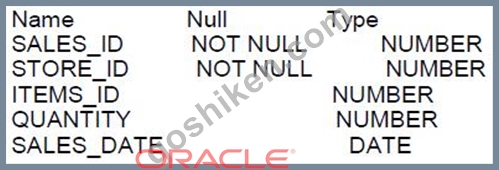
SALES2は、SALES1と同じ説明のテーブルです。
一部の販売データは両方のテーブルで重複しています。
SALIES2テーブルに存在しないSALES1テーブルの行を表示したいとします。
どの集合演算子が必要な出力を生成しますか?
- A. 減算
- B. マイナス
- C. UNION ALL
- D. 交差
- E. UNION
正解:B
質問 # 22
ORDER_ITEMSテーブルの説明を調べます。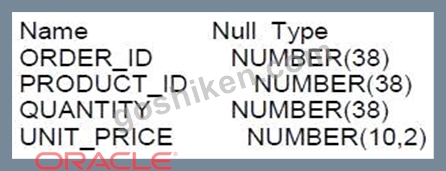
この不完全なクエリを調べてください。
SELECTDISTINCT数量* unit_price total_paid FROM order_items ORDER BY <clause>;
クエリが正常に完了するように<clause>を置き換えることができるのはどれですか?
- A. 数量* unit_price
- B. product_id
- C. total_paid
- D. 数量
- E. 数量、unit_price
正解:A、E
解説:
In a SELECT statement with DISTINCT, the ORDER BY clause can only order by expressions that are part of the SELECT list.
A). quantity alone is not sufficient to replace <clause> as it is not included in the SELECT list after DISTINCT.
B). This option can successfully replace <clause> because both quantity and unit_price are used in the SELECT expression, and thus their individual values are valid for the ORDER BY clause.
C). total_paid is an alias for the expression quantity * unit_price, but it cannot be used in the ORDER BY clause because Oracle does not allow aliases of expressions in DISTINCT queries to be used in ORDER BY.
D). product_id is not included in the SELECT list after DISTINCT and thus cannot be used in ORDER BY.
E). The expression quantity * unit_price is exactly what is selected, so it can replace <clause> and the query will complete successfully.
References:
* Oracle Database SQL Language Reference, 12c Release 1 (12.1): "ORDER BY Clause"
質問 # 23
自己結合について正しいのはどれですか?
- A. それらは常に状態です。
- B. INNER結合とLEFT .joinを使用できます。
- C. 結合条件に存在する演算子が必要です。
- D. 結合条件に存在しない演算子が必要です。
- E. 結合条件はありません。
- F. テーブルのエイリアスが必要です。
正解:B、F
質問 # 24
このビジネスルールを調べます。
各学生は複数のプロジェクトに取り組むことができ、各プロジェクトには複数の学生がいる可能性があります。
最適なデータストレージのためにエンティティリレーションシップ(ER)モデルを設計し、次の形式でレポートを生成できるようにする必要があります。
正しい2つのステートメントはどれですか?
- A. STUDENT IDは、STUDENTSエンティティの主キーおよびPROJECTSエンティティの外部キーである必要があります。
- B. ERは、STUDENTSエンティティとPROJECTSエンティティの間に多対多の関係を持っている必要があり、1対多の関係に解決する必要があります。
- C. ERは、STUDENTSエンティティとPROJECTSエンティティの間に1対多の関係を持っている必要があります。
- D. 連想テーブルは、STUDENT_IDとPROJRCT_IDの複合キーを使用して作成する必要があります。これは、STUDENTSエンティティとPROJECTSエンティティにリンクされた外部キーです。
- E. PROJECT_IDは、PROJECTSエンティティの主キーおよびSTUDENTSエンティティの外部キーである必要があります。
正解:B、D
質問 # 25
AMOUNT_SOLDが最も低い製品のSALESテーブルの行の5%を表示し、これにより出力が行の5%を超える場合でも同じAMOUNT_SOLDを持つ行を含める必要があります。
どのクエリが必要な結果を提供しますか?
- A. SELECT prod_id、cust_id、amount_soldFROM salesORDER BY amount_soldFETCH FIRST 5 PERCENT ROWS WITH TIES ONLY;
- B. SELECT prod_id、cust_id、amount_soldFROM salesORDER BY amount_soldFETCH FIRST 5 PERCENT ROWS ONLY;
- C. SELECT prod_id、cust_id、amount_soldFROM salesORDER BY amount_soldFETCH FIRST 5 PERCENT ROWS ONLY WITH TIES;
- D. SELECT prod_id、cust_id、amount_soldFROM salesORDER BY amount_soldFETCH FIRST 5 PERCENT ROWS WITH TIES;
正解:D
質問 # 26
このステートメントを調べます。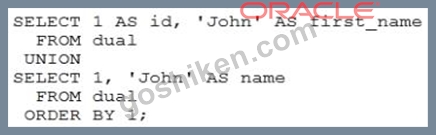
実行すると何が返されますか?
- A. 0行
- B. エラー
- C. 1行
- D. 2行
正解:D
質問 # 27
SALESテーブルの説明を調べます。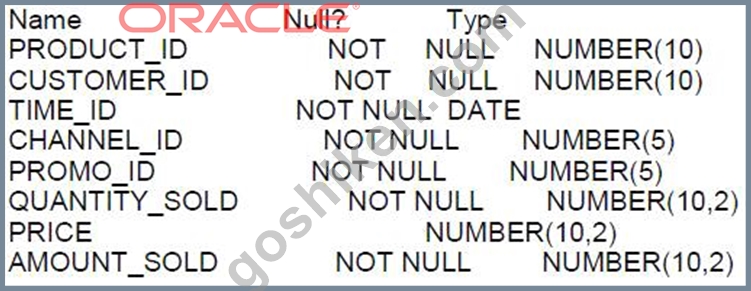
SALESテーブルには5,000行あります。
このステートメントを調べてください。
CREATE TABLE sales1(prod id、cust_id、quantity_sold、price)
なので
SELECT product_id、customer_id、quantity_sold、price
販売から
WHERE 1 = 1
正しい2つのステートメントはどれですか?
- A. SALES1には、SALESテーブルでこれらの制約があった選択された列にPRIMARYKEYおよびUNIQUE制約があります。
- B. SALES1は1行で作成されます。
- C. SALES1には、SALESテーブルでこれらの制約があった選択された列にNOTNULL制約があります。
- D. SALES1は5,000行で作成されます。
正解:B、C
解説:
When creating a new table with a query, the statements that are true are:
* A. SALES1 is created with 1 row.This is incorrect actually; the given query with WHERE 1=1 will retrieve all rows from the sales table, not just one row. Therefore, SALES1 will be created with the same number of rows as in the SALES table, assuming there are no WHERE clause conditions limiting the rows.
* D. SALES1 has NOT NULL constraints on any selected columns which had those constraints in the SALES table.This is true. When a table is created using a CREATE TABLE AS SELECT statement, the NOT NULL constraints on the columns in the selected columns are preserved in the new table.
Options B and C are incorrect:
* B is incorrect because the primary key and unique constraints are not carried over to the new table when using the CREATE TABLE AS SELECT syntax.
* C is incorrect in the context of this scenario. However, if interpreted as a standalone statement (ignoring A), C would be the correct description of the outcome since WHERE 1=1 will not filter out any rows.
質問 # 28
正しい2つのステートメントはどれですか?
- A. CASEを使用して評価されたすべての条件は、DECODEを使用して評価することもできます。
- B. CASEは関数であり、DECODEは関数ではありません。
- C. CASEとDECODEはどちらも関数です。
- D. CASEもDECODEも関数ではありません。
- E. DECODEは関数であり、CASEは関数ではありません。
- F. DECODEを使用して評価されたAIl条件は、CASEを使用して評価することもできます。
正解:E、F
質問 # 29
次のコマンドを実行します。
SQL> DEFINE採用日= '01 -APR -2011 ';
SQL> SELECT employee_id、first_name、salary FROM employees WHERE Hire date>&hiredate AND manager_id>&mgr_id;
どの置換変数に対してプロンプトが表示されますか?
- A. &mgr_idのみ
- B. なし
- C. &hiredateおよび&mgr_id
- D. &hiredateのみ
正解:A
解説:
* D. only &mgr_id: Since the hiredate variable is already defined before the SELECT statement, you will not be prompted for &hiredate again. However, &mgr_id has not been defined, so you will be prompted for this substitution variable.
質問 # 30
SELECTステートメントのWHERE句とHAVING句について正しい2つのステートメントはどれですか。
- A. HAVING句で使用される集計関数と列は、クエリのこれらのSELECTリストで指定する必要があります。
- B. WHERE句を使用して、行をグループに分割した後に行を除外できます
- C. HAVING句は、サブクエリの集計関数で使用できます。
- D. WHERE句とHAVING句は、異なるテーブル列に適用される場合にのみ同じステートメントで使用できます。
- E. WHERE句を使用して、行をグループに分割する前に行を除外できます。
正解:A、E
解説:
In SQL, the WHERE and HAVING clauses are used to filter records; the WHERE clause is applied before grouping the records, while the HAVING clause is used after grouping the records, particularly when using aggregation functions.
* Statement D is true because the HAVING clause is used to filter groups based on the result of aggregate functions. Therefore, any column or aggregate function appearing in the HAVING clause must also appear in the SELECT list of the query, unless it is used as part of an aggregate function.
* Statement E is true because the WHERE clause is designed to filter rows before they are grouped into aggregate groups in a GROUP BY clause. This is a fundamental aspect of SQL that optimizes query performance by reducing the number of rows to be processed in the aggregate phase.
* Statements A, B, and C are incorrect based on the following:
* A is incorrect because the WHERE clause does not operate on groups but on individual rows before grouping.
* B is misleading; while WHERE and HAVING can be used in the same statement, their usage is not restricted to different columns. They perform different functions (row-level filtering vs.
group-level filtering).
* C is incorrect because subqueries using aggregate functions typically do not use HAVING clauses; rather, HAVING is used in the outer query to filter the results of aggregates.
質問 # 31
どの2つのクエリが文字列Hello!を返しますか。準備はいいですか?
- A. SELECT "Hello!We are ready" FROM | DUAL;
- B. SELECT q '[Hello!準備ができました] 'FROM DUAL;
- C. SELECT q '!こんにちは!準備ができました! 'FROM DUAL;
- D. SELECT 'こんにちは!私たちはデュアルから準備ができています。
- E. SELECT 'こんにちは!私たちは準備ができています 'エスケープ' N'FROMDUAL:
正解:B、C
解説:
In Oracle SQL, the q quote operator can be used to define string literals that contain single quotes or other special characters without needing to escape them. The queries using the q quote mechanism, like in options A and C, will successfully return the string as it is, including single quotes within the string.
* A: Correct, it uses the q quote operator with the exclamation mark ! as the delimiter, which allows the string to contain single quotes.
* B: Incorrect, double quotes " in Oracle SQL are used for identifiers such as column names, not string literals.
* C: Correct, this also uses the q quote operator, with the square brackets [] as the delimiters.
* D: Incorrect, the backslash \ is not used as an escape character in Oracle SQL string literals, and the ESCAPE keyword is used incorrectly here.
* E: Incorrect, this does not account for the single quote within the string, which would terminate the string literal prematurely, and it lacks the q quote operator or proper escape mechanism.
質問 # 32
このビジネスルールを調べます。
各学生は複数のプロジェクトに取り組むことができ、各プロジェクトには複数の学生がいる可能性があります。
最適なデータストレージのためにエンティティリレーションシップ(ER)モデルを設計し、次の形式でレポートを生成できるようにする必要があります。
正しい2つのステートメントはどれですか?
- A. STUDENT IDは、STUDENTSエンティティの主キーおよびPROJECTSエンティティの外部キーである必要があります。
- B. ERは、STUDENTSエンティティとPROJECTSエンティティの間に多対多の関係を持っている必要があり、1対多の関係に解決する必要があります。
- C. ERは、STUDENTSエンティティとPROJECTSエンティティの間に1対多の関係を持っている必要があります。
- D. 連想テーブルは、STUDENT_IDとPROJRCT_IDの複合キーを使用して作成する必要があります。これは、STUDENTSエンティティとPROJECTSエンティティにリンクされた外部キーです。
- E. PROJECT_IDは、PROJECTSエンティティの主キーおよびSTUDENTSエンティティの外部キーである必要があります。
正解:B、D
解説:
Based on the business rule, the true statements regarding the Entity Relationship (ER) model are:
* A. An associative table must be created with a composite key of STUDENT_ID and PROJECT_ID, which is the foreign key linked to the STUDENTS and PROJECTS entities. This is true because, in a many-to-many relationship, an associative (junction) table is used to maintain the associations between two entities.
* D. The ER must have a many-to-many relationship between the STUDENTS and PROJECTS entities that must be resolved into 1-to-many relationships. This is correct because many-to-many relationships are resolved by introducing an associative table that breaks it down into two 1-to-many relationships.
Options B, C, and E are incorrect:
* B is incorrect because PROJECT_ID should not be a foreign key in the STUDENTS entity in a many-to-many relationship.
* C is incorrect as the rule indicates a many-to-many relationship, not 1-to-many.
* E is incorrect because STUDENT_ID should not be a foreign key in the PROJECTS entity in a many-to-many relationship.
質問 # 33
セッションでは、NLS_ DATE_FORMATがDD-MON_RRに設定されています。
年を4桁で表示する2つのクエリはどれですか?
- A. SELECT TO_CHAR(ADD_MONTHS(SYSDATE、6)、 'dd-mon-yyyy')FROM DUAL;
- B. SELECT TO_CHAR(SYSDATE、 'MM / DD / YYYY')FROM DUAL;
- C. SELECT TO_DATE(SYSDATE、 'RRRR-MM-DD')FROM DUAL;
- D. SELECT TO_DATE(TO_CHAR(SYSDATE、 'MM / DD / YYYY')、 'MM / DD / YYYY')FROM DUAL;
- E. SELECT TO_CHAR(ADD_MONTHS(SYSDATE、6))FROM DUAL;
- F. SELECT TO_DATE(ADD_MONTHS(SYSDATE、6)、 'dd-mon-yyyy')FROM DUAL;
正解:A、B
質問 # 34
SALESテーブルの説明を調べます。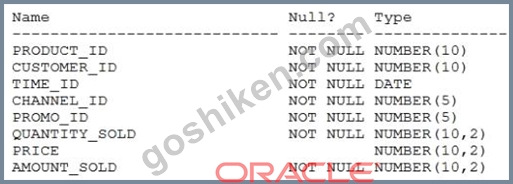
SALESテーブルには55,000行があります。
このステートメントを調べます。
どちらが正しいですか?
- A. SALES1には、SALESテーブルにこれらの制約があった選択された列に対するPRIMARY KEYおよびUNIQUE制約があります。
- B. SALES1は1行で作成されます。
- C. SALES1は行なしで作成されます。
- D. SALES1には、SALESテーブルにこれらの制約があった選択した列に対するNOT NULL制約があります。
- E. 55,000行のSALES1が作成されます。
正解:C、D
質問 # 35
......
1z0-071日本語テスト問題練習は2024年最新のに更新された323問あります:https://www.goshiken.com/Oracle/1z1-071-JPN-mondaishu.html