

[2024年12月] ベストな問題集を使おうVCP-VMC 2022 2V0-33.22PSE専門試験問題
100%の合格率を試そう!更新されたのは2V0-33.22PSE試験問題 [2024]
質問 # 36
A cloud administrator Is tasked with deploying two virtual machines (APP01 and APP02) to a software-defined data center (SDDC) with multiple clusters hosted In VMware Cloud on AWS based on the following requirements:
* APP01 and APP02 should NOT run on the same host.
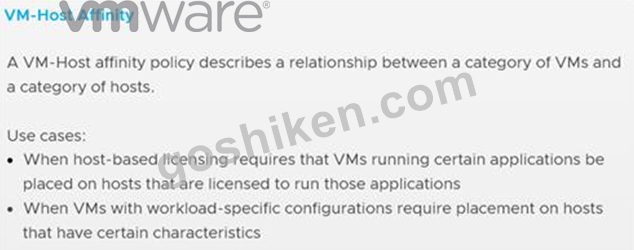
* Only three hosts in the SDDC are entitled to run the software installed on these servers.
* All entitled hosts are in cluster 1.
Which two actions should the administrator take to meet these requirements? (Choose two)
- A. Create a VM-VM anti-affinity policy.
- B. Create a VM-Host affinity policy.
- C. Create a Disable DRS vMotion policy.
- D. Deploy APP01 to Cluster 1 and APP02 to cluster 2. a Create a VM-Host anti-affinity policy.
正解:A、B
解説: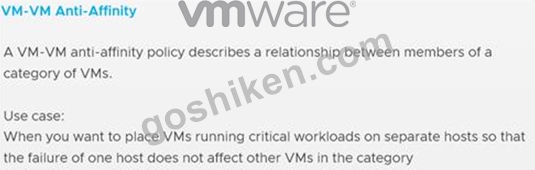
質問 # 37
Which vSphere HA default response is applied when a virtual machine crashes on a VMware Cloud cluster?
- A. Shut down the impacted virtual machine and do not restart it anywhere
- B. Restart the impacted virtual machine on other hosts in other SDDC Cluster
- C. Restart the impacted virtual machine on other hosts in the same SDDC Cluster
- D. Restart the impacted virtual machine on the same host in the same SDDC cluster
正解:C
解説:
VMware High Availability (HA) is a feature of the VMware Cloud platform that monitors the health of virtual machines and restarts virtual machines on other hosts if they crash or become unresponsive. This ensures that the virtual machines are always available and that no downtime is experienced. The default response is to restart the impacted virtual machine on other hosts in the same SDDC Cluster, however, this can be customized to suit the needs of the customer.
質問 # 38
A cloud administrator is tasked with moving critical business workloads between two VMware Cloud on AWS software-defined data centers (SDDCs) located in different geographical regions. The following requirements must be met:
* Migrate 300 virtual machines from region A to region B with minimal downtime of the applications.
* Non-disruptively resume application access of the targeted virtual machines in the event the migration fails.
* Support concurrent switch over of the application workloads to occur during a pre-defined maintenance window.
Which VMware HCX migration type should be used to meet these requirements?
- A. VMware HCX Bulk Migration
- B. VMware HCX Replication Assisted vMotion
- C. VMware HCX Cold Migration
- D. VMware HCX vMotion
正解:B
解説:
https://docs.vmware.com/en/VMware-HCX/4.5/hcx-user-guide/GUID-741F47D5-A3C9-4D74-9672-E54D8791D8F0.html
"VMware HCX Replication Assisted vMotion (RAV) uses the HCX Interconnect appliance along with replication and vMotion technologies to provide large scale, parallel migrations with zero downtime." Understanding VMware HCX Replication Assisted vMotion: https://docs.vmware.com/en/VMware-HCX/4.6/hcx-user-guide/GUID-741F47D5-A3C9-4D74-9672-E54D8791D8F0.html#GUID-741F47D5-A3C9-4D74-9672-E54D8791D8F0
質問 # 39
A cloud administrator would like the VMware Cloud on AWS cluster to automatically scale-out and scale-In based on resource demand. Which two Elastic DRS policies can be configured to meet this requirement? (Choose two.)
- A. Optimize for Best Performance policy
- B. Optimize for Rapid Scale-Out policy
- C. Optimize for Lowest Cost policy
- D. Elastic DRS Baseline policy
- E. Custom Elastic DRS policy
正解:A、C
質問 # 40
A cloud administrator establishes a VPN connection to the VMware Cloud data center but Is unable to access the VMware Cloud vCenter. Which step can the administrator take to resolve this?
- A. Create a segment in the VMware Cloud data center for connection to the vCenter.
- B. Modify the default vCenter management network to participate in the on-premises IP space.
- C. Establish a layer 2 connection between the on-premises data center and the VMware Cloud data center.
- D. Create an NSX firewall rule In the VMware Cloud data center allowing access to the vCenter from the on-premises data center.
正解:D
解説:
https://docs.vmware.com/en/VMware-Cloud-on-AWS/services/com.vmware.vmc-aws-operations/GUID-ED8B84E8-BF1C-47EE-BB60-8D5741351822.html By default, the management gateway firewall is set to deny all traffic between the internet and vCenter Server. Verify that the appropriate firewall rules are in place.
The administrator can create an NSX firewall rule in the VMware Cloud data center that allows access to the vCenter from the on-premises data center. This would allow the VPN connection to connect to the vCenter, allowing the administrator to access and manage the VMware Cloud environment.
質問 # 41
Which three factors should a cloud administrator consider when sizing a new VMware Cloud software-defined data center (SDDC) to support the migration of workloads from an on-premises SDDC? (Choose three.)
- A. Total amount of available storage across all on-premises datastores
- B. Total number of workloads
- C. Average size of workload resources (CPU & RAM)
- D. Total number of 10Gb network ports required
- E. Host hardware type in the target VMware Cloud
- F. Total number of on-premises hosts
正解:A、B、C
解説:
Total number of workloads. This determines how many hosts are needed in the VMware Cloud SDDC cluster.
Total amount of available storage across all on-premises datastores. This determines how much storage capacity is needed in the VMware Cloud SDDC cluster.
Average size of workload resources (CPU & RAM). This determines how much compute capacity is needed in the VMware Cloud SDDC cluster.
https://docs.vmware.com/en/VMware-Cloud/services/vmc-cloud-sizer-user/GUID-7CECF719-E56B-4830-84ED-77206A2A118D.html
質問 # 42
As per company policy, all administrator level accounts need to have their password changed on a regular basis. The [email protected] account password is changed by an administrator from the vSphere Client.
Another administrator is using the credentials in the VMware Cloud console and gets an 'access denied' error.
What could be the problem?
- A. The password change email confirmation has NOT been approved by the organization owner.
- B. The password should only be changed through the VMware Cloud console.
- C. The password should be changed by escalation of privileges.
- D. The new password is NOT synchronized with the password that is displayed for the Default vCenter user account.
正解:D
解説:
The problem could be that the new password is not synchronized with the password that is displayed for the Default vCenter user account. The administrator must make sure that the same password is used in both the vSphere Client and the VMware Cloud console in order for the user to access the account. Changing the password in one place does not automatically change it in the other, so this must be done manually.
https://docs.vmware.com/en/VMware-Cloud-on-AWS/services/com.vmware.vmc-aws-operations/GUID-7F72EA90-5BFA-404F-A2EC-B93070A52A67.html
質問 # 43
Which three functions are provided by the components within the Kubernetes control plane? (Choose three.)
- A. Stores and distributes container images.
- B. Configures network rules to route traffic to containers within the Kubernetes cluster.
- C. Balances pods across the nodes within a Kubernetes cluster.
- D. Watches the API for changes and responds with appropriate actions.
- E. Ensures that containers are running in a pod.
- F. Stores Kubernetes cluster data in a key-value data store.
正解:C、D、F
解説:
https://kubernetes.io/docs/concepts/overview/components/#control-plane-components
https://kubernetes.io/docs/concepts/overview/components/
質問 # 44
What is a prerequisite step to adding additional users to a Google Cloud VMware Engine's vCenter (GCVE)?
- A. Add a user in Google Cloud Platform Identity and Access Management.
- B. Open a support ticket to escalate VMware vSphere privileges.
- C. Change the default administrator password.
- D. Escalate VMware vSphere privileges In the GCVE portal.
正解:A
解説:
The prerequisite step to adding additional users to a Google Cloud VMware Engine's vCenter (GCVE) is to add a user in Google Cloud Platform Identity and Access Management. This will allow for the user to be added to the vCenter and properly authenticated.
To add additional users to a GCVE vCenter, a prerequisite step is to add a user in Google Cloud Platform Identity and Access Management (IAM)1. This is because GCVE uses Google Cloud IAM to manage access to the private cloud2. The user must have the appropriate IAM role, such as VMware Engine Admin or VMware Engine Viewer, to access the GCVE portal and vCenter2. The user must also have a Google account or a Cloud Identity account2. After adding a user in Google Cloud IAM, the user can sign in to the GCVE portal and launch the vCenter web console2. The user can then perform operations based on the assigned vCenter role and group3. Reference: 1: Adding users to Google Cloud VMware Engine, 2: Managing access to Google Cloud VMware Engine, 3: Private cloud vSphere permission model
質問 # 45
Which two steps does a cloud administrator need to take when protecting a VMware Cloud on AWS software-defined data center (SDDC) with VMware site Recovery? (Choose Two.)
- A. Connect the Site Recovery manager instance on the protected recovery site.
- B. Set the NSX-T Edge management gateway firewall rules.
- C. Register the vSphere Replication appliance with vCenter Single Sign-On
- D. Deploy the Site Recovery manager virtual Appliance.
- E. Deploy the vSphere Replication virtual appliance.
正解:A、E
解説:
A cloud administrator needs to deploy the vSphere Replication virtual appliance and the Site Recovery manager virtual appliance when protecting a VMware Cloud on AWS software-defined data center (SDDC) with VMware Site Recovery.
The vSphere Replication virtual appliance is responsible for replicating the virtual machines from the source to the target site. Site Recovery Manager virtual appliance acts as the central management and orchestration platform for the entire disaster recovery process.
Reference:
In order to protect a VMware Cloud on AWS software-defined data center (SDDC) with VMware Site Recovery [1][2], a cloud administrator needs to take the following two steps:
A) Deploy the vSphere Replication virtual appliance - This can be done by logging into the vSphere Client, navigating to the vCenter Server, and then selecting the Deploy OVF Template option. From here, the cloud administrator can upload the OVF template for the vSphere Replication appliance and configure it.
B) Connect the Site Recovery manager instance on the protected recovery site - This involves logging into the Site Recovery Manager (SRM) and setting up the connection between the protected recovery site and the SRM instance. This can be done by going to the SRM dashboard and then selecting the Connect Remote Site option.
[1] https://docs.vmware.com/en/VMware-Site-Recovery/services/vmc-dr-deployment/GUID-DBF6CD69-6F7E-47E2-9417-91D5C5F5AC5E.html
[2] https://docs.vmware.com/en/VMware-Site-Recovery/services/vmc-dr-deployment/GUID-1C8B7BCA-D4BE-4EAF-9A8A-4B42E2B7236A.html
質問 # 46
A cloud administrator is managing a VMware Cloud on AWS environment connected to an on-premises data center using IPSec VPN connection. The administrator is Informed of performance issues with applications replicating data between VMware Cloud and the on-premises data center. The total bandwidth used by this replication is 3.8 Gbps.
What should the administrator do to improve application performance?
- A. Contact VMware support to request more bandwidth for IPSec VPN connection.
- B. Deploy a layer 2 VPN connection.
- C. Deploy AWS Direct Connect.
- D. Deploy VMware HCX.
正解:C
解説:
AWS Direct Connect is a service that establishes a dedicated network connection between an on-premises data center and an AWS region. This can improve network performance, reduce costs, and increase security for applications that require high bandwidth and low latency1.
A layer 2 VPN connection would not improve performance as it still relies on the public internet. VMware HCX is a service that simplifies workload migration and mobility between different clouds, but it does not address network performance issues. Contacting VMware support to request more bandwidth for IPSec VPN connection is unlikely to be effective as IPSec VPN has inherent limitations such as encryption overhead and packet fragmentation
質問 # 47
What is the purpose or the VMware cloud on AWS management gateway (MGW)?
- A. A Tier-0 router that handles network traffic for workload virtual machines connected to routed computer network segments
- B. A Tier-1 router handles routing and firewalling for the VMware vCenter Server and Other management appliances running in the software-defined datacenter (SDDC).
- C. A Tier-0 router that handles routing and firewalling for the VMware vCenter Server and other management appliances running in the software-defined datacenter (SDDC).
- D. A Tier-1 router that handles network traffic for workload virtual machines connected to routes compute network segments
正解:B
解説:
Management Gateway (MGW) The MGW is a Tier 1 router that handles routing and firewalling for vCenter Server and other management appliances running in the SDDC. Management gateway firewall rules run on the MGW and control access to management VMs. In a new SDDC, the Internet connection is labelled Not Connected in the Overview tab and remains blocked until you create a Management Gateway Firewall rule allowing access from a trusted source.
質問 # 48
A cloud administrator is managing a Google Cloud VMware Engine environment with a single cluster consisting of 28 Hosts. The Administrator and, based on estimates from the application team, requires seven additional hosts. What should the administrator do?
- A. Nothing; the cluster will scale automatically.
- B. Add seven hosts to the existing cluster.
- C. Provision a new cluster.
- D. Provision a new private cloud.
正解:B
質問 # 49
A Cloud Administrator is looking to migrate several dozen workloads from their on-premises location to a VMware public cloud using VMWare -- need to be stretched for the migration. They will also be utilizing the capabilities of the WAN application for the migration.
HCX appliance requirements are as follows:
HCX Manager: 4 vCPU, 128GB Memory
HCX-IX Interconnect: 8 vCPU, 3GB Memory
HCX network Extension: 8 vCPU, 3GB Memory
HCX WAN Optimization: 8 vCPU, 14GB Memory
What are the on-premises vCPU and Memory component requirements for the VMWare HCX deployment?
- A. 28 vCPUs, 32GB of memory
- B. 30 vCPUs, 36GB of memory
- C. 32 vCPUs, 40GB of memory
- D. 36 vCPUs, 35GB of memory
正解:D
解説:
https://docs.vmware.com/en/VMware-HCX/4.6/hcx-user-guide/GUID-D64901F4-6AB4-4820-9303-27927648A34D.html
質問 # 50
Which two key components are required in every instance in the VMware Cloud software-defined datacenter (SDDC)? (Choose two.)
- A. VMware vSphere
- B. CloudHealth by VMWare
- C. VMware Tanzu Kubernetes Grid
- D. VMware NSX-T
- E. VMware vRealize Operations
正解:A、D
解説:
The correct answers are A and D. Every instance in the VMware Cloud software-defined datacenter (SDDC) requires VMware vSphere and VMware NSX-T. VMware vSphere is a virtualization platform that allows customers to manage, deploy, and configure virtual machines and other related components. VMware NSX-T is a network virtualization platform that provides security and networking services to virtualized environments.
質問 # 51
A Cloud administrator is starting to plan a workload migration and wants to estimate the cost of running those workloads on VMware Cloud. Which VMware Cloud service should the administrator use to achieve this goal?
- A. VMware vRealize Operations Cloud
- B. VMware vRealize Automation Cloud
- C. VMware vRealize Log Insight Cloud
- D. VMware vRealize Network Insight Cloud
正解:A
質問 # 52
Which two Tanzu Kubernetes Grid service component must an administrator configure within VMware Cloud to enable to deploy a namespace or their Kubernetes Application developments? (Choose two)
- A. Tanzu Kubernetes Cluster
- B. Tanzu Application Platform
- C. Management cluster
- D. Tanzu Observability by Wavefront
- E. Tanzu Service Mesh
正解:A、C
解説:
Tanzu Kubernetes Grid is a service from VMware Cloud that enables customers to deploy and manage Kubernetes applications in the cloud. In order to deploy a namespace or their Kubernetes Application developments, an administrator must configure a Tanzu Kubernetes Cluster and a Management Cluster.
A Tanzu Kubernetes Cluster is a cluster of nodes that are used to run applications and services. The nodes are connected to the Management Cluster, where administrators can manage and monitor deployments.
The Management Cluster is a cluster of nodes that are used to manage and monitor the Tanzu Kubernetes Cluster nodes. It provides the tools to manage and monitor deployments, as well as to configure and maintain the Tanzu Kubernetes Cluster nodes.
According to VMware's official website, "Tanzu Kubernetes Grid is a service that provides a simplified way to deploy and manage Kubernetes applications in the cloud. It provides a single control plane for managing multiple Kubernetes clusters, allowing customers to easily deploy and manage their applications across multiple clusters and environments." [1]
[1] https://www.vmware.com/products/tanzu-kubernetes-grid.html
質問 # 53
A Cloud Administrator is managing a VMware Cloud environment consisting of a single cluster with to hosts. The administrator is trying to create a new virtual machine and is getting the following error message: cannot complete file creation operation. There are currently 2 unable failure domains. the operation requires 3 more usable fault domain. failed to create object.
- A. There is insufficient CPU and memory based on the current virtual machine resource reservation settings.
- B. The VM storage policy is configured Incorrectly for the cluster.
- C. One of the hosts is in maintenance mode.
- D. vSphere Distributed Resource Scheduler (DRS) is enabled.
正解:C
解説:
The error message that the Cloud Administrator is receiving indicates that the cluster is not able to meet the requirements of the new virtual machine due to insufficient fault domains. The most likely cause of this is that one of the hosts is in maintenance mode. When a host is in maintenance mode, it is not available to the cluster, and thus cannot provide the necessary fault domains. To correct this issue, the Cloud Administrator should ensure that all hosts in the cluster are available and not in maintenance mode before attempting to create the new virtual machine.
質問 # 54
Which VMware Cloud tool would an administrator use to forward all the monitored traffic to a network appliance for analysis and remediation?
- A. Port mirroring
- B. vRealize Log Insight
- C. Traceflow
- D. IPFIX
正解:A
解説:
Port mirroring is a VMware Cloud tool that an administrator can use to forward all the monitored traffic to a network appliance for analysis and remediation. The network appliance can then analyze the mirrored traffic and take the appropriate remedial action. Port mirroring can also be used to identify and troubleshoot network issues, as well as monitor network activities.
Port mirroring lets you replicate and redirect all of the traffic coming from a source. The mirrored traffic is sent encapsulated within a Generic Routing Encapsulation (GRE) tunnel to a collector so that all of the original packet information is preserved while traversing the network to a remote destination.
Port mirroring is used in the following scenarios:
Troubleshooting - Analyze the traffic to detect intrusion and debug and diagnose errors on a network.
Compliance and monitoring - Forward all of the monitored traffic to a network appliance for analysis and remediation.
Port mirroring includes a source group where the data is monitored and a destination group where the collected data is copied to. The source group membership criteria require VMs to be grouped based on the workload such as web group or application group. The destination group membership criteria require VMs to be grouped based on IP addresses. Port mirroring has one enforcement point, where you can apply policy rules to your SDDC environment.
The traffic direction for port mirroring is Ingress, Egress, or Bi Directional traffic:
Ingress is the outbound network traffic from the VM to the logical network.
Egress is the inbound network traffic from the logical network to the VM.
Bi Directional is the traffic from the VM to the logical network and from the logical network to the VM. This is the default option.
https://docs.vmware.com/en/VMware-Cloud-on-AWS/services/com.vmware.vmc-aws-networking-security/GUID-3268A0D3-89D0-406F-B44F-156DD1A30E00.html
質問 # 55
A cloud administrator is establishing connectivity between their on-premises data center and VMware Cloud. The Administrator wants to leverage Border gateway Protocol (BGP) to Dynamically learn when new networks are created. Which type of VPN should the administrator configure to accomplish this?
- A. Route-based IPSec VPN
- B. Policy-based IPSec VPN
- C. SSL VPN
- D. Layer 2 VPN
正解:A
解説:
Route-based IPSec VPNs provide the flexibility to dynamically learn when new networks are created, making them the ideal choice for establishing connectivity between an on-premises data center and VMware Cloud. Route-based IPSec VPNs use the Border Gateway Protocol (BGP) to dynamically learn and propagate routes over the VPN tunnel, allowing for scalable and secure connectivity. [1]
[1] https://docs.vmware.com/en/VMware-Cloud-on-AWS/services/com.vmware.vmc-aws.networking/GUID-EDA5A6E5-6C5B-4F66-9C2F-2C6D4F6EF8F6.html
質問 # 56
A cloud administrator is responsible for managing a VMware Cloud solution and would like to ensure that I/O-intensive workloads run in the most optimum way possible.
Which two steps should the administrator complete on I/O-intensive workloads to meet this requirement? (Choose two.)
- A. Configure the LSI Logic Parallel SCSI controller.
- B. Configure the VMware Paravirtual SCSI (PVSCSI) adapter.
- C. Enable the memory hot-add feature.
- D. Ensure that the VMware hardware version is 7 or later.
- E. Configure a maximum of two CPU cores per socket.
正解:B、D
解説:
The two steps that the cloud administrator should complete on I/O-intensive workloads to ensure the best performance possible are to configure the VMware Paravirtual SCSI (PVSCSI) adapter and to ensure that the VMware hardware version is 7 or later. The PVSCSI adapter provides improved performance and scalability compared to the LSI Logic Parallel SCSI controller. Additionally, the hardware version should be 7 or later to ensure that the virtual machine is able to take advantage of the latest features and enhancements. Enabling the memory hot-add feature and configuring a maximum of two CPU cores per socket will not improve the performance of I/O-intensive workloads.
https://communities.vmware.com/t5/VMware-Education-Services/Why-does-VMware-refuse-to-educate-their-customers/td-p/2005973 Why does VMware refuse to educate their customers ... - VMware ...
https://communities.vmware.com/t5/VMware-Education-Services/Why-does-VMware-refuse-to-educate-their-customers/td-p/2005973
https://www.vmware.com/pdf/techsupportguide.pdf
VMware Technical Support Guide
https://www.vmware.com/pdf/techsupportguide.pdf
https://vcdx.vmware.com/content/dam/digitalmarketing/vmware/ru/pdf/techpaper/vmware-horizon-7-application-publishing.pdf Publishing Applications with VMware Horizon 7
https://vcdx.vmware.com/content/dam/digitalmarketing/vmware/ru/pdf/techpaper/vmware-horizon-7-application-publishing.pdf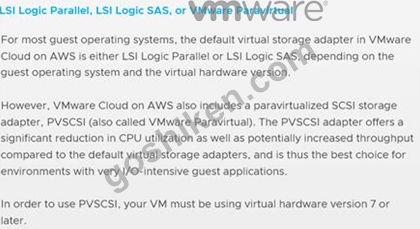
https://docs.vmware.com/en/VMware-Cloud-on-AWS/services/vmc-aws-performance.pdf VMware Cloud on AWS also includes a paravirtualized SCSI storage adapter, PVSCSI (also called VMware Paravirtual). The PVSCSI adapter offers a significant reduction in CPU utilization as well as potentially increased throughput compared to the default virtual storage adapters, and is thus the best choice for environments with very I/O-intensive guest applications. In order to use PVSCSI, virtual machine must be using virtual hardware version 7 .or later https://docs.vmware.com/en/VMware-Cloud-on-AWS/services/vmc-aws-performance.pdf
質問 # 57
Refer to the exhibit.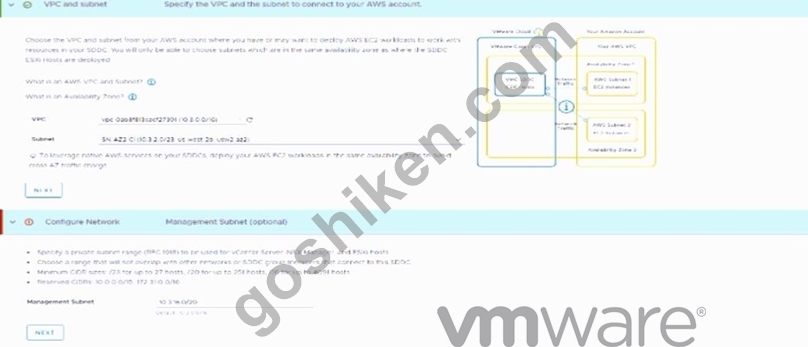
A cloud administrator is deploying a new VMware Cloud on AWS virtual private cloud (VPC). After clicking on deploy, the screen refreshes and displays the information that is provided in the exhibit.
What is the issue with the management CIDR that is causing the deployment to fall?
- A. It is an invalid size.
- B. It overlaps with the AWS VPC CIDR.
- C. It overlaps with the AWS subnet.
- D. It is part of the reserved CIDRs.
正解:C
解説:
https://docs.aws.amazon.com/whitepapers/latest/sddc-deployment-and-best-practices/deploying-vmware-cloud-on-aws-sddc.htmlThis must be a RFC1918 private address space (10.0.0.0/8, 172.16.0.0/12, or 192.168.0.0/16) with CIDR block sizes of /16, /20, or /23. The management CIDR block cannot be changed after the SDDC is deployed. Choose a range of IP addresses that does not overlap with the AWS subnet you are connecting to. If you plan to connect the SDDC to an on-premises DC or another environment, the IP subnet must be unique within your enterprise network infrastructure. Choose a CIDR that will give you future scalability.
質問 # 58
A cloud administrator needs to configure a VM storage policy for virtual machines that will host a business critical application. The environment consists of a single cluster with six hosts. The application is storage I/O intensive and redundancy must be provided at the highest level possible.
Which VM storage policy settings should the administrator configure to meet these requirements?
- A. RAID-5
- B. RAID-1 FTT = 2
- C. RAID-1 FTT = 3
- D. RAID-6
正解:B
解説:
RAID-1 is a mirror configuration that provides high availability by creating multiple copies of a VMDK. RAID-5 and RAID-6 are erasure coding configurations that provide fault tolerance by distributing data and parity across multiple hosts.
The number of failures to tolerate (FTT) determines how many copies or parity blocks are created for each VMDK. For example, RAID-1 FTT = 2 means that there are three copies of each VMDK.
Therefore, based on your requirements, a possible VM storage policy setting could be RAID-1 FTT = 2, which would provide redundancy at the highest level possible with six hosts.
https://docs.vmware.com/en/VMware-Cloud-on-AWS/services/com.vmware.vsphere.vmc-aws-manage-data-center-vms.doc/GUID-EDBB551B-51B0-421B-9C44-6ECB66ED660B.html
質問 # 59
......
2V0-33.22PSE試験問題を今すぐ試そう!最新の[2024年最新] 正解回答付き:https://www.goshiken.com/VMware/2V0-33.22PSE-mondaishu.html
合格させる2V0-33.22PSE試験にはリアル問題解答:https://drive.google.com/open?id=1LJR8Bwb0c4zLs9iol9XADdQJfsHpiEwp