

[2025年12月05日] C_AIG_2412テストエンジンお試しセット、C_AIG_2412問題集PDF
最新のSAP C_AIG_2412のPDFと問題集で(2025)無料試験問題解答
質問 # 32
Which of the following techniques uses a prompt to generate or complete subsequent prompts (streamlining the prompt development process), and to effectively guide Al model responses?
- A. Few-shot prompting
- B. One-shot prompting
- C. Meta prompting
- D. Chain-of-thought prompting
正解:C
解説:
Meta prompting is a technique in prompt engineering where a prompt is designed to generate or refine subsequent prompts.
1. Definition and Purpose:
* Streamlining Prompt Development:Meta prompting automates the creation of effective prompts by utilizing AI to generate or enhance them, thereby streamlining the prompt development process.
* Guiding AI Model Responses:By generating refined prompts, meta prompting effectively guides AI models to produce more accurate and contextually relevant responses.
2. Application in SAP's Generative AI Hub:
* Prompt Engineering Tools:SAP's Generative AI Hub provides tools that support advanced prompt engineering techniques, including meta prompting, to enhance AI model interactions.
質問 # 33
What capabilities does the Exploration and Development feature of the generative Al hub provide? Note:
There are 2 correct answers to this question.
- A. Prompt editor and management
- B. Automatic model selection
- C. Develop and debug ABAP code
- D. Al playground and chat
正解:A、D
解説:
The Exploration and Development feature of SAP's Generative AI Hub provides several capabilities to facilitate AI solution development:
1. AI Playground and Chat:
* Interactive Environment:The AI playground offers an interactive space for developers to experiment with various AI models, test prompts, and observe outputs in real-time.
* Conversational Interface:The chat functionality enables users to engage in dialogue with AI models, refining prompts and understanding model behavior through iterative interactions.
2. Prompt Editor and Management:
* Prompt Creation:The prompt editor allows developers to craft and modify prompts tailored to specific business needs, enhancing the precision of AI responses.
* Prompt Organization:Prompt management tools facilitate the organization, versioning, and storage of prompts, ensuring efficient retrieval and reuse in various projects.
質問 # 34
Why is generative Al gaining significant attention and investment in the current business landscape? Note: There are 2 correct answers to this question.
- A. It can run entire business operations without human intervention.
- B. It lowers barriers to adoption.
- C. It only requires natural language skills to use.
- D. It can replicate complex technical skills without training or quality control.
正解:B、C
質問 # 35
Match the components of a Retrieval Augmented Generation architecture to the diagram.
正解:
解説: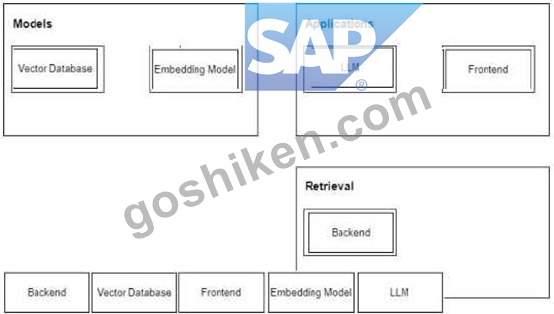
質問 # 36
Which of the following are functionalities provided by the generative-Al-hub-SDK ?
Note: There are 2 correct answers to this question.
- A. Create chat responses and embeddings
- B. Customize SAP AI Launchpad
- C. Interact with LLMs
- D. Configure SAP BTP credentials
正解:A、C
質問 # 37
What are some components of the training pipeline in SAP AI Core? Note: There are 2 correct answers to this question.
- A. Input datasets stored in a hyperscaler object store
- B. Executables that define the training process
- C. Automated deployment to Kubernetes clusters
- D. The SAP HANA database for model storage
正解:A、B
解説:
The training pipeline in SAP AI Core comprises several key components that facilitate the development and deployment of machine learning models.
1. Input Datasets Stored in a Hyperscaler Object Store:
* Data Storage:Input datasets are often stored in hyperscaler object stores, which provide scalable and secure storage solutions. These datasets serve as the foundational data for training machine learning models.
* Integration:SAP AI Core integrates with various hyperscaler object stores, allowing seamless access to training data during the model development process.
質問 # 38
Which of the following are functionalities provided by the generative-Al-hub-SDK ? Note: There are 2 correct answers to this question.
- A. Create chat responses and embeddings
- B. Customize SAP AI Launchpad
- C. Interact with LLMs
- D. Configure SAP BTP credentials
正解:A、C
解説:
The Generative AI Hub SDK offers functionalities that empower developers to:
1. Interact with Large Language Models (LLMs):
* Model Access:The SDK provides a developer-friendly way to consume foundational models available in the SAP Generative AI Hub, facilitating seamless interactions with these models.
2. Create Chat Responses and Embeddings:
* Natural Language Processing:With this SDK, developers can interact with models to create natural language completions, chat responses, and embeddings, enabling the development of sophisticated AI- driven applications.
Conclusion:
The Generative AI Hub SDK enables developers to interact with LLMs and create chat responses and embeddings, supporting the development of advanced AI functionalities within applications.
質問 # 39
You want to extract useful information from customer emails to augment existing applications in your company.
How can you use generative-ai-hub-sdk in this context?
- A. Generate random email content and send them to customers.
- B. Generate a new SAP application based on the mail data.
- C. Train custom models based on the mail data.
- D. Generate JSON strings based on extracted information.
正解:D
解説:
The generative-ai-hub-sdk in SAP's Generative AI Hub enables developers to interact with large language models (LLMs) for various tasks, including information extraction and data formatting.
1. Extracting Information from Customer Emails:
* Natural Language Processing (NLP):By leveraging LLMs, the SDK can process unstructured email content to identify and extract pertinent information, such as customer inquiries, sentiments, or intents.
2. Generating JSON Strings:
* Structured Data Output:After extracting the necessary information, the SDK can format the data into JSON strings. This structured format is essential for integrating the extracted information into existing applications, facilitating seamless data exchange and processing.
3. Integration into Existing Applications:
* Application Enhancement:The JSON-formatted data can be utilized to augment existing applications, such as customer relationship management (CRM) systems, by providing insights derived from customer emails, thereby improving decision-making and customerinteractions.
質問 # 40
Which of the following are grounding principles included in SAP's AI Ethics framework?
Note: There are 3 correct answers to this question.
- A. Maximize business profits
- B. Avoid bias and discrimination
- C. Transparency and explainability
- D. Human agency and oversight
- E. Store all user data for legal proceedings
正解:B、C、D
質問 # 41
Which of the following capabilities does the generative Al hub provide to developers? Note: There are 2 correct answers to this question.
- A. Code generation to extend SAP BTP applications
- B. Proprietary LLMs exclusively
- C. Tools for prompt engineering and experimentation
- D. Integration of foundation models into applications
正解:C、D
解説:
* C. Tools for prompt engineering and experimentation:Generative AI hubs often provide tools and resources to help developers refine their prompts. This is crucial because the quality of the output from a generative AI model heavily depends on how well the prompt is crafted. These tools might include:
* Prompt libraries:Collections of effective prompts for various tasks.
* Prompt testing and analysis:Features to test different prompts and analyze the AI's response.
* Guides and tutorials:Resources to learn about prompt engineering best practices.
* D. Integration of foundation models into applications:Generative AI hubs make it easier for developers to integrate powerful foundation models (large language models like those from Google, OpenAI, etc.) into their own applications. This means developers don't have to build these complex models from scratch. Instead, they can leverage existing models and customize them for their specific needs. This might involve:
* APIs and SDKs:Providing easy-to-use interfaces to access and interact with the foundation models.
* Model customization:Tools to fine-tune existing models on specific datasets or for particular tasks.
* Deployment options:Support for deploying AI models in different environments (cloud, on- premises, etc.).
Why the other options are incorrect:
* A. Proprietary LLMs exclusively:While some generative AI hubs might offer their own proprietary models, they usually provide access to a variety of models, including open-source and those from other providers. This gives developers more flexibility and choice.
* B. Code generation to extend SAP BTP applications:While code generation is a common feature of generative AI, it's not the primary focus of a generative AI hub. The hub's main purpose is to provide access to and facilitate the use of foundation models, not to specifically extend SAP BTP applications.
質問 # 42
What contract type does SAP offer for Al ecosystem partner solutions?
- A. Pay-as-you-go for each partner service
- B. Annual subscription-only contracts
- C. Bring Your Own License (BYOL) for embedded partner solutions
- D. All-in-one contracts, with services that are contracted through SAP
正解:D
解説:
SAP collaborates with a wide ecosystem of partners, including leading general-purpose AI vendors, to provide tailored solutions to its customers. Through the SAP Store, customers have access to numerous partner applications and a variety of tools, allowing them to choose solutions that best fit their requirements.
Contractual Approach:
* All-in-One Contracts:SAP offers all-in-one contracts for AI ecosystem partner solutions, where services are white-labeled and contracted directly through SAP. This approach simplifies the procurement process for customers, as they engage with SAP as the single point of contact for both SAP and partner services.
* Exclusion of Bring Your Own License (BYOL) Model:SAP does not adopt a "bring your own license" model for these embedded partner solutions. Instead, all services are integrated and provided under unified contracts managed by SAP.
Benefits of This Contractual Model:
* Simplified Procurement:Customers benefit from a streamlined purchasing process, dealing with a single contract and point of contact for multiple services.
* Integrated Solutions:The all-in-one contract ensures that partner solutions are seamlessly integrated with SAP's offerings, providing a cohesive experience.
* Assured Compliance and Support:By contracting through SAP, customers can be confident in the compliance, security, and support standards upheld across all services.
質問 # 43
Which of the following statements accurately describe the RAG process?
Note: There are 2 correct answers to this question.
- A. The user's question is used to search a knowledge base or a set of documents.
- B. The retrieved content is combined with the LLM's capabilities to generate a response.
- C. The embedding model stores the generated answers for future reference.
- D. The LLM directly answers the user's question without accessing external information.
正解:A、B
質問 # 44
How does the Al API support SAP AI scenarios? Note: There are 2 correct answers to this question.
- A. By providing a unified framework for operating Al services
- B. By integrating Al services into business applications
- C. By managing Kubernetes clusters automatically
- D. By integrating Al models into third-party platforms like AWS
正解:A、B
解説:
The AI API in SAP plays a crucial role in supporting AI scenarios by facilitating the integration of AI services into business applications and providing a unified framework for operating these services.
1. Integration of AI Services into Business Applications:
* Seamless Integration:The AI API enables developers to incorporate AI functionalities directly into SAP and non-SAP business applications, enhancing their capabilities with intelligent features.
* Use Case Example:Integrating AI models into SAP Build Apps allows for the creation of AI-powered applications that can perform tasks such as data analysis, predictive modeling, and more.
2. Unified Framework for Operating AI Services:
* Standardized Operations:The AI API provides a consistent and standardized framework for managing AI services, ensuring uniformity in deployment, monitoring, and maintenance across different platforms.
* Scalability and Flexibility:This unified approach allows for scalable AI operations, accommodating various AI models and services within a cohesive operational structure.
質問 # 45
Why is generative Al gaining significant attention and investment in the current business landscape? Note:
There are 2 correct answers to this question.
- A. It can run entire business operations without human intervention.
- B. It lowers barriers to adoption.
- C. It only requires natural language skills to use.
- D. It can replicate complex technical skills without training or quality control.
正解:B、C
解説:
Generative AI is attracting significant attention and investment in the current business landscape due to several compelling factors:
1. Lowering Barriers to Adoption:
* Accessibility of Tools:The proliferation of user-friendly generative AI tools has made advanced AI capabilities accessible to a broader audience, including those without specialized technical expertise.
* Integration with Existing Systems:Generative AI solutions, such as SAP's Joule, are designed to integrate seamlessly with existing business systems, reducing the complexity and cost associated with adoption.
2. Natural Language Interaction:
* Ease of Use:Generative AI models are capable of understanding and processing natural language inputs, allowing users to interact with AI systems using everyday language. This reduces the need for specialized training and enables more intuitive user experiences.
* Enhanced User Engagement:The ability to communicate with AI systems in natural language fosters greater user engagement and facilitates the integration of AI into daily business operations.
質問 # 46
What is Machine Learning (ML)?
- A. A form of Al that only focuses on creating new content, including text, images, sound, and videos.
- B. A technology that equips machines with human-like capabilities such as problem-solving, visual perception, and decision-making.
- C. A subset of Al that focuses on enabling computer systems to learn and improve from experience or data.
- D. A statistical method for data processing that does not involve any Al techniques.
正解:A、B、D
質問 # 47
Which of the following steps must be performed to deploy LLMs in the generative Al hub?
- A. Run the booster
*Create service keys
*Select the executable ID - B. Provision SAP AI
*Core Create a configuration
*Run the booster - C. Check for foundation model scenario
*Create a deployment
*Configuring entitlements - D. Provision SAP AI Core
*Check for foundation model scenario
*Create a configuration
*Create a deployment
正解:D
解説:
Deploying Large Language Models (LLMs) in SAP's Generative AI Hub involves a structured process:
1. Provision SAP AI Core:
* Setup:Ensure that SAP AI Core is provisioned in your SAP Business Technology Platform (BTP) account to manage AI workloads.
2. Check for Foundation Model Scenario:
* Validation:Verify the availability of the foundation model scenario within SAP AI Core to confirm that the necessary resources and configurations are in place for deploying LLMs.
3. Create a Configuration:
* Configuration Setup:Define the parameters and settings required for the LLM deployment, including model specifications and resource allocations.
4. Create a Deployment:
* Deployment Execution:Initiate the deployment process within SAP AI Core, making the LLM available for integration and use within your applications.
質問 # 48
Which statement best describes the Chain-of-Thought (COT) prompting technique?
- A. Concatenating multiple related prompts to form a chain, guiding the model through sequential reasoning steps.
- B. Linking multiple Al models in sequence, where each model's output becomes the input for the next model in the chain.
- C. Writing a series of connected prompts creating a chain of related information.
- D. Connecting related concepts by having the LLM generate chains of ideas.
正解:A
解説:
Chain-of-Thought (CoT) prompting is a technique that involves concatenating multiple related prompts to guide a language model through a series of reasoning steps, leading to a final conclusion.
1. Structure of CoT Prompting:
* Sequential Reasoning:By breaking down a complex problem into a sequence of intermediate prompts, the model addresses each step methodically, enhancing its problem-solving capabilities.
* Logical Progression:Each prompt builds upon the previous one, ensuring a coherent flow of information that mirrors human logical reasoning.
2. Advantages of CoT Prompting:
* Enhanced Comprehension:This structured approach helps the model understand and process intricate tasks by focusing on one aspect at a time.
* Improved Accuracy:By guiding the model through detailed reasoning steps, CoT prompting reduces the likelihood of errors in the final output.
質問 # 49
What are some features of Joule?
Note: There are 3 correct answers to this question.
- A. Maintaining data privacy while offering generative Al capabilities.
- B. Downloading and processing data.
- C. Generating standalone applications.
- D. Providing coding assistance and content generation.
- E. Streamlining tasks with an Al assistant that knows your unique role.
正解:A、D、E
質問 # 50
Where can you configure language models in generative Al hub?
- A. The Orchestration tab in SAP AI Launchpad
- B. The Configuration tab of the SAP BTP cockpit
- C. The Configuration tab within ML Operations in SAP AI Launchpad
- D. The Models tab in Prompt Editor
正解:C
解説:
In SAP's Generative AI Hub, configuring language models is a crucial step for integrating AI capabilities into applications.
1. Accessing the Configuration Interface:
* ML Operations Section:Within SAP AI Launchpad, navigate to theML Operationssection to manage machine learning models and operations.
* Configuration Tab:In theConfigurationtab, you can set up and manage various aspects of language models, including selecting model providers, specifying model versions, and configuring deployment settings.
2. Steps to Configure Language Models:
* Model Selection:Choose the desired language model from the available options, such as GPT-4 or other large language models (LLMs) provided through the Generative AI Hub.
* Parameter Configuration:Set parameters like model version, input constraints, and performance settings to tailor the model's behavior to your application's requirements.
* Deployment Setup:Configure deployment details to ensure the model is accessible andintegrated appropriately within your application's infrastructure.
質問 # 51
Match the components of a Retrieval Augmented Generation architecture to the diagram.
正解:
解説:
Explanation:
A screenshot of a computer Description automatically generated
質問 # 52
What are some drivers for the rapid adoption of generative AI? Note: There are 2 correct answers to this question.
- A. Wide availability
- B. Ease of use
- C. Significant hardware cost savings
- D. Availability of skilled developers
正解:A、B
解説:
The rapid adoption of generative AI is driven by several key factors:
1. Wide Availability:
* Access to Generative AI Tools:The proliferation of generative AI tools and platforms has made the technology widely accessible to businesses and individuals. This widespread availability facilitates experimentation and integration into various applications.
2. Ease of Use:
* User-Friendly Interfaces:Modern generative AI tools often feature intuitive interfaces that require minimal technical expertise, enabling a broader range of users to leverage AI capabilities without deep technical knowledge.
質問 # 53
What is a significant risk associated with using LLMs?
- A. Potential biases in generated content
- B. Complete elimination of human oversight in content creation
- C. Unlimited processing power usage without cost control
- D. Inability to generate text in multiple languages
正解:A
解説:
A significant risk of using LLMs is the potential for biases in generated content, stemming from biases present in their training data. Option A is incorrect because LLMs do not inherently eliminate human oversight; oversight is often maintained, especially in enterprise settings like SAP's. Option B is false as LLMs can generate text in multiple languages, as seen with models like GPT-4. Option D, while a concern in terms of resource management, is not the most significant risk compared to bias, and cost control can be implemented. Option C is correct because biased outputs can lead to unfair decisions or misinformation, a risk SAP mitigates through its AI Ethics framework, which includes principles like avoiding bias and discrimination, ensuring responsible AI deployment.
質問 # 54
......
あなたを合格させるSAP Certified Associate C_AIG_2412試験問題集で2025年12月05日には66問あります:https://www.goshiken.com/SAP/C_AIG_2412-mondaishu.html
C_AIG_2412無料試験学習ガイド!(更新された66問あります):https://drive.google.com/open?id=1lLmwkGGhSsaBg39DG4bFkCsYhVgT24P7