

[2026年03月]更新のSnowflake SOL-C01実際のブレーン知能問題集
合格できるSOL-C01試験更新されたSOL-C01試験問題集PDFを獲得2026年更新
質問 # 71
A Snowflake administrator wants to use the 'TRANSLATE function from Snowflake Cortex LLM within a user-defined function (UDF).
However, they encounter a 'permission denied' error. Which of the following steps are necessary to grant the UDF the required privileges to successfully call the 'TRANSLATE function? (Select all that apply)
- A. Grant the EXECUTE MANAGED TASK' privilege to the role that owns the UDF.
- B. Grant the 'SNOWFLAKE.CORTEX.TRANSLATE function usage privilege to the role that owns the UDF.
- C. Grant the 'USAGE privilege on the schema where the UDF is defined to the role that owns the UDF.
- D. Grant the 'SNOWFLAKE.ML.FEATURE_ENGINEERING.TRANSLATE function usage privilege to the role that owns the UDF.
- E. Grant the 'USAGE privilege on the database where the UDF is defined to the role that owns the UDF.
正解:B、C
解説:
To allow a UDF to call the 'TRANSLATE' function, you need to grant usage privileges on the schema containing the UDF and the TRANSLATE function itself. You do not need to execute managed tasks or grant usage on the database. Also, TRANSLATE is part of the Snowflake Cortex namespace. Therefore the correct way to call the TRANSLATE function is to grant the usage privilege to SNOWFLAKE.CORTEX.TRANSLATE
質問 # 72
You need to implement a data governance strategy that ensures data stewards can only access specific columns within a table to perform data quality checks. The table is `RAW DATA.PUBLIC.CUSTOMER DETAILS' and you want to allow the data stewards to only see the
'CUSTOMER ID', `EMAIL', and 'PHONE NUMBER columns. Which is the most efficient and secure method to grant access?
- A. Grant SELECT privilege on the table to the 'PUBLIC' role. Revoke SELECT privilege on the columns they should not see.
- B. Create a role hierarchy where a data steward role inherits from a higher-level role that has SELECT access on the entire table.
- C. Grant SELECT privilege on the table to a custom role used by the data stewards. Use masking policies to hide the columns they should not see.
- D. Create a secure view that only includes the `EMAIL ` , and 'PHONE_NUMBER columns. Grant SELECT privilege on the secure view to a custom role used by the data stewards.
- E. Create a standard view that only includes the 'CUSTOMER ID', 'EMAIL', and 'PHONE NUMBER columns.Grant SELECT privilege on the view to a custom role used by the data stewards.
正解:D
解説:
Option B is the most secure and efficient. Secure views provide enhanced security compared to regular views, preventing potential information leakage through side-channel attacks. Secure views guarantee that data stewards only have access to the specified columns, enforcing the principle of least privilege. Masking policies (Option A) can introduce performance overhead.
Granting access to the 'PUBLIC' role (Option C) is generally not recommended for security reasons. Role hierarchy by inheriting privileges on the entire table breaks down security, as the user could switch to the parent role.
質問 # 73
A large e-commerce company is experiencing seasonal spikes in sales traffic, leading to significant increases in data ingestion and query processing. You are tasked with optimizing their Snowflake environment. Which of the following strategies BEST leverage Snowflake's elastic storage and compute capabilities to handle these fluctuating workloads efficiently and cost- effectively?
- A. Manually resize the Snowflake virtual warehouse based on anticipated peak loads at the beginning of each season and reduce it back down after the peak ends.
- B. Pre-process all incoming data into smaller, aggregated tables before loading it into Snowflake to reduce the storage footprint.
- C. Use only the X-Small virtual warehouse size, since Snowflake's cloud-based architecture distributes processing across nodes automatically without needing larger warehouses.
- D. Utilize Snowflake's auto-scaling feature for virtual warehouses to automatically adjust compute resources based on real-time demand, coupled with setting resource monitors to control spending.
- E. Rely solely on Snowflake's automatic storage scaling and ignore the virtual warehouse size, as storage is the primary bottleneck during peak seasons.
正解:D
解説:
Option B is the most effective strategy. Snowflake's auto-scaling feature automatically adjusts compute resources to match demand, ensuring optimal performance during peak periods.
Resource monitors prevent runaway costs. Option A is less efficient as it relies on manual intervention and might not react quickly enough to changing demands. Option C neglects the importance of compute scaling. Option D introduces unnecessary complexity and potential data loss. Option E will lead to poor performance during peak loads.
質問 # 74
A Snowflake architect is designing a data lake solution using Snowflake's external tables. The data lake contains JSON files stored in AWS S3. The architect needs to ensure that Snowflake can automatically discover new JSON files added to the S3 bucket and make them available for querying through the external table. Which of the following approaches provides the MOST efficient and scalable solution for automatically refreshing the external table metadata?
Schedule a daily task in Snowflake to execute 'ALTER EXTERNAL TABLE REFRESH' to manually update the metadata.
- A. Enable Snowflake's Event Tables and configure them to capture S3 events. Then, create a stream on the Event Table and a task that triggers 'ALTER EXTERNAL TABLE REFRESH' whenever a new event is detected in the stream. Requires Snowflake Enterprise Edition or higher.
- B. Use Snowflake's Snowpipe with auto-ingest configured to automatically load data from the S3 bucket into a Snowflake internal stage and then use the COPY INTO statement to load the data into a regular Snowflake table.
- C. Configure an AWS Lambda function triggered by S3 events (e.g., `s3:ObjectCreated') to execute
'ALTER EXTERNAL TABLE REFRESH' via the Snowflake API whenever a new file is added to the S3 bucket. - D. Utilize Snowflake's automatic data clustering feature on the external table based on the file creation timestamp in S3. Snowflake will automatically update the metadata when new files are detected.
正解:B
解説:
Using Event Tables (Option C) is the most efficient and scalable solution. Snowflake Event Tables are designed to capture and process events directly within Snowflake, making them ideal for this scenario. The stream and task can automatically trigger the refresh whenever a new S3 event is detected. Option A (scheduled task) is less efficient. Option B (Lambda function) adds external complexity. Option D (Snowpipe) loads data into Snowflake, not updating external table metadata. Option E (automatic data clustering) does not automatically update the metadata of external tables when new files are added.
質問 # 75
Which SQL clause is used to query historical data in Snowflake using Time Travel?
- A. RESTORE
- B. BACKUP
- C. HISTORY
- D. AT | BEFORE (TIMESTAMP => ...)
正解:D
解説:
Snowflake'sTime Travelenables querying historical data as it existed at a prior point in time. This is accomplished using theATorBEFOREclause within the FROM statement:
SELECT * FROM my_table AT (TIMESTAMP => '2025-06-18 10:00:00');
SELECT * FROM my_table BEFORE (OFFSET => -3600);
Time Travel supports access via timestamp, statement ID, or time offset. This is essential for auditing, recovery, and reconstructing past states for analysis.
Incorrect options:
* RESTOREis used to recover dropped objects, not to query history.
* BACKUPis not a Snowflake SQL clause.
* HISTORYis not a valid SQL clause.
Thus, AT | BEFORE enables precise historical queries.
質問 # 76
What are compute resources called in Snowflake?
- A. Data Nodes
- B. Virtual Machines
- C. Virtual Warehouses
- D. Compute Clusters
正解:C
解説:
Snowflake compute resources are referred to asVirtual Warehouses. A virtual warehouse is a cluster of compute nodes that executes SQL queries, performs DML operations (INSERT/UPDATE/DELETE), and runs data loading or transformation tasks.
Virtual Warehouses provide:
* Dedicated compute isolation
* Independent scaling (resize at any time)
* Concurrency support through multi-cluster mode
* Auto-suspend and auto-resume for cost efficiency
While Virtual Warehouses consist of compute clusters under the hood, Snowflake abstracts the underlying VM and node architecture, exposing only the warehouse construct to users. This ensures simplicity and avoids operational burdens such as node management.
Incorrect terms like Data Nodes or Virtual Machines represent underlying infrastructure concepts not exposed to end users.
質問 # 77
Within a Snowflake Notebook, you have defined a Python variable named 'warehouse_size' with a value of 'X-SMALL'. You want to dynamically set the warehouse size for the Snowpark session using this variable. Which of the following code snippets correctly sets the warehouse size using Python variable substitution?
- A.

- B.

- C.

- D.

- E.

正解:E
解説:
Option D, , is the correct and preferred method for changing the active warehouse within a Snowpark session. Snowpark provides a dedicated function for this purpose. Options A, B, C, and E, while they might seem to work using SQL commands, are less efficient and less Snowpark API idiomatic, or does not work as intended. In particular, options A, C, and E incur overhead of executing DDL statements and there are no direct command to execute SQL statement in session in the Snowflake.
質問 # 78
What is a key feature of custom roles in Snowflake? (Choose any 2 options)
- A. They cannot be granted to users
- B. They can be tailored to specific organizational requirements
- C. They have predefined privileges
- D. They are created by Snowflake administrators
正解:B、D
解説:
Custom roles in Snowflake allow administrators to design access patterns aligned with organizational security requirements. They are created by Snowflake administrators and do not have predefined privileges; instead, privileges must be granted explicitly. Custom roles can be assigned to users or other roles, just like system- defined roles. Thus, the key attributes are that they are created by administrators and tailored to meet specific organizational needs.
質問 # 79
A data engineer needs to create a table named 'EMPLOYEES in the `PUBLIC' schema of the database 'COMPANY DATA'. The table should store employee IDs as integers, names as strings, and hire dates as dates. Which of the following SQL statements correctly creates this table?
- A. CREATE OR REPLACE TABLE COMPANY_DATA.PUBLIC.EMPLOYEES (EmployeelD
NUMBER, Name VARCHAR(255), HireDate DATE); - B. CREATE TABLE COMPANY_DATA.PUBLIC.EMPLOYEES (EmployeelD INT, Name STRING, HireDate DATE);
- C. CREATE OR REPLACE TABLE EMPLOYEES (EmployeelD NUMBER, Name VARCHAR,
HireDate DATE); - D. CREATE TABLE EMPLOYEES (EmployeelD INTEGER, Name VARCHAR(255), HireDate DATETIME);
- E. CREATE OR REPLACE TABLE COMPANY DATA.PUBLIC.EMPLOYEES (EmployeelD INT, Name VARCHAR(255), HireDate DATE);
正解:E
解説:
The correct answer is E. It uses 'CREATE OR REPLACE to avoid errors if the table exists, specifies the full table name with database and schema ('COMPANY_DATA.PUBLIC.EMPLOYEES'), and uses appropriate data types: 'INT' for integers,
'VARCHAR(255)' for strings, and 'DATE for dates. Option A would cause errors if table already exists, Option B and C does not specify the database and schema. Option D uses NUMBER datatype.
質問 # 80
A data engineer needs to create a new external stage in Snowflake to access data stored in AWS S3. The S3 bucket is encrypted using AWS KMS. Which of the following SQL commands is the MOST SECURE and complete way to create the stage, assuming the necessary IAM role and key ARN are already known and have the appropriate Snowflake permissions?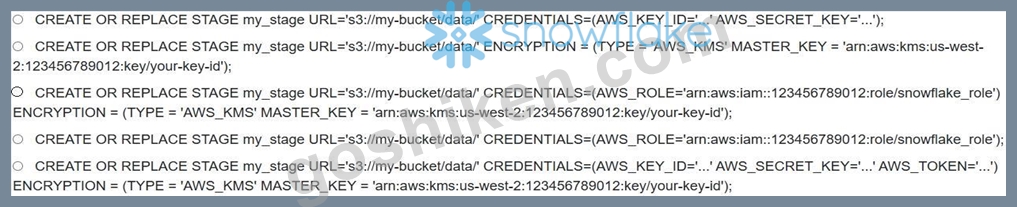
- A. Option D
- B. Option A
- C. Option C
- D. Option B
正解:C
解説:
Option C is the most secure because it uses an IAM role for authentication, which avoids storing long- term AWS keys directly in Snowflake. It also specifies the KMS encryption, which is necessary for accessing data encrypted with KMS. Option A uses AWS Keys, which is less secure. Option B doesn't provide the credentials. Option D only provides credentials with IAM role but not ENCRYPTION parameter for KMS encryption. Option E uses AWS Keys along with a token, which is still less secure than using an IAM role for authentication.
質問 # 81
You are using the 'SNOWFLAKE.ML.COMPLETE function in Snowflake Cortex to generate creative text formats, specifically poems, based on customer feedback. You have a table
'FEEDBACK' with a 'TEXT column. However, you are consistently encountering the following error: 'SQL compilation error:
Unsupported feature 'External functions". What is the MOST likely cause of this error?
- A. The 'SNOWFLAKE.ML.COMPLETE function is disabled at the account level. Requires enabling it with ALTER ACCOUNT SET ENABLE EXTERNAL FUNCTIONS-TRUE;
- B. The 'SNOWFLAKE.ML.COMPLETE function requires a minimum Snowflake edition (e.g., Enterprise), and your account is running on a lower edition.
- C. The virtual warehouse being used does not have sufficient resources allocated to it.
- D. The 'SNOWFLAKE.ML.COMPLETE function is only available in specific regions, and your Snowflake account is not in a supported region.
- E. The user executing the query lacks the necessary privileges to call external functions.
正解:A
解説:
The error `Unsupported feature 'External functions" strongly indicates that external functions are disabled at the account level. While other options might contribute to issues in other scenarios, this error message directly points to the need to enable external functions using the provided ALTER ACCOUNT statement. Snowflake Cortex ML Complete function is implemented as extemal function internally.
質問 # 82
You have created an internal stage in Snowflake named 'my_internal stage'. You want to grant the 'DATA LOADER role the privilege to read files from this stage, but NOT the privilege to write files to it.
Which of the following SQL commands will achieve this?
- A.

- B.

- C.

- D.

- E.

正解:A
解説:
The 'USAGE' privilege on a stage grants the ability to list files within the stage and read data from them. To grant the 'READ' privilege, USAGE must also be granted as a prerequisite. 'SELECT is not applicable to stages. 'USAGE ON INTEGRATION' applies to integrations, not stages directly.
'READ, WRITE' grants both read and write privileges, which is not the desired outcome.
質問 # 83
You are designing a data warehouse in Snowflake and need to implement a role-based access control (RBAC) system. You have the following requirements: A 'DATA ENGINEER role that can create and manage tables, views, and other objects in the 'RAW DATA' schema. A 'DATA ANALYST role that can query data from tables and views in the 'RAW DATA' schema and create temporary tables for their analysis. Neither role should be able to drop tables owned by the other role. Which set of SQL statements will correctly implement the desired RBAC system? (Select two that apply.)
- A.

- B.

- C.

- D.

- E.

正解:A、D
解説:
Options A and B are correct because they grant the necessary privileges to the
'DATA_ENGINEER and "DATA_ANALYST roles. Option A uses FUTURE grants to the DATA ANALYST role; any new tables created will grant select permissions automatically. Option B explicitly grants SELECT on ALL TABLES, meaning it's a one-time grant. Option C grants ownership, which allows the to drop tables created by other roles. Option D grants ALL PRIVILEGES, which allows the 'DATA ENGINEER to drop tables created by other roles. Option E grants create temporary table on SCHEMA, it has to be on DATABASE.
質問 # 84
A data engineer, Bob, created a table 'CUSTOMER DATA' in schema 'SALES SCHEMA' within the database 'ENTERPRISE_DB' Bob is leaving the company, and ownership of the table needs to be transferred to Alice. Which of the following SQL commands will correctly transfer ownership of the 'CUSTOMER DATA' table to the 'ALICE role, ensuring Alice can grant further privileges on the table to other roles?
- A.

- B.

- C.

- D.

- E.

正解:A
解説:
The correct command to transfer ownership in Snowflake is 'ALTER TABLE ... TRANSFER OWNERSHIP TO ROLE ..:. option A is a GRANT statement, not an ownership transfer. Option B is incorrect SQL syntax in Snowflake. Option C attempts to grant ownership to a user instead of a role, which isn't the requirement. Option D uses incorrect syntax, there is no SET OWNER property. Option E is the only command that correctly transfers ownership to a role.
質問 # 85
You are tasked with securing sensitive data in a table called `CUSTOMER DATA'. You want to grant the 'SELECT privilege on this table to a role called 'ANALYST ROLE, but prevent them from seeing the 'CREDIT CARD NUMBER column, which contains personally identifiable information (PII). Which of the following approaches are valid in Snowflake to achieve this?
- A. Grant `SELECT on 'CUSTOMER_DATA' to 'ANALYST_ROLE and then 'REVOKE SELECT specifically on the column.
- B. Create a view on 'CUSTOMER_DATA' that excludes the column and grant 'SELECT' on the view to 'ANALYST_ROLE.
- C. Apply a row access policy to filter out rows containing sensitive information when accessed by
'ANALYST_ROLE. - D. Use dynamic data masking on the column and grant the 'UNMASK' privilege to only specific roles other than 'ANALYST_ROLE'.
- E. Create a secure view on 'CUSTOMER DATA that excludes the 'CREDIT CARD NUMBER column and grant 'SELECT on the secure view to 'ANALYST ROLE.
正解:B、D、E
解説:
Option A is valid: Creating a view and granting 'SELECT on the view allows you to control which columns are visible to the 'ANALYST ROLE. Option B is valid: Dynamic data masking allows you to mask the sensitive column for unauthorized users (in this case, 'ANALYST_ROLE') while allowing authorized users to see the unmasked data using the 'UNMASK' privilege. Option C is invalid: You cannot revoke privileges on a specific column; privileges are granted and revoked at the table level. Option D is incorrect: Row Access Policies filter rows, not columns. Option E is valid: Secure views are the most secure way to filter the specific data.
質問 # 86
You are tasked with loading data from a large number of small CSV files (each less than IOMB) stored in an S3 bucket into a single Snowflake table. You anticipate frequent additions of new CSV files to the bucket. Which of the following approaches would provide the MOST efficient and cost-effective solution for continuously loading this data into Snowflake, while minimizing operational overhead and latency? Select all that apply.
- A. Employing a third-party ETL tool to periodically extract data from the S3 bucket, transform it, and load it into Snowflake.
- B. Creating a Snowpipe that leverages an external function to preprocess each file before loading it into the table.
- C. Using the 'COPY INTO' command with the 'VALIDATION_MODE = RETURN_ERRORS parameter to load all files in the S3 bucket on a scheduled basis using a Snowflake Task.
- D. Creating a Snowpipe that uses the 'AUTO INGEST = TRUE parameter and a notification integration configured to monitor the S3 bucket.
- E. Creating a Snowpipe with SQS integration and a dedicated compute warehouse only configured for the pipe.
正解:D、E
解説:
Snowpipe with 'AUTO_INGEST = TRUE and a notification integration (SNS/SQS) is designed for continuous loading of files from cloud storage. This is the most efficient and cost-effective solution. Batch loading with 'COPY INTO' via a Task is less responsive and incurs unnecessary costs due to scheduled execution. Third-party ETL tools add complexity and cost. While Snowpipe can use external functions, it's generally not recommended for this simple scenario and adds unnecessary overhead. For Snowpipe dedicated compute warehouse is a important point for cost effective way
質問 # 87
......
更新されたSOL-C01パスして合格保証試験問題集正確で更新された問題:https://www.goshiken.com/Snowflake/SOL-C01-mondaishu.html
SOL-C01試験知能問題集で学習ノートと理論:https://drive.google.com/open?id=1m57m4pgE9DO9TdK_t-EgyBYAT32Rq197