

AZ-220認定の有効な試験問題集解答学習ガイド!(最新の128問題)
AZ-220問題集で時間限定!無料アクセスせよ
Microsoft AZ-220 認定試験の出題範囲:
| トピック | 出題範囲 |
|---|---|
| トピック 1 |
|
| トピック 2 |
|
| トピック 3 |
|
| トピック 4 |
|
| トピック 5 |
|
| トピック 6 |
|
| トピック 7 |
|
| トピック 8 |
|
| トピック 9 |
|
| トピック 10 |
|
| トピック 11 |
|
| トピック 12 |
|
| トピック 13 |
|
| トピック 14 |
|
| トピック 15 |
|
| トピック 16 |
|
| トピック 17 |
|
| トピック 18 |
|
| トピック 19 |
|
| トピック 20 |
|
| トピック 21 |
|
| トピック 22 |
|
| トピック 23 |
|
| トピック 24 |
|
質問 12
You have an Azure subscription that contains an Azure Time Series Insights environment. The environment has the properties shown in the following table.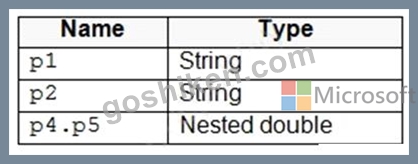
You need to create a D.
Which two time series expressions can be correctly used as part of the query? Each correct answer presents a complete solution.
NOTE: Each correct selection is worth one point.
- A. $event.p2 = 'abc'
- B. $event.p4.p5 = 0.0
- C. $event.p1.String = 'abc'
- D. $event['p1'] != NULL
正解: C,D
解説:
Example: $event['p1'] != NULL
['p1'] is the only token used. Interpreted as $event['p1'].Double != NULL Reference:
https://docs.microsoft.com/en-us/rest/api/time-series-insights/reference-time-series-expression-syntax
質問 13
You have an Azure IoT Central application.
You need to connect an IoT device to the application.
Which two settings do you require in IoT Central to configure the device? Each correct answer presents part of the solution.
NOTE: Each correct selection is worth one point.
- A. Application Name
- B. Group SAS Primary Key
- C. Device ID
- D. the IoT hub name
- E. Scope ID
正解: C,E
解説:
In your Azure IoT Central application, add a real device to the device template
1. On the Devices page, select the Environmental sensor device template.
2. Select + New.
3. Make sure that Simulated is Off. Then select Create.
Click on the device name, and then select Connect. Make a note of the device connection information on the Device Connection page - ID scope, Device ID, and Primary key. You need these values when you create your device code: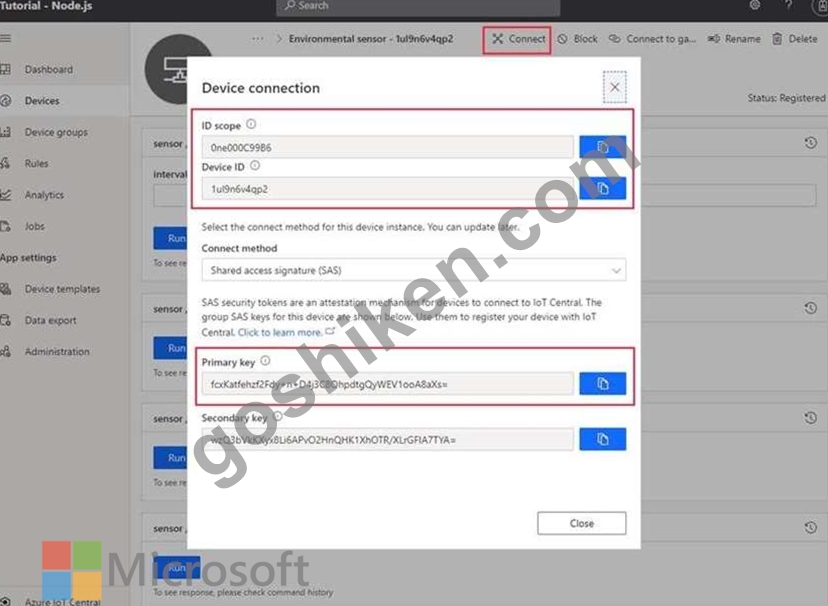
Reference:
https://docs.microsoft.com/bs-cyrl-ba/azure/iot-central/core/tutorial-connect-device-python
質問 14
You have an Azure IoT solution that contains an Azure IoT hub.
You need to ensure that the IoT hub configuration is compliant with the Health Insurance Portability and Accountability Act (HIPAA) audit logging requirements.
What should you use?
- A. Azure Monitor alerts
- B. an Azure Sentinel workspace
- C. Azure Advisor recommendations
- D. an Azure Policy definition
正解: D
解説:
Regulatory Compliance in Azure Policy provides Microsoft created and managed initiative definitions, known as built-ins, for the compliance domains and security controls related to different compliance standards, including HIPAA auditing logging.
Reference:
https://docs.microsoft.com/en-us/azure/iot-hub/security-controls-policy
質問 15
You have an Azure IoT solution.
You need to create a digital twin model.
Which language should you use?
- A. YAML
- B. XHTML
- C. DTDL
- D. XML
正解: C
解説:
Azure Digital Twins models are represented in the JSON-LD-based Digital Twin Definition Language (DTDL).
Reference:
https://docs.microsoft.com/en-us/azure/digital-twins/concepts-models
質問 16
You need to configure Stream Analytics to meet the POV requirements.
What are two ways to achieve the goal? Each Answer presents a complete solution.
NOTE: Each correct selection is worth one point.
- A. From IoT Hub, create a custom event hub endpoint, and then configure the endpoint as an input to Stream Analytics.
- B. Create an input in Stream Analytics that uses the built-in events endpoint of IoT Hub as the source.
- C. Create a Stream Analytics module, and then deploy the module to all IoT Edge devices in the fleet.
- D. Route telemetry to an Azure Blob storage custom endpoint, and then configure the Blob storage as a reference input for Stream Analytics.
正解: A,B
解説: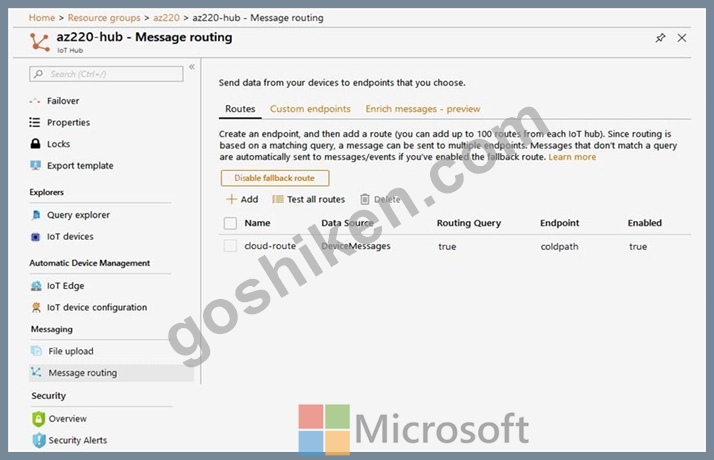
質問 17
You have 1,000 devices that connect to an Azure IoT hub.
You are performing a scheduled check of deployed IoT devices.
You plan to run the following command from the Azure CLI prompt.
az iot hub query --hub-name hub1 --query-command "SELECT * FROM devices WHERE connectionState = 'Disconnected'" What does the command return?
- A. the Device Disconnected events
- B. the device twins
- C. the Connections logs
- D. the device credentials
正解: B
解説:
Device twin queries: IoT Hub exposes the device twins as a document collection called devices. For example, the following query retrieves the whole set of device twins:
SELECT * FROM devices
Reference:
https://docs.microsoft.com/en-us/azure/iot-hub/iot-hub-devguide-query-language#device-and-module-twin- queries
質問 18
How should you complete the GROUP BY clause to meet the Streaming Analytics requirements?
- A. GROUP BY SessionWindow(Second, 30, 60)
- B. GROUP BY SlidingWindow(Second, 30)
- C. GROUP BY TumblingWindow(Second, 30)
- D. GROUP BY HoppingWindow(Second, 60, 30)
正解: C
解説:
Scenario: You plan to use a 30-second period to calculate the average temperature reading of the sensors.
Tumbling window functions are used to segment a data stream into distinct time segments and perform a function against them, such as the example below. The key differentiators of a Tumbling window are that they repeat, do not overlap, and an event cannot belong to more than one tumbling window.
InAnswers:
A: Hopping window functions hop forward in time by a fixed period. It may be easy to think of them as Tumbling windows that can overlap, so events can belong to more than one Hopping window result set.
Reference:
https://docs.microsoft.com/en-us/azure/stream-analytics/stream-analytics-window-functions
質問 19
You need to recommend the format of telemetry messages to meet the POV requirements.
What should you recommend?
- A. JSON
- B. XML
- C. Avro
正解: A
解説:
Scenario: POV Requirements
Ensure that all message content during this phase is human readable to simplify debugging.
Avro uses a binary format, so it is not human readable.
The more lightweight JSON (Javascript object notation) has become a popular alternative to XML for various reasons. A couple obvious ones are:
Less verbose- XML uses more words than necessary
JSON is faster- Parsing XML software is slow and cumbersome.
Reference:
https://blog.cloud-elements.com/json-better-xml
質問 20
You have an Azure IoT solution that includes several Azure IoT hubs.
A new alerting feature was recently added to the IoT devices. The feature uses a new device twin reported property named alertCondition.
You need to send alerts to an Azure Service Bus queue named MessageAlerts. The alerts must include alertCondition and the name of the IoT hub.
Which two actions should you perform? Each Answer presents part of the solution.
NOTE: Each correct selection is worth one point.
- A. Add the following message enrichments:
Name = iotHubName Value = $iothubname
Endpoint = MessageAlert - B. Add the following message enrichments:
Name = iotHubName
Value = $twin.tag.location
Endpoint = MessageAlert - C. Create an IoT Hub routing rule that has a data source of Device Telemetry Messages and select the endpoint for MessageAlerts.
- D. Configure File upload for each IoT hub. Configure the device to send a file to an Azure Storage container that contains the device name and status message.
- E. Create an IoT Hub routing rule that has a data source of Device Twin Change Events and select the endpoint for MessageAlerts.
正解: A,B
解説:
B: Message enrichments is the ability of the IoT Hub to stamp messages with additional information before the messages are sent to the designated endpoint. One reason to use message enrichments is to include data that can be used to simplify downstream processing. For example, enriching device telemetry messages with a device twin tag can reduce load on customers to make device twin API calls for this information.
D: Applying enrichments
The messages can come from any data source supported by IoT Hub message routing, including the following examples:
-->device twin change notifications -- changes in the device twin device telemetry, such as temperature or pressure device life-cycle events, such as when the device is created or deleted Reference:
https://docs.microsoft.com/en-us/azure/iot-hub/iot-hub-message-enrichments-overview
質問 21
You have 100 devices that connect to an Azure IoT hub named Hub1. The devices connect by using a symmetric key.
You deploy an IoT hub named Hub2.
You need to migrate 10 devices from Hub1 to Hub2. The solution must ensure that the devices retain the existing symmetric key.
What should you do?
- A. Disable the 10 devices on Hub1. Update the endpoint of the 10 devices to use Hub2.
- B. Recreate the device identity on Hub2. Update the endpoint of the 10 devices to use Hub2.
- C. Add a desired property to the device twin of Hub2. Update the endpoint of the 10 devices to use Hub2.
- D. Add a desired property to the device twin of Hub1. Recreate the device identity on Hub2.
正解: D
解説:
Desired properties. Used along with reported properties to synchronize device configuration or conditions. The solution back end can set desired properties, and the device app can read them. The device app can also receive notifications of changes in the desired properties.
Reference:
https://docs.microsoft.com/en-us/azure/iot-hub/iot-hub-devguide-device-twins
質問 22
You have an Azure IoT solution that includes an Azure IoT hub, a Device Provisioning Service instance, and 1,000 connected IoT devices. The IoT devices are allocated to tour enrollment groups. Each enrollment group is configured to use certificate attestation.
You need to decommission all the devices in a single enrollment group and the enrollment group itself.
Which three actions should you perform in sequence? To answer, move the appropriate actions from the list of actions to the answer area and arrange them in the correct order.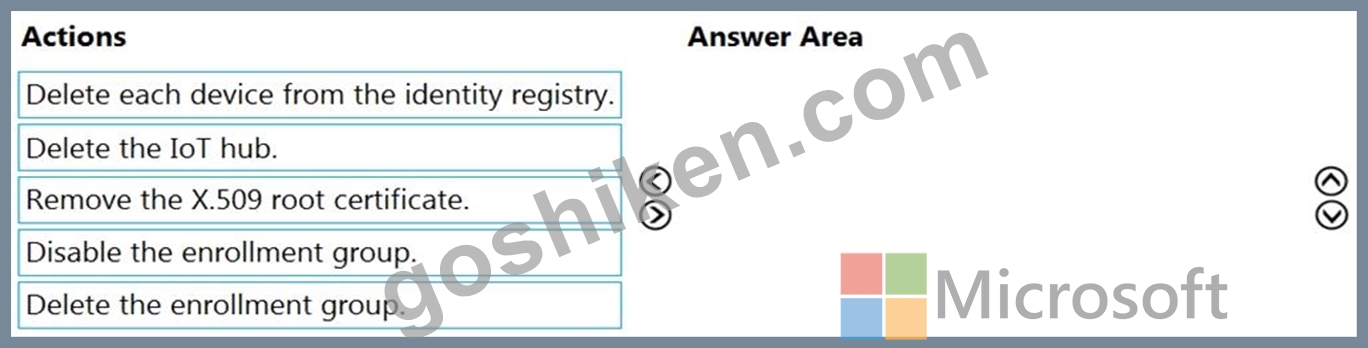
正解:
解説: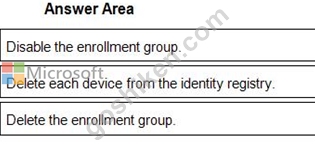
1 - Disable the enrollment group.
2 - Delete each device from the identity registry.
3 - Delete the enrollment group.
Reference:
https://docs.microsoft.com/en-us/azure/iot-dps/how-to-unprovision-devices
質問 23
You have an Azure subscription that contains an Azure IoT hub, an Azure IoT Edge gateway, and 1,000 leaf devices. The leaf devices use a custom communication protocol that is NOT supported by the IoT hub.
You need to configure the gateway to meet the following requirements:
Minimize the number of connections between the gateway and the IoT hub.
Support addressing cloud-to-device messages to individual leaf devices.
How should you configure the gateway? To answer, select the appropriate options in the answer area.
NOTE: Each correct selection is worth one point.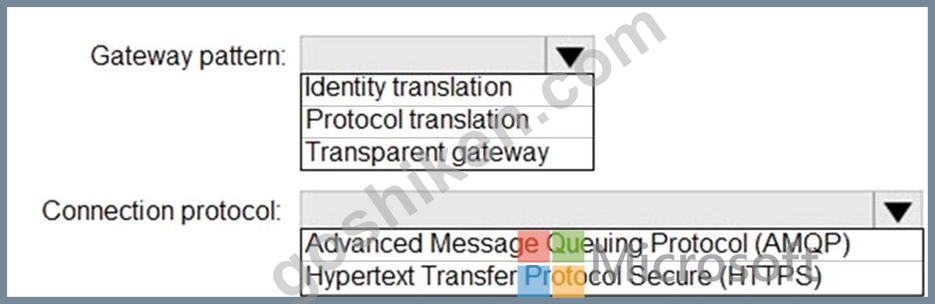
正解:
解説: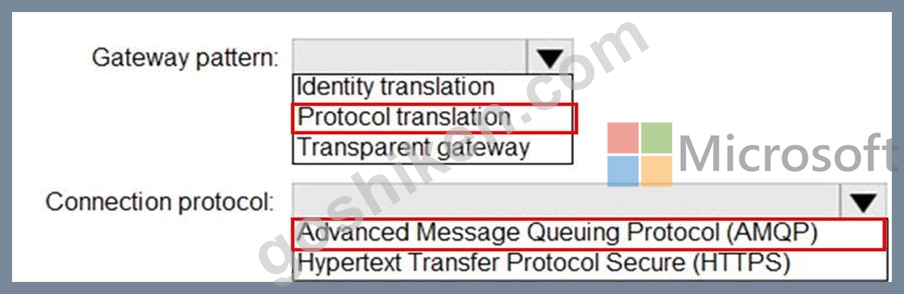
Reference:
https://docs.microsoft.com/en-us/azure/iot-edge/iot-edge-as-gateway
質問 24
You have an Azure IoT hub.
You plan to implement IoT Hub events by using Azure Event Grid.
You need to send an email when the following events occur:
* Device Created
* Device Deleted
* Device Connected
* Device Disconnected
Which two actions should you perform? Each correct answer presents part of the solution.
NOTE: Each correct selection is worth one point.
- A. Create an Azure logic app that has a Request trigger.
- B. From the IoT hub, configure an event subscription that has Web Hook as the Endpoint Type.
- C. From the IoT hub, configure an event subscription that has API management as the Endpoint Type.
- D. From the IoT hub, configure an event subscription that has Service Bus Queue as the Endpoint Type.
正解: A,B
解説:
For non-telemetry events like DeviceConnected, DeviceDisconnected, DeviceCreated and DeviceDeleted, the Event Grid filtering can be used when creating the subscription.
C: Azure Event Grid enables you to react to events in IoT Hub by triggering actions in your downstream business applications.
A trigger, such as a Request trigger, is a specific event that starts your logic app.
Reference:
https://docs.microsoft.com/en-us/azure/event-grid/publish-iot-hub-events-to-logic-apps
質問 25
You have 100 devices that connect to an Azure IoT hub named Hub1. The devices connect by using a symmetric key.
You deploy an IoT hub named Hub2.
You need to migrate 10 devices from Hub1 to Hub2. The solution must ensure that the devices retain the existing symmetric key.
What should you do?
- A. Disable the 10 devices on Hub1. Update the endpoint of the 10 devices to use Hub2.
- B. Recreate the device identity on Hub2. Update the endpoint of the 10 devices to use Hub2.
- C. Add a desired property to the device twin of Hub2. Update the endpoint of the 10 devices to use Hub2.
- D. Add a desired property to the device twin of Hub1. Recreate the device identity on Hub2.
正解: D
解説:
Desired properties. Used along with reported properties to synchronize device configuration or conditions. The solution back end can set desired properties, and the device app can read them. The device app can also receive notifications of changes in the desired properties.
Reference:
https://docs.microsoft.com/en-us/azure/iot-hub/iot-hub-devguide-device-twins Provision and manage devices Question Set 1
質問 26
You have three Azure IoT hubs named Hub1, Hub2, and Hub3, a Device Provisioning Service instance, and an IoT device named Device1.
Each IoT hub is deployed to a separate Azure region. Device enrollment uses the Lowest latency allocation policy.
The Device Provisioning Service uses the Lowest latency allocation policy. Device1 is auto-provisioned to Hub1 by using the Device Provisioning Service. Device1 regularly moves between regions.
You need to ensure that Device1 always connects to the IoT hub that has the lowest latency. What should you do?
- A. Disenroll and reenroll Device1.
- B. Implement device certificate rolling.
- C. Configure device attestation that uses X.509 certificates.
- D. Configure the re-provisioning policy.
正解: D
質問 27
......
Microsoft AZ-220試験実践テスト問題:https://www.goshiken.com/Microsoft/AZ-220-mondaishu.html
AZ-220問題集で2022年最新のMicrosoft AZ-220試験問題:https://drive.google.com/open?id=1W1fRXrlsytp-DPUVmm-XAryQWIfHbzuX