

PDF無料ダウンロードにはL4M5有効な練習テスト問題
L4M5テストエンジンお試しセット、L4M5問題集PDF
質問 # 121
Which of the following isthe definition of safety margin?
- A. The amount of revenue that remains after subtracting costs directly associated with production
- B. The production level at which total revenues for a product equal total expenses
- C. The incremental money generated for each product/unit sold after deducting the variable costs
- D. The difference between current or forecasted sales and sales at the break-even point
正解:D
解説:
As a financial metric, the margin of safety (safety margin) is equal to the difference between current or forecasted sales and sales at the break-even point. The margin of safety is sometimes reported as a ratio, in which the aforementioned formula is divided by current or forecasted sales to yield a percentage value. The figure is used in both break-even analysis and forecasting to inform a firm's management of the existing cushion in actual sales or budgeted sales before the firm would incur a loss.
This is a question that a student met in her actual exam. The margin of safety is not even mentioned in the CIPS study guide.
質問 # 122
Which of the following are examples of variable costs?
- A. 1 and 4 (Building and site rent and Delivery costs for materials)
- B. 3 and 4 (Raw materials expenditure and Delivery costs for materials)
- C. 1 and 3 (Building and site rent and Raw materials expenditure)
- D. 2 and 3 (Annual insurance premium and Raw materials expenditure)
正解:B
質問 # 123
A procurement professional is preparing for a negotiation with supplier. She is setting targets for price which her company is seeking to achieve. Which of the following acronyms can help her identify limits before engaging in the negotiation?
- A. TIMWOOD
- B. RAQSCI
- C. MIL
- D. PPCA
正解:C
解説:
:
MIL criteria indicate 3 limits that negotiator should establish:
M - Must achieve: minimum target/maximum you can concede on this point; the mandatory requirement or fall back position I - Intend to achieve: realistic target you are aiming for on this point L - Like to achieve: stretch target to achieve on this point.
PPCA is purchase cost analysis
TIMWOOD indicates 7 types of waste in Lean principles
The RAQSCI model is a mnemonic summary of a business model used to define and structure business requirements
質問 # 124
Distributive approach in negotiation is typified by which of the following?
- A. Distributive approaches are inherently inferior to integrative approaches in commercial negotiation
- B. Both parties share 50:50 of the 'pie'
- C. Each party attempts to maximise the value obtained at other's expense
- D. Both parties understand each other's goals
正解:C
解説:
:
Distributive approach to negotiation used when the interested parties are attempting to divide something up or distribute something of value, also known as zero-sum approach or win-lose. Commercial situations often demand a distributive bargaining approach, if the 'pie' is inherently of a fixed size. In this case, any conflicts must be resolved by sharing it.
In win-lose approach, a negotiator wants to maximise the value obtained in a single deal, the relationship with the other party is not important. Therefore, a strong party may win more than 50% of the metaphorical 'pie'.
It should not be assumed that win-win can be applied to all commercial negotiations, or that win-lose approaches are inherently inferior.
質問 # 125
Which of the following is the true statement?
- A. Commercial negotiation objectives should be driven by just the instincts of procurement
- B. External stakeholders such as suppliers can largely influence an organisation's procurement negotiations
- C. Internal stakeholder support will be important for both negotiation and contract performance
- D. All connected stakeholders have a low level of impact on procurement negotiations
正解:C
解説:
:
Internal stakeholder support will be important not just at the initial negotiation of the contract, but potentially throughout the life of the contract right through to exit.
As a general rule, connected stakeholders (with the exception of suppliers) have a low level of influence on procurement negotiations.
Suppliers are connected stakeholders who have contractual relationships with the organisation.
Commercial negotiation objective should be driven by the business needs of the organisation, and not just the instinct of procurement.
質問 # 126
Freefields Housing Authority (FHA) is a housing provider that has outsourced a range of management services using fixed-price long-term contracts. FHA's regular supplier credit reviews have identified that some key outsourced service suppliers are at risk of insolvency due to high inflation rates observed in the macroeconomic climate. Which of the following actions would enable FHA to reduce this risk for the lifetime of the affected contracts?
- A. Allow affected suppliers to review and resubmit their fixed costs
- B. Introduce indexation of contracts linked to the Consumer Prices Index
- C. End the contracts and procure the services
- D. Offer advance payment terms to the affected suppliers
正解:B
質問 # 127
Which of the following are most likely to be fundamentals of Fisher & Ury's principled negotiation?
1. Depersonalise the argument
2. Focus on positions
3. Generate creative options
4. Using subjective criteria
- A. 2 and 4 only
- B. 1 and 3 only
- C. 2 and 3 only
- D. 1 and 4 only
正解:B
解説:
Principled negotiation is based on four fundamentals: people, interest, options and criteria: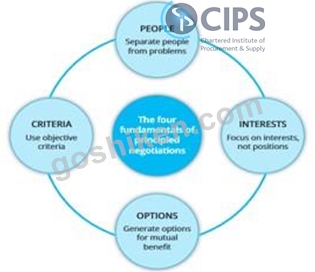
Diagram Description automatically generated
1st Principle: separate the people from the problem: Negotiator should depersonalise the situation and accepting that the subject matter of the negotiation. This can be difficult for untrained negotiators, but this is a key skill to develop
2nd principle: focus on interests, not positions: It is important in principled negotiations not to focus on their parties' positions (what are expressed during negotiations), but on the interests (underlying needs) behind them
3rd principle: invent options for mutual gains: this principle aims to help the parties find a solution that both would benefit from. The more options - or tradeables - that can be brought to the table the better.
4th principle: insist on using objective criteria: is about making sure that the negotiation stays focused on outcomes based on objective criteria and that it is productive.
LO 1, AC 1.2
質問 # 128
Which of the following are most likely to be sources of conflict that can emerge from the process of commercial negotiations? Select TWO that apply.
- A. Types of purchase
- B. Standard terms and conditions
- C. Differences in culture
- D. Differences in conflict management style
- E. Line of the best fits
正解:C、D
解説:
There are multiple sources of divergent positions that can arise in situations where money is exchange for goods and services. There are 2 different types of sources. Those that arise from the content or subject matter of the negotiation (what is being negotiated) and those that arise from the process of negotiation (how it is being negotiated).
Sources of divergent positions - the process of negotiation:
Table Description automatically generated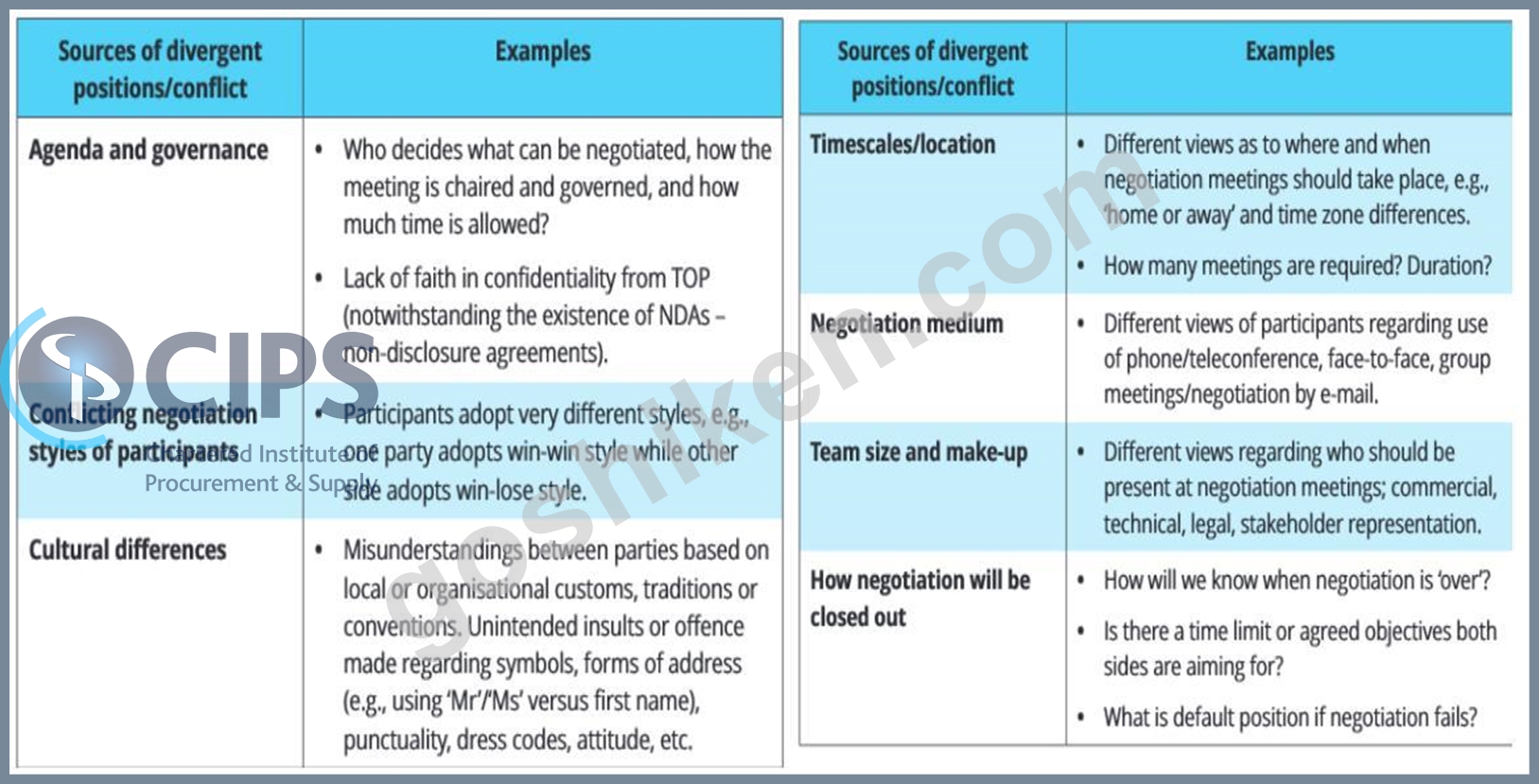
Line of best fits is the line that goes approximately through the middle of the data points with an equal number of data points above and below it. Line of best fits is a method of calculating medium value instatistics.
Standard terms and conditions are basic terms and conditions of business governing transactions that do not have a definitive contract, usually designed to be included in form documents such as orders. While there may be conflicts regarding standard terms and conditions, they are about the content of negotiation, not the process.
Type of purchase: when buying organisation makes an decision to purchase an item, a buyer is faced with three possible scenarios. The item to be bought could be a straight re-buy, a modified re-buy or a new purchase. Decision on type of purchase is purely an internal decision.
質問 # 129
The buyer's bargaining power tends to be relatively higher than supplier's bargaining power in which of the following circumstances?
- A. The buyer demand is so urgent that it can't be postponed
- B. The buyer does not have the option to move to an alternative supplier
- C. The buyer's spend takes up a small proportion of supplier revenue
- D. The buyer is large in size relative to its suppliers
正解:D
解説:
:
Buyer power gives customers/consumers (buyers) the ability to squeeze industry margins by pressuring firms (the suppliers) to reduce prices or increase the quality of services or products offered.
There are four major factors to consider when determining the bargaining power of buyers:
1. Number of buyers relative to suppliers: If the number of buyers is small relative to that of suppliers, the buyer's power will be stronger.
2. Dependence of a buyer's purchase on a particular supplier: If a buyer is able to get similar products
/services from other suppliers, buyers depend less on a particular supplier. Therefore, the power of the buyer would be greater.
3. Switching costs: If there are not many alternative suppliers available, the cost of switching is high.
Therefore, buyer power would be low.
4. Backward Integration: If the buyer is able to integrate or merge suppliers, the buyer has greater bargaining power over the existing suppliers.
When is Bargaining Power of Buyers High/Strong?
There are fewer buyers relative to that of suppliers
The switching costs of the buyer are low
If the buyer is able to backward integrate
The buyer purchases product in bulk (high volume)
The buyer is able to get similar product/services from other suppliers
The buyer purchases the majority of the seller's products
Several substitutes are available on the market
Product is not differentiated
質問 # 130
During a negotiation, the supplier requests for payment term shortened to 45days from 60 days. Seeing that this proposal lies within the concession plan, the procurement manager asks for 5% discount in return. Is that right thing to do?
- A. Yes, since procurement manager has his own cost savings target to achieve and he should make use of supplier's financial status
- B. No, it is unethical to exploit the weakness of the other party
- C. No, procurement should insist the payment term remains 60 days
- D. Yes, the procurement manager should keep that 5% for himself because that amount is a fair compensation for his effort
正解:A
解説:
Explanation
When preparing for a negotiation, negotiator should establish a list of tradeables and a concession plan. Good negotiators never give anything away that has not already been planned as part of the bargaining mix in the concession planning stage.
In the above scenario, the procurement manager has planned his own concession, so he can trade with supplier. The answer should be "Yes, since procurement manager has his own cost savings target to achieve and he should make use of supplier's financial status" Table Description automatically generated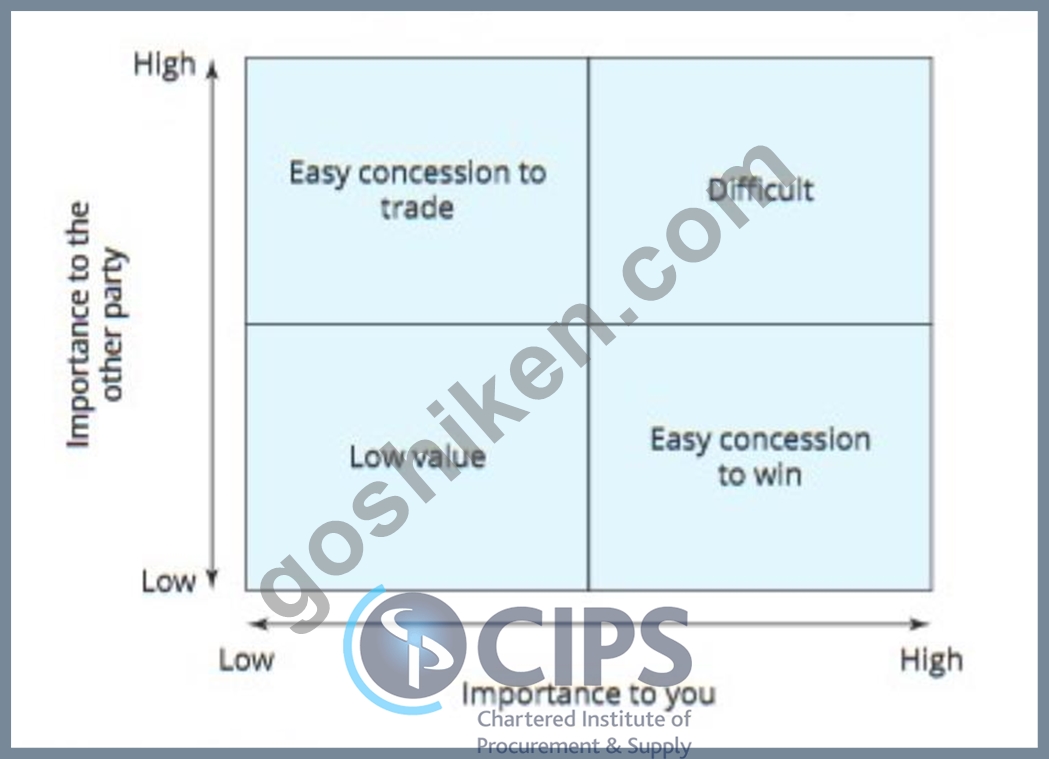
LO 2, AC 2.3
質問 # 131
Which of the following are internal factors when a supplier is making its pricing decision?
Price elasticity of demand
Environmental legislation
Risk management
The stage in the product life cycle
- A. 3 and 4 only
- B. 1 and 2 only
- C. 2 and 3 only
- D. 1 and 4 only
正解:A
解説:
Risk management (3) and the stage in the product life cycle (4) are internal factors within the supplier's control and directly influence pricing decisions. These internal factors guide strategic pricing policies. In contrast, price elasticity of demand and environmental legislation are external factors, as per CIPS's guidelines on pricing influences.
質問 # 132
In airline industry, suppliers prefer to adopt dynamic pricing in order to constantly monitor and change their fares in response to market conditions. Dynamics pricing is based on which costing method?
- A. Cost plus costing
- B. Marginal costing
- C. Absorption costing
- D. Activity-based costing
正解:B
解説:
:
Dynamic pricing is the practice of dynamically calculating the price of a product or service in order to incorporate real-time market conditions, input costs, and/or competitive perspectives. Dynamic pricing which is based on marginal costing, is used by airlines and many other organisations.
Marginal cost is the cost of producing an additional unit of output. Marginal Costing is a costing technique wherein the marginal cost, i.e. variable cost is charged to units of cost, while the fixed cost for the period is completely written off against the contribution.
質問 # 133
Which of the following are hardball tactics in negotiations? Select TWO that apply.
- A. Snow job
- B. Bridging
- C. Expand the pie
- D. Sweetening the deal
- E. Good cop, bad cop
正解:A、E
解説:
In difficult negotiations and disputes, hardball tactics like punishment and threats often seem like the only way to win concessions. Some negotiators seem to believe that hardball tactics are the key to success in any negotiation. They resort to extreme demands and even unethical behaviour to try to get the upper hand in a negotiation.
The following are 8 typical hardball tactics:
1. Good cop / Bad cop
2. Low ball / High ball
3. Bogey
4. The Nibble
5. Chicken
6. Intimidation
7.Aggressive Behaviour
8. Snow Job
You can read the details of each tactic here.
In the contrary to hardball tactics, negotiators can adopt integrative approach to the negotiation. Some of integrative tactics are:
1. Expand the Pie
2. Bridging
3. Post Settlement -Settlement
Et cetera
質問 # 134
Which of the following are most likely to be direct costs of a steel manufacturer? Select THREE that apply.
- A. Scrap metal
- B. Senior management salary
- C. Coal
- D. Hourly production wages
- E. Cleaning services
- F. Insurance for production lines
正解:A、C、D
解説:
:
Direct costs are those costs of a product/service directly attributable/traceable to its production. Examples of direct costs including the following:
Materials and services bought-in: In steel manufacturer, raw materials are iron ores, scrap metal, coals, etc Labour or wages: money paid to staff for the work involved in producing the product.
Other expenses: other charges incurred that can be specifically attributed to a particular product, batch or service
質問 # 135
Buyers should have the ability to analyse the costs of their purchases not only for determining their impact to their organisation's cost but also for the purpose of reducing them during commercial negotiations to contribute to the profitability of their organisation. One way of analysing costs is to classify them into direct and indirect costs. Which ONE of the following is an explanation of 'direct costs'?
- A. Costs of labour and expenses incurred directly whether or not the production fluctuates owing to demand or downtime
- B. Costs that are connected with materials and labour, excluding expenses used directly in manufacturing products
- C. Costs of materials, labour, and other expenses that are directly identified with manufactured units of a product
- D. Costs that are only related to manufacturing firms where raw materials are directly converted into specific product units
正解:C
質問 # 136
Which of the following are most likely to be fixed costs of an airline? Select TWO that apply.
- A. Advertising and promotion
- B. Purchase of aircraft
- C. Flight crew training
- D. Fuel
- E. Catering services
正解:B、C
解説:
Fixed costs (FC) are costs that do not vary with volume. To an airline once aircraft are purchased, flight crews trained and departures scheduled, costs are disproportionately fixed.
Variable costs (VC) are those which vary with the amount produced. Fuel, catering services and marketing are examples of variable.
LO 2, AC 2.1
質問 # 137
A procurement professional is preparing for a negotiation of purchasing non-critical commodity products. He knows that the product can be easily replaced by other substitutes in the market. The negotiation for these products is typified by which of the following?
- A. There will be regular structured negotiations
- B. The buyer should focus on wider costs and risk elements
- C. There will be only limited negotiation
- D. The approach must be collaborative
正解:C
解説:
With non-critical commodity products, the relationship will be transactional. Buyer should not spend too much time and effort into the negotiation.
LO 1, AC 1.4
質問 # 138
The National Schools Purchasing Forum (NSPF) is a procurement organisation that purchases goods and services on behalf of schools on a national scale. NSPF is close to concluding negotiations in a meeting with Hygienics For All (HFA) for the supply of consumables to school washrooms. Both parties have reached an agreeable position and NSPF feels it is important that they conclude the negotiation at this point. What type of questions should NSPF ask HFA to achieve this?
- A. Open questions
- B. Hypothetical questions
- C. Probing questions
- D. Closed questions
正解:D
質問 # 139
The trust is built based on the other party's professional qualifications or proven or certified technical capability or experience is known as...?
- A. Goodwill trust
- B. Contractual trust
- C. Competence trust
- D. Irrevocable Trust
正解:C
解説:
:
Trust is the expectation that the other party will behave in a predictable and mutually acceptable way. In inter- firm relationships, the presence and absence of trust can affect the level of cost in a relationship. The existence of trust is taught to lower the transaction cost in a relationship. Dr. Mari Sako identified taxonomy of 3 types of trust in commercial relationship, which is very useful from the perspective of procurement.
Contractual trust: Trust based on the contract with TOP. This is potentially the weakest source of trust if there is nothing else to base the trust on, but it is the quickest to establish.
Competence trust: Trust based on TOP's professional qualifications or proven or certified technical capability or experience.
Goodwill trust: Trust based on knowing TOP has your interest at heart and will not behave opportunistically.
This is potentially the strongest type of trust, but it takes the longest time to build.
質問 # 140
......
あなたを合格させるCIPS Level 4 Diploma in Procurement and Supply L4M5試験問題集で2025年07月19日には277問あります:https://www.goshiken.com/CIPS/L4M5-mondaishu.html
最新のCIPS L4M5PDFと問題集で(2025)無料試験問題解答:https://drive.google.com/open?id=1BT0h1XvgNFxlkDW8uTQOMtXG3YIvoGsc