

認証トレーニング010-160試験問題集テストエンジン [2026]
2026年03月21日ガイド準備で010-160試験合格
LPI 010-160試験は、40の質問で構成される複数選択試験です。候補者は、試験を完了するのに60分です。試験の合格スコアは800のうち500です。試験は複数の言語で利用でき、世界中のどのLPIテストセンターでも取得できます。
質問 # 18
What information can be displayed bytop?
- A. Existing files, ordered by their size.
- B. User accounts, ordered by the number of files.
- C. User groups, ordered by the number of members.
- D. Running processes, ordered by CPU or RAM consumption.
- E. User accounts, ordered by the number of logins.
正解:D
解説:
Explanation
The top command is a Linux command that shows the running processes on the system. It provides a dynamic real-time view of the system performance and resource usage. The top command can display various information about the processes, such as their process ID, user, priority, state, CPU and memory usage, command name, and more. The top command can also sort the processes by different criteria, such as CPU or RAM consumption, by using the interactive commands. The top command is useful for monitoring the system load and identifying the processes that are consuming the most resources. References:
* Linux Essentials Topic 104: The Linux Operating System, section 104.3: Basic features and commands of the Linux standard shells.
* Linux Essentials Topic 106: Security and File Permissions, section 106.4: Monitor and manage Linux processes.
質問 # 19
Which command adds the new usertuxand creates the user's home directory with default configuration files?
- A. useradd -m tux
- B. passwd -a tux
- C. useradd -o default tux
- D. defaultuser tux
- E. usercreate tux
正解:A
質問 # 20
Members of a team already have experience using Red Hat Enterprise Linux. For a small hobby project, the team wants to set up a Linux server without paying for a subscription. Which of the following Linux distributions allows the team members to apply as much of their Red Hat Enterprise Linux knowledge as possible?
- A. Debian GNU/Linux
- B. CentOS
- C. openSUSE
- D. Ubuntu Linux LTS
- E. Raspbian
正解:B
解説:
CentOS is a Linux distribution that is based on the source code of Red Hat Enterprise Linux (RHEL). It is a free and open-source community-supported OS that provides an enterprise-level computing platform. CentOS is fully compatible with RHEL and can run the same applications and packages. Therefore, CentOS allows the team members to apply as much of their Red Hat Enterprise Linux knowledge as possible for their hobby project. Reference:
Linux Essentials Version 1.6 Objectives1, Topic 1.1: Linux Evolution and Popular Operating Systems, Subtopic: Linux Distributions Linux Essentials Version 1.6 Exam Preparation Guide2, Section 1.1: Linux Evolution and Popular Operating Systems, Page 7 CentOS Website3, About CentOS Linux Red Hat Enterprise Linux derivatives - Wikipedia4
質問 # 21
What is true about links in a Linux file system?
- A. A symbolic link can point to a file on another file system.
- B. Only the root user can create hard links.
- C. When the target of the symbolic link is moved, the link is automatically updated.
- D. A hard link can only point to a directory and never to a file.
- E. A symbolic link can only point to a file and not to a directory.
正解:A
解説:
Explanation/Reference:
質問 # 22
Which of the following are typical services offered by public cloud providers? (Choose three correct answers.)
- A. Platform as a Service(PaaS)
- B. Infrastructure as a Service(IaaS)
- C. Software as a Service (SaaS)
- D. Graphics as a Service (GaaS)
- E. Internet as aService(IaaS)
正解:A、B、C
質問 # 23
Which files are the source of the information in the following output? (Choose two.) uid=1000 (bob) gid=1000 (bob) groups=1000 (bob), 10 (wheel), 150 (wireshark), 989 (docker), 1001 (libvirt)
- A. /etc/group
- B. /etc/passwd
- C. /var/db/users
- D. /etc/id
- E. /home/index
正解:A、B
質問 # 24
Which of the following statements are true regarding a typical shell script? (Choose two.)
- A. It is located in /usr/local/scripts/.
- B. It is located in /etc/bash/scripts/.
- C. It has the executable permission bit set.
- D. It is compiled into a binary file compatible with the current machine architecture.
- E. It starts with the two character sequence #!.
正解:C、D
質問 # 25
Which of the following commands sorts the output of the command export-logs?
- A. export-logs | sort
- B. export-logs > sort
- C. export-logs & sort
- D. export-logs < sort
- E. export-logs <> sort
正解:A
解説:
The sort command is used to sort the lines of a text file or the output of another command in alphabetical, numerical, or other order. The sort command has the following syntax: sort [options] [file...]. The file argument is the name of one or more files to be sorted. If no file is given, the sort command reads from the standard input, which is usually the keyboard or the output of another command.
The | (pipe) symbol is used to connect the output of one command to the input of another command. This allows the creation of pipelines of commands that process data sequentially. The pipe symbol has the following syntax: command1 | command2. The command1 argument is the name of the first command, whose output is sent to the input of the second command. The command2 argument is the name of the second command, which receives the output of the first command as its input.
Therefore, the command export-logs | sort sorts the output of the export-logs command in alphabetical order. The export-logs command is assumed to be a custom command that exports some logs to the standard output. The sort command receives the output of the export-logs command as its input and sorts it according to the default criteria, which is the first character of each line. The sorted output is then displayed on the screen or can be redirected to a file or another command.
The other options in the question are incorrect because they use the wrong symbols to connect the commands. The < (input redirection) symbol is used to read the input of a command from a file instead of the keyboard. The > (output redirection) symbol is used to write the output of a command to a file instead of the screen. The & (background) symbol is used to run a command in the background, which means the command does not wait for user input and allows the user to run other commands simultaneously. The <> (bidirectional redirection) symbol is used to read and write the input and output of a command from and to the same file. None of these symbols can be used to sort the output of the export-logs command. Reference:
Linux Essentials Version 1.6 Objectives: 3.2. Searching and Extracting Data from Files1 Linux Essentials Version 1.6 Exam Study Resources: Linux Essentials Manual - Chapter 9. The Power of the Command Line - 9.2. Searching and Extracting Data from Files - 9.2.1. The sort Command2 Linux Essentials Version 1.6 Exam Study Resources: Linux Essentials Manual - Chapter 9. The Power of the Command Line - 9.3. Turning Commands into a Script - 9.3.1. Pipes and Redirection2 Linux Essentials Version 1.6 Exam Study Resources: Linux Essentials Manual - Appendix A. Answers to the Exercises - Chapter 9. The Power of the Command Line - 9.2. Searching and Extracting Data from Files - Exercise 9.2.12 Linux Essentials Version 1.6 Exam Study Resources: Linux Essentials Manual - Appendix A. Answers to the Exercises - Chapter 9. The Power of the Command Line - 9.3. Turning Commands into a Script - Exercise 9.3.12
質問 # 26
Which operator in a regular expression matches the preceding character either zero or one time?
- A. *
- B. $
- C. +
- D. ?
- E. %
正解:D
解説:
Explanation
The operator that matches the preceding character either zero or one time in a regular expression is the question mark (?). This operator is also known as the optional quantifier, because it makes the preceding character or group of characters optional. For example, the regular expression colou?r matches both color and colour, because the u is optional. The question mark can also be used to modify other quantifiers, such as * (zero or more), + (one or more), or {m,n} (between m and n times), to make them non-greedy, meaning they will match the shortest possible string instead of the longest. For example, the regular expression .*? matches any character zero or more times, but as few as possible. The question mark is one of the basic regular expression operators covered in the Linux Essentials certification program from the Linux Professional Institute (LPI). References:
* Linux Essentials - Linux Professional Institute (LPI)
* Regular Expressions:Difference between 'optional occurrence' and 'zero ...
質問 # 27
Why are web browser cookies considered dangerous?
- A. Cookies support identification and tracking of users.
- B. Cookies consume significant amounts of storage and can exhaust disk space.
- C. Cookies can contain and execute viruses and malware.
- D. Cookies are always public and accessible to anyone on the internet.
- E. Cookies store critical data which is lost when a cookie is deleted.
正解:A
解説:
Explanation/Reference:
質問 # 28
Which of the following commands creates an archive file work.tarfrom the contents of the directory ./
work/?
- A. tar work > work.tar
- B. tar -create work.tgz -content ./work/
- C. tar -cf work.tar ./work/
- D. tar --new work.tar ./work/
- E. tar work.tar < ./work/
正解:C
質問 # 29
Which of the following outputs could stem from the command last?
- A. EXT4-fs (dm-7): mounted filesystem with ordered data mode. Opts: (null)
- B. 1 lsB.2 cat text.txt
3 logout
Password for user last changed at Sat Mar 31 16:38:57 EST 2018 - C. Last login: Fri Mar 23 10:56:39 2018 from server.example.com
- D. root tty2 Wed May 17 21:11 - 21:11 (00:00)
正解:D
質問 # 30
The current directory contains the following file:
-rw-r-r- 1 root exec 24551 Apr 2 12:36 test.sh
The file contains a valid shell script, but executing this file using ./test.sh leads to this error:
bash: ./test.sh: Permission denied
What should be done in order to successfully execute the script?
- A. The script should be run using #!./test. sh instead of ./test.sh.
- B. The SetUID bit should be set in the file's permissions
- C. The user executing the script should be added to the exec group.
- D. The file's extension should be changed from .sh to .bin.
- E. The execute bit should be set in the file's permissions.
正解:E
解説:
The execute bit in Linux is a permission bit that allows the user to run an executable file or enter a directory. For regular files, such as scripts or binaries, the execute bit must be set for the user to run them. For directories, the execute bit allows the user to access the files and subdirectories inside. Therefore, to successfully execute the script test.sh, the execute bit should be set in the file's permissions. This can be done by using the chmod command with the +x option, for example: chmod +x test.sh. The other options are either irrelevant or incorrect. The file's extension does not affect its executability, only its association with a program. The user executing the script does not need to be in the exec group, as long as the user has the execute permission on the file. The SetUID bit is a special permission bit that allows the user to run the file as the file's owner, regardless of the user's identity. This is not necessary for executing the script, and may pose a security risk. The #!./test.sh syntax is invalid, as the #! is used to specify the interpreter for the script, not the script itself. Reference:
Linux Essentials Version 1.6 Objectives1, Topic 1.4: Command Line Basics, Subtopic: Basic Shell Commands Linux Essentials Version 1.6 Exam Preparation Guide2, Section 1.4: Command Line Basics, Page 16 Execute vs Read bit. How do directory permissions in Linux work?3
質問 # 31
Which of the followingtaroptions handle compression? (Choose two correct answers.)
- A. -bz
- B. -z2
- C. -g
- D. -j
- E. -z
正解:D、E
解説:
Explanation
The tar command is used to create or extract compressed archive files that contain multiple files or directories.
The tar command has the following syntax: tar [options] [archive-file] [file or directory...]. The options argument specifies how the tar command should operate and what kind of compression should be used. The archive-file argument is the name of the archive file to be created or extracted. The file or directory argument is the name of one or more files or directories to be included in or extracted from the archive file.
The following are some of the common options for the tar command:
* -c: create a new archive file.
* -x: extract files from an existing archive file.
* -t: list the contents of an archive file.
* -v: show the progress of the operation.
* -f: specify the name of the archive file.
* -z: use gzip compression or decompression.
* -j: use bzip2 compression or decompression.
* -J: use xz compression or decompression.
The options -z and -j are used to handle compression with the tar command. The option -z uses the gzip program to compress or decompress the archive file, which usually has the extension .tar.gz or .tgz. The option
-j uses the bzip2 program to compress or decompress the archive file, which usually has the extension .tar.bz2 or .tbz. Both gzip and bzip2 are popular compression programs that reduce the size of files by removing redundant or unnecessary information.
For example, to create a compressed archive file called backup.tar.gz that contains the files and directories in the current directory, the following command can be used:
tar -czvf backup.tar.gz .
To extract the files and directories from the archive file backup.tar.gz to the current directory, the following command can be used:
tar -xzvf backup.tar.gz
To create a compressed archive file called backup.tar.bz2 that contains the files and directories in the current directory, the following command can be used:
tar -cjvf backup.tar.bz2 .
To extract the files and directories from the archive file backup.tar.bz2 to the current directory, the following command can be used:
tar -xjvf backup.tar.bz2
The other options in the question are not related to compression. The option -bz is invalid, as there is no such option for the tar command. The option -g is used to create or update an incremental archive file, which only contains the files that have changed since the last backup. The option -z2 is also invalid, as there is no such option for the tar command. References:
* Linux Essentials Version 1.6 Objectives: 3.1. Archiving Files on the Command Line1
* Linux Essentials Version 1.6 Exam Study Resources: Linux Essentials Manual - Chapter 9. The Power of the Command Line - 9.1. Archiving Files on the Command Line - 9.1.1. The tar Command2
* Linux Essentials Version 1.6 Exam Study Resources: Linux Essentials Manual - Appendix A. Answers to the Exercises - Chapter 9. The Power of the Command Line - 9.1. Archiving Files on the Command Line - Exercise 9.1.12
質問 # 32
A directory contains the following files: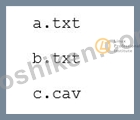
What would be the output of the following shell script?
for file in *.txt
- A. c.cav
- B. A. txt
b. txt - C. *.txt
- D. a b
- E. A.txt
正解:B
質問 # 33
Which of the following commands can be used to resolve a DNS name to an IP address?
- A. dnsname
- B. iplookup
- C. host
- D. dns
- E. query
正解:C
解説:
The host command is used to resolve a DNS name to an IP address or vice versa. It can also perform other DNS queries, such as finding the mail servers for a domain. The host command has the following syntax: host [options] [name] [server]. The name argument can be a hostname, such as www.lpi.org, or an IP address, such as 192.168.0.1. The server argument is optional and specifies the name or IP address of the DNS server to query. If no server is given, the default system resolver is used. Reference:
Linux Essentials Version 1.6 Objectives: 1.4.1. Demonstrate an understanding of the purpose and types of DNS records1 Linux Essentials Version 1.6 Exam Study Resources: Linux Essentials Manual - Chapter 10. Network Fundamentals - 10.3. DNS and Hostname Resolution - 10.3.1. The host Command2 Linux Essentials Version 1.6 Exam Study Resources: Linux Essentials Manual - Appendix A. Answers to the Exercises - Chapter 10. Network Fundamentals - 10.3. DNS and Hostname Resolution - Exercise 10.3.12
質問 # 34
Which of the following statements regarding Linux hardware drivers is correct?
- A. Drivers are not used by Linux because the BIOS handles all access to hardware on behalf of Linux.
- B. Drivers are either compiled into the Linux kernel or are loaded as kernel modules.
- C. Drivers are downloaded from the vendor's driver repository when a new device is attached.
- D. Drivers are regular Linux programs which have to be run by the user who wants to use a device.
- E. Drivers are stored on their devices and are copied by the Linux kernel when a new device is attached
正解:B
解説:
Explanation
Linux hardware drivers are software components that enable the Linux kernel to communicate with various devices, such as keyboards, mice, printers, scanners, network cards, etc. Drivers are either compiled into the Linux kernel or are loaded as kernel modules. Kernel modules are pieces of code that can be loaded and unloaded into the kernelon demand. They extend the functionality of the kernel without requiring to rebuild or reboot the system. Drivers that are compiled into the kernel are always available, but they increase the size and complexity of the kernel. Drivers that are loaded as kernel modules are only available when needed, but they require a matching version of the kernel and the module. Linux supports a large number of hardware devices, thanks to the efforts of the open source community and some vendors who provide drivers for their products.
However, some devices may not have a driver available for Linux, or may require a proprietary driver that is not included in the Linux distribution. In such cases, the user may need to install the driver manually from the vendor's website or from a third-party repository. References:
* Linux Essentials - Linux Professional Institute (LPI), section 2.2.1
* LPI Linux Essentials Study Guide: Exam 010 v1.6, 3rd Edition, chapter 3, page 67.
質問 # 35
Which of the following are typical services offered by public cloud providers? (Choose three.)
- A. Platform as a Service(PaaS)
- B. Infrastructure as a Service(IaaS)
- C. Software as a Service (SaaS)
- D. Graphics as a Service (GaaS)
- E. Internet as a Service(IaaS)
正解:A、B、C
質問 # 36
......
究極のガイド010-160認証試験準備LPI Linux Essentials:https://www.goshiken.com/Lpi/010-160-mondaishu.html
無料最新のLPI Linux Essentials 010-160リアル試験問題と解答:https://drive.google.com/open?id=1q9NzNvLzpoRla6b5dGNmM5TgjLxjxb0P