

更新された2025年03月プレミアムDatabricks-Generative-AI-Engineer-Associate試験エンジンPDFで今すぐダウンロード!無料更新された47問あります
正真正銘のDatabricks-Generative-AI-Engineer-Associate問題集には100%合格率練習テスト問題集
質問 # 28
A Generative Al Engineer has already trained an LLM on Databricks and it is now ready to be deployed.
Which of the following steps correctly outlines the easiest process for deploying a model on Databricks?
- A. Log the model as a pickle object, upload the object to Unity Catalog Volume, register it to Unity Catalog using MLflow, and start a serving endpoint
- B. Save the model along with its dependencies in a local directory, build the Docker image, and run the Docker container
- C. Log the model using MLflow during training, directly register the model to Unity Catalog using the MLflow API, and start a serving endpoint
- D. Wrap the LLM's prediction function into a Flask application and serve using Gunicorn
正解:C
解説:
* Problem Context: The goal is to deploy a trained LLM on Databricks in the simplest and most integrated manner.
* Explanation of Options:
* Option A: This method involves unnecessary steps like logging the model as a pickle object, which is not the most efficient path in a Databricks environment.
* Option B: Logging the model with MLflow during training and then using MLflow's API to register and start serving the model is straightforward and leverages Databricks' built-in functionalities for seamless model deployment.
* Option C: Building and running a Docker container is a complex and less integrated approach within the Databricks ecosystem.
* Option D: Using Flask and Gunicorn is a more manual approach and less integrated compared to the native capabilities of Databricks and MLflow.
OptionBprovides the most straightforward and efficient process, utilizing Databricks' ecosystem to its full advantage for deploying models.
質問 # 29
A Generative Al Engineer is building a RAG application that answers questions about internal documents for the company SnoPen AI.
The source documents may contain a significant amount of irrelevant content, such as advertisements, sports news, or entertainment news, or content about other companies.
Which approach is advisable when building a RAG application to achieve this goal of filtering irrelevant information?
- A. Include in the system prompt that any information it sees will be about SnoPenAI, even if no data filtering is performed.
- B. Keep all articles because the RAG application needs to understand non-company content to avoid answering questions about them.
- C. Include in the system prompt that the application is not supposed to answer any questions unrelated to SnoPen Al.
- D. Consolidate all SnoPen AI related documents into a single chunk in the vector database.
正解:C
解説:
In a Retrieval-Augmented Generation (RAG) application built to answer questions about internal documents, especially when the dataset contains irrelevant content, it's crucial to guide the system to focus on the right information. The best way to achieve this is byincluding a clear instruction in the system prompt(option C).
* System Prompt as Guidance:The system prompt is an effective way to instruct the LLM to limit its focus to SnoPen AI-related content. By clearly specifying that the model should avoid answering questions unrelated to SnoPen AI, you add an additional layer of control that helps the model stay on- topic, even if irrelevant content is present in the dataset.
* Why This Approach Works:The prompt acts as a guiding principle for the model, narrowing its focus to specific domains. This prevents the model from generating answers based on irrelevant content, such as advertisements or news unrelated to SnoPen AI.
* Why Other Options Are Less Suitable:
* A (Keep All Articles): Retaining all content, including irrelevant materials, without any filtering makes the system prone to generating answers based on unwanted data.
* B (Include in the System Prompt about SnoPen AI): This option doesn't address irrelevant content directly, and without filtering, the model might still retrieve and use irrelevant data.
* D (Consolidating Documents into a Single Chunk): Grouping documents into a single chunk makes the retrieval process less efficient and won't help filter out irrelevant content effectively.
Therefore, instructing the system in the prompt not to answer questions unrelated to SnoPen AI (option C) is the best approach to ensure the system filters out irrelevant information.
質問 # 30
A Generative AI Engineer is designing a RAG application for answering user questions on technical regulations as they learn a new sport.
What are the steps needed to build this RAG application and deploy it?
- A. Ingest documents from a source -> Index the documents and saves to Vector Search -> User submits queries against an LLM -> LLM retrieves relevant documents -> Evaluate model -> LLM generates a response -> Deploy it using Model Serving
- B. User submits queries against an LLM -> Ingest documents from a source -> Index the documents and save to Vector Search -> LLM retrieves relevant documents -> LLM generates a response -> Evaluate model -> Deploy it using Model Serving
- C. Ingest documents from a source -> Index the documents and save to Vector Search -> User submits queries against an LLM -> LLM retrieves relevant documents -> LLM generates a response -> Evaluate model -> Deploy it using Model Serving
- D. Ingest documents from a source -> Index the documents and save to Vector Search -> Evaluate model -
> Deploy it using Model Serving
正解:C
解説:
The Generative AI Engineer needs to follow a methodical pipeline to build and deploy a Retrieval- Augmented Generation (RAG) application. The steps outlined in optionBaccurately reflect this process:
* Ingest documents from a source: This is the first step, where the engineer collects documents (e.g., technical regulations) that will be used for retrieval when the application answers user questions.
* Index the documents and save to Vector Search: Once the documents are ingested, they need to be embedded using a technique like embeddings (e.g., with a pre-trained model like BERT) and stored in a vector database (such as Pinecone or FAISS). This enables fast retrieval based on user queries.
* User submits queries against an LLM: Users interact with the application by submitting their queries.
These queries will be passed to the LLM.
* LLM retrieves relevant documents: The LLM works with the vector store to retrieve the most relevant documents based on their vector representations.
* LLM generates a response: Using the retrieved documents, the LLM generates a response that is tailored to the user's question.
* Evaluate model: After generating responses, the system must be evaluated to ensure the retrieved documents are relevant and the generated response is accurate. Metrics such as accuracy, relevance, and user satisfaction can be used for evaluation.
* Deploy it using Model Serving: Once the RAG pipeline is ready and evaluated, it is deployed using a model-serving platform such as Databricks Model Serving. This enables real-time inference and response generation for users.
By following these steps, the Generative AI Engineer ensures that the RAG application is both efficient and effective for the task of answering technical regulation questions.
質問 # 31
A Generative Al Engineer would like an LLM to generate formatted JSON from emails. This will require parsing and extracting the following information: order ID, date, and sender email. Here's a sample email:
They will need to write a prompt that will extract the relevant information in JSON format with the highest level of output accuracy.
Which prompt will do that?
- A. You will receive customer emails and need to extract date, sender email, and order ID. Return the extracted information in a human-readable format.
- B. You will receive customer emails and need to extract date, sender email, and order ID. Return the extracted information in JSON format.
- C. You will receive customer emails and need to extract date, sender email, and order ID. Return the extracted information in JSON format.
Here's an example: {"date": "April 16, 2024", "sender_email": "[email protected]", "order_id":
"RE987D"} - D. You will receive customer emails and need to extract date, sender email, and order ID. You should return the date, sender email, and order ID information in JSON format.
正解:C
解説:
Problem Context: The goal is to parse emails to extract certain pieces of information and output this in a structured JSON format. Clarity and specificity in the prompt design will ensure higher accuracy in the LLM' s responses.
Explanation of Options:
* Option A: Provides a general guideline but lacks an example, which helps an LLM understand the exact format expected.
* Option B: Includes a clear instruction and a specific example of the output format. Providing an example is crucial as it helps set the pattern and format in which the information should be structured, leading to more accurate results.
* Option C: Does not specify that the output should be in JSON format, thus not meeting the requirement.
* Option D: While it correctly asks for JSON format, it lacks an example that would guide the LLM on how to structure the JSON correctly.
Therefore,Option Bis optimal as it not only specifies the required format but also illustrates it with an example, enhancing the likelihood of accurate extraction and formatting by the LLM.
質問 # 32
A Generative AI Engineer is building an LLM to generate article summaries in the form of a type of poem, such as a haiku, given the article content. However, the initial output from the LLM does not match the desired tone or style.
Which approach will NOT improve the LLM's response to achieve the desired response?
- A. Provide the LLM with a prompt that explicitly instructs it to generate text in the desired tone and style
- B. Fine-tune the LLM on a dataset of desired tone and style
- C. Include few-shot examples in the prompt to the LLM
- D. Use a neutralizer to normalize the tone and style of the underlying documents
正解:D
解説:
The task at hand is to improve the LLM's ability to generate poem-like article summaries with the desired tone and style. Using aneutralizerto normalize the tone and style of the underlying documents (option B) will not help improve the LLM's ability to generate the desired poetic style. Here's why:
* Neutralizing Underlying Documents:A neutralizer aims to reduce or standardize the tone of input data. However, this contradicts the goal, which is to generate text with aspecific tone and style(like haikus). Neutralizing the source documents will strip away the richness of the content, making it harder for the LLM to generate creative, stylistic outputs like poems.
* Why Other Options Improve Results:
* A (Explicit Instructions in the Prompt): Directly instructing the LLM to generate text in a specific tone and style helps align the output with the desired format (e.g., haikus). This is a common and effective technique in prompt engineering.
* C (Few-shot Examples): Providing examples of the desired output format helps the LLM understand the expected tone and structure, making it easier to generate similar outputs.
* D (Fine-tuning the LLM): Fine-tuning the model on a dataset that contains examples of the desired tone and style is a powerful way to improve the model's ability to generate outputs that match the target format.
Therefore, using a neutralizer (option B) isnotan effective method for achieving the goal of generating stylized poetic summaries.
質問 # 33
A Generative Al Engineer is creating an LLM system that will retrieve news articles from the year 1918 and related to a user's query and summarize them. The engineer has noticed that the summaries are generated well but often also include an explanation of how the summary was generated, which is undesirable.
Which change could the Generative Al Engineer perform to mitigate this issue?
- A. Tune the chunk size of news articles or experiment with different embedding models.
- B. Provide few shot examples of desired output format to the system and/or user prompt.
- C. Revisit their document ingestion logic, ensuring that the news articles are being ingested properly.
- D. Split the LLM output by newline characters to truncate away the summarization explanation.
正解:B
解説:
To mitigate the issue of the LLM including explanations of how summaries are generated in its output, the best approach is to adjust the training or prompt structure. Here's why Option D is effective:
* Few-shot Learning: By providing specific examples of how the desired output should look (i.e., just the summary without explanation), the model learns the preferred format. This few-shot learning approach helps the model understand not only what content to generate but also how to format its responses.
* Prompt Engineering: Adjusting the user prompt to specify the desired output format clearly can guide the LLM to produce summaries without additional explanatory text. Effective prompt design is crucial in controlling the behavior of generative models.
Why Other Options Are Less Suitable:
* A: While technically feasible, splitting the output by newline and truncating could lead to loss of important content or create awkward breaks in the summary.
* B: Tuning chunk sizes or changing embedding models does not directly address the issue of the model's tendency to generate explanations along with summaries.
* C: Revisiting document ingestion logic ensures accurate source data but does not influence how the model formats its output.
By using few-shot examples and refining the prompt, the engineer directly influences the output format, making this approach the most targeted and effective solution.
質問 # 34
A Generative AI Engineer is creating an LLM-powered application that will need access to up-to-date news articles and stock prices.
The design requires the use of stock prices which are stored in Delta tables and finding the latest relevant news articles by searching the internet.
How should the Generative AI Engineer architect their LLM system?
- A. Use an LLM to summarize the latest news articles and lookup stock tickers from the summaries to find stock prices.
- B. Create an agent with tools for SQL querying of Delta tables and web searching, provide retrieved values to an LLM for generation of response.
- C. Query the Delta table for volatile stock prices and use an LLM to generate a search query to investigate potential causes of the stock volatility.
- D. Download and store news articles and stock price information in a vector store. Use a RAG architecture to retrieve and generate at runtime.
正解:B
解説:
To build an LLM-powered system that accesses up-to-date news articles and stock prices, the best approach is tocreate an agentthat has access to specific tools (option D).
* Agent with SQL and Web Search Capabilities:By using an agent-based architecture, the LLM can interact with external tools. The agent can query Delta tables (for up-to-date stock prices) via SQL and perform web searches to retrieve the latest news articles. This modular approach ensures the system can access both structured (stock prices) and unstructured (news) data sources dynamically.
* Why This Approach Works:
* SQL Queries for Stock Prices: Delta tables store stock prices, which the agent can query directly for the latest data.
* Web Search for News: For news articles, the agent can generate search queries and retrieve the most relevant and recent articles, then pass them to the LLM for processing.
* Why Other Options Are Less Suitable:
* A (Summarizing News for Stock Prices): This convoluted approach would not ensure accuracy when retrieving stock prices, which are already structured and stored in Delta tables.
* B (Stock Price Volatility Queries): While this could retrieve relevant information, it doesn't address how to obtain the most up-to-date news articles.
* C (Vector Store): Storing news articles and stock prices in a vector store might not capture the real-time nature of stock data and news updates, as it relies on pre-existing data rather than dynamic querying.
Thus, using an agent with access to both SQL for querying stock prices and web search for retrieving news articles is the best approach for ensuring up-to-date and accurate responses.
質問 # 35
A Generative AI Engineer is building a Generative AI system that suggests the best matched employee team member to newly scoped projects. The team member is selected from a very large team. Thematch should be based upon project date availability and how well their employee profile matches the project scope. Both the employee profile and project scope are unstructured text.
How should the Generative Al Engineer architect their system?
- A. Create a tool for finding available team members given project dates. Embed all project scopes into a vector store, perform a retrieval using team member profiles to find the best team member.
- B. Create a tool for finding team member availability given project dates, and another tool that uses an LLM to extract keywords from project scopes. Iterate through available team members' profiles and perform keyword matching to find the best available team member.
- C. Create a tool to find available team members given project dates. Create a second tool that can calculate a similarity score for a combination of team member profile and the project scope. Iterate through the team members and rank by best score to select a team member.
- D. Create a tool for finding available team members given project dates. Embed team profiles into a vector store and use the project scope and filtering to perform retrieval to find the available best matched team members.
正解:D
質問 # 36
A team wants to serve a code generation model as an assistant for their software developers. It should support multiple programming languages. Quality is the primary objective.
Which of the Databricks Foundation Model APIs, or models available in the Marketplace, would be the best fit?
- A. Llama2-70b
- B. BGE-large
- C. CodeLlama-34B
- D. MPT-7b
正解:C
解説:
For a code generation model that supports multiple programming languages and where quality is the primary objective,CodeLlama-34Bis the most suitable choice. Here's the reasoning:
* Specialization in Code Generation:CodeLlama-34B is specifically designed for code generation tasks.
This model has been trained with a focus on understanding and generating code, which makes it particularly adept at handling various programming languages and coding contexts.
* Capacity and Performance:The "34B" indicates a model size of 34 billion parameters, suggesting a high capacity for handling complex tasks and generating high-quality outputs. The large model size typically correlates with better understanding and generation capabilities in diverse scenarios.
* Suitability for Development Teams:Given that the model is optimized for code, it will be able to assist software developers more effectively than general-purpose models. It understands coding syntax, semantics, and the nuances of different programming languages.
* Why Other Options Are Less Suitable:
* A (Llama2-70b): While also a large model, it's more general-purpose and may not be as fine- tuned for code generation as CodeLlama.
* B (BGE-large): This model may not specifically focus on code generation.
* C (MPT-7b): Smaller than CodeLlama-34B and likely less capable in handling complex code generation tasks at high quality.
Therefore, for a high-quality, multi-language code generation application,CodeLlama-34B(option D) is the best fit.
質問 # 37
When developing an LLM application, it's crucial to ensure that the data used for training the model complies with licensing requirements to avoid legal risks.
Which action is NOT appropriate to avoid legal risks?
- A. Use any available data you personally created which is completely original and you can decide what license to use.
- B. Reach out to the data curators directly after you have started using the trained model to let them know.
- C. Reach out to the data curators directly before you have started using the trained model to let them know.
- D. Only use data explicitly labeled with an open license and ensure the license terms are followed.
正解:B
解説:
* Problem Context: When using data to train a model, it's essential to ensure compliance with licensing to avoid legal risks. Legal issues can arise from using data without permission, especially when it comes from third-party sources.
* Explanation of Options:
* Option A: Reaching out to data curatorsbeforeusing the data is an appropriate action. This allows you to ensure you have permission or understand the licensing terms before starting to use the data in your model.
* Option B: Usingoriginal datathat you personally created is always a safe option. Since you have full ownership over the data, there are no legal risks, as you control the licensing.
* Option C: Using data that is explicitly labeled with an open license and adhering to the license terms is a correct and recommended approach. This ensures compliance with legal requirements.
* Option D: Reaching out to the data curatorsafteryou have already started using the trained model isnot appropriate. If you've already used the data without understanding its licensing terms, you may have already violated the terms of use, which could lead to legal complications. It's essential to clarify the licensing termsbeforeusing the data, not after.
Thus,Option Dis not appropriate because it could expose you to legal risks by using the data without first obtaining the proper licensing permissions.
質問 # 38
A Generative AI Engineer is building a RAG application that will rely on context retrieved from source documents that are currently in PDF format. These PDFs can contain both text and images. They want to develop a solution using the least amount of lines of code.
Which Python package should be used to extract the text from the source documents?
- A. beautifulsoup
- B. unstructured
- C. flask
- D. numpy
正解:B
解説:
* Problem Context: The engineer needs to extract text from PDF documents, which may contain both text and images. The goal is to find a Python package that simplifies this task using the least amount of code.
* Explanation of Options:
* Option A: flask: Flask is a web framework for Python, not suitable for processing or extracting content from PDFs.
* Option B: beautifulsoup: Beautiful Soup is designed for parsing HTML and XML documents, not PDFs.
* Option C: unstructured: This Python package is specifically designed to work with unstructured data, including extracting text from PDFs. It provides functionalities to handle various types of content in documents with minimal coding, making it ideal for the task.
* Option D: numpy: Numpy is a powerful library for numerical computing in Python and does not provide any tools for text extraction from PDFs.
Given the requirement,Option C(unstructured) is the most appropriate as it directly addresses the need to efficiently extract text from PDF documents with minimal code.
質問 # 39
A Generative Al Engineer interfaces with an LLM with prompt/response behavior that has been trained on customer calls inquiring about product availability. The LLM is designed to output "In Stock" if the product is available or only the term "Out of Stock" if not.
Which prompt will work to allow the engineer to respond to call classification labels correctly?
- A. Respond with "In Stock" if the customer asks for a product.
- B. Respond with "Out of Stock" if the customer asks for a product.
- C. You will be given a customer call transcript where the customer inquires about product availability.Respond with "In Stock" if the product is available or "Out of Stock" if not.
- D. You will be given a customer call transcript where the customer asks about product availability. The outputs are either "In Stock" or "Out of Stock". Format the output in JSON, for example: {"call_id":
"123", "label": "In Stock"}.
正解:D
解説:
* Problem Context: The Generative AI Engineer needs a prompt that will enable an LLM trained on customer call transcripts to classify and respond correctly regarding product availability. The desired response should clearly indicate whether a product is "In Stock" or "Out of Stock," and it should be formatted in a way that is structured and easy to parse programmatically, such as JSON.
* Explanation of Options:
* Option A: Respond with "In Stock" if the customer asks for a product. This prompt is too generic and does not specify how to handle the case when a product is not available, nor does it provide a structured output format.
* Option B: This option is correctly formatted and explicit. It instructs the LLM to respond based on the availability mentioned in the customer call transcript and to format the response in JSON.
This structure allows for easy integration into systems that may need to process this information automatically, such as customer service dashboards or databases.
* Option C: Respond with "Out of Stock" if the customer asks for a product. Like option A, this prompt is also insufficient as it only covers the scenario where a product is unavailable and does not provide a structured output.
* Option D: While this prompt correctly specifies how to respond based on product availability, it lacks the structured output format, making it less suitable for systems that require formatted data for further processing.
Given the requirements for clear, programmatically usable outputs,Option Bis the optimal choice because it provides precise instructions on how to respond and includes a JSON format example for structuring the output, which is ideal for automated systems or further data handling.
質問 # 40
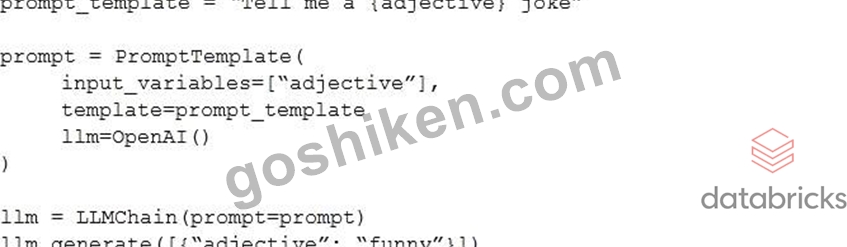
A Generative AI Engineer is testing a simple prompt template in LangChain using the code below, but is getting an error.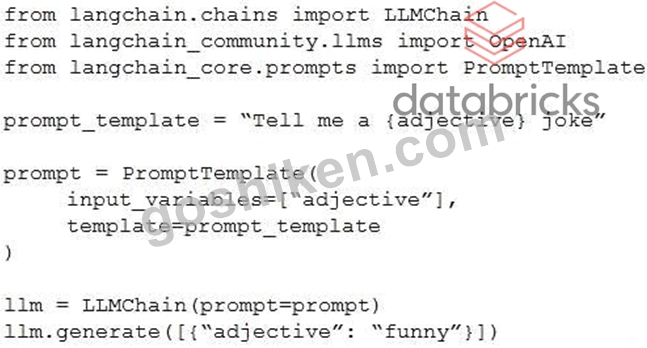
Assuming the API key was properly defined, what change does the Generative AI Engineer need to make to fix their chain?
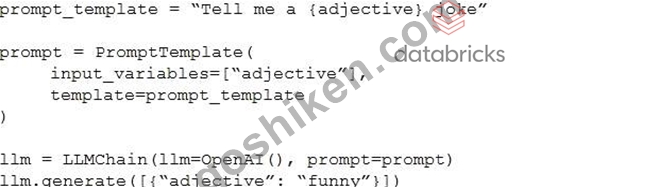
- A.
- B.
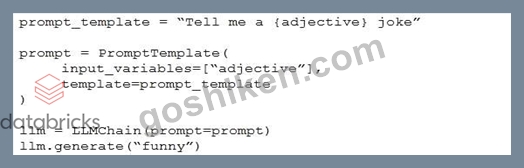
- C.
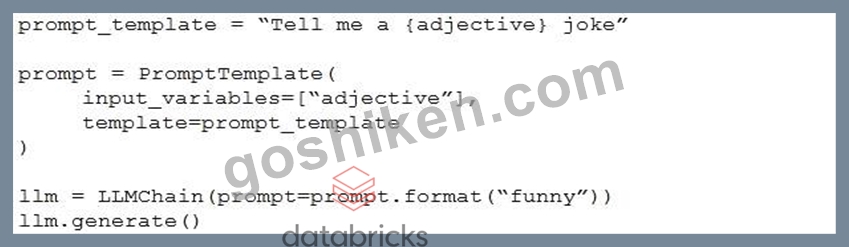
- D.
正解:D
解説:
To fix the error in the LangChain code provided for using a simple prompt template, the correct approach is Option C. Here's a detailed breakdown of why Option C is the right choice and how it addresses the issue:
* Proper Initialization: In Option C, the LLMChain is correctly initialized with the LLM instance specified as OpenAI(), which likely represents a language model (like GPT) from OpenAI. This is crucial as it specifies which model to use for generating responses.
* Correct Use of Classes and Methods:
* The PromptTemplate is defined with the correct format, specifying that adjective is a variable within the template. This allows dynamic insertion of values into the template when generating text.
* The prompt variable is properly linked with the PromptTemplate, and the final template string is passed correctly.
* The LLMChain correctly references the prompt and the initialized OpenAI() instance, ensuring that the template and the model are properly linked for generating output.
Why Other Options Are Incorrect:
* Option A: Misuses the parameter passing in generate method by incorrectly structuring the dictionary.
* Option B: Incorrectly uses prompt.format method which does not exist in the context of LLMChain and PromptTemplate configuration, resulting in potential errors.
* Option D: Incorrect order and setup in the initialization parameters for LLMChain, which would likely lead to a failure in recognizing the correct configuration for prompt and LLM usage.
Thus, Option C is correct because it ensures that the LangChain components are correctly set up and integrated, adhering to proper syntax and logical flow required by LangChain's architecture. This setup avoids common pitfalls such as type errors or method misuses, which are evident in other options.
質問 # 41
A Generative AI Engineer has created a RAG application which can help employees retrieve answers from an internal knowledge base, such as Confluence pages or Google Drive. The prototype application is now working with some positive feedback from internal company testers. Now the Generative Al Engineer wants to formally evaluate the system's performance and understand where to focus their efforts to further improve the system.
How should the Generative AI Engineer evaluate the system?
- A. Curate a dataset that can test the retrieval and generation components of the system separately. Use MLflow's built in evaluation metrics to perform the evaluation on the retrieval and generation components.
- B. Benchmark multiple LLMs with the same data and pick the best LLM for the job.
- C. Use cosine similarity score to comprehensively evaluate the quality of the final generated answers.
- D. Use an LLM-as-a-judge to evaluate the quality of the final answers generated.
正解:A
解説:
* Problem Context: After receiving positive feedback for the RAG application prototype, the next step is to formally evaluate the system to pinpoint areas for improvement.
* Explanation of Options:
* Option A: While cosine similarity scores are useful, they primarily measure similarity rather than the overall performance of an RAG system.
* Option B: This option provides a systematic approach to evaluation by testing both retrieval and generation components separately. This allows for targeted improvements and a clear understanding of each component's performance, using MLflow's metrics for a structured and standardized assessment.
* Option C: Benchmarking multiple LLMs does not focus on evaluating the existing system's components but rather on comparing different models.
* Option D: Using an LLM as a judge is subjective and less reliable for systematic performance evaluation.
OptionBis the most comprehensive and structured approach, facilitating precise evaluations and improvements on specific components of the RAG system.
質問 # 42
A Generative AI Engineer just deployed an LLM application at a digital marketing company that assists with answering customer service inquiries.
Which metric should they monitor for their customer service LLM application in production?
- A. HuggingFace Leaderboard values for the base LLM
- B. Number of customer inquiries processed per unit of time
- C. Energy usage per query
- D. Final perplexity scores for the training of the model
正解:B
解説:
When deploying an LLM application for customer service inquiries, the primary focus is on measuring the operational efficiency and quality of the responses. Here's whyAis the correct metric:
* Number of customer inquiries processed per unit of time: This metric tracks the throughput of the customer service system, reflecting how many customer inquiries the LLM application can handle in a given time period (e.g., per minute or hour). High throughput is crucial in customer service applications where quick response times are essential to user satisfaction and business efficiency.
* Real-time performance monitoring: Monitoring the number of queries processed is an important part of ensuring that the model is performing well under load, especially during peak traffic times. It also helps ensure the system scales properly to meet demand.
Why other options are not ideal:
* B. Energy usage per query: While energy efficiency is a consideration, it is not the primary concern for a customer-facing application where user experience (i.e., fast and accurate responses) is critical.
* C. Final perplexity scores for the training of the model: Perplexity is a metric for model training, but it doesn't reflect the real-time operational performance of an LLM in production.
* D. HuggingFace Leaderboard values for the base LLM: The HuggingFace Leaderboard is more relevant during model selection and benchmarking. However, it is not a direct measure of the model's performance in a specific customer service application in production.
Focusing on throughput (inquiries processed per unit time) ensures that the LLM application is meeting business needs for fast and efficient customer service responses.
質問 # 43
A Generative AI Engineer is developing a chatbot designed to assist users with insurance-related queries. The chatbot is built on a large language model (LLM) and is conversational. However, to maintain the chatbot's focus and to comply with company policy, it must not provide responses to questions about politics. Instead, when presented with political inquiries, the chatbot should respond with a standard message:
"Sorry, I cannot answer that. I am a chatbot that can only answer questions around insurance." Which framework type should be implemented to solve this?
- A. Compliance Guardrail
- B. Security Guardrail
- C. Safety Guardrail
- D. Contextual Guardrail
正解:C
解説:
In this scenario, the chatbot must avoid answering political questions and instead provide a standard message for such inquiries. Implementing aSafety Guardrailis the appropriate solution for this:
* What is a Safety Guardrail?Safety guardrails are mechanisms implemented in Generative AI systems to ensure the model behaves within specific bounds. In this case, it ensures the chatbot does not answer politically sensitive or irrelevant questions, which aligns with the business rules.
* Preventing Responses to Political Questions:The Safety Guardrail is programmed to detect specific types of inquiries (like political questions) and prevent the model from generating responses outside its intended domain. When such queries are detected, the guardrail intervenes and provides a pre-defined response: "Sorry, I cannot answer that. I am a chatbot that can only answer questions around insurance."
* How It Works in Practice:The LLM system can include aclassification layeror trigger rules based on specific keywords related to politics. When such terms are detected, the Safety Guardrail blocks the normal generation flow and responds with the fixed message.
* Why Other Options Are Less Suitable:
* B (Security Guardrail): This is more focused on protecting the system from security vulnerabilities or data breaches, not controlling the conversational focus.
* C (Contextual Guardrail): While context guardrails can limit responses based on context, safety guardrails are specifically about ensuring the chatbot stays within a safe conversational scope.
* D (Compliance Guardrail): Compliance guardrails are often related to legal and regulatory adherence, which is not directly relevant here.
Therefore, aSafety Guardrailis the right framework to ensure the chatbot only answers insurance-related queries and avoids political discussions.
質問 # 44
A Generative Al Engineer is tasked with improving the RAG quality by addressing its inflammatory outputs.
Which action would be most effective in mitigating the problem of offensive text outputs?
- A. Inform the user of the expected RAG behavior
- B. Curate upstream data properly that includes manual review before it is fed into the RAG system
- C. Increase the frequency of upstream data updates
- D. Restrict access to the data sources to a limited number of users
正解:B
解説:
Addressing offensive or inflammatory outputs in a Retrieval-Augmented Generation (RAG) system is critical for improving user experience and ensuring ethical AI deployment. Here's whyDis the most effective approach:
* Manual data curation: The root cause of offensive outputs often comes from the underlying data used to train the model or populate the retrieval system. By manually curating the upstream data and conducting thorough reviews before the data is fed into the RAG system, the engineer can filter out harmful, offensive, or inappropriate content.
* Improving data quality: Curating data ensures the system retrieves and generates responses from a high-quality, well-vetted dataset. This directly impacts the relevance and appropriateness of the outputs from the RAG system, preventing inflammatory content from being included in responses.
* Effectiveness: This strategy directly tackles the problem at its source (the data) rather than just mitigating the consequences (such as informing users or restricting access). It ensures that the system consistently provides non-offensive, relevant information.
Other options, such as increasing the frequency of data updates or informing users about behavior expectations, may not directly mitigate the generation of inflammatory outputs.
質問 # 45
Which indicator should be considered to evaluate the safety of the LLM outputs when qualitatively assessing LLM responses for a translation use case?
- A. The latency of the response and the length of text generated
- B. The accuracy and relevance of the responses
- C. The similarity to the previous language
- D. The ability to generate responses in code
正解:B
解説:
* Problem Context: When assessing the safety and effectiveness of LLM outputs in a translation use case, it is essential to ensure that the translations accurately and relevantly convey the intended message. The evaluation should focus on how well the LLM understands and processes different languages and contexts.
* Explanation of Options:
* Option A: The ability to generate responses in code- This is not relevant to translation quality or safety.
* Option B: The similarity to the previous language- While ensuring that translations preserve the original's intent is important, this doesn't directly address the overall quality or safety of the translation.
* Option C: The latency of the response and the length of text generated- These operational metrics are less critical in assessing the qualitative aspects of translation safety.
* Option D: The accuracy and relevance of the responses- This is crucial in translation to ensure that the translated content is true to the original in meaning and appropriateness. Accuracy and relevance directly impact the effectiveness and safety of translations, especially in sensitive or nuanced contexts.
Thus,Option Dis the most important indicator when evaluating the safety of LLM outputs in translation, focusing on the core aspects that determine the utility and trustworthiness of translated content.
質問 # 46
......
検証済み!合格できるDatabricks-Generative-AI-Engineer-Associate試験一発合格保証付き:https://www.goshiken.com/Databricks/Databricks-Generative-AI-Engineer-Associate-mondaishu.html
Databricks Databricks-Generative-AI-Engineer-Associateリアル試験問題保証付き 更新された問題集にはGoShiken:https://drive.google.com/open?id=1wy2xIpix7nQTk4CAaQ1kLdYVUA8jMsW_