

[2026年最新] 最高の試験Databricks-Generative-AI-Engineer-Associate問題集は無料サイトの資料を試そう
無料Generative AI Engineer Databricks-Generative-AI-Engineer-Associateオフィシャル認証ガイドPDFをダウンロード
Databricks Databricks-Generative-AI-Engineer-Associate 認定試験の出題範囲:
| トピック | 出題範囲 |
|---|---|
| トピック 1 |
|
| トピック 2 |
|
| トピック 3 |
|
質問 # 26
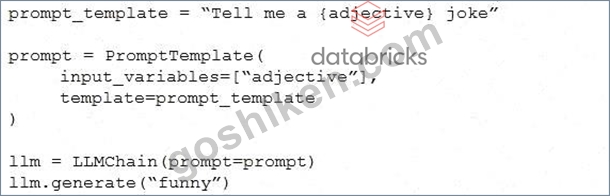
A Generative AI Engineer is testing a simple prompt template in LangChain using the code below, but is getting an error.
Assuming the API key was properly defined, what change does the Generative AI Engineer need to make to fix their chain?
- A.

- B.
- C.

- D.

正解:A
解説:
To fix the error in the LangChain code provided for using a simple prompt template, the correct approach is Option C. Here's a detailed breakdown of why Option C is the right choice and how it addresses the issue:
* Proper Initialization: In Option C, the LLMChain is correctly initialized with the LLM instance specified as OpenAI(), which likely represents a language model (like GPT) from OpenAI. This is crucial as it specifies which model to use for generating responses.
* Correct Use of Classes and Methods:
* The PromptTemplate is defined with the correct format, specifying that adjective is a variable within the template. This allows dynamic insertion of values into the template when generating text.
* The prompt variable is properly linked with the PromptTemplate, and the final template string is passed correctly.
* The LLMChain correctly references the prompt and the initialized OpenAI() instance, ensuring that the template and the model are properly linked for generating output.
Why Other Options Are Incorrect:
* Option A: Misuses the parameter passing in generate method by incorrectly structuring the dictionary.
* Option B: Incorrectly uses prompt.format method which does not exist in the context of LLMChain and PromptTemplate configuration, resulting in potential errors.
* Option D: Incorrect order and setup in the initialization parameters for LLMChain, which would likely lead to a failure in recognizing the correct configuration for prompt and LLM usage.
Thus, Option C is correct because it ensures that the LangChain components are correctly set up and integrated, adhering to proper syntax and logical flow required by LangChain's architecture. This setup avoids common pitfalls such as type errors or method misuses, which are evident in other options.
質問 # 27
After changing the response generating LLM in a RAG pipeline from GPT-4 to a model with a shorter context length that the company self-hosts, the Generative AI Engineer is getting the following error:
What TWO solutions should the Generative AI Engineer implement without changing the response generating model? (Choose two.)
- A. Decrease the chunk size of embedded documents
- B. Retrain the response generating model using ALiBi
- C. Reduce the maximum output tokens of the new model
- D. Reduce the number of records retrieved from the vector database
- E. Use a smaller embedding model to generate
正解:A、D
解説:
* Problem Context: After switching to a model with a shorter context length, the error message indicating that the prompt token count has exceeded the limit suggests that the input to the model is too large.
* Explanation of Options:
* Option A: Use a smaller embedding model to generate- This wouldn't necessarily address the issue of prompt size exceeding the model's token limit.
* Option B: Reduce the maximum output tokens of the new model- This option affects the output length, not the size of the input being too large.
* Option C: Decrease the chunk size of embedded documents- This would help reduce the size of each document chunk fed into the model, ensuring that the input remains within the model's context length limitations.
* Option D: Reduce the number of records retrieved from the vector database- By retrieving fewer records, the total input size to the model can be managed more effectively, keeping it within the allowable token limits.
* Option E: Retrain the response generating model using ALiBi- Retraining the model is contrary to the stipulation not to change the response generating model.
OptionsCandDare the most effective solutions to manage the model's shorter context length without changing the model itself, by adjusting the input size both in terms of individual document size and total documents retrieved.
質問 # 28
A Generative Al Engineer is creating an LLM-based application. The documents for its retriever have been chunked to a maximum of 512 tokens each. The Generative Al Engineer knows that cost and latency are more important than quality for this application. They have several context length levels to choose from.
Which will fulfill their need?
- A. context length 514; smallest model is 0.44GB and embedding dimension 768
- B. context length 2048: smallest model is 11GB and embedding dimension 2560
- C. context length 512: smallest model is 0.13GB and embedding dimension 384
- D. context length 32768: smallest model is 14GB and embedding dimension 4096
正解:C
解説:
When prioritizing cost and latency over quality in a Large Language Model (LLM)-based application, it is crucial to select a configuration that minimizes both computational resources and latency while still providing reasonable performance. Here's whyDis the best choice:
* Context length: The context length of 512 tokens aligns with the chunk size used for the documents (maximum of 512 tokens per chunk). This is sufficient for capturing the needed information and generating responses without unnecessary overhead.
* Smallest model size: The model with a size of 0.13GB is significantly smaller than the other options.
This small footprint ensures faster inference times and lower memory usage, which directly reduces both latency and cost.
* Embedding dimension: While the embedding dimension of 384 is smaller than the other options, it is still adequate for tasks where cost and speed are more important than precision and depth of understanding.
This setup achieves the desired balance between cost-efficiency and reasonable performance in a latency- sensitive, cost-conscious application.
質問 # 29
A small and cost-conscious startup in the cancer research field wants to build a RAG application using Foundation Model APIs.
Which strategy would allow the startup to build a good-quality RAG application while being cost-conscious and able to cater to customer needs?
- A. Limit the number of queries a customer can send per day
- B. Limit the number of relevant documents available for the RAG application to retrieve from
- C. Pick a smaller LLM that is domain-specific
- D. Use the largest LLM possible because that gives the best performance for any general queries
正解:C
解説:
For a small, cost-conscious startup in the cancer research field, choosing a domain-specific and smaller LLM is the most effective strategy. Here's whyBis the best choice:
* Domain-specific performance: A smaller LLM that has been fine-tuned for the domain of cancer research will outperform a general-purpose LLM for specialized queries. This ensures high-quality responses without needing to rely on a large, expensive LLM.
* Cost-efficiency: Smaller models are cheaper to run, both in terms of compute resources and API usage costs. A domain-specific smaller LLM can deliver good quality responses without the need for the extensive computational power required by larger models.
* Focused knowledge: In a specialized field like cancer research, having an LLM tailored to the subject matter provides better relevance and accuracy for queries, while keeping costs low.Large, general- purpose LLMs may provide irrelevant information, leading to inefficiency and higher costs.
This approach allows the startup to balance quality, cost, and customer satisfaction effectively, making it the most suitable strategy.
質問 # 30
Generative AI Engineer at an electronics company just deployed a RAG application for customers to ask questions about products that the company carries. However, they received feedback that the RAG response often returns information about an irrelevant product.
What can the engineer do to improve the relevance of the RAG's response?
- A. Use a different semantic similarity search algorithm
- B. Use a different LLM to improve the generated response
- C. Assess the quality of the retrieved context
- D. Implement caching for frequently asked questions
正解:C
解説:
In a Retrieval-Augmented Generation (RAG) system, the key to providing relevant responses lies in the quality of the retrieved context. Here's why option A is the most appropriate solution:
* Context Relevance:The RAG model generates answers based on retrieved documents or context. If the retrieved information is about an irrelevant product, it suggests that the retrieval step is failing to select the right context. The Generative AI Engineer must first assess the quality of what is being retrieved and ensure it is pertinent to the query.
* Vector Search and Embedding Similarity:RAG typically uses vector search for retrieval, where embeddings of the query are matched against embeddings of product descriptions. Assessing the semantic similarity searchprocess ensures that the closest matches are actually relevant to the query.
* Fine-tuning the Retrieval Process:By improving theretrieval quality, such as tuning the embeddings or adjusting the retrieval strategy, the system can return more accurate and relevant product information.
* Why Other Options Are Less Suitable:
* B (Caching FAQs): Caching can speed up responses for frequently asked questions but won't improve the relevance of the retrieved content for less frequent or new queries.
* C (Use a Different LLM): Changing the LLM only affects the generation step, not the retrieval process, which is the core issue here.
* D (Different Semantic Search Algorithm): This could help, but the first step is to evaluate the current retrieval context before replacing the search algorithm.
Therefore, improving and assessing the quality of the retrieved context (option A) is the first step to fixing the issue of irrelevant product information.
質問 # 31
A Generative Al Engineer at an automotive company would like to build a question-answering chatbot for customers to inquire about their vehicles. They have a database containing various documents of different vehicle makes, their hardware parts, and common maintenance information.
Which of the following components will NOT be useful in building such a chatbot?
- A. Response-generating LLM
- B. Embedding model
- C. Invite users to submit long, rather than concise, questions
- D. Vector database
正解:C
解説:
The task involves building a question-answering chatbot for an automotive company using a database of vehicle-related documents. The chatbot must efficiently process customer inquiries and provide accurate responses. Let's evaluate each component to determine which isnotuseful, per Databricks Generative AI Engineer principles.
* Option A: Response-generating LLM
* An LLM is essential for generating natural language responses to customer queries based on retrieved information. This is a core component of any chatbot.
* Databricks Reference:"The response-generating LLM processes retrieved context to produce coherent answers"("Building LLM Applications with Databricks," 2023).
* Option B: Invite users to submit long, rather than concise, questions
* Encouraging long questions is a user interaction design choice, not a technical component of the chatbot's architecture. Moreover, long, verbose questions can complicate intent detection and retrieval, reducing efficiency and accuracy-counter to best practices for chatbot design. Concise questions are typically preferred for clarity and performance.
* Databricks Reference: While not explicitly stated, Databricks' "Generative AI Cookbook" emphasizes efficient query processing, implying that simpler, focused inputs improve LLM performance. Inviting long questions doesn't align with this.
* Option C: Vector database
* A vector database stores embeddings of the vehicle documents, enabling fast retrieval of relevant information via semantic search. This is critical for a question-answering system with a large document corpus.
* Databricks Reference:"Vector databases enable scalable retrieval of context from large datasets"("Databricks Generative AI Engineer Guide").
* Option D: Embedding model
* An embedding model converts text (documents and queries) into vector representations for similarity search. It's a foundational component for retrieval-augmented generation (RAG) in chatbots.
* Databricks Reference:"Embedding models transform text into vectors, facilitating efficient matching of queries to documents"("Building LLM-Powered Applications").
Conclusion: Option B is not a usefulcomponentin building the chatbot. It's a user-facing suggestion rather than a technical building block, and it could even degrade performance by introducing unnecessary complexity. Options A, C, and D are all integral to a Databricks-aligned chatbot architecture.
質問 # 32
A Generative Al Engineer has successfully ingested unstructured documents and chunked them by document sections. They would like to store the chunks in a Vector Search index. The current format of the dataframe has two columns: (i) original document file name (ii) an array of text chunks for each document.
What is the most performant way to store this dataframe?
- A. Flatten the dataframe to one chunk per row, create a unique identifier for each row, and save to a Delta table
- B. First create a unique identifier for each document, then save to a Delta table
- C. Split the data into train and test set, create a unique identifier for each document, then save to a Delta table
- D. Store each chunk as an independent JSON file in Unity Catalog Volume. For each JSON file, the key is the document section name and the value is the array of text chunks for that section
正解:A
解説:
* Problem Context: The engineer needs an efficient way to store chunks of unstructured documents to facilitate easy retrieval and search. The current dataframe consists of document filenames and associated text chunks.
* Explanation of Options:
* Option A: Splitting into train and test sets is more relevant for model training scenarios and not directly applicable to storage for retrieval in a Vector Search index.
* Option B: Flattening the dataframe such that each row contains a single chunk with a unique identifier is the most performant for storage and retrieval. This structure aligns well with how data is indexed and queried in vector search applications, making it easier to retrieve specific chunks efficiently.
* Option C: Creating a unique identifier for each document only does not address the need to access individual chunks efficiently, which is critical in a Vector Search application.
* Option D: Storing each chunk as an independent JSON file creates unnecessary overhead and complexity in managing and querying large volumes of files.
OptionBis the most efficient and practical approach, allowing for streamlined indexing and retrieval processes in a Delta table environment, fitting the requirements of a Vector Search index.
質問 # 33
A Generative Al Engineer is tasked with developing an application that is based on an open source large language model (LLM). They need a foundation LLM with a large context window.
Which model fits this need?
- A. Llama2-70B
- B. DBRX
- C. DistilBERT
- D. MPT-30B
正解:A
解説:
* Problem Context: The engineer needs an open-source LLM with a large context window to develop an application.
* Explanation of Options:
* Option A: DistilBERT: While an efficient and smaller version of BERT, DistilBERT does not provide a particularly large context window.
* Option B: MPT-30B: This model, while large, is not specified as being particularly notable for its context window capabilities.
* Option C: Llama2-70B: Known for its large model size and extensive capabilities, including a large context window. It is also available as an open-source model, making it ideal for applications requiring extensive contextual understanding.
* Option D: DBRX: This is not a recognized standard model in the context of large language models with extensive context windows.
Thus,Option C(Llama2-70B) is the best fit as it meets the criteria of having a large context window and being available for open-source use, suitable for developing robust language understanding applications.
質問 # 34
A Generative AI Engineer is designing a RAG application for answering user questions on technical regulations as they learn a new sport.
What are the steps needed to build this RAG application and deploy it?
- A. Ingest documents from a source -> Index the documents and save to Vector Search -> Evaluate model -
> Deploy it using Model Serving - B. Ingest documents from a source -> Index the documents and saves to Vector Search -> User submits queries against an LLM -> LLM retrieves relevant documents -> Evaluate model -> LLM generates a response -> Deploy it using Model Serving
- C. Ingest documents from a source -> Index the documents and save to Vector Search -> User submits queries against an LLM -> LLM retrieves relevant documents -> LLM generates a response -> Evaluate model -> Deploy it using Model Serving
- D. User submits queries against an LLM -> Ingest documents from a source -> Index the documents and save to Vector Search -> LLM retrieves relevant documents -> LLM generates a response -> Evaluate model -> Deploy it using Model Serving
正解:C
解説:
The Generative AI Engineer needs to follow a methodical pipeline to build and deploy a Retrieval- Augmented Generation (RAG) application. The steps outlined in optionBaccurately reflect this process:
* Ingest documents from a source: This is the first step, where the engineer collects documents (e.g., technical regulations) that will be used for retrieval when the application answers user questions.
* Index the documents and save to Vector Search: Once the documents are ingested, they need to be embedded using a technique like embeddings (e.g., with a pre-trained model like BERT) and stored in a vector database (such as Pinecone or FAISS). This enables fast retrieval based on user queries.
* User submits queries against an LLM: Users interact with the application by submitting their queries.
These queries will be passed to the LLM.
* LLM retrieves relevant documents: The LLM works with the vector store to retrieve the most relevant documents based on their vector representations.
* LLM generates a response: Using the retrieved documents, the LLM generates a response that is tailored to the user's question.
* Evaluate model: After generating responses, the system must be evaluated to ensure the retrieved documents are relevant and the generated response is accurate. Metrics such as accuracy, relevance, and user satisfaction can be used for evaluation.
* Deploy it using Model Serving: Once the RAG pipeline is ready and evaluated, it is deployed using a model-serving platform such as Databricks Model Serving. This enables real-time inference and response generation for users.
By following these steps, the Generative AI Engineer ensures that the RAG application is both efficient and effective for the task of answering technical regulation questions.
質問 # 35
A team wants to serve a code generation model as an assistant for their software developers. It should support multiple programming languages. Quality is the primary objective.
Which of the Databricks Foundation Model APIs, or models available in the Marketplace, would be the best fit?
- A. CodeLlama-34B
- B. BGE-large
- C. MPT-7b
- D. Llama2-70b
正解:A
解説:
For a code generation model that supports multiple programming languages and where quality is the primary objective,CodeLlama-34Bis the most suitable choice. Here's the reasoning:
* Specialization in Code Generation:CodeLlama-34B is specifically designed for code generation tasks.
This model has been trained with a focus on understanding and generating code, which makes it particularly adept at handling various programming languages and coding contexts.
* Capacity and Performance:The "34B" indicates a model size of 34 billion parameters, suggesting a high capacity for handling complex tasks and generating high-quality outputs. The large model size typically correlates with better understanding and generation capabilities in diverse scenarios.
* Suitability for Development Teams:Given that the model is optimized for code, it will be able to assist software developers more effectively than general-purpose models. It understands coding syntax, semantics, and the nuances of different programming languages.
* Why Other Options Are Less Suitable:
* A (Llama2-70b): While also a large model, it's more general-purpose and may not be as fine- tuned for code generation as CodeLlama.
* B (BGE-large): This model may not specifically focus on code generation.
* C (MPT-7b): Smaller than CodeLlama-34B and likely less capable in handling complex code generation tasks at high quality.
Therefore, for a high-quality, multi-language code generation application,CodeLlama-34B(option D) is the best fit.
質問 # 36
A Generative Al Engineer would like an LLM to generate formatted JSON from emails. This will require parsing and extracting the following information: order ID, date, and sender email. Here's a sample email:
They will need to write a prompt that will extract the relevant information in JSON format with the highest level of output accuracy.
Which prompt will do that?
- A. You will receive customer emails and need to extract date, sender email, and order ID. You should return the date, sender email, and order ID information in JSON format.
- B. You will receive customer emails and need to extract date, sender email, and order ID. Return the extracted information in JSON format.
- C. You will receive customer emails and need to extract date, sender email, and order ID. Return the extracted information in a human-readable format.
- D. You will receive customer emails and need to extract date, sender email, and order ID. Return the extracted information in JSON format.
Here's an example: {"date": "April 16, 2024", "sender_email": "[email protected]", "order_id":
"RE987D"}
正解:D
解説:
Problem Context: The goal is to parse emails to extract certain pieces of information and output this in a structured JSON format. Clarity and specificity in the prompt design will ensure higher accuracy in the LLM' s responses.
Explanation of Options:
* Option A: Provides a general guideline but lacks an example, which helps an LLM understand the exact format expected.
* Option B: Includes a clear instruction and a specific example of the output format. Providing an example is crucial as it helps set the pattern and format in which the information should be structured, leading to more accurate results.
* Option C: Does not specify that the output should be in JSON format, thus not meeting the requirement.
* Option D: While it correctly asks for JSON format, it lacks an example that would guide the LLM on how to structure the JSON correctly.
Therefore,Option Bis optimal as it not only specifies the required format but also illustrates it with an example, enhancing the likelihood of accurate extraction and formatting by the LLM.
質問 # 37
A Generative Al Engineer is helping a cinema extend its website's chat bot to be able to respond to questions about specific showtimes for movies currently playing at their local theater. They already have the location of the user provided by location services to their agent, and a Delta table which is continually updated with the latest showtime information by location. They want to implement this new capability In their RAG application.
Which option will do this with the least effort and in the most performant way?
- A. Set up a task in Databricks Workflows to write the information in the Delta table periodically to an external database such as MySQL and query the information from there as part of the agent logic / tool implementation.
- B. Create a Feature Serving Endpoint from a FeatureSpec that references an online store synced from the Delta table. Query the Feature Serving Endpoint as part of the agent logic / tool implementation.
- C. implementation. Write the Delta table contents to a text column.then embed those texts using an embedding model and store these in the vector index Look up the information based on the embedding as part of the agent logic / tool implementation.
- D. Query the Delta table directly via a SQL query constructed from the user's input using a text-to-SQL LLM in the agent logic / tool
正解:B
解説:
The task is to extend a cinema chatbot to provide movie showtime information using a RAG application, leveraging user location and a continuously updated Delta table, with minimal effort and high performance.
Let's evaluate the options.
* Option A: Create a Feature Serving Endpoint from a FeatureSpec that references an online store synced from the Delta table. Query the Feature Serving Endpoint as part of the agent logic / tool implementation
* Databricks Feature Serving provides low-latency access to real-time data from Delta tables via an online store. Syncing the Delta table to a Feature Serving Endpoint allows the chatbot to query showtimes efficiently, integrating seamlessly into the RAG agent'stool logic. This leverages Databricks' native infrastructure, minimizing effort and ensuring performance.
* Databricks Reference:"Feature Serving Endpoints provide real-time access to Delta table data with low latency, ideal for production systems"("Databricks Feature Engineering Guide," 2023).
* Option B: Query the Delta table directly via a SQL query constructed from the user's input using a text-to-SQL LLM in the agent logic / tool
* Using a text-to-SQL LLM to generate queries adds complexity (e.g., ensuring accurate SQL generation) and latency (LLM inference + SQL execution). While feasible, it's less performant and requires more effort than a pre-built serving solution.
* Databricks Reference:"Direct SQL queries are flexible but may introduce overhead in real-time applications"("Building LLM Applications with Databricks").
* Option C: Write the Delta table contents to a text column, then embed those texts using an embedding model and store these in the vector index. Look up the information based on the embedding as part of the agent logic / tool implementation
* Converting structured Delta table data (e.g., showtimes) into text, embedding it, and using vector search is inefficient for structured lookups. It's effort-intensive (preprocessing, embedding) and less precise than direct queries, undermining performance.
* Databricks Reference:"Vector search excels for unstructured data, not structured tabular lookups"("Databricks Vector Search Documentation").
* Option D: Set up a task in Databricks Workflows to write the information in the Delta table periodically to an external database such as MySQL and query the information from there as part of the agent logic / tool implementation
* Exporting to an external database (e.g., MySQL) adds setup effort (workflow, external DB management) and latency (periodic updates vs. real-time). It's less performant and more complex than using Databricks' native tools.
* Databricks Reference:"Avoid external systems when Delta tables provide real-time data natively"("Databricks Workflows Guide").
Conclusion: Option A minimizes effort by using Databricks Feature Serving for real-time, low-latency access to the Delta table, ensuring high performance in a production-ready RAG chatbot.
質問 # 38
Which indicator should be considered to evaluate the safety of the LLM outputs when qualitatively assessing LLM responses for a translation use case?
- A. The similarity to the previous language
- B. The accuracy and relevance of the responses
- C. The latency of the response and the length of text generated
- D. The ability to generate responses in code
正解:B
解説:
* Problem Context: When assessing the safety and effectiveness of LLM outputs in a translation use case, it is essential to ensure that the translations accurately and relevantly convey the intended message. The evaluation should focus on how well the LLM understands and processes different languages and contexts.
* Explanation of Options:
* Option A: The ability to generate responses in code- This is not relevant to translation quality or safety.
* Option B: The similarity to the previous language- While ensuring that translations preserve the original's intent is important, this doesn't directly address the overall quality or safety of the translation.
* Option C: The latency of the response and the length of text generated- These operational metrics are less critical in assessing the qualitative aspects of translation safety.
* Option D: The accuracy and relevance of the responses- This is crucial in translation to ensure that the translated content is true to the original in meaning and appropriateness. Accuracy and relevance directly impact the effectiveness and safety of translations, especially in sensitive or nuanced contexts.
Thus,Option Dis the most important indicator when evaluating the safety of LLM outputs in translation, focusing on the core aspects that determine the utility and trustworthiness of translated content.
質問 # 39
After changing the response generating LLM in a RAG pipeline from GPT-4 to a model with a shorter context length that the company self-hosts, the Generative AI Engineer is getting the following error:
What TWO solutions should the Generative AI Engineer implement without changing the response generating model? (Choose two.)
- A. Decrease the chunk size of embedded documents
- B. Retrain the response generating model using ALiBi
- C. Reduce the maximum output tokens of the new model
- D. Reduce the number of records retrieved from the vector database
- E. Use a smaller embedding model to generate
正解:A、D
解説:
* Problem Context: After switching to a model with a shorter context length, the error message indicating that the prompt token count has exceeded the limit suggests that the input to the model is too large.
* Explanation of Options:
* Option A: Use a smaller embedding model to generate- This wouldn't necessarily address the issue of prompt size exceeding the model's token limit.
* Option B: Reduce the maximum output tokens of the new model- This option affects the output length, not the size of the input being too large.
* Option C: Decrease the chunk size of embedded documents- This would help reduce the size of each document chunk fed into the model, ensuring that the input remains within the model's context length limitations.
* Option D: Reduce the number of records retrieved from the vector database- By retrieving fewer records, the total input size to the model can be managed more effectively, keeping it within the allowable token limits.
* Option E: Retrain the response generating model using ALiBi- Retraining the model is contrary to the stipulation not to change the response generating model.
OptionsCandDare the most effective solutions to manage the model's shorter context length without changing the model itself, by adjusting the input size both in terms of individual document size and total documents retrieved.
質問 # 40
A Generative AI Engineer I using the code below to test setting up a vector store:
Assuming they intend to use Databricks managed embeddings with the default embedding model, what should be the next logical function call?
- A. vsc.similarity_search()
- B. vsc.create_direct_access_index()
- C. vsc.create_delta_sync_index()
- D. vsc.get_index()
正解:C
解説:
Context: The Generative AI Engineer is setting up a vector store using Databricks' VectorSearchClient. This is typically done to enable fast and efficient retrieval of vectorized data for tasks like similarity searches.
Explanation of Options:
* Option A: vsc.get_index(): This function would be used to retrieve an existing index, not create one, so it would not be the logical next step immediately after creating an endpoint.
* Option B: vsc.create_delta_sync_index(): After setting up a vector store endpoint, creating an index is necessary to start populating and organizing the data. The create_delta_sync_index() function specifically creates an index that synchronizes with a Delta table, allowing automatic updates as the data changes. This is likely the most appropriate choice if the engineer plans to use dynamic data that is updated over time.
* Option C: vsc.create_direct_access_index(): This function would create an index that directly accesses the data without synchronization. While also a valid approach, it's less likely to be the next logical step if the default setup (typically accommodating changes) is intended.
* Option D: vsc.similarity_search(): This function would be used to perform searches on an existing index; however, an index needs to be created and populated with data before any search can be conducted.
Given the typical workflow in setting up a vector store, the next step after creating an endpoint is to establish an index, particularly one that synchronizes with ongoing data updates, henceOption B.
質問 # 41
......
Databricks Databricks-Generative-AI-Engineer-Associateオフィシャル認証ガイドPDF:https://www.goshiken.com/Databricks/Databricks-Generative-AI-Engineer-Associate-mondaishu.html
試験Databricks-Generative-AI-Engineer-AssociateのDatabricks Certified Generative AI Engineer Associateの問題集にはここにある:https://drive.google.com/open?id=19u-LE2vwAQdBITKWmLdUoT8c37GlxGaN