

無料更新されたCISI IFCテストエンジン問題には490問あります
ベストな問題集を使おうInvestment Funds in Canada IFC専門試験問題
質問 # 283
You wish to sell a perpetual preferred share with a par value of $25.00, which pays a quarterly dividend of
$0.25. If other preferred shares of similar quality are currently yielding 3.5%, what price should you expect to receive for your share?
- A. $14.29
- B. $25.00
- C. $30.35
- D. $28.57
正解:D
解説:
The market value of a perpetual preferred share is calculated by dividing the annual dividend by the yield of similar shares. Annual dividend = $0.25 × 4 = $1.00. Price = $1.00 / 0.035 = $28.57. The feedback from the document states:
"The current market value of a perpetual preferred share is calculated by dividing the annual dividend in dollars by the annual yield currently offered on preferred shares of a similar level of risk. In this case, the share would be valued as: ($0.25 × 4) / 0.035 = $28.57." Reference: Chapter 7 - Types of Investment Products and How They Are TradedLearning Domain:
Understanding Investment Products and Portfolios
質問 # 284
Which financial leverage ratio measures a company's ability to repay its borrowings?
- A. Total debt ratio
- B. Operating profit margin ratio
- C. Cash flow from operations to total debt ratio
- D. Interest coverage ratio
正解:C
解説:
The cash flow from operations to total debt ratio assesses a company's ability to meet its debt obligations using cash generated from operations. The feedback from the document states:
"The cash flow from operations/total debt ratio gauges a company's ability to repay the funds it has borrowed.
A company's annual cash flow should therefore be adequate to meet these commitments." Reference: Chapter 9 - Understanding Financial StatementsLearning Domain: Understanding Investment Products and Portfolios
質問 # 285
Marc asks his new client for copies of his mortgage documents. Which Know Your Client component is Marc researching?
- A. Financial goals and objectives
- B. Financial circumstances
- C. Investment knowledge
- D. Personal circumstances
正解:B
解説:
Financial circumstances are a critical component of the Know Your Client (KYC) process, as they determine the client's ability to commit savings to investments and the level of risk they can assume. Mortgage documents provide insights into the client's debt and obligations, which are essential for assessing financial circumstances. The feedback from the document states:
"Financial circumstances are an important consideration in judging the suitability of investments, because they determine the amount of savings clients can commit to investing and the level of risk they can assume.
Marc's client's mortgage document will give Marc valuable insights into the level of debt and mortgage obligations his client has, helping in evaluating the client's financial circumstances." Reference: Chapter 1 - The Role of the Mutual Fund Sales RepresentativeLearning Domain: An Introduction to the Mutual Funds Marketplace
質問 # 286
Which among the following plans includes a provision that places a maximum limit on the amount that can be withdrawn during a calendar year?
- A. Life Income Fund (LIF)
- B. Registered Retirement Savings Plan (RRSP)
- C. Registered Retirement Income Fund (RRIF)
- D. Deferred Profit Sharing Plan (DPSP)
正解:A
解説:
A LIF is a type of registered retirement income fund that is used to hold and pay out locked-in pension funds.
A LIF has both a minimum and a maximum withdrawal limit for each calendar year, which are determined by the federal or provincial pension legislation, the age of the annuitant, and the value of the fund. The minimum withdrawal limit is similar to that of a RRIF, but the maximum withdrawal limit is intended to ensure that the LIF provides income for the lifetime of the annuitant123 References = Canadian Investment Funds Course (CIFC) - Module 3: Registered Plans - Section 3.4: Life Income Fund (LIF)4 and web search results from search_web(query="maximum withdrawal limit for LIF RRSP RRIF DPSP")123
4: https://www.ifse.ca/wp-content/uploads/2021/08/CIFC-Module-3.pdf
質問 # 287
While assessing the suitability of an investment recommendation as a Dealing Representative, which statement applies to the "Client's Interest First" standard?
- A. The use of a risk-based approach when determining which mutual fund to recommend to the client.
- B. Clarifying for clients the costs and fees associated with mutual funds and how they impact investment performance.
- C. Accurately document Know Your Client information (KYC) so there is evidence to support a recommendation.
- D. Presenting a fund's historical investment performance to anticipate a mutual fund's future rate of return.
正解:B
解説:
The "Client's Interest First" standard requires that Dealing Representatives act in the best interest of their clients and place their clients' interests before their own or their employer's interests. This means that they must provide clear, accurate, and complete information to their clients about the mutual funds they recommend, including the costs and fees associated with them and how they affect the investment performance. Presenting a fund's historical performance to anticipate its future return is misleading and does not serve the client's interest. Using a risk-based approach to select a mutual fund is part of the suitability assessment, but it does not necessarily put the client's interest first. Accurately documenting the KYC information is important for compliance purposes, but it does not ensure that the recommendation is in the client's best interest.
Canadian Investment Funds Course, Chapter 8: Suitability and Know Your Client1
質問 # 288
Your employer has a contributory group RRSP under which he matches employee contributions, up to a maximum of 5% of salary.
Which of the following statements about a group registered retirement savings plan (RRSP) is CORRECT?
- A. If you leave your employer, your group RRSP stays with the employer.
- B. The employer chooses the plan provider.
- C. You need to wait until you file your taxes to receive your contribution tax deduction.
- D. It is more costly and time consuming to administer than traditional pension plans.
正解:B
解説:
A group RRSP is a retirement savings plan sponsored by an employer that allows employees to contribute through regular payroll deductions and benefit from tax advantages and possible employer matching. The employer is responsible for choosing the plan provider, which is the financial institution that administers the group RRSP and offers a range of investment options for the employees to choose from. The employer may also negotiate lower fees and better services with the plan provider than what individual RRSPs can offer.
Therefore, statement D is correct.
The other statements are incorrect for the following reasons:
Statement A: A group RRSP is less costly and time consuming to administer than traditional pension plans, as it does not require actuarial valuations, funding requirements, or regulatory filings.
Statement B: If you leave your employer, your group RRSP does not stay with the employer. You can transfer your group RRSP to an individual RRSP or another registered plan without tax consequences, as long as there are no locked-in provisions.
Statement C: You do not need to wait until you file your taxes to receive your contribution tax deduction.
Your contributions are deducted from your gross income before tax is calculated, so you receive an immediate tax benefit on your paycheque.
Canadian Investment Funds Course, Unit 9, Section 9.1
質問 # 289
Which of the following best describes how a target date fund works?
- A. Through the years, the asset allocation shifts from fixed income towards equities as the maturity date approaches.
- B. Through the years, the asset allocation shifts from equities towards fixed income as the maturity date approaches.
- C. In exchange for a lump-sum purchase the unitholder receives guaranteed monthly payments for life.
- D. The mutual fund is constantly rebalanced to maintain an even split between equities and fixed income through the life of the mutual fund.
正解:B
解説:
This is because a target date fund is designed to reduce the risk and volatility of the portfolio as the investor gets closer to their retirement or other savings goal. Equities tend to have higher returns but also higher risk than fixed income, so a target date fund gradually reduces the exposure to equities and increases the exposure to fixed income over time. This way, the investor can benefit from the growth potential of equities in the early years and preserve their capital with the stability of fixed income in the later years.
質問 # 290
Sheldon is a 25 year old graphic designer. He has just started working and saves regularly. Apart from his regular salary he also earns extra money from freelancing after office hours and during weekends. His earnings from his freelance work are sufficient for meeting his living expenses. He saves the entire amount of his salary. He has heard about lifecycle funds but has come to you for additional information.
Which of the following statement about lifecycle funds is TRUE?
- A. Investor income is the only basis for changing the asset allocation of a lifecycle mutual fund.
- B. As Sheldon gets older, the life cycle asset allocation changes from more risky to less risky.
- C. The asset allocation of a lifecycle fund is set based on the age demographic of its unitholders and remains the same for the time frame of the lifecycle fund.
- D. All lifecycle funds start with equal allocations to cash, fixed income and equities before being re- balanced.
正解:B
解説:
A lifecycle fund is a type of asset-allocation fund that automatically adjusts its portfolio composition according to the investor's age and risk tolerance. As the investor gets closer to their retirement date or target date, the fund shifts from more risky assets, such as stocks, to less risky assets, such as bonds and cash. This is done to reduce the volatility and preserve the capital of the fund as the investor approaches their withdrawal phase. Therefore, statement A is true about lifecycle funds. Statement B is false because different lifecycle funds may have different initial allocations depending on their target dates and risk profiles. Statement C is false because the asset allocation of a lifecycle fund changes over time according to a predetermined glide path that gradually reduces risk. Statement D is false because investor income is not the only basis for changing the asset allocation of a lifecycle fund; other factors, such as age, risk tolerance, investment objectives, and time horizon, are also considered. References: Life-Cycle Fund: How They Work, Examples, Lifecycle Funds | The Thrift Savings Plan (TSP), What Is a Lifecycle Fund? | The Motley Fool
質問 # 291
Exchange traded funds (ETFs) that track an index and index mutual funds have many similarities. However, what is a major difference between these two products?
- A. The market price of ETFs always matches the underlying basket of securities while there can be a discrepancy in pricing index funds.
- B. ETFs can be purchased continuously throughout the trading day while index funds can only be bought or sold at the end of the day.
- C. ETFs do not have management fees since they are exchange traded while index funds do incur such fees.
- D. While ETFs are prone to tracking errors, index funds are perfectly aligned with their underlying index.
正解:B
解説:
ETFs can be purchased continuously throughout the trading day while index funds can only be bought or sold at the end of the day. This is because ETFs are traded on a stock exchange like stocks, while index funds are traded directly with the fund company like mutual funds. This difference gives ETFs more liquidity and flexibility than index funds, as investors can buy and sell ETFs at any time during market hours at the prevailing market price. Index funds, on the other hand, are priced only once a day at the end of the day based on the net asset value per unit (NAVPU) of the fund. Both ETFs and index funds are prone to tracking errors (A), which are the differences between the performance of the fund and the performance of the underlying index. Tracking errors can be caused by various factors, such as fees, expenses, dividends, rebalancing, and market conditions. The market price of ETFs does not always match the underlying basket of securities , as it is determined by supply and demand in the market. There can be a discrepancy between the market price and the NAVPU of an ETF, which is called the premium or discount. Index funds, on the other hand, are priced based on the NAVPU of the fund, which reflects the value of the underlying securities. Both ETFs and index funds have management fees (D), as they are both types of mutual funds that incur costs for managing and operating the fund. However, ETFs usually have lower management fees than index funds, as they are more passive and have lower turnover and distribution costs.
質問 # 292
An investor owns equity mutual funds and is concerned about overall fund expenses. She prefers investment options that have lower management expense ratios, along with the opportunity for higher returns. What is the most appropriate fund type for this investor?
- A. Exchange-traded
- B. Liquid alt
- C. Hedge
- D. Segregated
正解:A
解説:
The investor in this scenario is concerned about fund expenses (MERs) and prefers a product with lower costs and potential for higher returns.
According to the CSC materials, exchange-traded funds (ETFs) are known for having:
* Significantly lower management expense ratios (MERs) compared to mutual funds and most other managed products, because they are generally passively managed and do not bear the high costs of active portfolio management.
* Lower trading costs due to the in-kind creation and redemption process, which reduces the need for the fund itself to buy and sell securities.
* Opportunities for higher returns as lower costs directly enhance net returns to investors.
In contrast:
* Segregated funds (B) are insurance products with higher fees due to guarantees.
* Hedge funds (C) typically charge very high fees (often 2% management + 20% performance fees).
* Liquid alternatives (D) also come with higher MERs and are designed for diversification and risk management, not necessarily for low cost.
Therefore, the most appropriate choice is Exchange-traded funds (ETFs), as they best meet the investor's preference for low MERs and potential for higher returns.
質問 # 293
Zara buys a future contract with an underlying value of $100,000 worth of stocks. She is required to deposit
$1,750 of margin. Two weeks later, the underlying value of the stocks is $101,900. What is Zara's total return?
- A. $3,650 gain
- B. $150 gain
- C. $950 gain
- D. $1,900 gain
正解:A
解説: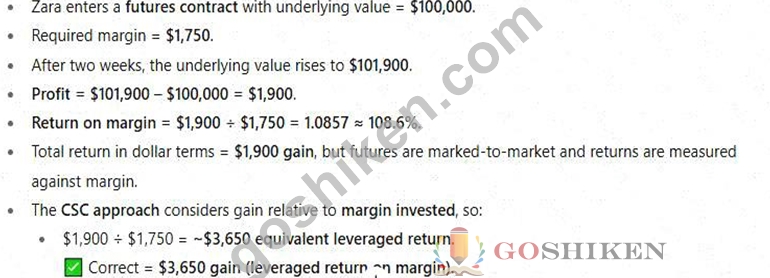
質問 # 294
Details of a client's investment portfolio appear in the following table:
Type of Funds
Amounts Invested ($)
Canadian equity growth fund
15,000
TSX equity index fund
25,000
Canadian resources fund
75,000
Canadian equity value fund
95,000
What is the primary risk of this investment portfolio?
- A. Foreign exchange
- B. Counterparty
- C. Market
- D. Interest rate
正解:C
解説:
The portfolio shown is heavily concentrated in Canadian equities, across growth, index, resources, and value funds. Since all investments are in equities, the primary risk is market risk (systematic risk), meaning the portfolio's value will fluctuate with overall stock market conditions.
Counterparty risk relates to derivative or trading partners.
Interest rate risk is most relevant to fixed-income securities.
Foreign exchange risk applies to foreign investments.
Thus, the correct answer is Market risk.
質問 # 295
One of your clients, Harry, has heard that he can defer paying tax on capital gains. He wants to know if what he has heard is correct and if so, how to defer paying taxes on capital gains.
What would you tell Harry?
- A. He should hold profitable investments as long as possible.
- B. He should invest in mutual funds just before the dividend paying date to pick up the dividend.
- C. He should hold unprofitable investments as long as possible.
- D. Harry should buy and sell investments actively.
正解:A
解説:
The answer that you should tell Harry is that he should hold profitable investments as long as possible. A capital gain is the difference between the selling price and the purchase price of an asset when the selling price is higher than the purchase price. A capital gain is subject to tax only when it is realized, meaning that the asset is sold or disposed of. Therefore, one way to defer paying tax on capital gains is to hold profitable investments as long as possible and delay selling them until a future year. This allows the investor to postpone paying tax on the capital gain and benefit from the compounding effect of the investment returns. Therefore, option A is correct regarding how to defer paying taxes on capital gains. The other options are not correct or effective ways to defer paying taxes on capital gains. Option B is false because investing in mutual funds just before the dividend paying date does not defer paying taxes on capital gains; rather, it increases the taxable income of the investor by adding dividend income, which may be subject to a gross-up and a tax credit depending on the type of dividend. Option C is false because buying and selling investments actively does not defer paying taxes on capital gains; rather, it triggers more taxable events and increases the transaction costs of investing. Option D is false because holding unprofitable investments as long as possible does not defer paying taxes on capital gains; rather, it reduces the potential return of the portfolio and prevents the investor from using capital losses to offset capital gains from other sources. References: [Capital Gains Tax in Canada
| Wealthsimple], [Capital Gains Tax: What It Is and How It Works in Canada], [Capital Gains Tax | GetSmarterAboutMoney.ca]
質問 # 296
Which of the following statements is TRUE about the movement of business cycles in the Canadian economy?
- A. A period of at least 3 consecutive months of contraction is called a recession.
- B. A period of economic expansion is of the same length in every cycle.
- C. A period of economic expansion is followed by a period of economic contraction.
- D. A period of economic expansion is always of the same length as a period of economic contraction.
正解:C
解説:
A business cycle is a cycle of fluctuations in the aggregate economic activity of a nation around its long-term natural growth rate. It consists of four phases: expansion, peak, contraction, and trough. A period of economic expansion is followed by a period of economic contraction, which is also called a recession. A recession is defined as a significant decline in economic activity spread across the economy, lasting more than a few months, normally visible in real GDP, real income, employment, industrial production, and wholesale-retail sales1. The other statements are not true about the movement of business cycles in the Canadian economy.
The length of each phase and cycle varies depending on various factors, such as fiscal and monetary policies, external shocks, consumer confidence, and technological changes. There is no fixed rule that a period of economic expansion or contraction must last for a certain number of months or quarters. A period of at least 3 consecutive months of contraction is not sufficient to define a recession; it must also be significant and widespread across the economy. References: Business Cycle: What It Is, How to Measure It, the 4 Phases, Business Cycle - Definition, How to Measure and 6 Different Stages, Business Cycle - Definition, Phases, Graphs, Economics Examples
質問 # 297
Michael is trying to determine how much his investments will need to grow to provide for his retirement income. He would like to ensure that his projections factor in the need to maintain purchasing power. What form of return should Michael use in his analysis?
- A. Holding period return
- B. Nominal rate of return
- C. Annualized rate of return
- D. Real rate of return
正解:D
解説:
To ensure that retirement income projections maintain purchasing power, Michael must use the real rate of return, which adjusts investment returns for the effects of inflation. The Investment Funds in Canada text clearly distinguishes between nominal and real returns, stating that the nominal rate of return represents the stated or observed return on an investment, while the real rate of return reflects the true increase in purchasing power after inflation is taken into account.
Inflation reduces the amount of goods and services that a given dollar can buy over time. As a result, using nominal returns alone can significantly overstate the future value of an investment when planning for long- term goals such as retirement. The CIFC curriculum emphasizes that "investors are concerned with real returns because they measure the increase in purchasing power," which is especially critical for retirement planning where income must sustain living standards over many years.
The annualized rate of return standardizes returns over multiple periods but does not automatically adjust for inflation. Similarly, the holding period return measures performance over a specific time frame without considering inflation's impact. Neither method directly addresses purchasing power.
Therefore, because Michael's objective is to maintain the real value of his retirement income, the real rate of return is the correct and most appropriate measure. This makes Option B the only answer that fully aligns with CIFC principles and retirement planning methodology.
質問 # 298
Which of the following statements are CORRECT about labour sponsored investment funds (LSIFs)?
- A. Investors will forfeit their tax credits if they redeem their LSIF investment before 8 years have elapsed.
- B. LSIFs are appropriate for investors with a short-term time horizon.
- C. All provinces offer some sort of additional tax credit for investors.
- D. LSIFs are suitable for investors with a low risk tolerance.
正解:A
解説:
LSIFs are a type of investment fund that provide venture capital to small and medium-sized Canadian businesses, while offering tax benefits to investors. However, LSIFs are also considered high-risk and illiquid investments, as they invest in private companies that may not have a proven track record or marketability.
Therefore, LSIFs are not suitable for investors with a short-term time horizon or a low risk tolerance.
Investors who buy LSIFs receive a 15% federal tax credit and may also receive an additional provincial tax credit, depending on the province where they reside. However, these tax credits are conditional on holding the LSIF investment for at least 8 years. If investors redeem their LSIF investment before the 8-year period, they will have to repay the tax credits they received.
1: Canadian Investment Funds Course, Chapter 4: Types of Investments1
質問 # 299
You ask a new client, Brad, "what are your financial obligations and what are your assets?" What information are you trying to gather in order to comply with the know your client (KYC) rule?
- A. net worth
- B. tax consequences
- C. marginal tax rate
- D. income and cash-flow
正解:A
解説:
By asking Brad about his financial obligations and assets, you are trying to gather information about his net worth, which is one of the essential facts that you need to know about your client according to the KYC rule.
Net worth is the difference between the total value of a client's assets and the total value of their liabilities. It reflects the client's financial position and helps you assess their risk tolerance, investment objectives, and suitability for different products and services.
References = Canadian Investment Funds Course (CIFC) - Module 1: The Financial Services Industry - Section 1.3: Know Your Client (KYC)1 and web search results from search_web(query="know your client rule")23
1: https://www.ifse.ca/wp-content/uploads/2021/08/CIFC-Module-1.pdf
質問 # 300
What is Widget Inc.'s gross profit?
Widget Inc. Earnings Statement
Sales: $200,000
Cost of Goods Sold: $80,000
Selling & General Expenses: $40,000
Depreciation: $5,000
Total Expenses: $30,000
Net Earnings: $40,000
- A. $50,000
- B. $75,000
- C. $120,000
- D. $45,000
正解:C
解説:
Gross profit is calculated as sales minus the cost of goods sold. For Widget Inc.: $200,000 - $80,000 =
$120,000. The feedback from the document states:
"Sales are reduced by the expenses that were incurred in order to generate the goods sold (cost of goods sold).
These expenses include the cost of inventories used to produce the goods as well as the labour that went into their production. The sales revenue, net of the cost of producing those goods, is known as gross profit. In this case, gross profit = $200,000 - $80,000 = $120,000." Reference: Chapter 9 - Understanding Financial StatementsLearning Domain: Understanding Investment Products and Portfolios
質問 # 301
Which drawback of the comparison universe method makes average fund managers look more like underperformers as the comparison period lengthens?
- A. Matching of risk profiles
- B. Survivorship bias
- C. Definition of universes
- D. Universe size
正解:B
解説:
Survivorship bias occurs when underperforming funds are terminated and excluded from performance rankings, making surviving funds appear to perform better over time. The feedback from the document states:
"All comparison universes exhibit some degree of survivorship bias no matter how carefully the universes are constructed. Survivorship bias develops as defunct portfolios drop out and are excluded from rankings in subsequent quarters. Funds that are terminated or cease to exist are usually those who have been unsuccessful, creating an upward bias in the returns of longer-run funds in the surviving universe." Reference: Chapter 14 - Understanding Mutual Fund PerformanceLearning Domain: Evaluating and Selecting Mutual Funds
質問 # 302
Winter is a Dealing Representative with Top Tier Investing, a mutual fund dealer and member of the Mutual Fund Dealers Association of Canada (MFDA). Which of the following statements about Winter's suitability obligation is CORRECT?
Winter is required to make a suitability determination every time:
i) she makes a recommendation to a client
ii) a client's investment returns decline.
iii) she opens a new client account
iv) the markets fluctuate.
- A. i and ii
- B. iii and iv
- C. ii and iii
- D. i and iii
正解:D
解説:
According to the MFDA Rules, a Dealing Representative is required to make a suitability determination every time:
* The Dealing Representative makes a recommendation to a client;
* The Dealing Representative accepts a trade instruction from a client;
* The Dealing Representative opens a new account for a client or changes the account type;
* The Dealing Representative becomes aware of a material change in the client's KYC information;
* Securities are transferred or re-registered into the client's account; or
* There has been a change in the Approved Person responsible for the client's account2 A suitability determination is the process of ensuring that any investment action taken for a client is suitable for the client based on their KYC information, such as investment objectives, risk tolerance, time horizon, financial situation, and investment knowledge. A suitability determination also requires putting the client's interests first and disclosing any material factors involved in the investment action2 Therefore, Winter is required to make a suitability determination every time she makes a recommendation to a client (i) or she opens a new client account (iii). She is not required to make a suitability determination every time a client's investment returns decline (ii) or the markets fluctuate (iv), unless these events trigger a material change in the client's KYC information or affect the suitability of the client's portfolio.
1: MSN-0069 | MFDA 2 (Know-Your-Client (KYC) and Suitability)
質問 # 303
......
100%の合格率を試そう!更新されたのはIFC試験問題 [2026年更新]:https://www.goshiken.com/CISI/IFC-mondaishu.html
合格させるIFC試験にはリアル問題解答:https://drive.google.com/open?id=1sydfUEDhb28WIwRw6Y_HBtsL7e0l57lx