

試験問題解答ブレーン問題集でH12-821_V1.0試験問題集PDF問題
無料ダウンロードHuawei H12-821_V1.0リアル試験問題
質問 # 34
Which of the following statements regarding the summary automatic command and BGP route summarization is false?
- A. After this command is configured, BGP sends only the summarized routes to peers
- B. After this command is configured, BGP summarizes routes based on natural network segments
- C. This command enables automatic summarization for the locally imported routes
- D. This command is used to implement automatic summarization. Automatic summarization takes precedence over manual summarization
正解:D
解説:
The summary automatic command in BGP is used to enable automatic summarization of routes, particularly for classful networks. However, manual summarization takes precedence over automatic summarization when both are configured. This makes the statement claiming automatic summarization takes precedence false .
質問 # 35
Four routers run ISIS and have established adjacencies. The area IDs and router levels are marked in the following figure. If route leaking is configured on R3, which of the following is the cost of the route from R4 to 10.0.2.2/32?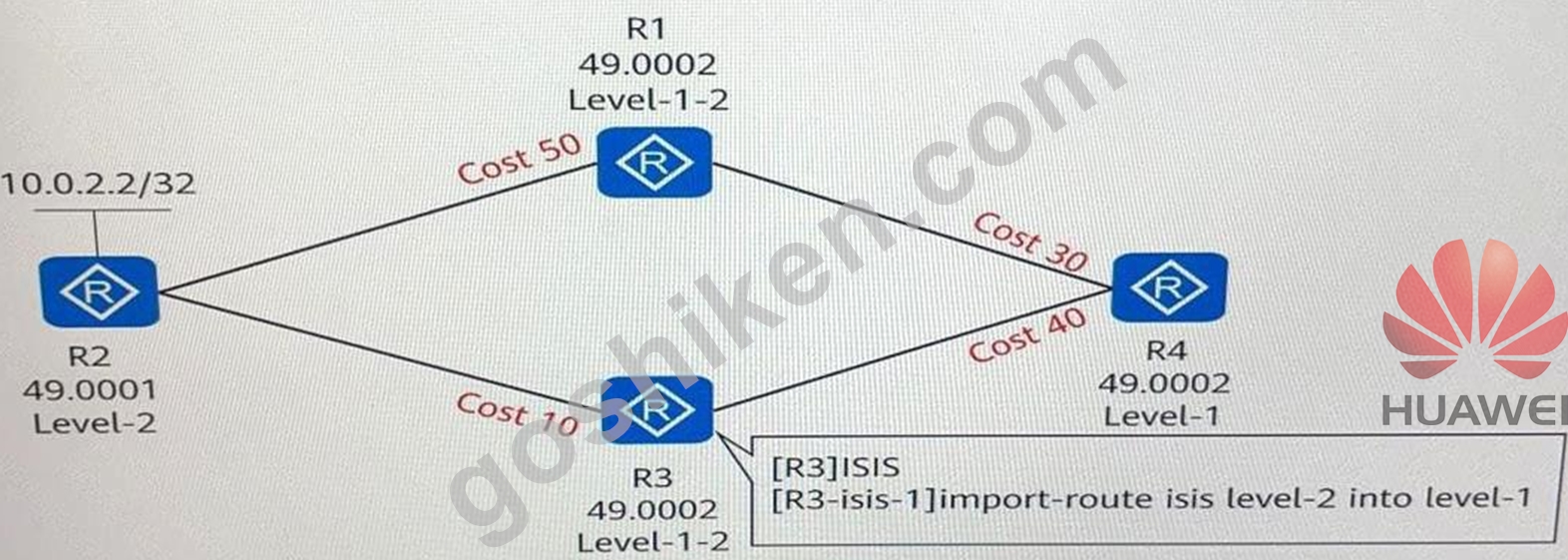
- A. 0
- B. 1
- C. 2
- D. 3
正解:C
解説:
In the given topology, the route from R4 to 10.0.2.2/32 traverses R3, which performs route leaking from Level-2 to Level-1. The cost is calculated as follows: R4 to R3 (40) + R3 to R2 (10) + R2 to the destination (30), resulting in a total cost of 80 .
質問 # 36
Which of the following attribute must be carried in an Update message?
- A. Prefval
- B. AS-Path
- C. MED
- D. Local-pref
正解:D
質問 # 37
Which of the following configurations are not mandatory when an administrator configures VRRP?
- A. Preemption mode
- B. Virtual router priority
- C. Preemption delay
- D. Virtual IP address
正解:A、C
解説:
When configuring VRRP, the virtual router priority and virtual IP address are mandatory because they define the VRRP instance and its role within the group. Preemption mode and preemption delay are optional configurations that influence how routers take over the master role when priorities change. These are not mandatory for the VRRP protocol to function .
質問 # 38
What is the default sending interval of BFD packets?
- A. 5s
- B. 10s
- C. 100ms
- D. 1000ms
正解:C
解説:
The default sending interval for BFD (Bidirectional Forwarding Detection) control packets is 100 milliseconds. This interval ensures rapid detection of link faults, providing fast failover and minimizing downtime in network operations .
質問 # 39
GRE is a VPN encapsulation technology that is widely used to transmit packets across heterogeneous networks. Which of the following statements is false about GRE?
- A. GRE can work with other VPN protocols to better ensure data security.
- B. GRE is a Layer 3 VPN encapsulation technology.
- C. GRE supports multicast transmission.
- D. GRE supports encryption and authentication.
正解:D
解説:
GRE Characteristics
* GRE does not inherently support encryption or authentication. It is a tunneling protocol for encapsulating packets, and data security features must be implemented using other protocols such as IPsec.
* Other correct attributes of GRE include:
* B. Supports multicast transmission.
* C. Acts as a Layer 3 VPN encapsulation technology.
* D. Can work with VPN protocols like IPsec for better security.
HCIP-Datacom-Core Reference
* GRE features and limitations are discussed in VPN encapsulation technology chapters.
質問 # 40
Which of the following statements about WLAN roaming are false?
- A. During roaming, the STA sends an Association Request frame containing home AP information to the foreign AP.
- B. APs with which a STA is associated before and after roaming must work on the same channel.
- C. APs with which a STA is associated before and after roaming can work on different channels.
- D. During roaming, the STA sends a Reassociation Request frame containing home AP information to the foreign AP.
正解:A、B
解説:
During WLAN roaming, the STA sends a Reassociation Request frame to the foreign AP to maintain connectivity. Association frames are used during initial connections, not roaming.
APs with which a STA is associated before and after roaming can work on different channels, as roaming often occurs across channels in environments like multi-SSID or multi-channel setups.Options C and D are false, as they contradict standard WLAN roaming procedures .
質問 # 41
See the following figure. RTA, RTB, RTC, and RTD are in the same AS and establish IBGP peer relationships through direct links. RTB an RTC are route reflectors (RRs), RTA and RTC are the RR clients of RTB, and RTB and RTD are the RR clients of RTC. If RTA advertises the route 10.1.1.0/24 to the BGP process, the Originator ID of the BGP route received by RTD is------------------.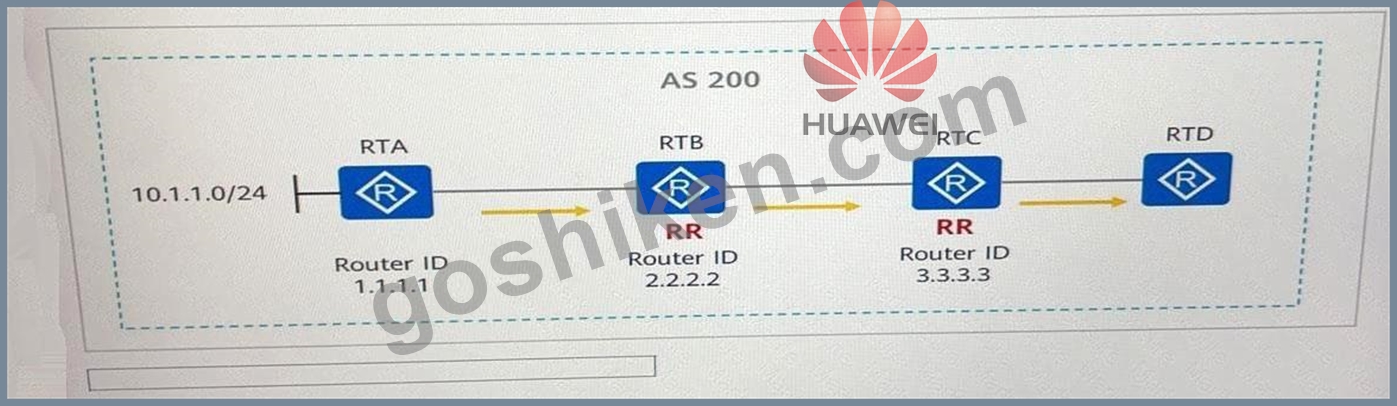
正解:
解説:
1.1.1.1
Explanation:
The Originator ID in a BGP route represents the Router ID of the device that originally advertised the route into the BGP domain. Since RTA originates the route 10.1.1.0/24 into the BGP process, the Originator ID in the route received by RTD will be set to 1.1.1.1 .
質問 # 42
IGMPV3 not only supports IGMPv1 General Query and IGMPv2 Group-Specific Query, and also IGMPv3 Source/Group-Specific Query.
- A. TRUE
- B. FALSE
正解:A
質問 # 43
Compress the 2001:0DB8:0000:C030:0000:0000:09A0 address.
正解:
解説:
2001:DB8:0:C030::9A0
Explanation:
To compress the IPv6 address 2001:0DB8:0000:C030:0000:0000:09A0, the following rules are applied:
* Remove leading zeros in each hextet (e.g., 0DB8 becomes DB8).
* Replace contiguous blocks of zeros with :: (only once in the address).Thus, the compressed form is
2001:DB8:0:C030::9A0 .
質問 # 44
On an STP network, the root bridge, root port, and designated port are elected in sequence. The election rules of these ports are different. List the steps for electing the root port in sequence.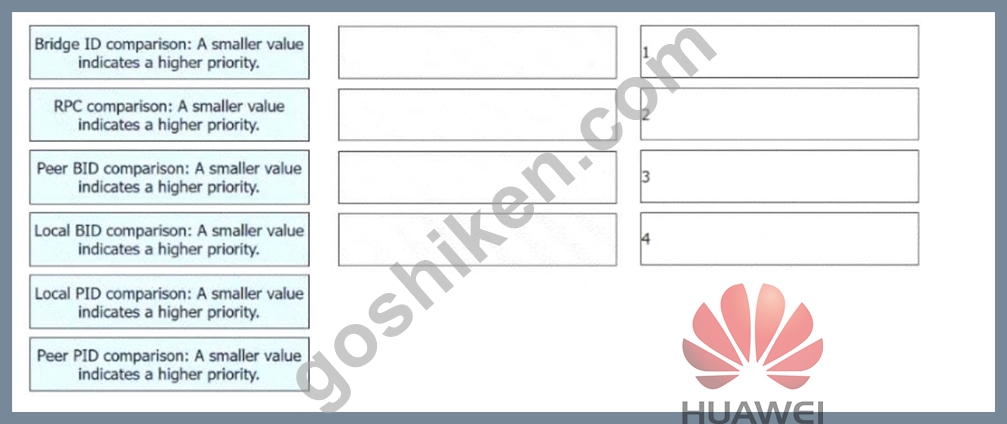
正解:
解説: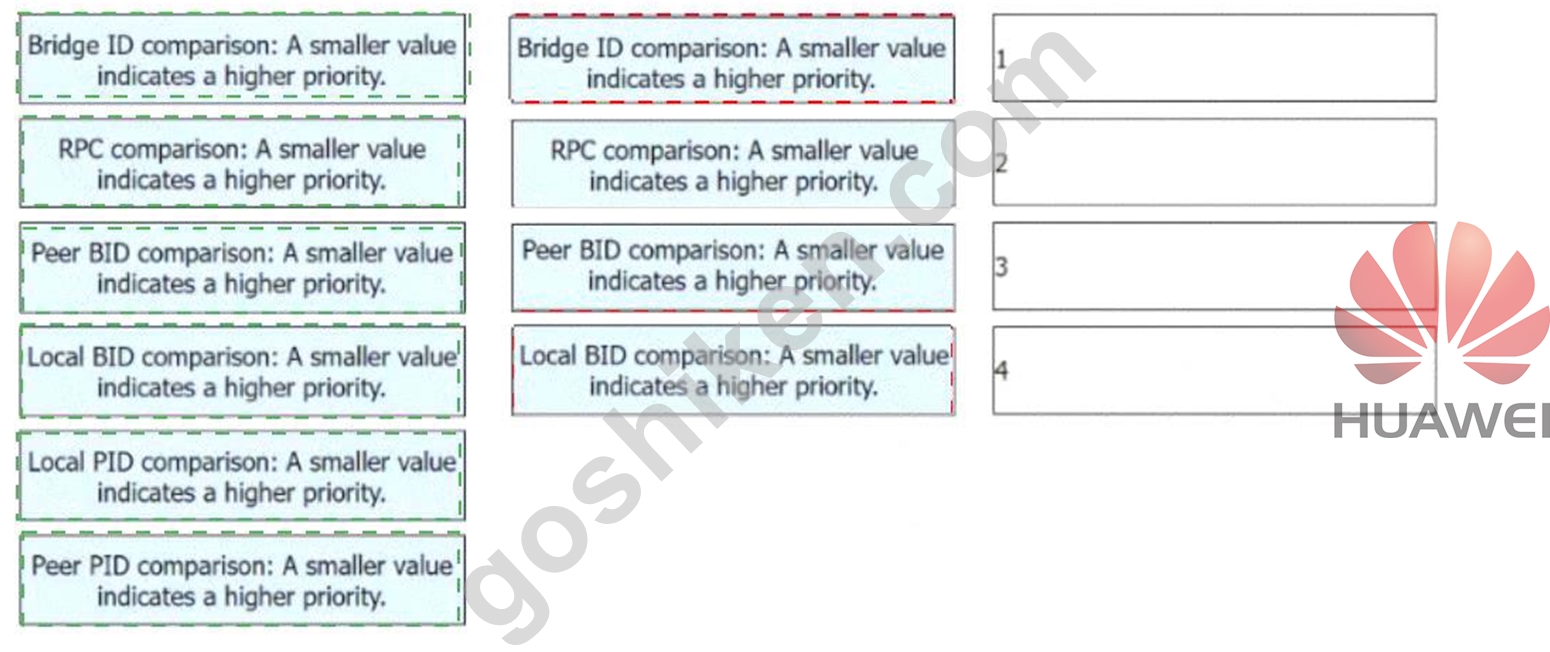
Explanation:
The sequence of steps for electing the root port in an STP (Spanning Tree Protocol) network is as follows:
* Bridge ID Comparison: The Bridge ID (BID) is compared between the bridges in the network. A smaller value indicates a higher priority, meaning the bridge with the lowest Bridge ID is elected as the root bridge.
* RPC (Root Path Cost) Comparison: The path cost to reach the root bridge is calculated. The router with the lowest Root Path Cost (RPC) to the root bridge will have a higher priority for the election of the root port.
* Peer BID Comparison: If there is a tie in the Root Path Cost, the Peer BID is compared. A smaller Peer BID indicates a higher priority. This step ensures that if two routers have the same RPC, the one with the lower Peer Bridge ID wins.
* Local BID Comparison: If there is still a tie, the Local BID is compared. A smaller Local BID indicates a higher priority. This final step ensures that the router with the lowest local identifier is selected.
* Bridge ID Comparison:The first step in electing the root port is comparing the Bridge IDs. The bridge with the lowest Bridge ID becomes the root bridge. The Bridge ID is made up of the bridge priority and MAC address. The root bridge is the center of the network for STP, and all other ports will calculate their paths based on this root.
質問 # 45
The Next_Hop attribute in BGP records the next hop of a route. Similar to the next hop in an IGP, the Next_Hop attribute in BGP must be the IP address of a peer interface.
- A. TRUE
- B. FALSE
正解:B
解説:
BGP Next_Hop Attribute
* Unlike IGP, the Next_Hop attribute in BGP does not necessarily have to be the IP address of a peer interface. For example, in multi-hop BGP configurations, the Next_Hop can point to a different router or interface within the network.
HCIP-Datacom-Core Reference
* Details of the Next_Hop attribute and its behavior are outlined in BGP path selection principles.
質問 # 46
In a route-policy, which of the following BGP attributes can be used in apply clauses?
- A. Tag
- B. AS_Path
- C. Local-Preference
- D. MED
正解:C、D
解説:
In a route-policy, attributes such as MED (Multi-Exit Discriminator) and Local-Preference can be used in apply clauses to influence BGP route selection. Attributes like AS_Path and Tag are typically matched or filtered but not directly applied in the apply clause .
質問 # 47
GRE is a Layer 2 VPN encapsulation technology that encapsulates packets of certain data link layer protocols so that the encapsulated packets can be transmitted over an IP network.
- A. TRUE
- B. FALSE
正解:B
解説:
GRE (Generic Routing Encapsulation) is not a Layer 2 VPN technology. Instead, it is a Layer 3 tunneling protocol used to encapsulate a wide variety of network layer protocols inside point-to-point connections. GRE is commonly used for creating VPN tunnels across IP networks, allowing for the transport of various types of payloads. This misunderstanding about GRE being a Layer 2 technology contradicts its definition and typical application .
質問 # 48
As shown in the following figure, a new AP is deployed In dual link MSB networking (load balancing mode).
Which AC will the connect to?
- A. AC2
- B. Random access
- C. AC1
- D. None
正解:A
解説:
In dual-link MSB networking with load balancing, the new AP will connect to the AC with the lower number of connected APs. In this case, AC2 has only 20 connected APs, while AC1 has 100. Therefore, the new AP will connect to AC2 .
質問 # 49
Which of the following statements about BFD operating modes are true?
- A. In demand mode, once a BFD session is set up, the system no longer periodically sends BFD Control packets.
- B. Asynchronous mode is the primary BFD operating mode.
- C. In asynchronous mode, two systems periodically exchange BFD Control packets at the negotiated interval. If one system does not receive any BFD Control packets from the other within the detection time, the BFD session is declared down.
- D. Asynchronous mode does not support the Echo function.
正解:A、B、C
解説:
In asynchronous mode, BFD control packets are exchanged periodically to detect faults.
In demand mode, once the session is established, BFD stops sending periodic control packets and relies on external mechanisms to verify connectivity.
Asynchronous mode is the most commonly used mode. However, the Echo function is supported in asynchronous mode, making Option B incorrect .
質問 # 50
Which of the following statements about WLAN roaming are true?
- A. APs for roaming must be in the same basic service set (BSS).
- B. APs for roaming must be in the same extended service set (ESS).
- C. APs for roaming do not need to have overlapping signal coverage.
- D. APs for roaming must have overlapping signal coverage.
正解:C
質問 # 51
A router performs a lookup in its FIB table for a packet. If the tunnel ID in the matching entry is 0, the packet needs to be forwarded through a tunnel, such as an MPLS tunnel.
- A. TRUE
- B. FALSE
正解:B
解説:
The question indicates that a router performs a lookup in its FIB table for a packet and determines that the tunnel ID in the matching entry is 0, suggesting that the packet needs to be forwarded through a tunnel such as an MPLS tunnel. However, this is a misunderstanding of the FIB functionality.
* FIB Table OverviewThe Forwarding Information Base (FIB) is used to make packet-forwarding decisions. Entries in the FIB include next-hop information, which can be directly linked to an interface or a tunnel.
* If the Tunnel ID is 0, it indicates that the packet is forwarded via a normal routing path and not through a tunnel.
* For MPLS or other tunnels, the Tunnel ID would have a non-zero value pointing to the associated tunnel.
* MPLS Tunnel OperationWhen a router forwards packets through an MPLS tunnel, a label-switched path (LSP) is set up. The FIB would reflect specific tunnel identifiers for packets that need such encapsulation.
* HCIP-Datacom-Core Reference
* Routing Principles and MPLSexplain the forwarding mechanisms clearly, stating that if a packet is routed normally, the tunnel ID remains 0.
* The section on MPLSclarifies the encapsulation process and the role of tunnel identifiers.
Hence, the claim in the question is incorrect. A Tunnel ID of 0 implies no tunneling is required, and normal IP forwarding occurs
質問 # 52
Which of the following scenarios is not suitable for deploying interface PBR?
- A. On an enterprise network with multiple ISP outbound interfaces, each internal network segment accesses the Internet through a particular ISP outbound interface.
- B. A core switch needs to forward the traffic between the intranet and extranet to a security detection device that connects to the core switch in off-path mode.
- C. A device needs to modify the next-hop IP address for locally originated traffic.
- D. A core switch needs to forward traffic between the intranet and extranet to an AC device that connects to the core switch in off-path mode.
正解:C
解説:
Policy-Based Routing (PBR) on interfaces is used to forward traffic based on specific policies rather than the routing table. However, PBR is not suitable for modifying the next-hop of locally originated traffic. Other scenarios listed are typical use cases for interface PBR .
質問 # 53
A local router runs IS-IS and its command output is shown in the following figure. Which of the following statements is true?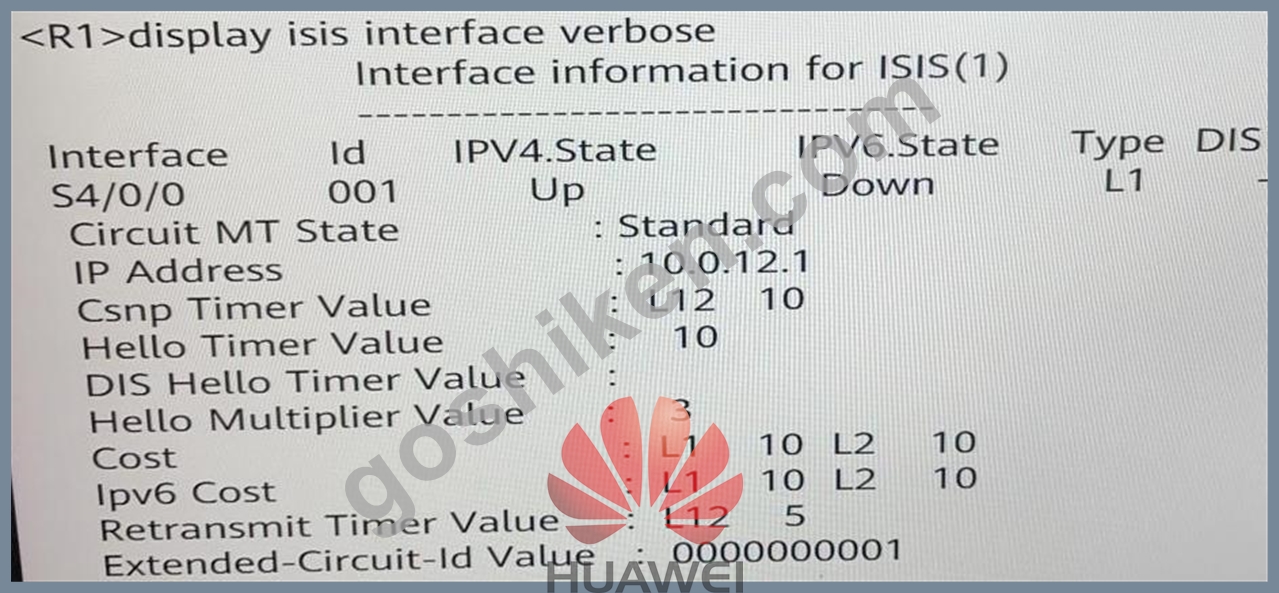
- A. The circuit level of S4/0/0 is Level-1.
- B. The cost of S4/0/0 is 20.
- C. S4/0/0 sends IIH packets at the interval of 30s.
- D. S4/0/0 supports IPv6.
正解:C
質問 # 54
When a routing policy is used to filter routes, which of the following route prefixes will be denied by the IP prefix below?
- A. 1.1.1.2/16
- B. 1.1.1.1/32
- C. 1.1.1.1/26
- D. 1.1.1.1/24
正解:D
質問 # 55
In the OSPF protocol, inter-area route calculation involves only Router LSA, Network LSA, and Summary LSA.
- A. TRUE
- B. FLASE
正解:A
質問 # 56
......
最新のHuawei H12-821_V1.0リアル試験問題集PDF:https://www.goshiken.com/Huawei/H12-821_V1.0-mondaishu.html
H12-821_V1.0試験問題集、H12-821_V1.0練習テスト問題:https://drive.google.com/open?id=1M5t8YVJNjFlLTJC27iILjUg9SL_nAYCq