

IIBA CCBA練習テストPDF試験材料
CCBA解答CCBA無料サンプルには全てリアル試験合格させます
CCBA試験に合格することは容易なことではなく、多大な準備と努力が必要です。しかし、CCBA認定を取得することにより、ビジネスアナリストは信頼性を高め、知識とスキルを拡大し、新しいキャリアの機会を得ることができます。
CCBA認定を取得することには、ビジネスアナリストにとって多くの利点があります。これにより、個人がビジネス分析に関する高度な知識と専門知識を持っていることが、雇用主や同僚に示され、求人機会やキャリアアップの機会が増える可能性があります。また、同じ認定を持つ専門家のコミュニティにアクセスできるため、ネットワーキングの機会や貴重なリソースと情報にアクセスできる可能性があります。全体的に、CCBA認定は、スキルを向上させ、キャリアを進めたいビジネスアナリストにとって貴重な投資となります。
質問 # 207
The project manager has tasked the business analyst (BA) to collect a performance measure on the solution implemented in the latest release. Which of the following considerations can help the BA obtain that information?
- A. Risk assessment
- B. Performance variance
- C. Sample size
- D. Solution size
正解:C
解説:
Explanation
Sample size is the number of observations or data points that are used to measure the performance of a solution. Sample size is an important consideration for the BA to obtain reliable and valid information, as it affects the accuracy, precision, and confidence of the results. A larger sample size can reduce the sampling error and increase the representativeness of the population, but it may also increase the cost and time of data collection. A smaller sample size can save resources and time, but it may also introduce bias and uncertainty in the results. Therefore, the BA should determine the appropriate sample size based on the purpose, scope, and quality criteria of the performance measurement12. The other options are not directly related to the data collection process, although they may influence the analysis and interpretation of the data. References:
1: BABOK® Guide v3, Chapter 7: Solution Evaluation, Section 7.3: Analyze Performance Measures
2: Business Analysis Expert Certification, CCBA® | IIBA®
質問 # 208
The business analyst (BA) has completed the verification of a set of requirements, but a change in scope has materialized. Which technique should the BA use to obtain consensus and reach agreement among the stakeholders?
- A. Decision analysis
- B. Financial analysis
- C. Business rules analysis
- D. Risk analysis and management
正解:C
解説:
Business rules analysis is used to identify, express, validate, refine, and organize the rules that shape day-to- day business behavior and guide operational business decision making.
質問 # 209
What do business goals and objectives of enterprise analysis actually describe?
- A. Business goals and objectives describe the increased revenue that the organization is seeking to gain.
- B. Business goals and objectives describe the desired future state of problems.
- C. Business goals and objectives describe the solution scope that the organization is seeking to accomplish.
- D. Business goals and objectives describe the ends that the organization is seeking to achieve.
正解:D
解説:
Explanation
Business goals and objectives describe the ends that the organization is seeking to achieve. It is the assessment of the desired future state of the organization.
Answer B is incorrect. The best answer is that the ends of the solution are defined, not just the solution scope.
Answer A is incorrect. Business goals and objectives aren't always focused on increased revenue so this isn't
the best choice for the question.
Answer D is incorrect. This answer is close, but it's not the future state of the problems that is defined, but the
future state of the organization.
質問 # 210
There are three inputs in the plan business analysis approach. Which one of the following is not one of the three inputs?
- A. Business need
- B. Organizational process assets
- C. Risk and rewards analysis
- D. Expert judgment
正解:C
質問 # 211
There are three inputs in the plan business analysis approach. Which one of the following is not one of the three inputs?
- A. Business need
- B. Organizational process assets
- C. Risk and rewards analysis
- D. Expert judgment
正解:C
解説:
Explanation/Reference:
Risk and rewards analysis is not, of itself, an input to the business analysis approach process.
D, B, and A are incorrect. Following are the inputs in the plan business analysis approach:
Business need
Expert judgment
Organizational process assets
質問 # 212
When a business analyst prepares for elicitation, he must define the scope of the selected elicitation technique, notify the stakeholders of the elicitation plan and technique to be used, and what other preparation activity?
- A. Create an elicitation plan.
- B. Perform stakeholder analysis.
- C. Define the solution.
- D. Schedule all needed resources.
正解:D
解説:
Explanation
When preparing for the elicitation event, the business analyst must also schedule all needed resources. The resources are people, facilities, equipment, and other things that can help complete the event.
Answer C is incorrect. Defining the solution is not part of preparing the elicitation.
Answer B is incorrect. The business analyst doesn't create an elicitation plan in preparation of the elicitation
event.
Answer D is incorrect. Performing stakeholder analysis is not an elicitation preparedness technique.
質問 # 213
The Chief Executive Officer (CEO) of a company presents a new corporate strategy that will introduce a new system to the organization. The CEO has expressed a concern about the impact to the staff once the strategy has been implemented. What must the business analyst (BA) do to address concerns of the CEO?
- A. Identify required cultural changes
- B. Ensure requirements are easily accessible
- C. Perform a cost-benefit analysis of the strategy
- D. Align the new capabilities to the company's architecture
正解:A
解説:
The BA must identify the required cultural changes to address the concerns of the CEO about the impact to the staff once the strategy has been implemented. This is because cultural changes are changes that affect the values, beliefs, behaviors, or norms of an organization or a group of people. Identifying the required cultural changes can help the BA to assess how the new system will affect the staff and what actions are needed to facilitate their adoption and acceptance of the change. The other options are not as effective or relevant as identifying the required cultural changes. References:
BABOK Guide, section 10.19: Identify Cultural Differences
CCBA Practice Test, question 114
質問 # 214
In a project meeting, stakeholders presented conflicting views on how the business analysis process should be conducted, leading to the sponsor becoming very upset. If a similar situation arises in the future, what can the business analyst (BA) do to avoid the situation?
- A. Develop a cleaner RACI matrix
- B. Communicate with each stakeholder individually
- C. Obtain approval for the business case
- D. Obtain stakeholder signoff on the approach
正解:A
解説:
The BA can avoid the situation of stakeholders presenting conflicting views on how the business analysis process should be conducted by developing a cleaner RACI matrix. A RACI matrix is a technique for defining and documenting the roles and responsibilities of stakeholders in relation to business analysis tasks or deliverables. It clarifies who is Responsible, Accountable, Consulted, or Informed for each task or deliverable1. By developing a cleaner RACI matrix, the BA can reduce ambiguity, confusion, and conflict among stakeholders regarding their involvement and expectations in the business analysis process. References: 1: BABOK Guide v3, Section 10.24
質問 # 215
The following chart represents attendance of subject matter experts (SME) and the solution owner for a requirements review and approval meeting held weekly by a business analyst (BA).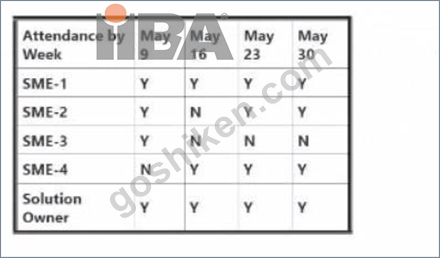
The requirements package was approved by the solution owner during the May 30 meeting. After implementation of the solution, the BA learns that the users in SME-3 s area are not using the system. Which business analysis activity should the BA have monitored more closely to mitigate this situation?
- A. Requirements scope
- B. Solution performance
- C. Stakeholder engagement
- D. Business processes
正解:C
質問 # 216
A business analyst is meeting with the customer of the project. The customer tells the business analyst that she can only allow the budget of $575,000 for the project. This budget is best described as what type of constraint?
- A. Business constraint
- B. Technical constraint
- C. Verified constraint
- D. Financial constraint
正解:A
解説:
A business constraint describes the limitations on the available solution - including financial, schedule, and resource limitations.
Answer C is incorrect. Financial constraint is not a category of business analysis constraints and assumptions.
Answer A is incorrect. A technical constraint describes an architectural decision that may affect the allowed solution, such as development language, hardware, or software.
Answer B is incorrect. There's not a category of constraints called a verified constraint.
質問 # 217
What condition of the requirements must be fulfilled in order to use the matrix documentation approach to specify and model requirements?
- A. The requirements must have rated goals, such as time, cost, and quality.
- B. The requirements must have opposing values.
- C. The requirements must have the uniform structure.
- D. The requirements must have common characteristics.
正解:C
解説:
In order to use the matrix documentation approach to model requirements, the identified requirements must have the uniform structure of their characteristics and identification.
Answer A is incorrect. The requirements do no need to have opposing values to use the matrix documentation approach.
Answer B is incorrect. While this choice is tempting, the best answer is the uniform structure.
Answer D is incorrect. This isn't a valid answer, as requirements don't need rated goals.
質問 # 218
You are the business analyst for your organization. You're creating a document that states the business need, identifies the key stakeholders, and defines the positive impact the solution will bring to the organization and stakeholders. What document are you creating?
- A. Project charter
- B. Vision statement
- C. Business case
- D. Requirements documentation
正解:B
解説:
This is an example of a vision statement. A vision statement, also called a problem statement, shows the categories of stakeholders and how the solution will help each stakeholder.
Answer C is incorrect. A project charter authorizes the project.
Answer B is incorrect. The business case justifies the cost of the solution for the rewards the solution will bring to the organization.
Answer A is incorrect. The requirements documentation doesn't define the benefits of the solution for the stakeholders; it only lists the requirements of the endeavor.
質問 # 219
A recent survey shows that a newly implemented system has features that the users have never used. Upon reviewing the survey report, the Chief Executive Officer (CEO) highlighted that the company must avoid future implementations with functionality that does not provide any business value. What must the business analyst (BA) do to ensure future requirements meet a business need?
- A. Choose appropriate format to communicate requirements
- B. Ensure test scenarios align to business requirements
- C. Facilitate a focus group with users to get feedback
- D. Consider business relevance while tracing requirements
正解:D
解説:
According to the BABOK Guide, considering business relevance while tracing requirements is a technique for maintaining requirements. This technique can help the BA ensure future requirements meet a business need, as it involves linking each requirement to a business objective or goal that provides value to stakeholders. By doing so, the BA can avoid implementing functionality that does not provide any business value or align with stakeholder needs. Therefore, the correct answer is A. References: [BABOK Guide], [CCBA Exam Questions]
質問 # 220
A business analyst has just hosted a brainstorming session that has generated 57 ideas for a solution. What should the business analyst do with the ideas now?
- A. Discuss each idea with the project manager.
- B. Record the ideas as requirements.
- C. Rate the ideas.
- D. Research each idea for time and cost.
正解:C
質問 # 221
A business analyst is studying the cost of the endeavor in relation to the projected income the endeavor will bring once the project is completed. What financial valuation technique can the business analyst use to determine the breakeven point for the project?
- A. Average rate of return
- B. Cost-benefit analysis
- C. Payback period
- D. Discounted cash flow
正解:C
解説:
Payback period quantifies the duration that the project will need to exist and generate revenue in order to pay back the original investment of the project. The payback period is also known as management horizon or the breakeven point.
Answer B is incorrect. Average rate of return describes the rate of return the project will create.
Answer C is incorrect. Cost-benefits analysis describes the relation of costs to benefits in a project.
Answer D is incorrect.
Discounted cash flow describes the future value on the investment of the project.
質問 # 222
John and Hanna are business analysts in their organization and they are completing the verification activities to check for completeness of the requirements. When should John and Hanna perform these verification activities?
- A. At each milestone of the requirements analysis process
- B. As often as the requirements management plan calls for
- C. Iteratively throughout the requirements analysis process
- D. Once all of the requirements have been gathered
正解:C
解説:
Requirements verification activities are performed iteratively throughout the requirements analysis process.
Answer A is incorrect. Requirements verification happens in iterations, not just at milestones (assuming there are milestones in the process).
Answer B is incorrect. Verification activities don't happen just at the end of the requirements gathering process, but iteratively throughout the process.
Answer D is incorrect. This answer is tempting, but it's not the best answer.
質問 # 223
A business analyst has determined that there are five possible solutions to a business need. If the business analyst completes the solution assessment on multiple solutions, what is the goal of the assessment?
- A. The business analyst should determine the opportunity cost of each assessment.
- B. The business analyst should only have one solution, not five.
- C. The business analyst should determine which solution is quickest to implement.
- D. The business analyst should determine which solution has the greatest business value.
正解:D
解説:
Explanation
The purpose of assessing proposed solutions is to determine how closely they meet stakeholder and solution requirements. The business analyst, while assessing a single solution, determines whether the solution delivers enough business value to justify its implementation.
However, the business analyst has the additional goal of attempting to determine which solution delivers the greatest business value while assessing multiple alternative solutions.
Answer C is incorrect. The business analyst can have multiple solutions for a business need. Answer B is incorrect. The opportunity cost is not applicable to this scenario.
Answer D is incorrect. The fastest implementation may not necessarily be the best solution for an organization.
質問 # 224
When an organization is using a change-driven approach to business analysis, how are communications managed?
- A. Communications in a change-driven approach typically use face-to-face channels.
- B. Communications in a change-driven approach focus more on formal communications.
- C. Communications in a change-driven approach are all ad hoc.
- D. Communications in a change-driven approach to business analysis focus more on the frequency of communication.
正解:D
質問 # 225
A change to support a regulatory requirement is proposed for inclusion in the scope of a project. A business analyst (BA) conducts an impact analysis to determine the extent of the change. What previous task could assist the BA in performing the impact analysis?
- A. Perform a risk analysis
- B. Create requirement relationships
- C. Conduct a cost-benefit analysis
- D. Update use case scenarios
正解:B
質問 # 226
You are the project manager of the NGQQ Project for your company. To help you communicate project status to your stakeholders, you are going to create a stakeholder register. All of the following information should be included in the stakeholder register except for which one?
- A. Stakeholder management strategy
- B. Assessment information of the stakeholders' major requirements, expectations, and potential influence
- C. Identification information for each stakeholder
- D. Stakeholder classification of their role in the project
正解:A
解説:
Explanation
The stakeholder management strategy is generally not included in the stakeholder registry because it may contain sensitive information that should not be shared with project team members or certain other individuals that could see the stakeholder register. The stakeholder register is a project management document that contains a list of the stakeholders associated with the project. It assesses how they are involved in the project and identifies what role they play in the organization. The information in this document can be very perceptive and is meant for limited exchange only. It also contains relevant information about the stakeholders, such as their requirements, expectations, and influence on the project.
Answer D is incorrect. Stakeholder identification should be included in the stakeholder register.
Answer A is incorrect. Assessment information should be included in the stakeholder register.
Answer C is incorrect. Stakeholder classification should be included in the stakeholder register.
質問 # 227
A business analyst (BA) has been asked to develop a plan to complete the associated business analysis activities for a project in which an organization is switching from a manual to an automated process for receiving payments. As the final step in developing the plan, which technique will the BA use?
- A. Process modelling from previous initiatives
- B. Surveys or Question:naires for the current initiative
- C. Functional Decomposition for the current initiative
- D. Lessons learned from previous initiatives
正解:B
解説:
According to the BABOK® v3 guide, the purpose of survey and Question:naires is " to elicit business analysis information - including information about customers, products, work practices, and attitudes - from a group of people in a structured way and in a relatively short period of time."
質問 # 228
You are the business analyst for your organization. You are currently working with Susan on creating a model as part of the specify and model requirements process. Susan doesn't understand why you need a model. You explain to Susan that a model is just a simplified representation of a complex reality that is useful for understanding that reality and making decisions regarding it. In fact, you tell Susan, model can do all of the following except one option. Choose the option that model cannot do?
- A. Define the resources that will be needed on the project team
- B. Describe thought processes and action flows
- C. Describe a situation or problem
- D. Define boundaries for the business domain
正解:A
解説:
Explanation
Models do not typically address the resources needed for the project team so this choice is incorrect.
Models can describe a situation or problem, define boundaries for the business domain, describe thought processes and action flows, categorize and create hierarchies of items, show components and relationships, and show business logic.
Answer C, B, D are incorrect. These are valid components of a model; so these choices are incorrect.
質問 # 229
After a number of requirements elicitation workshops, the business analyst (BA) notices that two business stakeholders did not speak up during any of the discussions. What should the BA do in the next workshop?
- A. Allow only the two stakeholders to speak, so that other stakeholders are able to hear their input.
- B. Proceed as normal, assuming that the two business stakeholders will speak up if and when they are ready
- C. Omit the two stakeholders from the next meeting since they do not seem to be engaged or interested
- D. Ask all attendees for their input, ensuring that each stakeholder is given time to speak and provide their opinion
正解:D
質問 # 230
......
CCBA[2024年03月] 最新リリース] 試験問題あなたを必ず合格させます:https://www.goshiken.com/IIBA/CCBA-mondaishu.html
IIBA CCBA試験の基礎問題と解答:https://drive.google.com/open?id=1GmLYojhSc6x_WkJIehAkckpWyxnwVIsS