

リアルPECB ISO-IEC-27001-Lead-Auditor試験問題集には正解290問題と解答があります
有効なISO-IEC-27001-Lead-Auditorテスト解答とPECB ISO-IEC-27001-Lead-Auditor試験PDF問題を試そう
PECB ISO-IEC-27001-Lead-Auditor 認定は、情報セキュリティの分野で経験を積んできた専門家が、知識とスキルをさらに深めることを目的としています。この認定は、監査人、コンサルタント、およびマネージャーが、情報セキュリティ管理における専門知識を実証し、自分たちの分野でリーダーとして認められたいと思っている場合に最適です。
この認証プログラムは、情報セキュリティ管理システムと監査原則を深く理解している専門家を対象に設計されています。PECB ISO-IEC-27001-Lead-Auditor試験は、情報セキュリティ管理システムの標準、監査技術、リスク管理、法的および規制要件の遵守など、様々なトピックをカバーしています。試験では、ISO/IEC 27001標準に従ってISMSの監査を計画、実施、報告、およびフォローアップする能力も試されます。
質問 # 149
The computer room is protected by a pass reader. Only the System Management department has a pass.
What type of security measure is this?
- A. a repressive security measure
- B. a physical security measure
- C. a corrective security measure
- D. a logical security measure
正解:B
質問 # 150
You are an experienced ISMS audit team leader, talking to an Auditor in training who has been assigned to your audit team. You want to ensure that they understand the importance of the Check stage of the Plan-Do- Check-Act cycle in respect of the operation of the information security management system.
You do this by asking him to select the words that best complete the sentence:
To complete the sentence with the best word(s), click on the blank section you want to complete so that it is highlighted in red, and then click on the applicable text from the options below. Alternatively, you may drag and drop the option to the appropriate blank section.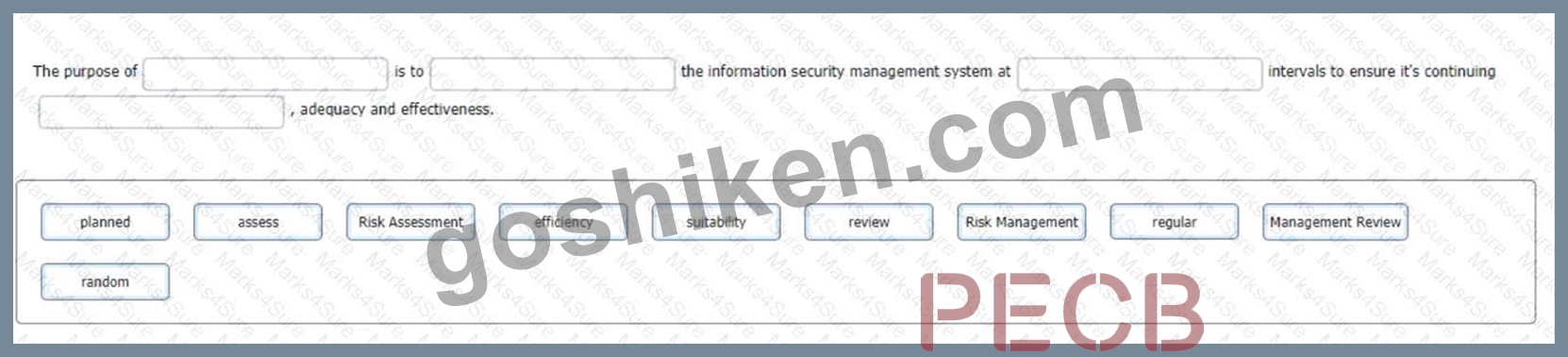
正解:
解説: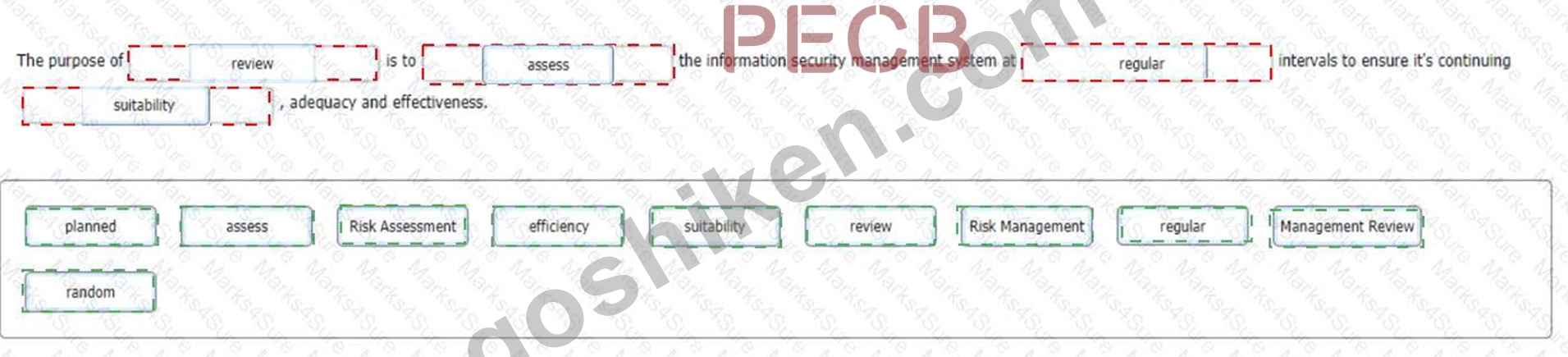
Explanation:
* Review is the third stage of the Plan-Do-Check-Act (PDCA) cycle, which is a four-step model for implementing and improving an information security management system (ISMS) according to ISO
/IEC 27001:202212. Review involves assessing and measuring the performance of the ISMS against the established policies, objectives, and criteria12.
* Assess is the verb that describes the action of reviewing the ISMS. Assess means to evaluate, analyze, or measure something in a systematic and objective manner3. Assessing the ISMS involves collecting and verifying audit evidence, identifying strengths and weaknesses, and determining the degree of conformity or nonconformity12.
* Regular is the adjective that describes the frequency or interval of reviewing the ISMS. Regular means occurring or done at fixed or uniform intervals4. Reviewing the ISMS at regular intervals means conducting internal audits and management reviews periodically, such as annually, quarterly, or monthly, depending on the needs and risks of the organization12.
* Suitability is one of the attributes that describes the quality or outcome of reviewing the ISMS. Suitability means being appropriate or fitting for a particular purpose, person, or situation5. Reviewing the ISMS for suitability means ensuring that it is aligned with the organization's strategic direction, business objectives, and information security requirements12.
References :=
* ISO/IEC 27001:2022 Information technology - Security techniques - Information security management systems - Requirements
* ISO/IEC 27003:2022 Information technology - Security techniques - Information security management systems - Guidance
* Assess | Definition of Assess by Merriam-Webster
* Regular | Definition of Regular by Merriam-Webster
* Suitability | Definition of Suitability by Merriam-Webster
質問 # 151
You have to carry out a third-party virtual audit. Which two of the following issues would you need to inform the auditee about before you start conducting the audit ?
- A. You will not record any part of the audit, unless permitted.
- B. You will ask to see the ID card of the person that is on the screen.
- C. You expect the auditee to have assessed all risks associated with online activities.
- D. You will take photos of every person you interview.
- E. You will ask those being interviewed to state their name and position beforehand.
- F. You will ask for a 360-degree view of the room where the audit is being carried out.
正解:E、F
解説:
A third-party virtual audit is an external audit conducted by an independent certification body using remote technology such as video conferencing, screen sharing, and electronic document exchange. The purpose of a third-party virtual audit is to verify the conformity and effectiveness of the information security management system (ISMS) and to issue a certificate of compliance12 Before you start conducting the audit, you would need to inform the auditee about the following issues: 12
* You will ask those being interviewed to state their name and position beforehand, i.e., to confirm their identity and role in the ISMS. This is to ensure that you are interviewing the relevant personnel and that they are authorized to provide information and evidence for the audit.
* You will ask for a 360-degree view of the room where the audit is being carried out, i.e., to verify the physical and environmental security of the audit location. This is to ensure that there are no unauthorized persons or devices in the vicinity that could compromise the confidentiality, integrity, or availability of the information being audited.
The other issues are not relevant or appropriate for a third-party virtual audit, because:
* You will ask to see the ID card of the person that is on the screen, i.e., to verify their identity. This is not necessary if you have already asked them to state their name and position beforehand, and if you have access to the auditee's organizational chart or staff directory. Asking to see the ID card could also be seen as intrusive or disrespectful by the auditee.
* You will take photos of every person you interview, i.e., to document the audit process. This is not advisable as it could violate the privacy or consent of the auditee and the interviewees. Taking photos could also be seen as unprofessional or suspicious by the auditee. You should rely on the audit records and evidence provided by the auditee and the audit tool instead.
* You will not record any part of the audit, unless permitted, i.e., to respect the auditee's preferences and rights. This is not a valid issue to inform the auditee about, as you should always record the audit for quality assurance and verification purposes. Recording the audit is also a requirement of the ISO/IEC
27001 standard and the certification body. You should inform the auditee that you will record the audit and obtain their consent before the audit begins.
* You expect the auditee to have assessed all risks associated with online activities, i.e., to ensure the security of the audit process. This is not an issue to inform the auditee about, as it is part of the auditee's responsibility and obligation to have a risk assessment and treatment process for their ISMS. You should assess the auditee's risk management practices and controls during the audit, not before it.
References:
1: ISO/IEC 27001:2022 Lead Auditor (Information Security Management Systems) Course by CQI and IRCA Certified Training 1 2: ISO/IEC 27001 Lead Auditor Training Course by PECB 2
質問 # 152
Which of the following is a possible event that can have a disruptive effect on the reliability of information?
- A. Dependency
- B. Vulnerability
- C. Risk
- D. Threat
正解:D
質問 # 153
You are an audit team leader conducting a third-party surveillance audit of a telecom services provider. You have assigned responsibility for auditing the organisation's information security objectives to a junior member of your audit team. Before they begin their assessment, you ask them the following question to check their understanding of the requirements of ISO/IEC 27001:2022.
Which four of the following criteria must Information security objectives fulfil?
- A. They must be reviewed annually
- B. They must always be monitored
- C. They must be available as documented information
- D. They must be communicated appropriately
- E. They must always be measured
- F. They must be achievable
- G. They must be clear and unambiguous
- H. They must be consistent with the IS Policy
正解:C、D、F、H
解説:
Explanation
According to ISO/IEC 27001:2022, clause 6.2, information security objectives are the specific results that an organisation intends to achieve with its information security management system (ISMS). The standard specifies that information security objectives must fulfil the following criteria:
* They must be communicated appropriately (A): The organisation must ensure that the relevant internal and external parties are informed about the information security objectives and their roles and responsibilities in achieving them. This can help to create awareness, commitment, and accountability for information security. This criterion is related to clause 6.2.2 of ISO/IEC 27001:2022.
* They must be available as documented information (B): The organisation must maintain and retain documented information on the information security objectives, including their scope, level, indicators, and time frame. This can help to provide evidence, traceability, and consistency for information security. This criterion is related to clause 6.2.1 of ISO/IEC 27001:2022.
* They must be consistent with the IS Policy (G): The organisation must ensure that the information security objectives are aligned with the information security policy, which is the top-level statement of the organisation's intentions and direction for information security. This can help to support the strategic objectives and the context of the organisation. This criterion is related to clause 5.2 of ISO/IEC
27001:2022.
* They must be achievable (H): The organisation must ensure that the information security objectives are realistic and attainable, considering the available resources, capabilities, and constraints. This can help to avoid setting unrealistic or unfeasible expectations and to monitor and measure the progress and performance of information security. This criterion is related to clause 6.2.1 of ISO/IEC 27001:2022.
References:
* ISO/IEC 27001:2022, Information technology - Security techniques - Information security management systems - Requirements1
* PECB Candidate Handbook ISO/IEC 27001 Lead Auditor2
* ISO 27001:2022 Lead Auditor - PECB3
* ISO 27001:2022 certified ISMS lead auditor - Jisc4
* ISO/IEC 27001:2022 Lead Auditor Transition Training Course5
* ISO 27001 - Information Security Lead Auditor Course - PwC Training Academy6
質問 # 154
In the context of a third-party certification audit, it is very important to have effective communication. Select an option that contains the correct answer about communication in an audit context.
- A. During the audit, the responibility for communication rests with the audit team leader
- B. During the audit, each auditor should periodically communicate any concerns to the auditee and audit client
- C. The formal communication channels between the audit team and the auditee can be established during the opening meeting
- D. There is no need to establish a formal communication arrangement because an auditee can communicate with the auditor at any time during the audit
正解:C
解説:
In the context of a third-party certification audit, it is very important to have effective communication between the audit team and the auditee. The formal communication channels, such as the names and contact details of the audit team members, the auditee representatives, the audit client and any other relevant parties, can be established during the opening meeting. This helps to ensure that the audit objectives, scope, criteria, methods, schedule and any other arrangements are clearly understood and agreed by all parties. It also facilitates the exchange of information, feedback, requests, concerns and complaints during the audit process.
References: = ISO 19011:2022, clause 6.4.2; PECB Candidate Handbook ISO 27001 Lead Auditor, page 25.
質問 # 155
You receive the following mail from the IT support team: Dear User,Starting next week, we will be deleting all inactive email accounts in order to create spaceshare the below details in order to continue using your account. In case of no response, Name:
Email ID:
Password:
DOB:
Kindly contact the webmail team for any further support. Thanks for your attention.
Which of the following is the best response?
- A. Ignore the email
- B. One should not respond to these mails and report such email to your supervisor
- C. Respond it by saying that one should not share the password with anyone
正解:B
解説:
Explanation
The best response to the email from the IT support team asking for personal details is to not respond to the email and report it to your supervisor. The email is likely a phishing attempt, which is a form of social engineering that uses deceptive emails or other messages to trick recipients into revealing sensitive information, such as passwords, credit card numbers, bank account details, etc. Phishing emails often impersonate legitimate organizations or individuals and create a sense of urgency or curiosity to lure the victims into clicking on malicious links, opening malicious attachments or providing personal information.
The IT support team should never ask for your password or other personal details via email, as this is a violation of information security policies and best practices. Ignoring the email or responding to it by saying that one should not share the password with anyone are not sufficient responses, as they do not alert the IT support team or your supervisor about the phishing attempt, which could affect other users as well. Reporting the email to your supervisor is a responsible action that could help prevent further damage or compromise of information. ISO/IEC 27001:2022 requires the organization to implement awareness and training programs to make users aware of the risks of social engineering attacks, such as phishing, and how to avoid them (see clause A.7.2.2). References: CQI & IRCA Certified ISO/IEC 27001:2022 Lead Auditor Training Course, ISO/IEC 27001:2022 Information technology - Security techniques - Information security management systems - Requirements, What is Phishing?
質問 # 156
You are an experienced ISMS audit team leader providing instruction to an auditor in training. They are unclear in their understanding of risk processes and ask you to provide them with an example of each of the processes detailed below.
Match each of the descriptions provided to one of the following risk management processes.
To complete the table click on the blank section you want to complete so that it is highlighted in red, and then click on the applicable text from the options below. Alternatively, you may drag and drop each option to the appropriate blank section.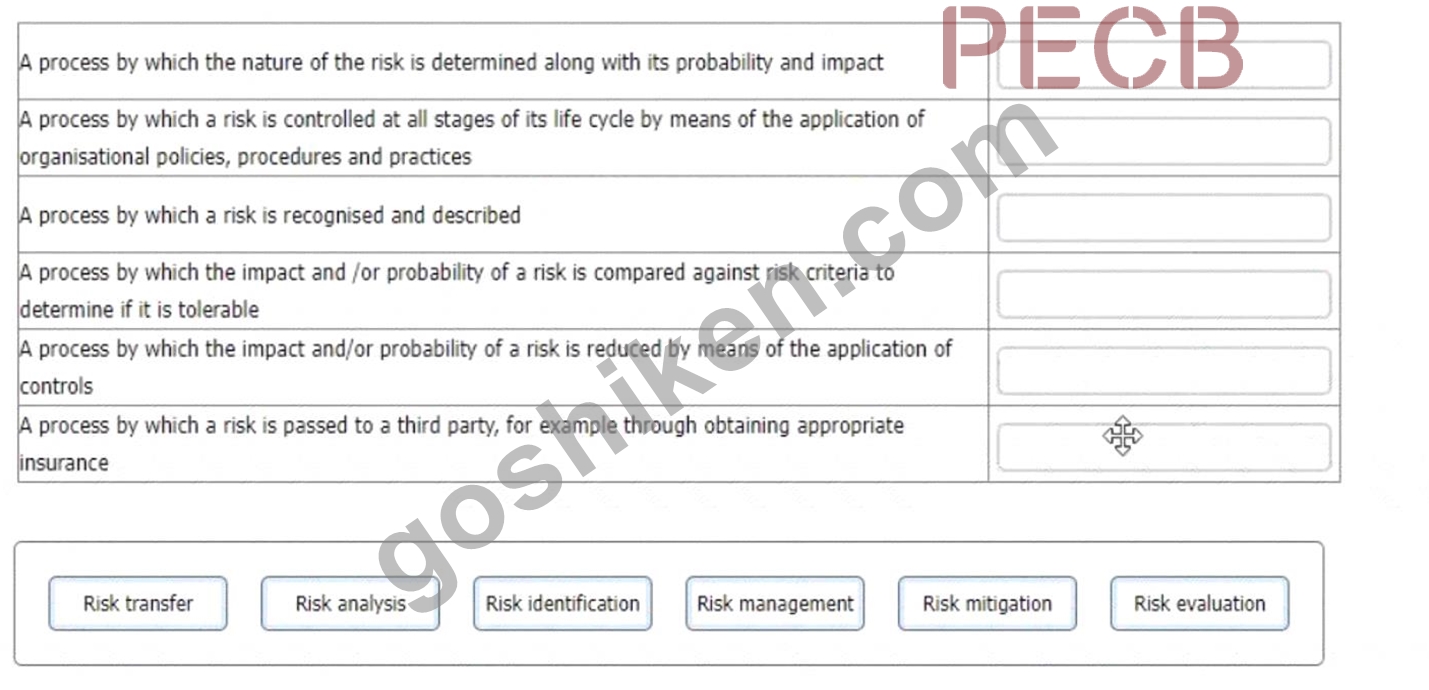
正解:
解説: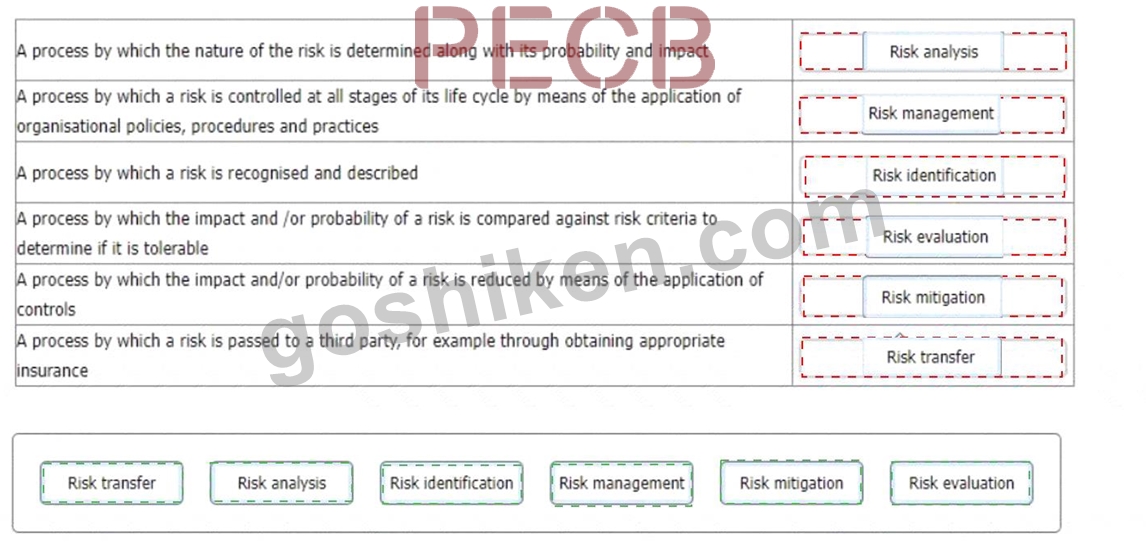
Explanation: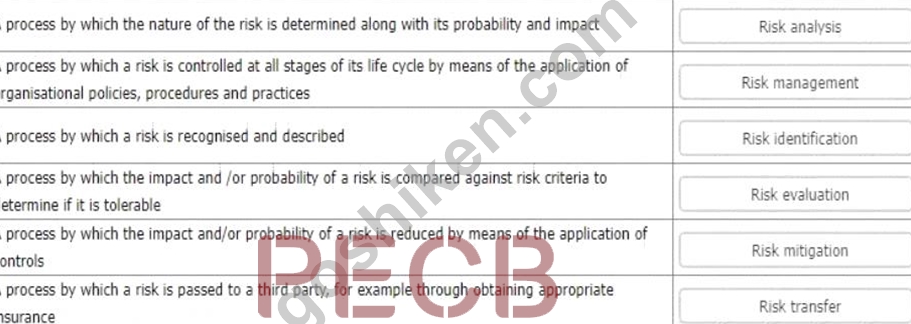
* Risk analysis is the process by which the nature of the risk is determined along with its probability and impact. Risk analysis involves estimating the likelihood and consequences of potential events or situations that could affect the organization's information security objectives or requirements12. Risk analysis could use qualitative or quantitative methods, or a combination of both12.
* Risk management is the process by which a risk is controlled at all stages of its life cycle by means of the application of organisational policies, procedures and practices. Risk management involves establishing the context, identifying, analyzing, evaluating, treating, monitoring, and reviewing the risks that could affect the organization's information security performance or compliance12. Risk management aims to ensure that risks are identified and treated in a timely and effective manner, and that opportunities for improvement are exploited12.
* Risk identification is the process by which a risk is recognised and described. Risk identification involves identifying and documenting the sources, causes, events, scenarios, and potential impacts of risks that could affect the organization's information security objectives or requirements12. Risk identification could use various techniques, such as brainstorming, interviews, checklists, surveys, or historical data12.
* Risk evaluation is the process by which the impact and/or probability of a risk is compared against risk criteria to determine if it is tolerable. Risk evaluation involves comparing the results of risk analysis with predefined criteria that reflect the organization's risk appetite, tolerance, or acceptance12. Risk evaluation could use various methods, such as ranking, scoring, or matrix12. Risk evaluation helps to prioritize and decide on the appropriate risk treatment options12.
* Risk mitigation is the process by which the impact and/or probability of a risk is reduced by means of the application of controls. Risk mitigation involves selecting and implementing measures that are designed to prevent, reduce, transfer, or accept risks that could affect the organization's information security objectives or requirements12. Risk mitigation could include various types of controls, such as technical, organizational, legal, or physical12. Risk mitigation should be based on a cost-benefit analysis and a residual risk assessment12.
* Risk transfer is the process by which a risk is passed to a third party, for example through obtaining appropriate insurance. Risk transfer involves sharing or shifting some or all of the responsibility or liability for a risk to another party that has more capacity or capability to manage it12. Risk transfer could include various methods, such as contracts, agreements, partnerships, outsourcing, or insurance12. Risk transfer should not be used as a substitute for effective risk management within the organization12.
References :=
* ISO/IEC 27001:2022 Information technology - Security techniques - Information security management systems - Requirements
* ISO/IEC 27005:2022 Information technology - Security techniques - Information security risk management
質問 # 157
How is the purpose of information security policy best described?
- A. An information security policy documents the analysis of risks and the search for countermeasures.
- B. An information security policy provides direction and support to the management regarding information security.
- C. An information security policy makes the security plan concrete by providing it with the necessary details.
- D. An information security policy provides insight into threats and the possible consequences.
正解:B
解説:
Explanation
The purpose of information security policy is best described as providing direction and support to the management regarding information security. An information security policy is a high-level document that defines the organization's vision, objectives, principles and responsibilities for information security. It also sets the scope and context of the information security management system and aligns it with the organization's strategy and culture. An information security policy does not document the analysis of risks or the search for countermeasures, nor does it make the security plan concrete or provide insight into threats and consequences.
These are tasks for other documents or processes within the information security management system.
ISO/IEC 27001:2022 defines information security policy as "policy that provides direction and support for information security in accordance with business requirements and relevant laws and regulations" (see clause
3.29). References: [CQI & IRCA Certified ISO/IEC 27001:2022 Lead Auditor Training Course], ISO/IEC
27001:2022 Information technology - Security techniques - Information security management systems - Requirements, What is Information Security Policy?
質問 # 158
Select the words that best complete the sentence:
"The purpose of maintaining regulatory compliance in a management system is to To complete the sentence with the best word(s), click on the blank section you want to complete so that it is highlighted in red, and then click on the applicable text from the options below. Alternatively, you may drag and drop the option to the appropriate blank section.
正解:
解説:
Explanation
According to ISO 27001:2013, clause 5.2, the top management of an organization must establish, implement and maintain an information security policy that is appropriate to the purpose of the organization and provides a framework for setting information security objectives. The information security policy must also include a commitment to comply with the applicable legal, regulatory and contractual requirements, as well as any other requirements that the organization subscribes to. Therefore, maintaining regulatory compliance is part of fulfilling the management system policy and ensuring its effectiveness and suitability. References:
* ISO/IEC 27001:2013, Information technology - Security techniques - Information security management systems - Requirements, clause 5.2
* PECB Candidate Handbook ISO 27001 Lead Auditor, page 10
* ISO 27001 Policy: How to write it according to ISO 27001
質問 # 159
Review the following statements and determine which two are false:
- A. The number of days assigned to a third-party audit is determined by the auditee's availability
- B. Due to confidentiality and security concerns, screen sharing during a virtual audit is one method by which the audit team can review the auditee's documentation
- C. Conducting a technology check in advance of a virtual audit can improve the effectiveness and efficiency of the audit
- D. The selection of onsite, virtual or combination audits should take into consideration historical performance and previous audit results
- E. Auditors approved for conducting onsite audits do not require additional training for virtual audits, as there are no significant differences in the skillset required
- F. During a virtual audit, auditees participating in interviews are strongly recommended to keep their webcam enabled
正解:A、E
解説:
* A: Auditors approved for conducting onsite audits do require additional training for virtual audits to ensure they are competent in using the technology and tools required for conducting audits remotely12.
* E: The number of days assigned to a third-party audit is not determined by the auditee's availability, but rather by factors such as the size and complexity of the organization, the scope of the audit, and the requirements of the certification body34.
References: The answers are verified based on the content and objectives of the ISMS ISO/IEC 27001 Lead Auditor course, as well as the guidelines provided in the reference materials and documents related to the course.
質問 # 160
Below is Purpose of "Integrity", which is one of the Basic Components of Information Security
- A. the property that information is not made available or disclosed to unauthorized individuals
- B. the property of safeguarding the accuracy and completeness of assets.
- C. the property that information is not made available or disclosed to unauthorized individuals
- D. the property of being accessible and usable upon demand by an authorized entity.
正解:B
解説:
Integrity is one of the basic components of information security, along with confidentiality and availability.
Integrity means that information is safeguarded from unauthorized or accidental changes that could affect its accuracy and completeness. Integrity ensures that information is reliable and trustworthy3. References: ISO/IEC 27001:2022 Lead Auditor Training Course - BSI
質問 # 161
During a third-party certification audit, you are presented with a list of issues by an auditee. Which four of the following constitute 'internal' issues in the context of a management system to ISO 27001:2022?
- A. Poor levels of staff competence as a result of cuts in training expenditure
- B. Poor morale as a result of staff holidays being reduced
- C. A rise in interest rates in response to high inflation
- D. Higher labour costs as a result of an aging population
- E. Inability to source raw materials due to government sanctions
- F. A reduction in grants as a result of a change in government policy
- G. Increased absenteeism as a result of poor management
- H. A fall in productivity linked to outdated production equipment
正解:A、B、G、H
解説:
According to ISO 27001:2022 clause 4.1, the organisation shall determine external and internal issues that are relevant to its purpose and that affect its ability to achieve the intended outcome(s) of its information security management system (ISMS)12 External issues are factors outside the organisation that it cannot control, but can influence or adapt to. They include political, economic, social, technological, legal, and environmental factors that may affect the organisation's information security objectives, risks, and opportunities12 Internal issues are factors within the organisation that it can control or change. They include the organisation' s structure, culture, values, policies, objectives, strategies, capabilities, resources, processes, activities, relationships, and performance that may affect the organisation's information security management system12 Therefore, the following issues are considered 'internal' in the context of a management system to ISO 27001:
2022:
* Poor levels of staff competence as a result of cuts in training expenditure: This is an internal issue because it relates to the organisation's capability, resource, and process of developing and maintaining the competence of its personnel involved in the ISMS. The organisation can control or change its training expenditure and its impact on staff competence12
* Poor morale as a result of staff holidays being reduced: This is an internal issue because it relates to the organisation's culture, value, and relationship with its employees. The organisation can control or change its staff holiday policy and its impact on staff morale12
* Increased absenteeism as a result of poor management: This is an internal issue because it relates to the organisation's performance, structure, and accountability of its management. The organisation can control or change its management practices and its impact on staff absenteeism12
* A fall in productivity linked to outdated production equipment: This is an internal issue because it relates to the organisation's capability, resource, and process of ensuring the availability and suitability of its production equipment. The organisation can control or change its equipment maintenance and upgrade and its impact on productivity12 The following issues are considered 'external' in the context of a management system to ISO 27001:2022:
* Higher labour costs as a result of an aging population: This is an external issue because it relates to the social and demographic factor that affects the availability and cost of labour in the market. The organisation cannot control or change the aging population, but can influence or adapt to its impact on labour costs12
* A rise in interest rates in response to high inflation: This is an external issue because it relates to the economic and monetary factor that affects the cost and availability of capital in the market. The organisation cannot control or change the interest rates or inflation, but can influence or adapt to its impact on capital costs12
* A reduction in grants as a result of a change in government policy: This is an external issue because it relates to the political and legal factor that affects the availability and conditions of public funding for the organisation. The organisation cannot control or change the government policy, but can influence or adapt to its impact on grants12
* Inability to source raw materials due to government sanctions: This is an external issue because it relates to the political and legal factor that affects the availability and cost of raw materials in the market. The organisation cannot control or change the government sanctions, but can influence or adapt to its impact on raw materials12 References:
1: ISO/IEC 27001:2022 Lead Auditor (Information Security Management Systems) Course by CQI and IRCA Certified Training 1 2: ISO/IEC 27001 Lead Auditor Training Course by PECB 2
質問 # 162
You are performing an ISMS audit at a European-based residential nursing home called ABC that provides healthcare services. The next step in your audit plan is to verify the effectiveness of the continual improvement process.
During the audit, you learned most of the residents' family members (90%) receive WeCare medical devices promotion advertisements through email and SMS once a week via ABC's healthcare mobile app. All of them do not agree on the use of the collected personal data for marketing or any other purposes than nursing and medical care on the signed service agreement with ABC. They have very strong reason to believe that ABC is leaking residents' and family members' personal information to a non-relevant third party and they have filed complaints.
The Service Manager says that, after investigation, all these complaints have been treated as nonconformities.
The corrective actions have been planned and implemented according to the nonconformity and corrective management procedure (Document reference ID: ISMS_L2_10.1, version 1).
You write a nonconformity which you will follow up on later. Select the words that best complete the sentence: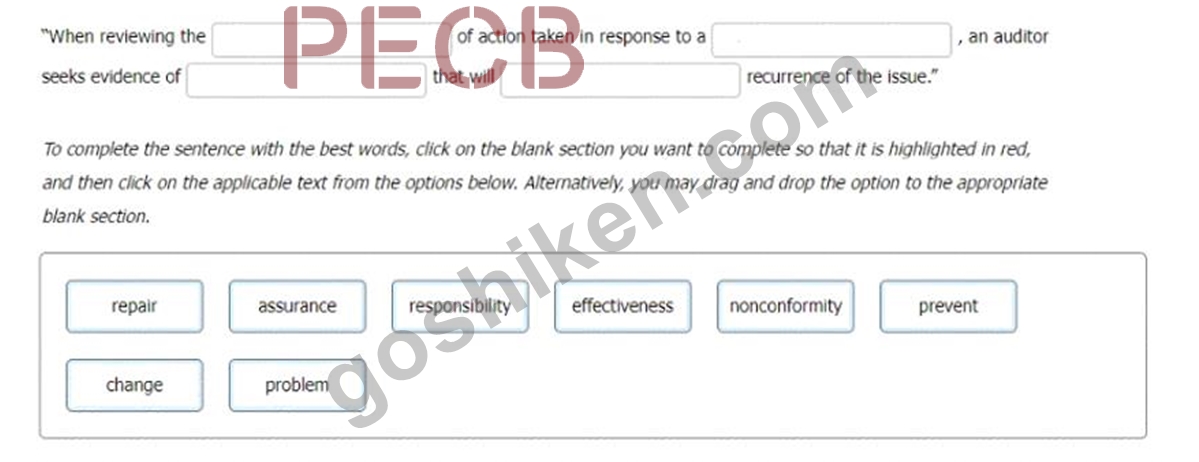
正解:
解説: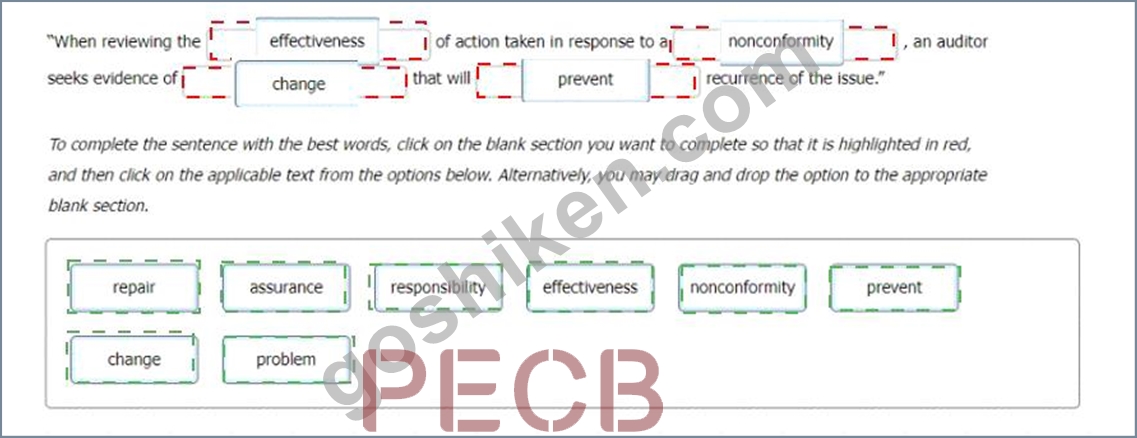
Explanation:
One possible way to complete the sentence is:
"When reviewing the effectiveness of action taken in response to a nonconformity, an auditor seeks evidence of change that will prevent recurrence of the issue." According to ISO/IEC 27001:2022, clause 10.1, the organization shall continually improve the suitability, adequacy, and effectiveness of the ISMS by evaluating the performance and the effectiveness of the ISMS, ensuring that the policy and objectives are aligned with the strategic direction of the organization, and taking actions to achieve the intended outcomes of the ISMS. One of the ways to achieve continual improvement is to identify and correct nonconformities and take actions to eliminate their causes and prevent their recurrence.
Therefore, when reviewing the effectiveness of the corrective actions, an auditor should look for evidence that the organization has analyzed the root cause of the nonconformity, implemented appropriate changes to the ISMS, and verified that the changes have resulted in the desired improvement and prevented the recurrence of the issue. References: =
* ISO/IEC 27001:2022, clause 10.1, Nonconformity and corrective action
* ISO/IEC 27001:2022, clause 10.2, Continual improvement
* PECB Candidate Handbook ISO 27001 Lead Auditor, page 19, Audit Process
* PECB Candidate Handbook ISO 27001 Lead Auditor, page 21, Audit Findings
質問 # 163
You are performing an ISMS audit at a European-based residential
nursing home called ABC that provides healthcare services. You find all nursing home residents wear an electronic wristband for monitoring their location, heartbeat, and blood pressure always. You learned that the electronic wristband automatically uploads all data to the artificial intelligence (AI) cloud server for healthcare monitoring and analysis by healthcare staff.
The next step in your audit plan is to verify that the information security policy and objectives have been established by top management.
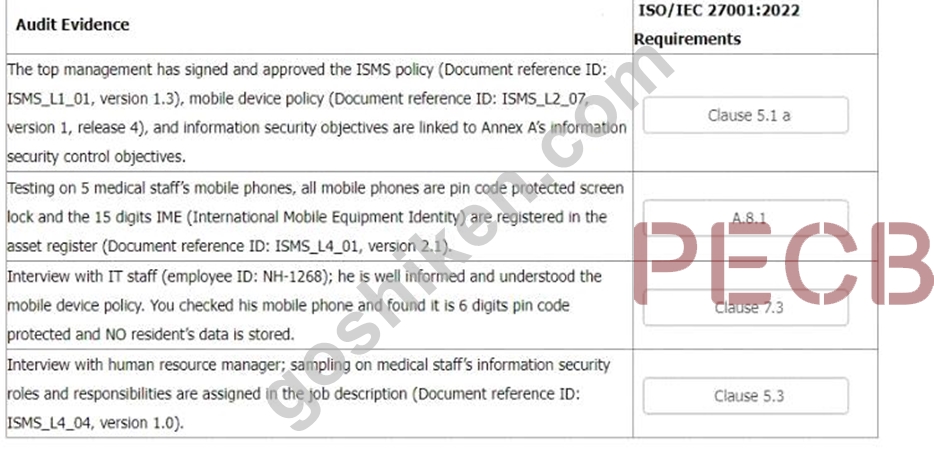
During the audit, you found the following audit evidence.
Match the audit evidence to the corresponding requirement in ISO/IEC 27001:2022.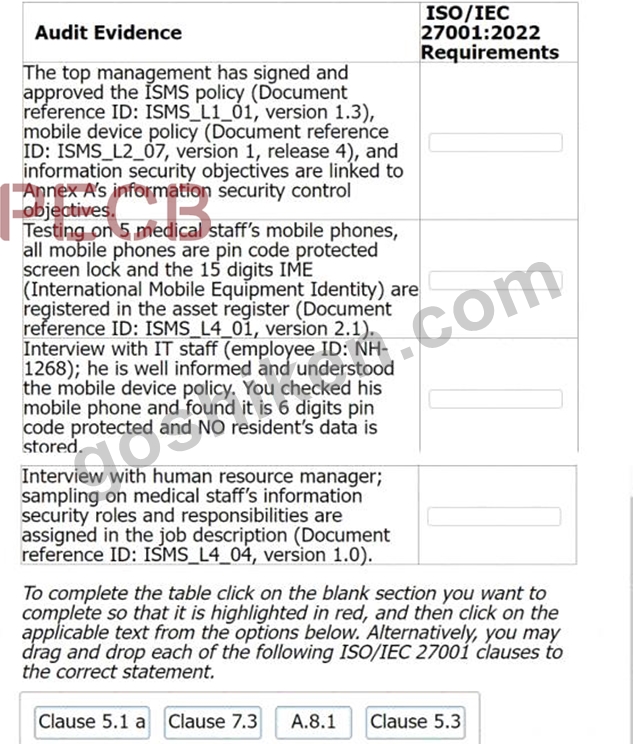
正解:
解説: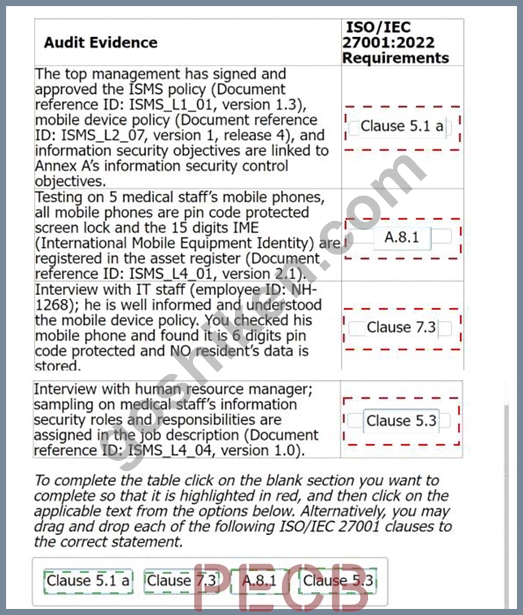
質問 # 164
You are performing an ISMS audit at a residential nursing home called ABC that provides healthcare services.
You find all nursing home residents wear an electronic wristband for monitoring their location, heartbeat, and blood pressure always. You learned that the electronic wristband automatically uploads all data to the artificial intelligence (AI) cloud server for healthcare monitoring and analysis by healthcare staff.
To verify the scope of ISMS, you interview the management system representative (MSR) who explains that the ISMS scope covers an outsourced data center.
Select three options for the audit evidence you need to find to verify the scope of the ISMS.
- A. The auditee has identified the resident's needs and expectations on healthcare medical treatment services
- B. The auditee is considering the purchase of a healthcare monitoring app from an external software company
- C. The auditee has ISO 9001 certification
- D. The IT service agreement with the data center where the artificial intelligence (AI) cloud server is located
- E. The auditee has identified the resident's needs and expectations on the comfort facility, medical professional's competence, and clean environment
- F. The auditee has identified the resident's needs and expectations on the facility and environmental safety
- G. The auditee has identified the governmental authorities' needs and expectations on healthcare services and patient data handling
- H. The auditee has identified the resident's needs and expectations on how they should protect the resident's personal data
正解:D、G、H
解説:
According to ISO 27001:2022 clause 4.3, the organisation shall determine the scope of the information security management system (ISMS) by considering the internal and external issues, the requirements of interested parties, and the interfaces and dependencies with other organisations12 In this case, the ISMS scope covers an outsourced data center that hosts the artificial intelligence (AI) cloud server for healthcare monitoring and analysis of the residents' data. Therefore, the audit evidence you need to find to verify the scope of the ISMS should include:
* The auditee has identified the governmental authorities' needs and expectations on healthcare services and patient data handling. This is an external issue and an interested party requirement that affects the ISMS scope, as the auditee has to comply with the relevant laws and regulations regarding the quality, safety, and privacy of healthcare services and patient data12
* The auditee has identified the resident's needs and expectations on how they should protect the resident's personal data. This is an external issue and an interested party requirement that affects the ISMS scope, as the auditee has to ensure the confidentiality, integrity, and availability of the resident's personal data that is collected, processed, and stored by the electronic wristband and the AI cloud server12
* The IT service agreement with the data center where the artificial intelligence (AI) cloud server is located. This is an interface and dependency with another organisation that affects the ISMS scope, as the auditee has to control the externally provided processes, products, and services that are relevant to the ISMS, and to implement appropriate contractual requirements related to information security12 The following options are not relevant or sufficient for verifying the scope of the ISMS:
* The auditee has identified the resident's needs and expectations on the facility and environmental safety.
This is an external issue and an interested party requirement, but it does not affect the ISMS scope, as it is not related to information security12
* The auditee has ISO 9001 certification. This is an indication of the auditee's quality management system, but it does not verify the scope of the ISMS, as it is not related to information security12
* The auditee has identified the resident's needs and expectations on the comfort facility, medical professional's competence, and clean environment. These are external issues and interested party requirements, but they do not affect the ISMS scope, as they are not related to information security12
* The auditee has identified the resident's needs and expectations on healthcare medical treatment services. These are external issues and interested party requirements, but they do not verify the scope of
* the ISMS, as they are not specific to information security12
* The auditee is considering the purchase of a healthcare monitoring app from an external software company. This is a potential change that may affect the ISMS scope in the future, but it does not verify the current scope of the ISMS, as it is not yet implemented or controlled12 References:
1: ISO/IEC 27001:2022 Lead Auditor (Information Security Management Systems) Course by CQI and IRCA Certified Training 1 2: ISO/IEC 27001 Lead Auditor Training Course by PECB 2
質問 # 165
Scenario 9: UpNet, a networking company, has been certified against ISO/IEC 27001. It provides network security, virtualization, cloud computing, network hardware, network management software, and networking technologies.
The company's recognition has increased drastically since gaining ISO/IEC 27001 certification. The certification confirmed the maturity of UpNefs operations and its compliance with a widely recognized and accepted standard.
But not everything ended after the certification. UpNet continually reviewed and enhanced its security controls and the overall effectiveness and efficiency of the ISMS by conducting internal audits. The top management was not willing to employ a full-time team of internal auditors, so they decided to outsource the internal audit function. This form of internal audits ensured independence, objectivity, and that they had an advisory role about the continual improvement of the ISMS.
Not long after the initial certification audit, the company created a new department specialized in data and storage products. They offered routers and switches optimized for data centers and software-based networking devices, such as network virtualization and network security appliances. This caused changes to the operations of the other departments already covered in the ISMS certification scope.
Therefore. UpNet initiated a risk assessment process and an internal audit. Following the internal audit result, the company confirmed the effectiveness and efficiency of the existing and new processes and controls.
The top management decided to include the new department in the certification scope since it complies with ISO/IEC 27001 requirements. UpNet announced that it is ISO/IEC 27001 certified and the certification scope encompasses the whole company.
One year after the initial certification audit, the certification body conducted another audit of UpNefs ISMS.
This audit aimed to determine the UpNefs ISMS fulfillment of specified ISO/IEC 27001 requirements and ensure that the ISMS is being continually improved. The audit team confirmed that the certified ISMS continues to fulfill the requirements of the standard. Nonetheless, the new department caused a significant impact on governing the management system. Moreover, the certification body was not informed about any changes. Thus, the UpNefs certification was suspended.
Based on the scenario above, answer the following question:
Based on scenario 9, why was UpNefs certification suspended?
- A. Because UpNet used and applied the certification out of its scope
- B. Because UpNefs ISMS does not fulfill the requirements of the standard
- C. Because UpNet outsourced the internal audit function
正解:A
解説:
UpNet's certification was suspended because the certification body was not informed about the significant changes caused by the new department, impacting the governance of the management system. ISO/IEC 27001 requires organizations to inform the certification body of any changes that significantly impact the ISMS.
質問 # 166
CMM stands for?
- A. Capacity Maturity Matrix
- B. Capability Maturity Model
- C. Capability Maturity Matrix
- D. Capable Mature Model
正解:B
質問 # 167
Which department maintain's contacts with law enforcement authorities, regulatory bodies, information service providers and telecommunications service providers depending on the service required.
- A. MRO
- B. CISO
- C. COO
- D. CSM
正解:B
解説:
The department that maintains contacts with law enforcement authorities, regulatory bodies, information service providers and telecommunications service providers depending on the service required is CISO. CISO stands for Chief Information Security Officer. A CISO is a senior-level executive who is responsible for overseeing the information security strategy and governance of an organization. A CISO also leads the information security function and coordinates with other departments and stakeholders to ensure compliance with laws, regulations and standards related to information security. A CISO may also act as a liaison between the organization and external parties, such as law enforcement authorities or service providers, in case of incidents or investigations involving information security issues. ISO/IEC 27001:2022 requires the organization to assign top management roles and responsibilities for ensuring that information security objectives are established and achieved (see clause 5.3). Reference: CQI & IRCA Certified ISO/IEC 27001:2022 Lead Auditor Training Course, ISO/IEC 27001:2022 Information technology - Security techniques - Information security management systems - Requirements, What is CISO?
質問 # 168
__________ is a software used or created by hackers to disrupt computer operation, gather sensitive information, or gain access to private computer systems.
- A. Virus
- B. Trojan
- C. Operating System
- D. Malware
正解:D
解説:
Explanation
Malware is a software used or created by hackers to disrupt computer operation, gather sensitive information, or gain access to private computer systems. Malware is a general term that covers various types of malicious software, such as viruses, worms, trojans, ransomware, spyware, adware, etc. Malware can cause serious damage to the organization's information assets and reputation, and may lead to legal or regulatory consequences. Therefore, the organization should implement appropriate controls to prevent, detect and remove malware, as specified in ISO/IEC 27001:2022 clause 12.2.1. References: [CQI & IRCA Certified ISO/IEC 27001:2022 Lead Auditor Training Course], ISO/IEC 27001:2022 Information technology - Security techniques - Information security management systems - Requirements, What is malware?
質問 # 169
You are conducting a third-party surveillance audit when another member of the audit team approaches you seeking clarification. They have been asked to assess the organisation's application of control 5.7 - Threat Intelligence. They are aware that this is one of the new controls introduced in the 2022 edition of ISO/IEC
27001, and they want to make sure they audit the control correctly.
They have prepared a checklist to assist them with their audit and want you to confirm that their planned activities are aligned with the control's requirements.
Which three of the following options represent valid audit trails?
- A. I will ensure that the organisation's risk assessment process begins with effective threat intelligence
- B. I will review the organisation's threat intelligence process and will ensure that this is fully documented
- C. I will speak to top management to make sure all staff are aware of the importance of reporting threats
- D. I will determine whether internal and external sources of information are used in the production of threat intelligence
- E. I will check that threat intelligence is actively used to protect the confidentiality, integrity and availability of the organisation's information assets
- F. I will ensure that appropriate measures have been introduced to inform top management as to the effectiveness of current threat intelligence arrangements
- G. I will review how information relating to information security threats is collected and evaluated to produce threat intelligence
- H. I will ensure that the task of producing threat intelligence is assigned to the organisation s internal audit team
正解:B、D、E
解説:
According to ISO/IEC 27001:2022, which specifies the requirements for establishing, implementing, maintaining and continually improving an information security management system (ISMS), control 5.7 requires an organization to establish and maintain a threat intelligence process to identify and evaluate information security threats that are relevant to its ISMS scope and objectives1. The organization should use internal and external sources of information, such as vulnerability databases, threat feeds, industry reports, etc., to produce threat intelligence that can be used to support risk assessment and treatment, as well as other information security activities1. Therefore, when auditing the organization's application of control 5.7, an ISMS auditor should verify that these aspects are met in accordance with the audit criteria.
Three options that represent valid audit trails for verifying control 5.7 are:
* I will review the organisation's threat intelligence process and will ensure that this is fully documented:
This option is valid because it can provide evidence of how the organization has established and maintained a threat intelligence process that is consistent with its ISMS scope and objectives. It can also verify that the process is documented according to clause 7.5 of ISO/IEC 27001:20221.
* I will check that threat intelligence is actively used to protect the confidentiality, integrity and availability of the organisation's information assets: This option is valid because it can provide evidence of how the organization has used threat intelligence to support its risk assessment and treatment, as well as other information security activities, such as incident response, awareness, or monitoring. It can also verify that the organization has achieved its information security objectives according to clause 6.2 of ISO/IEC 27001:20221.
* I will determine whether internal and external sources of information are used in the production of threat intelligence: This option is valid because it can provide evidence of how the organization has used various sources of information, such as vulnerability databases, threat feeds, industry reports, etc., to produce threat intelligence that is relevant and reliable. It can also verify that the organization has complied with the requirement of control 5.7 of ISO/IEC 27001:20221.
The other options are not valid audit trails for verifying control 5.7, as they are not related to the control or its requirements. For example:
* I will speak to top management to make sure all staff are aware of the importance of reporting threats:
This option is not valid because it does not provide evidence of how the organization has established and maintained a threat intelligence process or used threat intelligence to support its ISMS activities. It may be related to another control or requirement regarding information security awareness or communication, but not specifically to control 5.7.
* I will ensure that the task of producing threat intelligence is assigned to the organisation s internal audit team: This option is not valid because it does not provide evidence of how the organization has established and maintained a threat intelligence process or used threat intelligence to support its ISMS activities. It may also contradict the requirement for auditor independence and objectivity, as recommended by ISO 19011:20182, which provides guidelines for auditing management systems.
* I will ensure that the organisation's risk assessment process begins with effective threat intelligence:
This option is not valid because it does not provide evidence of how the organization has established and maintained a threat intelligence process or used threat intelligence to support its ISMS activities. It may also imply a prescriptive approach to risk assessment that is not consistent with ISO/IEC 27005:20183, which provides guidelines for information security risk management.
* I will review how information relating to information security threats is collected and evaluated to produce threat intelligence: This option is not valid because it does not provide evidence of how the organization has established and maintained a threat intelligence process or used threat intelligence to support its ISMS activities. It may also be too vague or broad to be an effective audit trail, as it does not specify what criteria or methods are used for collecting and evaluating information.
* I will ensure that appropriate measures have been introduced to inform top management as to the effectiveness of current threat intelligence arrangements: This option is not valid because it does not provide evidence of how the organization has established and maintained a threat intelligence process or used threat intelligence to support its ISMS activities. It may be related to another control or requirement regarding management review or performance evaluation, but not specifically to control 5.7.
References: ISO/IEC 27001:2022 - Information technology - Security techniques - Information security management systems - Requirements, ISO 19011:2018 - Guidelines for auditing management systems, ISO/IEC 27005:2018 - Information technology - Security techniques - Information security risk management
質問 # 170
You have to carry out a third-party virtual audit. Which two of the following issues would you need to inform the auditee about before you start conducting the audit ??
- A. You will not record any part of the audit, unless permitted.
- B. You will ask to see the ID card of the person that is on the screen.
- C. You expect the auditee to have assessed all risks associated with online activities.
- D. You will take photos of every person you interview.
- E. You will ask those being interviewed to state their name and position beforehand.
- F. You will ask for a 360-degree view of the room where the audit is being carried out.
正解:E、F
解説:
Explanation
A third-party virtual audit is an external audit conducted by an independent certification body using remote technology such as video conferencing, screen sharing, and electronic document exchange. The purpose of a third-party virtual audit is to verify the conformity and effectiveness of the information security management system (ISMS) and to issue a certificate of compliance12 Before you start conducting the audit, you would need to inform the auditee about the following issues: 12 You will ask those being interviewed to state their name and position beforehand, i.e., to confirm their identity and role in the ISMS. This is to ensure that you are interviewing the relevant personnel and that they are authorized to provide information and evidence for the audit.
You will ask for a 360-degree view of the room where the audit is being carried out, i.e., to verify the physical and environmental security of the audit location. This is to ensure that there are no unauthorized persons or devices in the vicinity that could compromise the confidentiality, integrity, or availability of the information being audited.
The other issues are not relevant or appropriate for a third-party virtual audit, because:
You will ask to see the ID card of the person that is on the screen, i.e., to verify their identity. This is not necessary if you have already asked them to state their name and position beforehand, and if you have access to the auditee's organizational chart or staff directory. Asking to see the ID card could also be seen as intrusive or disrespectful by the auditee.
You will take photos of every person you interview, i.e., to document the audit process. This is not advisable as it could violate the privacy or consent of the auditee and the interviewees. Taking photos could also be seen as unprofessional or suspicious by the auditee. You should rely on the audit records and evidence provided by the auditee and the audit tool instead.
You will not record any part of the audit, unless permitted, i.e., to respect the auditee's preferences and rights. This is not a valid issue to inform the auditee about, as you should always record the audit for quality assurance and verification purposes. Recording the audit is also a requirement of the ISO/IEC
27001 standard and the certification body. You should inform the auditee that you will record the audit and obtain their consent before the audit begins.
You expect the auditee to have assessed all risks associated with online activities, i.e., to ensure the security of the audit process. This is not an issue to inform the auditee about, as it is part of the auditee's responsibility and obligation to have a risk assessment and treatment process for their ISMS. You should assess the auditee's risk management practices and controls during the audit, not before it.
References:
1: ISO/IEC 27001:2022 Lead Auditor (Information Security Management Systems) Course by CQI and IRCA Certified Training 1 2: ISO/IEC 27001 Lead Auditor Training Course by PECB 2
質問 # 171
Your organisation is currently seeking ISO/IEC27001:2022 certification. You have just qualified as an Internal ISMS auditor and the ICT Manager wants to use your newly acquired knowledge to assist him with the design of an information security incident management process.
He identifies the following stages in his planned process and asks you to confirm which order they should appear in.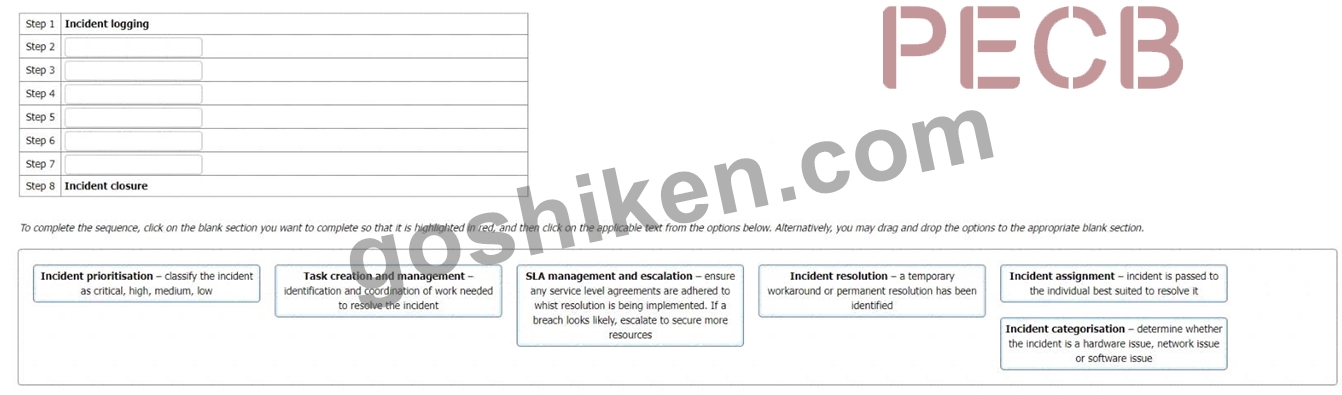
正解:
解説: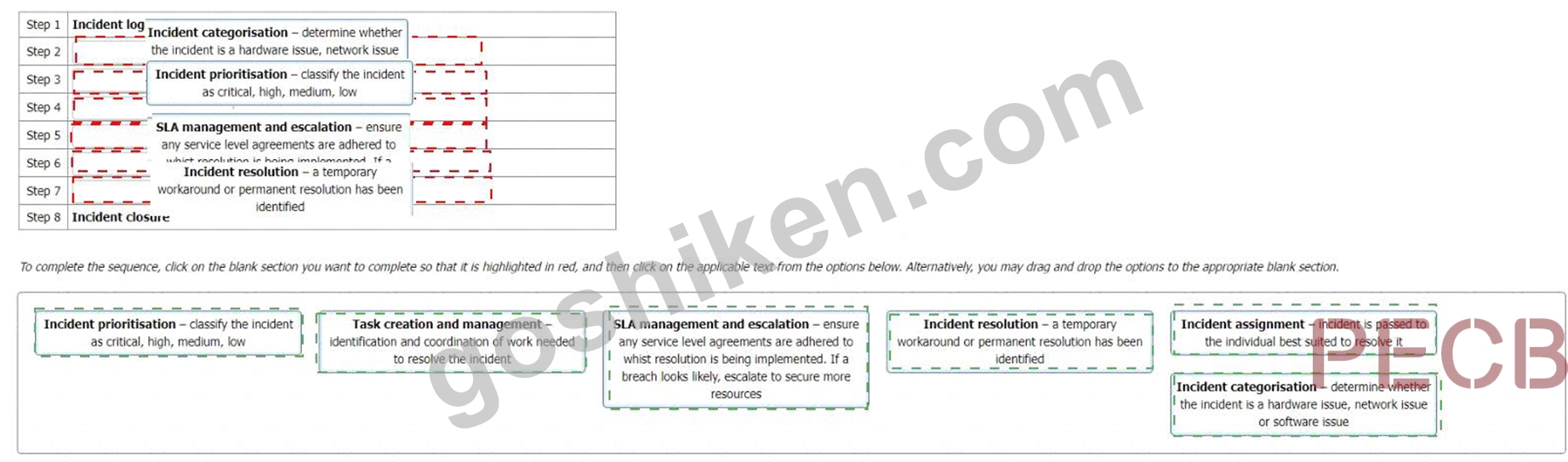
Explanation
Step 1 = Incident logging Step 2 = Incident categorisation Step 3 = Incident prioritisation Step 4 = Incident assignment Step 5 = Task creation and management Step 6 = SLA management and escalation Step 7 = Incident resolution Step 8 = Incident closure The order of the stages in the information security incident management process should follow a logical sequence that ensures a quick, effective, and orderly response to the incidents, events, and weaknesses. The order should also be consistent with the best practices and guidance provided by ISO/IEC 27001:2022 and ISO/IEC 27035:2022. Therefore, the following order is suggested:
* Step 1 = Incident logging: This step involves recording the details of the potential incident, event, or weakness, such as the date, time, source, description, impact, and reporter. This step is important to provide a traceable record of the incident and to facilitate the subsequent analysis and response. This step is related to control A.16.1.1 of ISO/IEC 27001:2022, which requires the organization to establish responsibilities and procedures for the management of information security incidents, events, and weaknesses. This step is also related to clause 6.2 of ISO/IEC 27035:2022, which provides guidance on how to log the incidents, events, and weaknesses.
* Step 2 = Incident categorisation: This step involves determining the type and nature of the incident, event, or weakness, such as whether it is a hardware issue, network issue, or software issue. This step is important to classify the incident and to assign it to the appropriate resolver or team. This step is related to control A.16.1.2 of ISO/IEC 27001:2022, which requires the organization to report information
* security events and weaknesses as quickly as possible through appropriate management channels. This step is also related to clause 6.3 of ISO/IEC 27035:2022, which provides guidance on how to categorize the incidents, events, and weaknesses.
* Step 3 = Incident prioritisation: This step involves assessing the severity and urgency of the incident, event, or weakness, and classifying it as critical, high, medium, or low. This step is important to prioritize the incident and to allocate the necessary resources and time for the response. This step is related to control A.16.1.3 of ISO/IEC 27001:2022, which requires the organization to assess and prioritize information security events and weaknesses in accordance with the defined criteria. This step is also related to clause 6.4 of ISO/IEC 27035:2022, which provides guidance on how to prioritize the incidents, events, and weaknesses.
* Step 4 = Incident assignment: This step involves passing the incident, event, or weakness to the individual or team who is best suited to resolve it, based on their skills, knowledge, and availability.
This step is important to ensure that the incident is handled by the right person or team and to avoid delays or confusion. This step is related to control A.16.1.4 of ISO/IEC 27001:2022, which requires the organization to respond to information security events and weaknesses in a timely manner, according to the agreed procedures. This step is also related to clause 6.5 of ISO/IEC 27035:2022, which provides guidance on how to assign the incidents, events, and weaknesses.
* Step 5 = Task creation and management: This step involves identifying and coordinating the work needed to resolve the incident, event, or weakness, such as performing root cause analysis, testing solutions, implementing changes, and documenting actions. This step is important to ensure that the incident is resolved effectively and efficiently, and that the actions are tracked and controlled. This step is related to control A.16.1.5 of ISO/IEC 27001:2022, which requires the organization to apply lessons learned from information security events and weaknesses to take corrective and preventive actions. This step is also related to clause 6.6 of ISO/IEC 27035:2022, which provides guidance on how to create and manage the tasks for the incidents, events, and weaknesses.
* Step 6 = SLA management and escalation: This step involves ensuring that any service level agreements (SLAs) are adhered to while the resolution is being implemented, and that the incident is escalated to a higher level of authority or support if a breach looks likely or occurs. This step is important to ensure that the incident is resolved within the agreed time frame and quality, and that any deviations or issues are communicated and addressed. This step is related to control A.16.1.6 of ISO/IEC 27001:2022, which requires the organization to communicate information security events and weaknesses to the relevant internal and external parties, as appropriate. This step is also related to clause 6.7 of ISO/IEC
27035:2022, which provides guidance on how to manage the SLAs and escalations for the incidents, events, and weaknesses.
* Step 7 = Incident resolution: This step involves applying a temporary workaround or a permanent solution to resolve the incident, event, or weakness, and restoring the normal operation of the information and information processing facilities. This step is important to ensure that the incident is resolved completely and satisfactorily, and that the information security is restored to the desired level.
This step is related to control A.16.1.7 of ISO/IEC 27001:2022, which requires the organization to identify the cause of information security events and weaknesses, and to take actions to prevent their recurrence or occurrence. This step is also related to clause 6.8 of ISO/IEC 27035:2022, which provides guidance on how to resolve the incidents, events, and weaknesses.
* Step 8 = Incident closure: This step involves closing the incident, event, or weakness, after verifying that it has been resolved satisfactorily, and that all the actions have been completed and documented.
This step is important to ensure that the incident is formally closed and that no further actions are
* required. This step is related to control A.16.1.8 of ISO/IEC 27001:2022, which requires the organization to collect evidence and document the information security events and weaknesses, and the actions taken. This step is also related to clause 6.9 of ISO/IEC 27035:2022, which provides guidance on how to close the incidents, events, and weaknesses.
References:
* ISO/IEC 27001:2022, Information technology - Security techniques - Information security management systems - Requirements1
* PECB Candidate Handbook ISO/IEC 27001 Lead Auditor2
* ISO 27001:2022 Lead Auditor - PECB3
* ISO 27001:2022 certified ISMS lead auditor - Jisc4
* ISO/IEC 27001:2022 Lead Auditor Transition Training Course5
* ISO 27001 - Information Security Lead Auditor Course - PwC Training Academy6
* ISO/IEC 27035:2022, Information technology - Security techniques - Information security incident management
質問 # 172
......
PECB ISO-IEC-27001-LEAD-Auditor認定試験は、認定された専門家がISMS監査を効果的に実行するために必要なスキルと知識を確保することを保証するため、世界中の組織や雇用主によって非常に評価されています。また、専門家がキャリアの見通しを強化し、情報セキュリティ管理の分野でスキルを向上させる絶好の機会でもあります。
ISO-IEC-27001-Lead-Auditor試験問題と有効なISO-IEC-27001-Lead-Auditor問題集でPDF:https://www.goshiken.com/PECB/ISO-IEC-27001-Lead-Auditor-mondaishu.html
PECB ISO-IEC-27001-Lead-Auditor認定リアル2025年最新の模擬試験:https://drive.google.com/open?id=1i-eqVXZEC3IrXw-gvNnSlI3JCXY0-Lc3