

[2024年02月23日] ISO-IEC-27001-Lead-AuditorのPDFで最近更新された問題です集試験点数を伸ばそう
ISO-IEC-27001-Lead-Auditor完全版問題集には無料PDF問題で合格させる
質問 # 73
During a third-party certification audit, you are presented with a list of issues by an auditee. Which four of the following constitute 'internal' issues in the context of a management system to ISO 27001:2022?
- A. A reduction in grants as a result of a change in government policy
- B. Poor morale as a result of staff holidays being reduced
- C. Poor levels of staff competence as a result of cuts in training expenditure
- D. Inability to source raw materials due to government sanctions
- E. Higher labour costs as a result of an aging population
- F. A rise in interest rates in response to high inflation
- G. A fall in productivity linked to outdated production equipment
- H. Increased absenteeism as a result of poor management
正解:B、C、G、H
解説:
Explanation
According to ISO 27001:2022 clause 4.1, the organisation shall determine external and internal issues that are relevant to its purpose and that affect its ability to achieve the intended outcome(s) of its information security management system (ISMS)12 External issues are factors outside the organisation that it cannot control, but can influence or adapt to. They include political, economic, social, technological, legal, and environmental factors that may affect the organisation's information security objectives, risks, and opportunities12 Internal issues are factors within the organisation that it can control or change. They include the organisation's structure, culture, values, policies, objectives, strategies, capabilities, resources, processes, activities, relationships, and performance that may affect the organisation's information security management system12 Therefore, the following issues are considered 'internal' in the context of a management system to ISO
27001:2022:
* Poor levels of staff competence as a result of cuts in training expenditure: This is an internal issue because it relates to the organisation's capability, resource, and process of developing and maintaining the competence of its personnel involved in the ISMS. The organisation can control or change its training expenditure and its impact on staff competence12
* Poor morale as a result of staff holidays being reduced: This is an internal issue because it relates to the organisation's culture, value, and relationship with its employees. The organisation can control or change its staff holiday policy and its impact on staff morale12
* Increased absenteeism as a result of poor management: This is an internal issue because it relates to the organisation's performance, structure, and accountability of its management. The organisation can control or change its management practices and its impact on staff absenteeism12
* A fall in productivity linked to outdated production equipment: This is an internal issue because it relates to the organisation's capability, resource, and process of ensuring the availability and suitability of its production equipment. The organisation can control or change its equipment maintenance and upgrade and its impact on productivity12 The following issues are considered 'external' in the context of a management system to ISO 27001:2022:
* Higher labour costs as a result of an aging population: This is an external issue because it relates to the social and demographic factor that affects the availability and cost of labour in the market. The organisation cannot control or change the aging population, but can influence or adapt to its impact on labour costs12
* A rise in interest rates in response to high inflation: This is an external issue because it relates to the economic and monetary factor that affects the cost and availability of capital in the market. The organisation cannot control or change the interest rates or inflation, but can influence or adapt to its impact on capital costs12
* A reduction in grants as a result of a change in government policy: This is an external issue because it relates to the political and legal factor that affects the availability and conditions of public funding for the organisation. The organisation cannot control or change the government policy, but can influence or adapt to its impact on grants12
* Inability to source raw materials due to government sanctions: This is an external issue because it relates to the political and legal factor that affects the availability and cost of raw materials in the market. The organisation cannot control or change the government sanctions, but can influence or adapt to its impact on raw materials12 References:
1: ISO/IEC 27001:2022 Lead Auditor (Information Security Management Systems) Course by CQI and IRCA Certified Training 1 2: ISO/IEC 27001 Lead Auditor Training Course by PECB 2
質問 # 74
-------------------------is an asset like other important business assets has value to an organization and consequently needs to be protected.
- A. Security
- B. Information
- C. Infrastructure
- D. Data
正解:B
解説:
Explanation
Information is an asset like other important business assets, as it has value to an organization and consequently needs to be protected. Information can be in any form, such as electronic, paper, or verbal. Information security is the protection of information from unauthorized access, use, disclosure, modification, or destruction2. References: ISO/IEC 27001:2022 Lead Auditor (Information Security Management Systems) | CQI | IRCA
質問 # 75
As a new member of the IT department you have noticed that confidential information has been leaked several times. This may damage the reputation of the company. You have been asked to propose an organisational measure to protect laptop computers. What is the first step in a structured approach to come up with this measure?
- A. Encrypt all sensitive information
- B. Appoint security staff
- C. Set up an access control procedure
- D. Formulate a policy
正解:D
解説:
Explanation
An organisational measure is a measure that involves the establishment of policies, procedures, roles, responsibilities, and structures to manage information security within an organization. Examples of organisational measures include security policies, awareness programs, risk assessments, audits, and incident response plans. A policy is a statement of intent or direction that provides guidance for decision making and actions within an organization. A policy defines the scope, objectives, principles, and roles for information security management. Therefore, formulating a policy is the first step in a structured approach to come up with an organisational measure to protect laptop computers. References: ISO/IEC 27000:2022, clause
3.47; ISO/IEC 27001:2022, clause 5.2.
質問 # 76
In acceptable use of Information Assets, which is the best practice?
- A. Accessing phone or network transmissions, including wireless or wifi transmissions
- B. Interfering with or denying service to any user other than the employee's host
- C. Playing any computer games during office hours
- D. Access to information and communication systems are provided for business purpose only
正解:D
質問 # 77
You are an experienced ISMS audit team leader providing instruction to an auditor in training. They are unclear in their understanding of risk processes and ask you to provide them with an example of each of the processes detailed below.
Match each of the descriptions provided to one of the following risk management processes.
To complete the table click on the blank section you want to complete so that it is highlighted in red, and then click on the applicable text from the options below. Alternatively, you may drag and drop each option to the appropriate blank section.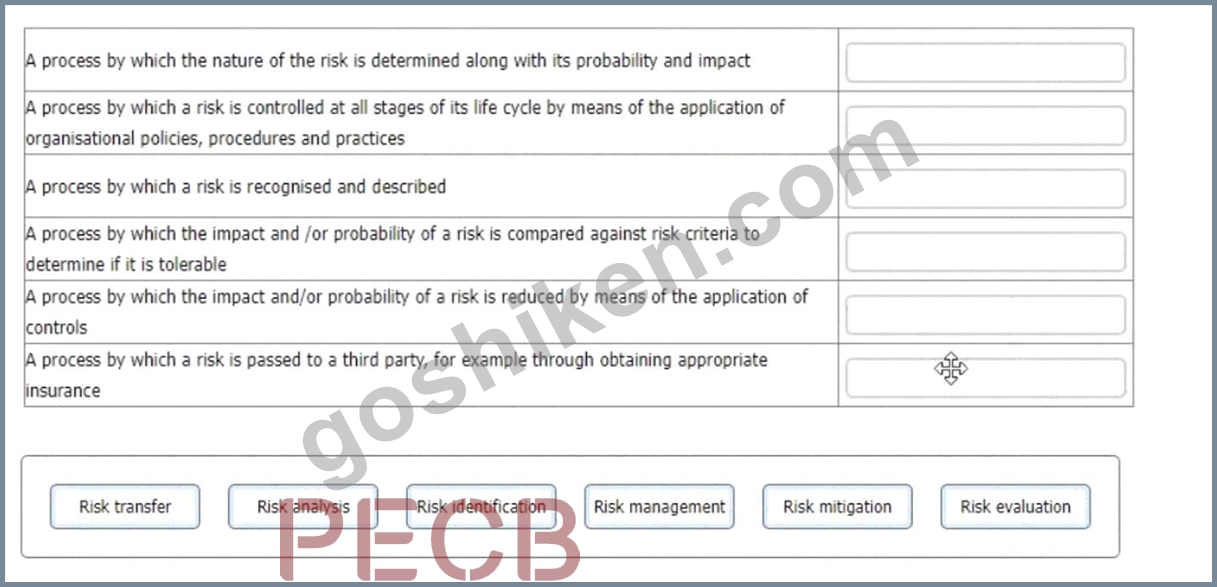
正解:
解説: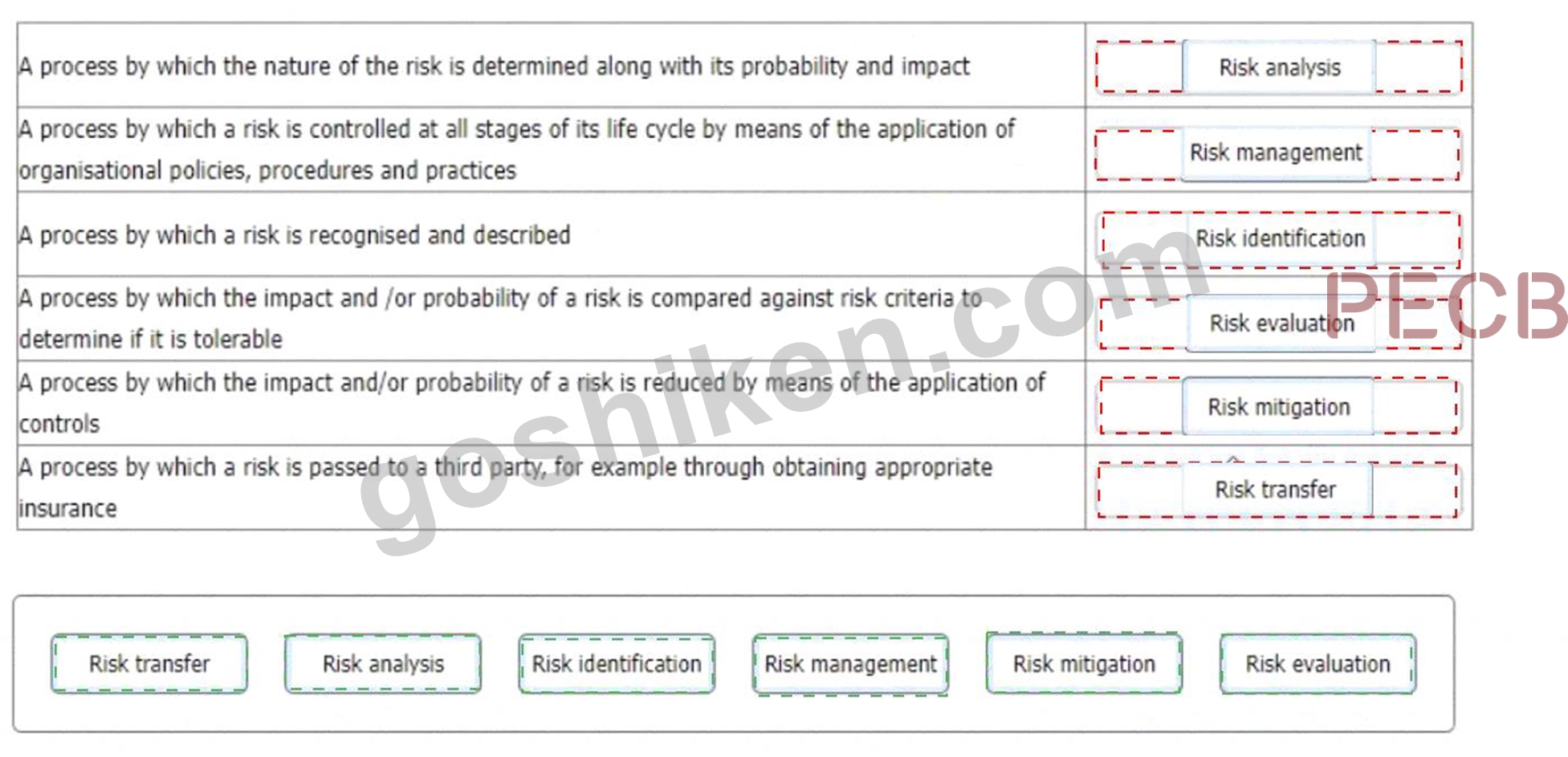
Explanation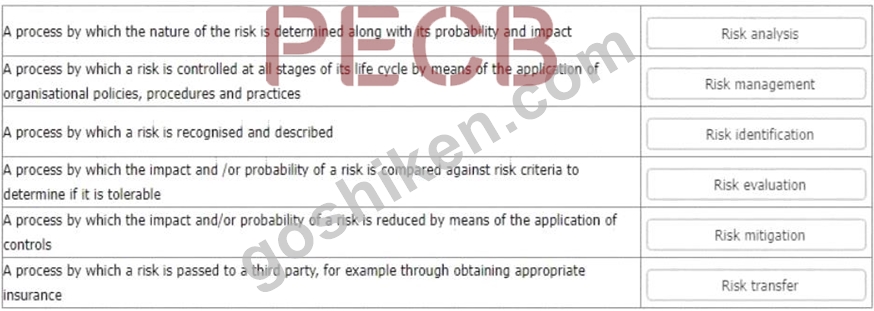
Risk analysis is the process by which the nature of the risk is determined along with its probability and impact. Risk analysis involves estimating the likelihood and consequences of potential events or situations that could affect the organization's information security objectives or requirements12. Risk analysis could use qualitative or quantitative methods, or a combination of both12.
Risk management is the process by which a risk is controlled at all stages of its life cycle by means of the application of organisational policies, procedures and practices. Risk management involves establishing the context, identifying, analyzing, evaluating, treating, monitoring, and reviewing the risks that could affect the organization's information security performance or compliance12. Risk management aims to ensure that risks are identified and treated in a timely and effective manner, and that opportunities for improvement are exploited12.
Risk identification is the process by which a risk is recognised and described. Risk identification involves identifying and documenting the sources, causes, events, scenarios, and potential impacts of risks that could affect the organization's information security objectives or requirements12. Risk identification could use various techniques, such as brainstorming, interviews, checklists, surveys, or historical data12.
Risk evaluation is the process by which the impact and/or probability of a risk is compared against risk criteria to determine if it is tolerable. Risk evaluation involves comparing the results of risk analysis with predefined criteria that reflect the organization's risk appetite, tolerance, or acceptance12. Risk evaluation could use various methods, such as ranking, scoring, or matrix12. Risk evaluation helps to prioritize and decide on the appropriate risk treatment options12.
Risk mitigation is the process by which the impact and/or probability of a risk is reduced by means of the application of controls. Risk mitigation involves selecting and implementing measures that are designed to prevent, reduce, transfer, or accept risks that could affect the organization's information security objectives or requirements12. Risk mitigation could include various types of controls, such as technical, organizational, legal, or physical12. Risk mitigation should be based on a cost-benefit analysis and a residual risk assessment12.
Risk transfer is the process by which a risk is passed to a third party, for example through obtaining appropriate insurance. Risk transfer involves sharing or shifting some or all of the responsibility or liability for a risk to another party that has more capacity or capability to manage it12. Risk transfer could include various methods, such as contracts, agreements, partnerships, outsourcing, or insurance12. Risk transfer should not be used as a substitute for effective risk management within the organization12.
References :=
ISO/IEC 27001:2022 Information technology - Security techniques - Information security management systems - Requirements ISO/IEC 27005:2022 Information technology - Security techniques - Information security risk management
質問 # 78
During a third-party certification audit, you are presented with a list of issues by an auditee. Which four of the following constitute 'internal' issues in the context of a management system to ISO 27001:2022?
- A. A reduction in grants as a result of a change in government policy
- B. Poor morale as a result of staff holidays being reduced
- C. Poor levels of staff competence as a result of cuts in training expenditure
- D. Inability to source raw materials due to government sanctions
- E. Higher labour costs as a result of an aging population
- F. A rise in interest rates in response to high inflation
- G. A fall in productivity linked to outdated production equipment
- H. Increased absenteeism as a result of poor management
正解:B、C、G、H
解説:
According to ISO 27001:2022 clause 4.1, the organisation shall determine external and internal issues that are relevant to its purpose and that affect its ability to achieve the intended outcome(s) of its information security management system (ISMS)12 External issues are factors outside the organisation that it cannot control, but can influence or adapt to. They include political, economic, social, technological, legal, and environmental factors that may affect the organisation's information security objectives, risks, and opportunities12 Internal issues are factors within the organisation that it can control or change. They include the organisation's structure, culture, values, policies, objectives, strategies, capabilities, resources, processes, activities, relationships, and performance that may affect the organisation's information security management system12 Therefore, the following issues are considered 'internal' in the context of a management system to ISO
27001:2022:
Poor levels of staff competence as a result of cuts in training expenditure: This is an internal issue because it relates to the organisation's capability, resource, and process of developing and maintaining the competence of its personnel involved in the ISMS. The organisation can control or change its training expenditure and its impact on staff competence12 Poor morale as a result of staff holidays being reduced: This is an internal issue because it relates to the organisation's culture, value, and relationship with its employees. The organisation can control or change its staff holiday policy and its impact on staff morale12 Increased absenteeism as a result of poor management: This is an internal issue because it relates to the organisation's performance, structure, and accountability of its management. The organisation can control or change its management practices and its impact on staff absenteeism12 A fall in productivity linked to outdated production equipment: This is an internal issue because it relates to the organisation's capability, resource, and process of ensuring the availability and suitability of its production equipment. The organisation can control or change its equipment maintenance and upgrade and its impact on productivity12 The following issues are considered 'external' in the context of a management system to ISO 27001:2022:
Higher labour costs as a result of an aging population: This is an external issue because it relates to the social and demographic factor that affects the availability and cost of labour in the market. The organisation cannot control or change the aging population, but can influence or adapt to its impact on labour costs12 A rise in interest rates in response to high inflation: This is an external issue because it relates to the economic and monetary factor that affects the cost and availability of capital in the market. The organisation cannot control or change the interest rates or inflation, but can influence or adapt to its impact on capital costs12 A reduction in grants as a result of a change in government policy: This is an external issue because it relates to the political and legal factor that affects the availability and conditions of public funding for the organisation. The organisation cannot control or change the government policy, but can influence or adapt to its impact on grants12 Inability to source raw materials due to government sanctions: This is an external issue because it relates to the political and legal factor that affects the availability and cost of raw materials in the market. The organisation cannot control or change the government sanctions, but can influence or adapt to its impact on raw materials12 References:
1: ISO/IEC 27001:2022 Lead Auditor (Information Security Management Systems) Course by CQI and IRCA Certified Training 1 2: ISO/IEC 27001 Lead Auditor Training Course by PECB 2
質問 # 79
After completing Stage 1 and in preparation for a Stage 2 initial certification audit, the auditee informs the audit team leader that they wish to extend the audit scope to include two additional sites that have recently been acquired by the organisation.
Considering this information, what action would you expect the audit team leader to take?
- A. Inform the auditee that the request can be accepted but a full Stage 1 audit must be repeated
- B. Increase the length of the Stage 2 audit to include the extra sites
- C. Arrange to complete a remote Stage 1 audit of the two sites using a video conferencing platform
- D. Obtain information about the additional sites to inform the certification body
正解:D
解説:
Explanation
According to ISO/IEC 17021-1, which specifies the requirements for bodies providing audit and certification of management systems, a certification body should establish criteria for determining audit time and audit team composition based on factors such as the scope of certification, size and complexity of the organization, risks associated with its activities, etc2. Therefore, if an auditee requests to extend the audit scope to include two additional sites after completing Stage 1 of an initial certification audit, the audit team leader should obtain information about the additional sites to inform the certification body, so that they can review and approve the change in scope and adjust the audit time and audit team accordingly2. The other options are not appropriate actions for the audit team leader to take in this situation. For example, increasing the length of the Stage 2 audit to include the extra sites without informing the certification body may violate their procedures and policies; arranging to complete a remote Stage 1 audit of the two sites using a video conferencing platform may not be feasible or effective depending on the nature and location of the sites; and informing the auditee that the request can be accepted but a full Stage 1 audit must be repeated may not be necessary or reasonable if there are no significant changes in the auditee's ISMS since Stage 12. References: ISO/IEC 17021-1:2015 - Conformity assessment - Requirements for bodies providing audit and certification of management systems - Part 1: Requirements
質問 # 80
After completing Stage 1 and in preparation for a Stage 2 initial certification audit, the auditee informs the audit team leader that they wish to extend the audit scope to include two additional sites that have recently been acquired by the organisation.
Considering this information, what action would you expect the audit team leader to take?
- A. Inform the auditee that the request can be accepted but a full Stage 1 audit must be repeated
- B. Increase the length of the Stage 2 audit to include the extra sites
- C. Arrange to complete a remote Stage 1 audit of the two sites using a video conferencing platform
- D. Obtain information about the additional sites to inform the certification body
正解:D
解説:
According to ISO/IEC 17021-1, which specifies the requirements for bodies providing audit and certification of management systems, a certification body should establish criteria for determining audit time and audit team composition based on factors such as the scope of certification, size and complexity of the organization, risks associated with its activities, etc2. Therefore, if an auditee requests to extend the audit scope to include two additional sites after completing Stage 1 of an initial certification audit, the audit team leader should obtain information about the additional sites to inform the certification body, so that they can review and approve the change in scope and adjust the audit time and audit team accordingly2. The other options are not appropriate actions for the audit team leader to take in this situation. For example, increasing the length of the Stage 2 audit to include the extra sites without informing the certification body may violate their procedures and policies; arranging to complete a remote Stage 1 audit of the two sites using a video conferencing platform may not be feasible or effective depending on the nature and location of the sites; and informing the auditee that the request can be accepted but a full Stage 1 audit must be repeated may not be necessary or reasonable if there are no significant changes in the auditee's ISMS since Stage 12. Reference: ISO/IEC 17021-1:2015 - Conformity assessment - Requirements for bodies providing audit and certification of management systems - Part 1: Requirements
質問 # 81
You are performing an ISMS audit at a residential nursing home that provides healthcare services. The next step in your audit plan is to verify the information security of the business continuity management process.
During the audit, you learned that the organisation activated one of the business continuity plans (BCPs) to make sure the nursing service continued during the recent pandemic. You ask Service Manager to explain how the organisation manages information security during the business continuity management process.
The Service Manager presents the nursing service continuity plan for a pandemic and summarises the process as follows:
Stop the admission of any NEW residents.
70% of administration staff and 30% of medical staff will work from home.
Regular staff self-testing including submitting a negative test report 1 day BEFORE they come to the office.
Install ABC's healthcare mobile app, tracking their footprint and presenting a GREEN Health Status QR-Code for checking on the spot.
You ask the Service Manager how to prevent non-relevant family members or interested parties from accessing residents' personal data when staff work from home. The Service Manager cannot answer and suggests the n" Security Manager should help with that.
You would like to further investigate other areas to collect more audit evidence Select three options that will be in your audit trail.
- A. Collect more evidence by interviewing more staff about their feeling about working from home.
(Relevant to clause 4.2) - B. Collect more evidence on how and when the Business Continuity Wan has been tested. (Relevant to control A.5.29)
- C. Collect more evidence on how the organisation makes sure only staff with a negative test result can enter the organisation (Relevant to control A.7.2)
- D. Collect more evidence on how the organisation manages information security on mobile devices and during teleworking (Relevant to control A.6.7)
- E. Collect more evidence on how the organisation performs a business risk assessment to evaluate how fast the existing residents can be discharged from the nursing home. (Relevant to clause 6)
- F. Collect more evidence on what resources the organisation provides to support the staff working from home. (Relevant to clause 7.1)
正解:B、C、D
解説:
Explanation
According to ISO/IEC 27001:2022, which specifies the requirements for establishing, implementing, maintaining and continually improving an information security management system (ISMS), control A.5.29 requires an organization to establish and maintain a business continuity management process to ensure the continued availability of information and information systems at the required level following disruptive incidents1. The organization should identify and prioritize critical information assets and processes, assess the risks and impacts of disruptive incidents, develop and implement business continuity plans (BCPs), test and review the BCPs, and ensure that relevant parties are aware of their roles and responsibilities1. Therefore, when verifying the information security of the business continuity management process, an ISMS auditor should verify that these aspects are met in accordance with the audit criteria.
Three options that will be in the audit trail for verifying control A.5.29 are:
Collect more evidence on how the organisation manages information security on mobile devices and during teleworking (Relevant to control A.6.7): This option is relevant because it can provide evidence of how the organization has implemented appropriate controls to protect the confidentiality, integrity and availability of information and information systems when staff work from home using mobile devices, such as laptops, tablets or smartphones. This is related to control A.6.7, which requires an organization to establish a policy and procedures for teleworking and use of mobile devices1.
Collect more evidence on how and when the Business Continuity Plan has been tested (Relevant to control A.5.29): This option is relevant because it can provide evidence of how the organization has tested and reviewed the BCPs to ensure their effectiveness and suitability for different scenarios, such as a pandemic. This is related to control A.5.29, which requires an organization to test and review the BCPs at planned intervals or when significant changes occur1.
Collect more evidence on how the organisation makes sure only staff with a negative test result can enter the organisation (Relevant to control A.7.2): This option is relevant because it can provide evidence of how the organization has implemented appropriate controls to prevent or reduce the risk of infection or transmission of diseases among staff or residents, such as requiring regular staff self-testing and using a health status app. This is related to control A.7.2, which requires an organization to ensure that all employees and contractors are aware of information security threats and concerns, their responsibilities and liabilities, and are equipped to support organizational policies and procedures in this respect1.
The other options are not relevant to verifying control A.5.29, as they are not related to the control or its requirements. For example:
Collect more evidence by interviewing more staff about their feeling about working from home (Relevant to clause 4.2): This option is not relevant because it does not provide evidence of how the organization has established and maintained a business continuity management process or ensured the continued availability of information and information systems following disruptive incidents. It may be related to clause 4.2, which requires an organization to understand the needs and expectations of interested parties, but not specifically to control A.5.29.
Collect more evidence on what resources the organisation provides to support the staff working from home (Relevant to clause 7.1): This option is not relevant because it does not provide evidence of how the organization has established and maintained a business continuity management process or ensured the continued availability of information and information systems following disruptive incidents. It may be related to clause 7.1, which requires an organization to determine and provide the resources needed for its ISMS, but not specifically to control A.5.29.
Collect more evidence on how the organisation performs a business risk assessment to evaluate how fast the existing residents can be discharged from the nursing home (Relevant to clause 6): This option is not relevant because it does not provide evidence of how the organization has established and maintained a business continuity management process or ensured the continued availability of information and information systems following disruptive incidents. It may be related to clause 6, which requires an organization to plan actions to address risks and opportunities for its ISMS, but not specifically to control A.5.29.
References: ISO/IEC 27001:2022 - Information technology - Security techniques - Information security management systems - Requirements
質問 # 82
You are an experienced ISMS internal auditor.
You have just completed a scheduled information security audit of your organisation when the IT Manager approaches you and asks for your assistance in the revision of the company's Statement of Applicability.
The IT Manager is attempting to update the ISO/IEC 27001:2013 based Statement of Applicability to a Statement aligned to the 4 control themes present in ISO/IEC 27001:2022 (Organizational controls, People Controls, Physical Controls, Technical Controls).
The IT Manager is happy with their reassignment of controls, with the following exceptions. He asks you which of the four control categories each of the following should appear under.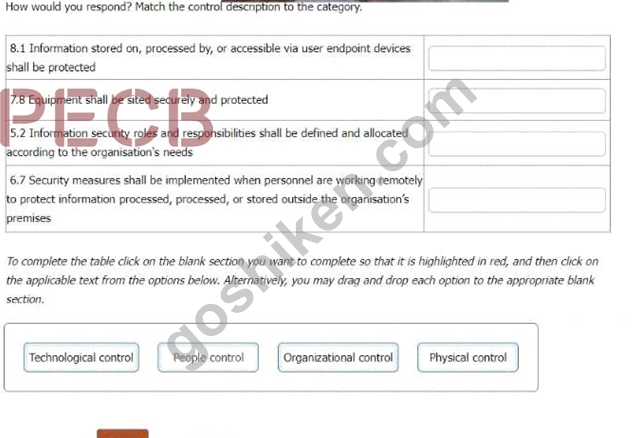
正解:
解説: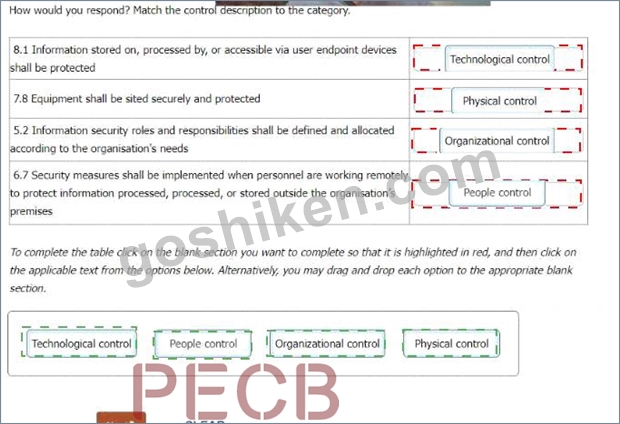
Explanation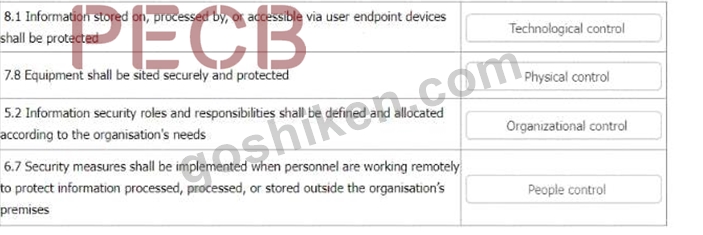
8.1 Information stored on, processed by, or accessible via user endpoint devices shall be protected
= Technological control 7.8 Equipment shall be sited securely and protected = Physical control 5.2 Information security roles and responsibilities shall be defined and allocated according to the organisation's needs = Organisational control 6.7 Security measures shall be implemented when personnel are working remotely to protect information processed, processed, or stored outside the organisation's premises = People control Explanation: According to the web search results from my predefined tool, ISO 27001:2022 has restructured and consolidated the Annex A controls into four categories: organisational, people, physical, and technological12. These categories reflect the different aspects and dimensions of information security, and are aligned with the cybersecurity concepts of identify, protect, detect, respond, and recover3. The controls in each category are as follows4:
* Organisational controls: These are controls that relate to the governance, management, and coordination of information security activities within the organisation. They include controls such as information security policies, roles and responsibilities, risk assessment and treatment, performance evaluation, and improvement.
* People controls: These are controls that relate to the behaviour, awareness, and competence of the people involved in information security, both within and outside the organisation. They include controls such as human resource security, training and awareness, access control, incident management, and business continuity.
* Physical controls: These are controls that relate to the protection of physical assets and environments that store, process, or transmit information. They include controls such as physical security, environmental security, equipment security, and media security.
* Technological controls: These are controls that relate to the use of technology to implement, monitor, and maintain information security. They include controls such as cryptography, network security, system security, application security, and threat intelligence.
Based on these categories, the controls listed in the question can be matched as follows:
* 8.1 Information stored on, processed by, or accessible via user endpoint devices shall be protected: This is a technological control, as it involves the use of technology to protect information on devices such as laptops, smartphones, tablets, etc. It may include measures such as encryption, authentication, antivirus, firewall, etc.
* 7.8 Equipment shall be sited securely and protected: This is a physical control, as it involves the protection of physical assets and environments that store, process, or transmit information. It may include measures such as locks, alarms, CCTV, fire suppression, etc.
* 5.2 Information security roles and responsibilities shall be defined and allocated according to the organisation's needs: This is an organisational control, as it involves the governance, management, and coordination of information security activities within the organisation. It may include measures such as defining the authority and accountability of information security personnel, establishing reporting lines and communication channels, assigning tasks and duties, etc.
* 6.7 Security measures shall be implemented when personnel are working remotely to protect information processed, processed, or stored outside the organisation's premises: This is a people control, as it involves the behaviour, awareness, and competence of the people involved in information security, both within and outside the organisation. It may include measures such as providing guidance and training on remote working, enforcing policies and procedures, monitoring and auditing remote activities, etc.
References: = 1: A Breakdown of ISO 27001:2022 Annex A Controls - BARR Advisory42: ISO 27001:2022 Annex A Controls - What's New? | ISMS.Online13: How many controls are there in ISO 27001:2022? - Strike Graph34: ISO/IEC 27001:2022 Information technology - Security techniques - Information security management systems - Requirements, Annex A.
質問 # 83
Which three of the following phrases are objectives' in relation to an audit?
- A. Identify opportunities for improvement
- B. Management policy
- C. Regulatory requirements
- D. International Standard
- E. Complete audit on time
- F. Confirm the scope of the management system
正解:A、C、F
解説:
Explanation
According to ISO 19011:2018, which provides guidelines for auditing management systems, the audit objectives are defined by the audit client and may include determining the extent of conformity or nonconformity of the audited management system against the audit criteria, evaluating the ability of the audited management system to ensure that the organization meets applicable statutory, regulatory and contractual requirements, identifying potential improvement opportunities for the audited management system, and facilitating continual improvement of the audited management system1. Therefore, these three phrases are examples of objectives in relation to an audit. The other options are not objectives, but rather elements or factors that may influence or affect an audit. For example, an international standard is a source of audit criteria, a management policy is a part of the audited management system, and completing an audit on time is a requirement for an effective audit. References: ISO 19011:2018 - Guidelines for auditing management systems
質問 # 84
The following options are key actions involved in a first-party audit. Order the stages to show the sequence in which the actions should take place.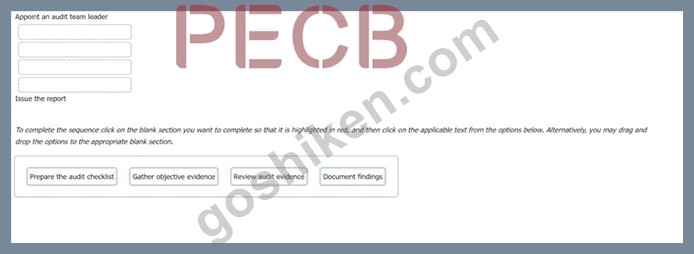
正解:
解説: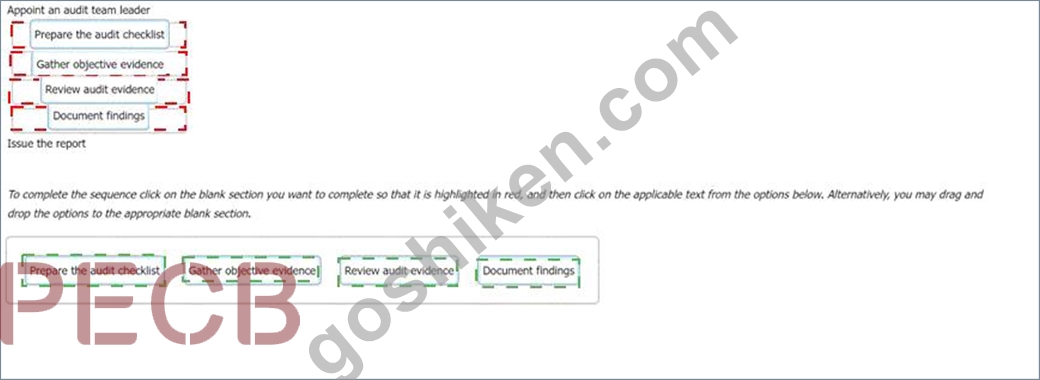

質問 # 85
What is the standard definition of ISMS?
- A. A systematic approach for establishing, implementing, operating,monitoring, reviewing, maintaining and improving an organization's information security to achieve business objectives.
- B. A company wide business objectives to achieve information security awareness for establishing, implementing, operating, monitoring, reviewing, maintaining and improving
- C. Is an information security systematic approach to achieve business objectives for implementation, establishing, reviewing,operating and maintaining organization's reputation.
- D. A project-based approach to achieve business objectives for establishing, implementing, operating, monitoring, reviewing, maintaining and improving an organization's information security
正解:A
解説:
The standard definition of ISMS is a systematic approach for establishing, implementing, operating, monitoring, reviewing, maintaining and improving an organization's information security to achieve business objectives. This definition is given in clause 3.17 of ISO/IEC 27001:2022, and it describes the main components and purpose of an ISMS. An ISMS is not a project-based approach, as it is an ongoing process that requires continual improvement. An ISMS is not a company wide business objective, as it is a management system that supports the organization's objectives. An ISMS is not an information security systematic approach, as it is a broader concept that encompasses the organization's context, risks, controls, and performance. Reference: : CQI & IRCA ISO 27001:2022 Lead Auditor Course Handbook, page 15. : ISO/IEC 27001:2022, clause 3.17.
質問 # 86
You are an ISMS audit team leader preparing to chair a closing meeting following a third-party surveillance audit. You are drafting a closing meeting agenda setting out the topics you wish to discuss with your auditee.
Which one of the following would be appropriate for inclusion?
- A. An explanation of the audit plan and its purpose
- B. A disclaimer that the result of the audit is based on the sampling of evidence
- C. A detailed explanation of the certification body's complaints process
- D. Names of auditees associated with nonconformities
正解:B
解説:
This option is appropriate for inclusion in the closing meeting agenda, as it is a requirement of the ISO 19011 standard, which provides guidelines for auditing management systems, including ISMS12. The standard states that the audit team leader should advise the auditee of any situations encountered during the audit that may decrease the confidence that can be placed in the audit conclusions, such as limitations in the audit scope, access, or sampling3. The standard also states that the audit report should include a statement that the audit is based on a sample of the information available at the time of the audit, and that the audit does not provide absolute assurance of the conformity or effectiveness of the audited management system4. Therefore, the audit team leader should include a disclaimer in the closing meeting agenda to inform the auditee of the nature and limitations of the audit, and to avoid any misunderstandings or false expectations. The other options are not appropriate for inclusion in the closing meeting agenda, as they are either irrelevant, incorrect, or incomplete.
For example:
*A detailed explanation of the certification body's complaints process is not relevant for the closing meeting agenda, as it is not related to the audit findings or conclusions. The certification body's complaints process should be communicated to the auditee before the audit, as part of the audit agreement or contract5.
*An explanation of the audit plan and its purpose is not correct for the closing meeting agenda, as it should have been done at the opening meeting or before the audit. The audit plan is a document that describes the scope, objectives, criteria, and methodology of the audit, as well as the audit schedule, the audit team, the audit locations, and the audit deliverables . The audit plan should be communicated and agreed with the auditee in advance, and any changes or deviations should be notified during the audit.
*Names of auditees associated with nonconformities are not complete for the closing meeting agenda, as they do not provide the details or the evidence of the nonconformities. The audit team leader should present the audit findings, which include the description, the audit criteria, and the audit evidence of each nonconformity, as well as the audit conclusions and the audit recommendation . The audit team leader should also avoid naming or blaming individuals, and focus on the processes and the system.
References: = 1: PECB Candidate Handbook - ISO/IEC 27001 Lead Auditor, page 222: ISO 19011:2018 Guidelines for auditing management systems, clause 13: ISO 19011:2018 Guidelines for auditing management systems, clause 6.4.94: ISO 19011:2018 Guidelines for auditing management systems, clause 7.5.25: ISO/IEC
17021-1:2015 Conformity assessment - Requirements for bodies providing audit and certification of management systems - Part 1: Requirements, clause 9.8. : ISO 19011:2018 Guidelines for auditing management systems, clause 6.4.1. : ISO/IEC 27007:2011 Information technology - Security techniques - Guidelines for information security management systems auditing, clause 6.2.1. : ISO 19011:2018 Guidelines for auditing management systems, clause 6.4.2. : ISO 19011:2018 Guidelines for auditing management systems, clause 6.4.10. : ISO/IEC 27007:2011 Information technology - Security techniques - Guidelines for information security management systems auditing, clause 6.3.3.
質問 # 87
You are performing an ISMS audit at a residential nursing home called ABC that provides healthcare services.
The next step in your audit plan is to verify the information security of ABC's healthcare mobile app development, support, and lifecycle process. During the audit, you learned the organisation outsourced the mobile app development to a professional software development organisation with CMMI Level 5, ITSM (ISO/IEC 20000-1), BCMS (ISO 22301) and ISMS (ISO/IEC 27001) certified.
The IT Manager presents the software security management procedure and summarises the process as follows:
The mobile app development shall adopt "security-by-design" and "security-by-default" principles, as a minimum. The following security functions for personal data protection shall be available:
Access control.
Personal data encryption, i.e., Advanced Encryption Standard (AES) algorithm, key lengths: 256 bits; and Personal data pseudonymization.
Vulnerability checked and no security backdoor
You sample the latest Mobile App Test report - Reference ID: 0098, details as follows: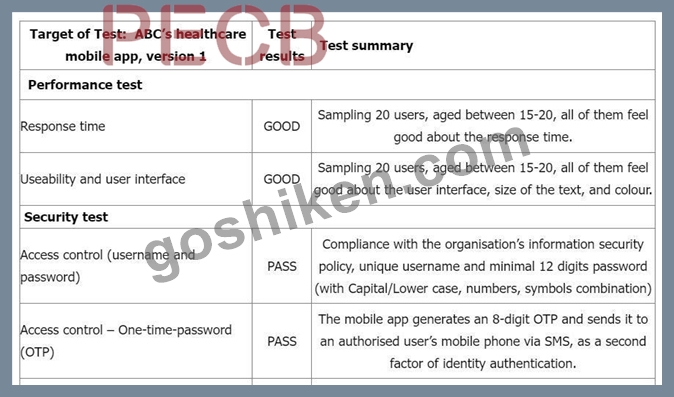
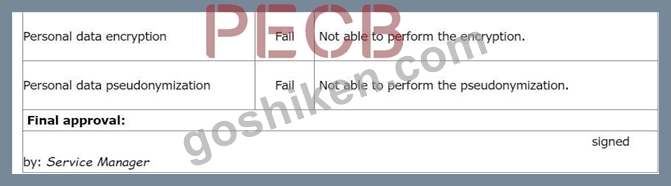
You would like to investigate other areas further to collect more audit evidence. Select three options that will not be in your audit trail.
- A. Collect more evidence on the organisation's business continuity policy. (Relevant to control A.5.30)
- B. Collect more evidence to determine the number of users of ABC's healthcare mobile app. (relevant to clause 4.2)
- C. Collect more evidence on how the developer trains its product support personnel. (Relevant to clause
7.2) - D. Collect more evidence on how the organisation performs testing of personal data handling. (Relevant to control A.5.34)
- E. Collect more evidence to verify the developer's CMMI Level 5, ITSM (ISO/IEC 20000-1), BCMS (ISO
22301) and ISMS (ISO/IEC 27001) certification. (Relevant to control A.5.21) - F. Collect more evidence by downloading and testing the mobile app on your phone. (Relevant to control A.8.1)
- G. Collect more evidence on how the organisation manages information security in the selection of an external service provider. (Relevant to control A.5.19)
- H. Collect more evidence on how much residents' family members pay to install ABC's healthcare mobile app. (Relevant to clause 4.2)
正解:B、E、H
解説:
The three options that will not be in your audit trail are A, C, and H. These options are either not relevant to the information security of ABC's healthcare mobile app development, support, and lifecycle process, or not within the scope of your audit. The amount of money that residents' family members pay to install the app (A) and the number of users of the app are not related to the information security aspects or objectives of the ISMS1. The verification of the developer's certifications (H) is not your responsibility as an ISMS auditor, as you should rely on the competence and impartiality of the certification bodies that issued them2. The other options are relevant and within the scope of your audit, as they relate to the security functions, testing, policies, and procedures of the mobile app development, support, and lifecycle process13. References: 1:
ISO/IEC 27001:2022, Information technology - Security techniques - Information security management systems - Requirements, Clause 4.2 \n2: ISO/IEC 27006:2022, Information technology - Security techniques - Requirements for bodies providing audit and certification of information security management systems, Clause 4.1 \n3: PECB Certified ISO/IEC 27001 Lead Auditor Exam Preparation Guide, Domain 5:
Conducting an ISO/IEC 27001 audit
質問 # 88
During a Stage 1 audit opening meeting, the Management System Representative (MSR) asks to extend the audit scope to include a new site overseas which they have expanded into since the certification application was made.
Select two options for how the auditor should respond.
- A. Suggest that the MSR cancels the audit contract and reapplies for the new situation
- B. Confirm that the auditor will advise the auditee that the audit scope will be revised to include the new work area
- C. Determine whether the Management System covers the processes at the new site and, if so, proceed with the audit
- D. Advise the MSR that an extension of the scope may be incorporated but will have to go through established procedures
- E. Advise the MSR that, within the existing scope, the new work area can be included without any problem
- F. Advise the MSR that the audit scope has been determined based on their initial application so the audit has to proceed as planned
正解:C、D
解説:
Explanation
The correct options for how the auditor should respond are:
* A. Advise the MSR that an extension of the scope may be incorporated but will have to go through established procedures
* D. Determine whether the Management System covers the processes at the new site and, if so, proceed with the audit These options are consistent with the ISO/IEC 27006:2015 standard, which states that any changes to the scope of certification should be notified by the client to the certification body, and that the certification body should evaluate and decide on these changes in accordance with its procedures1. The auditor should also verify that the ISMS is implemented and maintained at all sites included in the scope of certification1.
The other options are not appropriate for how the auditor should respond, because:
* B. Advise the MSR that the audit scope has been determined based on their initial application so the audit has to proceed as planned: This option is too rigid and does not allow for any flexibility or adaptation to the client's situation. The auditor should be open to consider any changes to the scope of
* certification that may have occurred since the initial application, as long as they are properly notified and evaluated by the certification body.
* C. Suggest that the MSR cancels the audit contract and reapplies for the new situation: This option is too drastic and unnecessary, as it would cause delays and costs for both the client and the certification body.
The auditor should not suggest that the client cancels the audit contract, but rather that they follow the established procedures for requesting and approving an extension of the scope of certification.
* E. Advise the MSR that, within the existing scope, the new work area can be included without any problem: This option is too lenient and does not ensure that the new work area meets the requirements of ISO/IEC 27001 and the ISMS. The auditor should not assume that the new work area can be included within the existing scope without any problem, but rather that they need to verify that the ISMS is implemented and maintained at the new site, and that any changes to the scope of certification are approved by the certification body.
* F. Confirm that the auditor will advise the auditee that the audit scope will be revised to include the new work area: This option is too presumptuous and does not respect the authority of the certification body.
The auditor should not confirm that they will revise the audit scope to include the new work area, but rather that they will advise the certification body of the client's request for an extension of the scope of certification, and wait for their decision.
質問 # 89
Select the correct sequence for the information security risk assessment process in an ISMS.
To complete the sequence click on the blank section you want to complete so that it is highlighted in red, and then click on the applicable text from the options below. Alternatively, you may drag and drop the options to the appropriate blank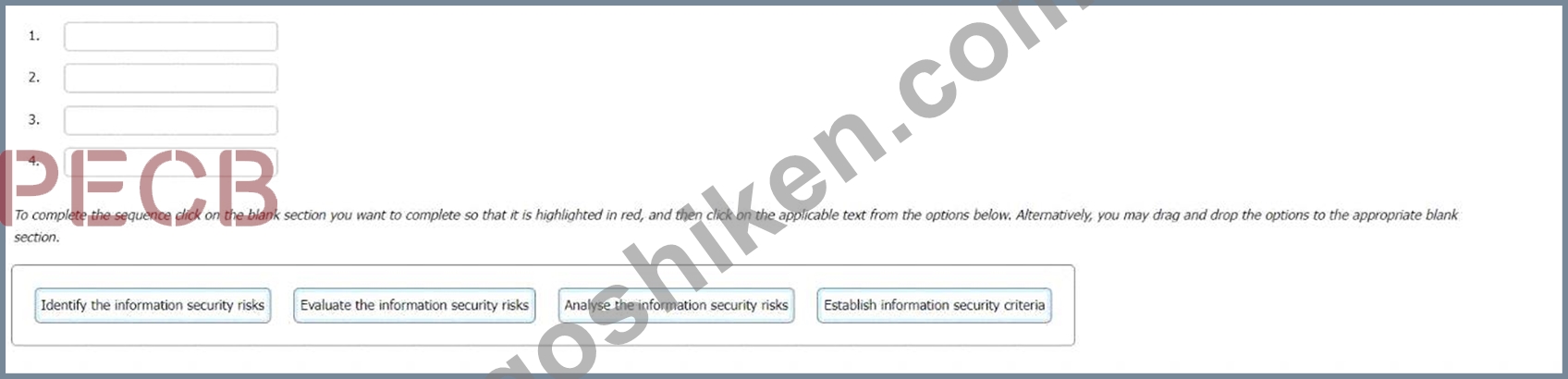
正解:
解説: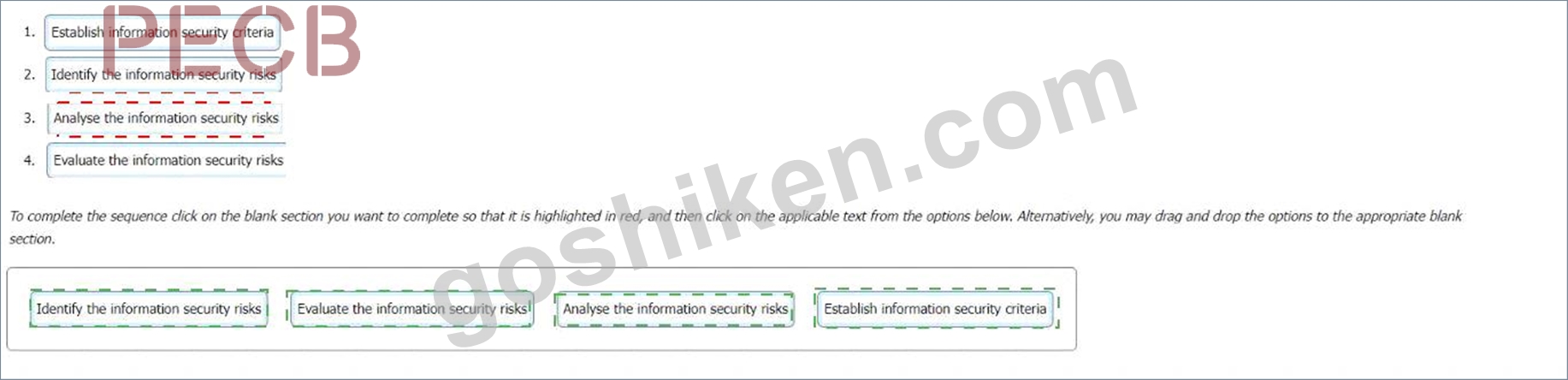
Explanation
A group of black text Description automatically generated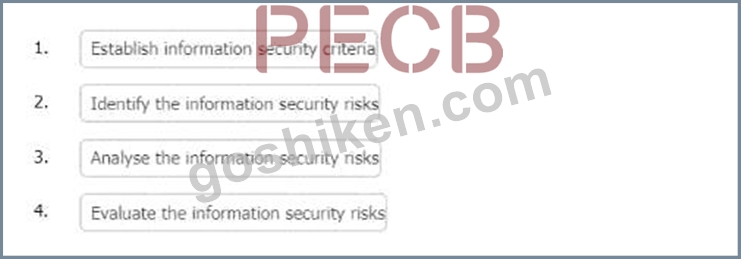
According to ISO 27001:2022, the standard for information security management systems (ISMS), the correct sequence for the information security risk assessment process is as follows:
* Establish information security criteria
* Identify the information security risks
* Analyse the information security risks
* Evaluate the information security risks
The first step is to establish the information security criteria, which include the risk assessment methodology, the risk acceptance criteria, and the risk evaluation criteria. These criteria define how the organization will perform the risk assessment, what level of risk is acceptable, and how the risks will be compared and prioritized.
The second step is to identify the information security risks, which involve identifying the assets, threats, vulnerabilities, and existing controls that are relevant to the ISMS. The organization should also identify the potential consequences and likelihood of each risk scenario.
The third step is to analyse the information security risks, which involve estimating the level of risk for each risk scenario based on the criteria established in the first step. The organization should also consider the sources of uncertainty and the confidence level of the risk estimation.
The fourth step is to evaluate the information security risks, which involve comparing the estimated risk levels with the risk acceptance criteria and determining whether the risks are acceptable or need treatment. The organization should also prioritize the risks based on the risk evaluation criteria and the objectives of the ISMS.
References: ISO 27001:2022 Clause 6.1.2 Information security risk assessment, ISO 27001 Risk Assessment
& Risk Treatment: The Complete Guide - Advisera, ISO 27001 Risk Assessment: 7 Step Guide - IT Governance UK Blog
質問 # 90
You are conducting an ISMS audit in the despatch department of an international logistics organisation that provides shipping services to large organisations including local hospitals and government offices. Parcels typically contain pharmaceutical products, biological samples, and documents such as passports and driving licences. You note that the company records show a very large number of returned items with causes including misaddressed labels and, in 15% of cases, two or more labels for different addresses for the one package. You are interviewing the Shipping Manager (SM).
You: Are items checked before being dispatched?
SM: Any obviously damaged items are removed by the duty staff before being dispatched, but the small profit margin makes it uneconomic to implement a formal checking process.
You: What action is taken when items are returned?
SM: Most of these contracts are relatively low value, therefore it has been decided that it is easier and more convenient to simply reprint the label and re-send individual parcels than it is to implement an investigation.
You raise a nonconformity against ISO 27001:2022 based on the lack of control of the labelling process.
At the closing meeting, the Shipping Manager issues an apology to you that his comments may have been misunderstood. He says that he did not realise that there is a background IT process that automatically checks that the right label goes onto the right parcel otherwise the parcel is ejected at labelling. He asks that you withdraw your nonconformity.
Select three options of the correct responses that you as the audit team leader would make to the request of the Shipping Manager.
- A. Inform the Shipping Manager that the nonconformity is minor and should be quickly corrected
- B. Advise management that the new information provided will be discussed when the auditors have more time
- C. Thank the Shipping Manager for his honesty but advise that withdrawing the nonconformity is not the right way to proceed
- D. Ask the audit team members to state what they think should happen
- E. Advise the Shipping Manager that his request will be included in the audit report
- F. Inform him of your understanding and withdraw the nonconformity
- G. Advise the Shipping Manager that the nonconformity must stand since the evidence obtained for it was dear
- H. Indicate that the nonconformity is evidence of a deeper system failure that needs to be rectified
正解:B、C、E
解説:
* A. Advise the Shipping Manager that his request will be included in the audit report. This is true because the audit report should document all the relevant information and evidence related to the audit, including any requests or objections raised by the auditee. The audit report should also provide the rationale for the audit conclusions and recommendations12.
* B. Advise management that the new information provided will be discussed when the auditors have more time. This is true because the auditors should not make hasty decisions based on incomplete or unverified information. The auditors should review and evaluate the new information in a systematic and objective manner, and determine whether it affects the audit findings, nonconformities, or conclusions12.
* F. Thank the Shipping Manager for his honesty but advise that withdrawing the nonconformity is not the right way to proceed. This is true because the auditors should acknowledge and appreciate the cooperation and transparency of the auditee, but also maintain their professional integrity and independence. The auditors should not withdraw a nonconformity unless they are satisfied that it was raised in error or that it has been effectively corrected and verified12.
References :=
* ISO 19011:2022 Guidelines for auditing management systems
* ISO/IEC 17021-1:2022 Conformity assessment - Requirements for bodies providing audit and certification of management systems - Part 1: Requirements
質問 # 91
You are an experienced ISMS audit team leader. During the conducting of a third-party surveillance audit, you decide to test your auditee's knowledge of ISO/IEC 27001's risk management requirements.
You ask her a series of questions to which the answer is either 'that is true' or 'that is false'. Which four of the following should she answer 'that is true'?
- A. The organisation must operate a risk treatment process to eliminate it's information security risks
- B. Risks assessments should be undertaken at monthly intervals
- C. Risk identification is used to determine the severity of an information security risk
- D. Risk assessments should be undertaken following significant changes
- E. ISO/IEC 27001 provides an outline approach for the management of risk
- F. The results of risk assessments must be maintained
- G. The organisation must produce a risk treatment plan for every business risk identified
- H. The initial phase in an organisation's risk management process should be information security risk assessment
正解:D、E、F、G
解説:
Explanation
The following four statements are true according to ISO/IEC 27001's risk management requirements: 12
* The results of risk assessments must be maintained. This is true because clause 8.2.3 of ISO/IEC
27001:2022 requires the organisation to retain documented information of the information security risk assessment process and the results12
* ISO/IEC 27001 provides an outline approach for the management of risk. This is true because clause
6.1.2 of ISO/IEC 27001:2022 specifies the general steps for the information security risk management process, which include establishing the risk criteria, assessing the risks, treating the risks, and monitoring and reviewing the risks12
* The organisation must produce a risk treatment plan for every business risk identified. This is true because clause 6.1.3 of ISO/IEC 27001:2022 requires the organisation to produce a risk treatment plan that defines the actions to be taken to address the unacceptable risks, the responsibilities, the expected dates, and the resources required12
* Risk assessments should be undertaken following significant changes. This is true because clause 8.2.4 of ISO/IEC 27001:2022 requires the organisation to review and update the risk assessment at planned intervals or when significant changes occur12 The following four statements are false according to ISO/IEC 27001's risk management requirements:
* Risk identification is used to determine the severity of an information security risk. This is false because risk identification is used to identify the assets, threats, vulnerabilities, and existing controls that are relevant to the information security risk management process. The severity of an information security risk is determined by the risk analysis, which evaluates the likelihood and impact of the risk scenarios12
* The organisation must operate a risk treatment process to eliminate its information security risks. This is false because the organisation can choose from four options to treat its information security risks: avoid, transfer, mitigate, or accept. The organisation does not have to eliminate all its information security risks, but only those that are unacceptable according to its risk criteria12
* The initial phase in an organisation's risk management process should be information security risk assessment. This is false because the initial phase in an organisation's risk management process should
* be establishing the risk management framework, which includes defining the risk management policy, objectives, scope, roles, responsibilities, and criteria. The information security risk assessment is the second phase in the risk management process12
* Risks assessments should be undertaken at monthly intervals. This is false because there is no fixed frequency for conducting risk assessments in ISO/IEC 27001. The organisation should determine the appropriate intervals for reviewing and updating the risk assessment based on its risk appetite, risk profile, and operational context12 References:
1: ISO/IEC 27001:2022 Lead Auditor (Information Security Management Systems) Course by CQI and IRCA Certified Training 1 2: ISO/IEC 27001 Lead Auditor Training Course by PECB 2
質問 # 92
You are an experienced ISMS audit team leader guiding an auditor in training. You decide to test her knowledge of follow-up audits by asking her a series of questions. Here are your questions and her answers.
Which four of your questions has she answered correctly?
- A. Q: Is the purpose of a follow-up audit to verify the completion of corrections, corrective actions, and opportunities for improvement? A:YES
- B. Q: Should follow-up audits seek to ensure nonconformities have been effectively addressed? A:YES
- C. Q: Should follow-up audits consider agreed opportunities for improvement as well as corrective action?
A:No - D. Q: Should the outcome from a follow-up audit be reported to the audit team leader who carried out the audit at which the NCs were originally identified? A:YES
- E. Q: Should the outcome from a follow-up audit be reported to the audit client? A:No
- F. Q: Should a follow-up audit seek to identify new nonconformities? A:YES
- G. Q: Could an outcome from a follow-up audit be another follow-up audit if required? A:YES
- H. Q: Are follow-up audits required for all audits? A:No
正解:A、B、F、G
解説:
Explanation
The four questions that she answered correctly are:
* Q: Should a follow-up audit seek to identify new nonconformities? A: YES
* Q: Should follow-up audits seek to ensure nonconformities have been effectively addressed? A: YES
* Q: Is the purpose of a follow-up audit to verify the completion of corrections, corrective actions, and opportunities for improvement? A: YES
* Q: Could an outcome from a follow-up audit be another follow-up
* A follow-up audit is an audit that is conducted after a previous audit to verify the implementation and effectiveness of the corrective actions and/or opportunities for improvement that were agreed upon as a result of the previous audit12. Therefore, a follow-up audit should seek to identify new nonconformities that may have arisen since the previous audit, as well as to ensure that the existing nonconformities have been effectively addressed.
* A follow-up audit should also consider the agreed opportunities for improvement as well as the corrective actions, because both are intended to enhance the performance and conformity of the ISMS12. However, the follow-up audit should not treat the opportunities for improvement as mandatory requirements, but rather as suggestions that may or may not have been implemented by the auditee3.
* The purpose of a follow-up audit is to verify the completion and effectiveness of the corrections, corrective actions, and opportunities for improvement that were agreed upon as a result of the previous audit12. A correction is the action taken to eliminate a detected nonconformity, while a corrective action is the action taken to eliminate the cause of a nonconformity and to prevent its recurrence4. An opportunity for improvement is a potential improvement that is identified during an audit, but is not a nonconformity3.
* An outcome from a follow-up audit could be another follow-up audit if required, depending on the nature and severity of the nonconformities and the effectiveness of the corrective actions12. For example, if the follow-up audit reveals that the nonconformities have not been adequately addressed, or that new nonconformities have emerged, then another follow-up audit may be necessary to ensure that the ISMS is compliant and effective.
References:
1: PECB Candidate Handbook - ISO 27001 Lead Auditor, page 25 2: ISO 19011:2018 - Guidelines for auditing management systems, clause 6.7 3: ISO 27007:2017 - Guidelines for information security management systems auditing, clause 7.5.3 4: ISO 27000:2018 - Information technology - Security techniques - Information security management systems - Overview and vocabulary, clause 3.9 and 3.10
質問 # 93
You are performing an ISMS audit at a European-based residential
nursing home called ABC that provides healthcare services. You find all nursing home residents wear an electronic wristband for monitoring their location, heartbeat, and blood pressure always. You learned that the electronic wristband automatically uploads all data to the artificial intelligence (AI) cloud server for healthcare monitoring and analysis by healthcare staff.
The next step in your audit plan is to verify that the information security policy and objectives have been established by top management.
During the audit, you found the following audit evidence.
Match the audit evidence to the corresponding requirement in ISO/IEC 27001:2022.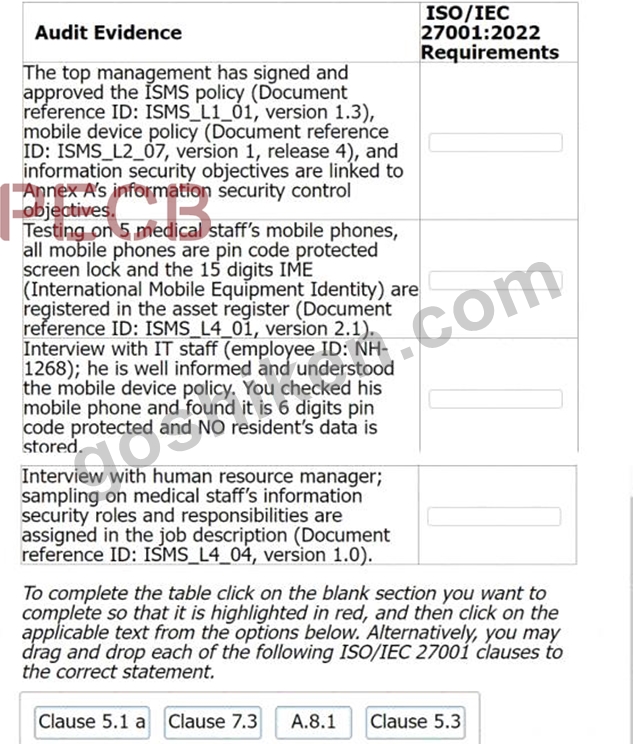
正解:
解説: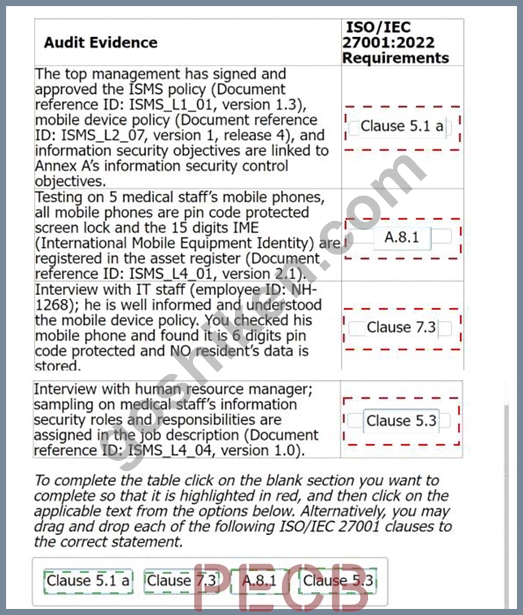
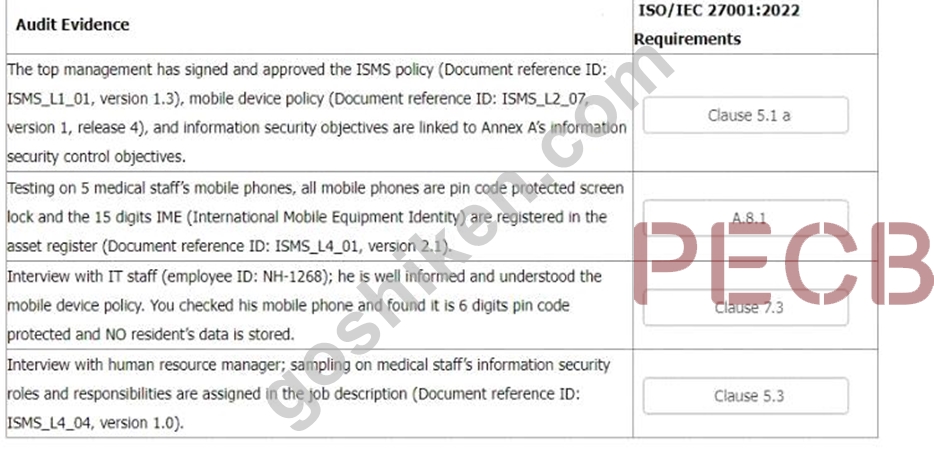
質問 # 94
The following are the guidelines to protect your password, except:
- A. Don't use the same password for various company system security access
- B. Do not share passwords with anyone
- C. For easy recall, use the same password for company and personal accounts
- D. Change a temporary password on first log-on
正解:B、C
解説:
The following are guidelines to protect your password, except for easy recall use the same password for company and personal accounts; do not share passwords with anyone. Using the same password for company and personal accounts is not a guideline to protect your password, as it increases the risk of compromising your password if one of your accounts is hacked or breached. You should use different and unique passwords for each account, and change them regularly. Sharing passwords with anyone is not a guideline to protect your password, as it reduces the security and accountability of your password. You should keep your password confidential and never disclose it to anyone, even if they claim to be authorized or trustworthy. Don't use the same password for various company system security access is a guideline to protect your password, as it prevents unauthorized access or misuse of your password if one of the systems is compromised or breached.
You should use different and complex passwords for each system, and follow the password policies and standards of the organization. Change a temporary password on first log-on is a guideline to protect your password, as it prevents unauthorized access or misuse of your password if the temporary password is intercepted or leaked. You should change the temporary password to a personal and secure password as soon as possible, and avoid using default or predictable passwords. References: : CQI & IRCA ISO 27001:2022 Lead Auditor Course Handbook, page 43. : [ISO/IEC 27001 LEAD AUDITOR - PECB], page 15.
質問 # 95
The following are definitions of Information, except:
- A. can lead to understanding and decrease in uncertainty
- B. accurate and timely data
- C. mature and measurable data
- D. specific and organized data for a purpose
正解:C
質問 # 96
Select the words that best complete the sentence:
正解:
解説:
Explanation
A third-party audit is an independent assessment of an organisation's management system by an external auditor, who is not affiliated with the organisation or its customers. The auditor verifies that the management system meets the requirements of a specific standard, such as ISO 27001, and evaluates its effectiveness and performance. The auditor also identifies any strengths, weaknesses, opportunities, or risks of the management system, and provides recommendations for improvement. The purpose of a third-party audit is to provide an objective and impartial evaluation of the organisation's management system, and to inform a certification decision by a certification body. A certification body is an organisation that grants a certificate of conformity to the organisation, after reviewing the audit report and evidence, and confirming that the management system meets the certification criteria. A certification decision is the outcome of the certification process, which can be positive (granting, maintaining, renewing, or expanding the scope of certification) or negative (suspending, withdrawing, or reducing the scope of certification). References:
PECB Candidate Handbook ISO 27001 Lead Auditor, pages 19-25
ISO 19011:2018 - Guidelines for auditing management systems
The ISO 27001 audit process | ISMS.online
質問 # 97
What is the worst possible action that an employee may receive for sharing his or her password or access with others?
- A. Forced roll off from the project
- B. The lowest rating on his or her performance assessment
- C. Termination
- D. Three days suspension from work
正解:C
解説:
The worst possible action that an employee may receive for sharing his or her password or access with others is termination, because this is a serious breach of the organization's information security policy and access control policy. Sharing password or access with others may allow unauthorized users to access sensitive or confidential information, or to perform malicious or fraudulent activities on behalf of the employee. The employee should keep his or her password or access confidential and secure, and should not disclose it to anyone under any circumstances. Reference: [CQI & IRCA Certified ISO/IEC 27001:2022 Lead Auditor Training Course], [ISO/IEC 27001:2022 Information technology - Security techniques - Information security management systems - Requirements], Example of an information security policy, Example of an access control policy
質問 # 98
......
100%更新されたのはPECB ISO-IEC-27001-Lead-Auditor限定版PDF問題集:https://www.goshiken.com/PECB/ISO-IEC-27001-Lead-Auditor-mondaishu.html
無料ISO 27001 ISO-IEC-27001-Lead-Auditor公式認定ガイドPDFダウンロード:https://drive.google.com/open?id=1j5WqAFvnTPHleDWXIrvulpx1EOpai85m