

[2024年03月14日] 有効なISO-IEC-27001-Lead-Auditorテスト解答とPECB ISO-IEC-27001-Lead-Auditor試験PDF問題を試そう
実際に出るISO-IEC-27001-Lead-Auditor試験問題集には正確で更新された問題
質問 # 91
Which two of the following phrases would apply to 'check' in the Plan-Do-Check-Act cycle for a business process?
- A. Resetting objectives
- B. Managing changes
- C. Auditing processes
- D. Updating the Information Security Policy
- E. Making improvements
- F. Verifying training
正解:C、F
解説:
The two phrases that would apply to 'check' in the Plan-Do-Check-Act cycle for a business process are:
C. Verifying training
F. Auditing processes
C. This phrase applies to 'check' in the PDCA cycle because it involves measuring and evaluating the effectiveness of the training activities that were implemented in the 'do' phase. Training is an important aspect of information security awareness, education, and competence, which are required by clause 7.2 of ISO 27001:20221. Verifying training can help the organisation to assess whether the staff have acquired the necessary knowledge, skills, and behaviour to perform their roles and responsibilities in relation to information security. Verifying training can also help the organisation to identify any gaps or weaknesses in the training program and to plan for improvement actions.
F. This phrase applies to 'check' in the PDCA cycle because it involves examining and reviewing the performance and conformity of the processes that were implemented in the 'do' phase. Auditing is a systematic, independent, and documented process for obtaining objective evidence and evaluating it to determine the extent to which the audit criteria are fulfilled2. Auditing processes can help the organisation to verify whether the information security objectives and requirements are met, whether the information security controls are effective and efficient, and whether the information security risks are adequately managed. Auditing processes can also help the organisation to identify any nonconformities or opportunities for improvement and to plan for corrective or preventive actions.
References:
1: ISO/IEC 27001:2022 - Information technology - Security techniques - Information security management systems - Requirements, clause 7.2 2: ISO 19011:2018 - Guidelines for auditing management systems, clause 3.2
質問 # 92
Stages of Information
- A. creation, use, disposition, maintenance, evolution
- B. creation, evolution, maintenance, use, disposition
- C. creation, distribution, use, maintenance, disposition
- D. creation, distribution, maintenance, disposition, use
正解:C
解説:
The stages of information are creation, distribution, use, maintenance, and disposition. These are the phases that information goes through during its lifecycle, from the moment it is generated to the moment it is destroyed or archived. Each stage of information has different security requirements and risks, and should be managed accordingly. Creation, evolution, maintenance, use, and disposition are not the correct stages of information, as evolution is not a distinct stage, but a process that can occur in any stage. Creation, use, disposition, maintenance, and evolution are not the correct stages of information, as they are not in the right order. Creation, distribution, maintenance, disposition, and use are not the correct stages of information, as they are not in the right order. Reference: : CQI & IRCA ISO 27001:2022 Lead Auditor Course Handbook, page 32. : [ISO/IEC 27001 LEAD AUDITOR - PECB], page 12.
質問 # 93
As the ISMS audit team leader, you are conducting a second-party audit of an international logistics company on behalf of an online retailer. During the audit, one of your team members reports a nonconformity relating to control 5.18 (Access rights) of Appendix A of ISO/IEC 27001:2022. She found evidence that removing the server access protocols of 20 people who left in the last 3 months took up to 1 week whereas the policy required removing access within 24 hours of their departure.
Complete the sentence with the best word(s), dick on the blank section you want to complete so that it is highlighted in red, and then click on the applicable text from the options below. Alternatively, you may drag and drop the option to the appropriate blank section.
正解:
解説:
質問 # 94
In the context of a third-party certification audit, confidentiality is an issue in an audit programme. Select two options which correctly state the function of confidentiality in an audit
- A. Auditors should obtain the auditee's permission before using a camera or recording equipment
- B. Confidentiality is one of the principles of audit conduct
- C. As an auditor is always accompanied by a guide, there is no risk to the auditee's sensitive information
- D. Observers in an audit team cannot access any confidential information
- E. Auditors are forced by regulatory requirements to maintain confidentiality in an audit
- F. Audit information can be used for improving personal competence by the auditor
正解:A、B
解説:
Explanation
Confidentiality is one of the principles of audit conduct that auditors should adhere to when performing audits. Confidentiality means that auditors should exercise discretion in the use and protection of information acquired in the course of their duties3. Auditors should respect the intellectual property rights of the auditee and other parties involved in the audit, and should not disclose any information that is sensitive, proprietary, or confidential without prior approval from the auditee or other authorized parties3. Auditors should also obtain the auditee's permission before using a camera or recording equipment during an audit, as these devices may capture confidential information or infringe on the privacy of individuals3. Therefore, these two options correctly state the function of confidentiality in an audit. The other options are either incorrect or irrelevant to confidentiality. For example, auditors are not forced by regulatory requirements to maintain confidentiality in an audit, but rather by ethical obligations and contractual agreements3. Observers in an audit team can access confidential information if they have signed a confidentiality agreement and have been authorized by the auditee3. Audit information can be used for improving personal competence by the auditor only if it does not compromise confidentiality or conflict with other interests3. As an auditor is always accompanied by a guide, there is still a risk to the auditee's sensitive information if the guide is not trustworthy or authorized to access such information3. References: ISO 19011:2018 - Guidelines for auditing management systems
質問 # 95
You are carrying out your first third-party ISMS surveillance audit as an Audit Team Leader. You are presently in the auditee's data centre with another member of your audit team.
Your colleague seems unsure as to the difference between an information security event and an information security incident. You attempt to explain the difference by providing examples.
Which three of the following scenarios can be defined as information security incidents?
- A. The organisation's malware protection software prevents a virus
- B. The organisation receives a phishing email
- C. An employee fails to clear their desk at the end of their shift
- D. A hard drive is used after its recommended replacement date
- E. The organisation fails a third-party penetration test
- F. The organisation's marketing data is copied by hackers and sold to a competitor
- G. An unhappy employee changes payroll records without permission
- H. A contractor who has not been paid deletes top management ICT accounts
正解:F、G、H
解説:
Explanation
According to ISO/IEC 27000:2018, which provides an overview and vocabulary of information security management systems, an information security event is an identified occurrence of a system, service or network state indicating a possible breach of information security policy or failure of safeguards, or a previously unknown situation that may be security relevant1. An information security incident is a single or a series of unwanted or unexpected information security events that have a significant probability of compromising business operations and threatening information security1. Therefore, based on this definition, three examples of information security incidents are:
* A contractor who has not been paid deletes top management ICT accounts: This is an example of an unwanted or unexpected information security event that has a significant probability of compromising business operations and threatening information security, as it may result in loss of access, data, or functionality for the top management.
* An unhappy employee changes payroll records without permission: This is an example of an unwanted or unexpected information security event that has a significant probability of compromising business operations and threatening information security, as it may result in financial fraud, legal liability, or reputational damage for the organization.
* The organisation's marketing data is copied by hackers and sold to a competitor: This is an example of an unwanted or unexpected information security event that has a significant probability of compromising business operations and threatening information security, as it may result in loss of confidentiality, competitive advantage, or customer trust for the organization.
The other options are not examples of information security incidents, but rather information security events that may or may not lead to incidents depending on their impact and severity. For example:
* The organisation's malware protection software prevents a virus: This is an example of an identified occurrence of a system state indicating a possible breach of information security policy or failure of safeguards, but it does not have a significant probability of compromising business operations and threatening information security, as it is prevented by the malware protection software.
* A hard drive is used after its recommended replacement date: This is an example of an identified occurrence of a system state indicating a possible breach of information security policy or failure of safeguards, but it does not have a significant probability of compromising business operations and threatening information security, unless it fails or causes other problems.
* The organisation receives a phishing email: This is an example of an identified occurrence of a network state indicating a possible breach of information security policy or failure of safeguards, but it does not have a significant probability of compromising business operations and threatening information security, unless it is opened or responded to by the recipient.
* An employee fails to clear their desk at the end of their shift: This is an example of an identified occurrence of a service state indicating a possible breach of information security policy or failure of safeguards, but it does not have a significant probability of compromising business operations and threatening information security, unless the desk contains sensitive or confidential information that is accessed by unauthorized persons.
* The organisation fails a third-party penetration test: This is an example of an identified occurrence of a system state indicating a possible breach of information security policy or failure of safeguards, but it does not have a significant probability of compromising business operations and threatening information security, unless the penetration test reveals serious vulnerabilities that are exploited by malicious actors.
References: ISO/IEC 27000:2018 - Information technology - Security techniques - Information security management systems - Overview and vocabulary
質問 # 96
You are an experienced audit team leader guiding an auditor in training.
Your team is currently conducting a third-party surveillance audit of an organisation that stores data on behalf of external clients. The auditor in training has been tasked with reviewing the TECHNOLOGICAL controls listed in the Statement of Applicability (SoA) and implemented at the site.
Select four controls from the following that would you expect the auditor in training to review.
You are an experienced audit team leader guiding an auditor in training, Your team is currently conducting a third-party surveillance audit of an organisation that stores data on behalf of external clients. The auditor in training has been tasked with reviewing the TECHNOLOGICAL controls listed in the Statement of Applicability (SoA) and implemented at the site.
Select four controls from the following that would you expect the auditor in training to review.
- A. How access to source code and development tools are managed
- B. How protection against malware is implemented
- C. The organisation's arrangements for maintaining equipment
- D. How the organisation evaluates its exposure to technical vulnerabilities
- E. The organisation's arrangements for information deletion
- F. The operation of the site CCTV and door control systems
- G. The development and maintenance of an information asset inventory
- H. The conducting of verification checks on personnel
- I. Confidentiality and nondisclosure agreements
- J. Rules for transferring information within the organisation and to other organisations
- K. Information security awareness, education and training
- L. How information security has been addressed within supplier agreements
- M. The organisation's business continuity arrangements
- N. Remote working arrangements
- O. How power and data cables enter the building
- P. Access to and from the loading bay
正解:A、B、D、F
解説:
Explanation
According to ISO/IEC 27001:2022, which specifies the requirements for establishing, implementing, maintaining and continually improving an information security management system (ISMS), an organization should select and implement appropriate controls to achieve its information security objectives1. The controls should be derived from the results of risk assessment and risk treatment, and should be consistent with the Statement of Applicability (SoA), which is a document that identifies the controls that are applicable and necessary for the ISMS1. The controls can be selected from various sources, such as ISO/IEC 27002:2013, which provides a code of practice for information security controls2. Therefore, if an auditor in training has been tasked with reviewing the technological controls listed in the SoA and implemented at the site of an organization that stores data on behalf of external clients, four controls that would be expected to review are:
* How protection against malware is implemented: This is a technological control that aims to prevent, detect and remove malicious software (such as viruses, worms, ransomware, etc.) that could compromise the confidentiality, integrity or availability of information or information systems2. This control is related to control A.12.2.1 of ISO/IEC 27002:20132.
* How the organisation evaluates its exposure to technical vulnerabilities: This is a technological control that aims to identify and assess the potential weaknesses or flaws in information systems or networks that could be exploited by malicious actors or cause accidental failures2. This control is related to control A.12.6.1 of ISO/IEC 27002:20132.
* How access to source code and development tools are managed: This is a technological control that aims to protect the intellectual property rights and integrity of software applications or systems that are developed or maintained by the organization or its external providers2. This control is related to control A.14.2.5 of ISO/IEC 27002:20132.
* The operation of the site CCTV and door control systems: This is a technological control that aims to monitor and restrict physical access to the premises or facilities where information or information systems are stored or processed2. This control is related to control A.11.1.4 of ISO/IEC 27002:20132.
The other options are not examples of technological controls, but rather organizational, legal or procedural controls that may also be relevant for an ISMS audit, but are not within the scope of the auditor in training's task. For example, the development and maintenance of an information asset inventory (related to control A.8.1.1), rules for transferring information within the organization and to other organizations (related to control A.13.2.1), confidentiality and nondisclosure agreements (related to control A.13.2.4), verification checks on personnel (related to control A.7.1.2), remote working arrangements (related to control A.6.2.1), information security within supplier agreements (related to control A.15.1.1), business continuity arrangements (related to control A.17), information deletion (related to control A.8.3), information security awareness, education and training (related to control A.7.2), equipment maintenance (related to controlA.11.2), and how power and data cables enter the building (related to control A.11) are not technological controls, but rather organizational, legal or procedural controls that may also be relevant for an ISMS audit, but are not within the scope of the auditor in training's task. References: ISO/IEC 27001:2022 - Information technology - Security techniques - Information security management systems - Requirements, ISO/IEC
27002:2013 - Information technology - Security techniques - Code of practice for information security controls
質問 # 97
Which of the following factors does NOT contribute to the value of data for an organisation?
- A. The content of data
- B. The importance of data for processes
- C. The correctness of data
- D. The indispensability of data
正解:A
質問 # 98
Which one of the following options is the definition of an interested party?
- A. A third party can appeal to an organisation when it perceives itself to be affected by a decision or activity
- B. An individual or organisation that can control, be controlled by, or perceive itself to be controlled by a decision or activity
- C. A group or organisation that can interfere in or perceive itself to be interfered with by a management decision
- D. A person or organisation that can affect, be affected by or perceive itself to be affected by a decision or activity
正解:D
解説:
Explanation
This is the definition of an interested party according to ISO 27001:2013, clause 3.16. An interested party is essentially a stakeholder, i.e., a person or organization that can influence or be influenced by the information security management system (ISMS) or its activities. Interested parties can have different needs and expectations regarding the ISMS, and these should be identified and addressed by the organization.
References:
* ISO/IEC 27001:2013, Information technology - Security techniques - Information security management systems - Requirements, clause 3.16
* PECB Candidate Handbook ISO 27001 Lead Auditor, page 10
* Identifying interested parties and their expectations for an ISO 27001 ISMS
* Examples of ISO 27001 interested parties
質問 # 99
You are an experienced ISMS audit team leader providing instruction to an auditor in training. They are unclear in their understanding of risk processes and ask you to provide them with an example of each of the processes detailed below.
Match each of the descriptions provided to one of the following risk management processes.
To complete the table click on the blank section you want to complete so that it is highlighted in red, and then click on the applicable text from the options below. Alternatively, you may drag and drop each option to the appropriate blank section.
正解:
解説:
Explanation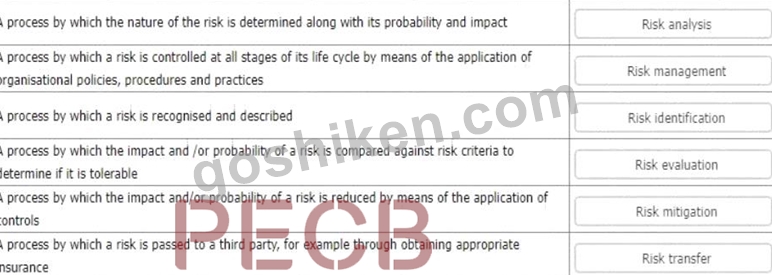
* Risk analysis is the process by which the nature of the risk is determined along with its probability and impact. Risk analysis involves estimating the likelihood and consequences of potential events or situations that could affect the organization's information security objectives or requirements12. Risk analysis could use qualitative or quantitative methods, or a combination of both12.
* Risk management is the process by which a risk is controlled at all stages of its life cycle by means of the application of organisational policies, procedures and practices. Risk management involves establishing the context, identifying, analyzing, evaluating, treating, monitoring, and reviewing the risks that could affect the organization's information security performance or compliance12. Risk management aims to ensure that risks are identified and treated in a timely and effective manner, and that opportunities for improvement are exploited12.
* Risk identification is the process by which a risk is recognised and described. Risk identification involves identifying and documenting the sources, causes, events, scenarios, and potential impacts of risks that could affect the organization's information security objectives or requirements12. Risk identification could use various techniques, such as brainstorming, interviews, checklists, surveys, or historical data12.
* Risk evaluation is the process by which the impact and/or probability of a risk is compared against risk criteria to determine if it is tolerable. Risk evaluation involves comparing the results of risk analysis with predefined criteria that reflect the organization's risk appetite, tolerance, or acceptance12. Risk evaluation could use various methods, such as ranking, scoring, or matrix12. Risk evaluation helps to prioritize and decide on the appropriate risk treatment options12.
* Risk mitigation is the process by which the impact and/or probability of a risk is reduced by means of the application of controls. Risk mitigation involves selecting and implementing measures that are designed to prevent, reduce, transfer, or accept risks that could affect the organization's information security objectives or requirements12. Risk mitigation could include various types of controls, such as technical, organizational, legal, or physical12. Risk mitigation should be based on a cost-benefit analysis and a residual risk assessment12.
* Risk transfer is the process by which a risk is passed to a third party, for example through obtaining appropriate insurance. Risk transfer involves sharing or shifting some or all of the responsibility or liability for a risk to another party that has more capacity or capability to manage it12. Risk transfer could include various methods, such as contracts, agreements, partnerships, outsourcing, or insurance12. Risk transfer should not be used as a substitute for effective risk management within the organization12.
References :=
* ISO/IEC 27001:2022 Information technology - Security techniques - Information security management systems - Requirements
* ISO/IEC 27005:2022 Information technology - Security techniques - Information security risk management
質問 # 100
You are an experienced audit team leader guiding an auditor in training.
Your team is currently conducting a third-party surveillance audit of an organisation that stores data on behalf of external clients. The auditor in training has been tasked with reviewing the TECHNOLOGICAL controls listed in the Statement of Applicability (SoA) and implemented at the site.
Select four controls from the following that would you expect the auditor in training to review.
- A. How access to source code and development tools are managed
- B. How protection against malware is implemented
- C. The organisation's arrangements for information deletion
- D. How the organisation evaluates its exposure to technical vulnerabilities
- E. Confidentiality and nondisclosure agreements
- F. Information security awareness, education and training
- G. The organisation's business continuity arrangements
- H. How power and data cables enter the building
正解:A、B、C、D
解説:
The four controls from the list that the auditor in training should review are:
*B. How access to source code and development tools are managed: This control requires the organisation to restrict and monitor the access to the source code and development tools that are used to create, modify, or maintain the software applications and systems that process or store the data of external clients. This is important for ensuring the integrity, confidentiality, and availability of the software and the data, as well as for preventing unauthorized changes, errors, or malicious code injection.
*D. How protection against malware is implemented: This control requires the organisation to implement appropriate measures to detect, prevent, and remove malware from the IT systems and devices that process or store the data of external clients. This includes using antivirus software, firewalls, email filtering, web filtering, and other tools to protect against viruses, worms, ransomware, spyware, and other malicious software. This is essential for safeguarding the data and the systems from corruption, theft, or damage caused by malware.
*E. How the organisation evaluates its exposure to technical vulnerabilities: This control requires the organisation to identify and assess the technical vulnerabilities that may affect the IT systems and devices that process or store the data of external clients. This includes using vulnerability scanning tools, penetration testing tools, threat intelligence sources, and other methods to discover and evaluate the weaknesses and gaps in the security of the systems and the devices. This is necessary for prioritizing and implementing the appropriate corrective actions and controls to mitigate the risks posed by the vulnerabilities.
*G. The organisation's arrangements for information deletion: This control requires the organisation to establish and implement policies and procedures for deleting the data of external clients from the IT systems and devices when it is no longer needed or required. This includes defining the criteria and methods for data deletion, such as secure erasure, encryption, or physical destruction. This is important for complying with the contractual obligations and the legal and regulatory requirements regarding the retention and disposal of the data, as well as for protecting the confidentiality and integrity of the data.
References: = ISO/IEC 27001:2022, Annex A, clauses A.8.9, A.8.10, A.8.11, and A.8.28; Understanding ISO
27001:2022: People, process, and technology, pages 6-7; What are the 11 new security controls in ISO
27001:2022? - Advisera.
質問 # 101
You are an ISMS audit team leader who has been assigned by your certification body to carry out a follow-up audit of a client. You are preparing your audit plan for this audit.
Which two of the following statements are true?
- A. Verification should focus on whether any action undertaken has been undertaken effectively
- B. Verification should focus on whether any action undertaken is complete
- C. Opportunities for improvement should be verified first, followed by corrections and finally corrective actions
- D. Corrective actions should be reviewed first, followed by corrections and finally opportunities for improvement
- E. Verification should focus on whether any action undertaken taken has been undertaken efficiently
- F. Corrections should be verified first, followed by corrective actions and finally opportunities for improvement
正解:A、B
解説:
According to ISO 27001:2022 clause 9.1.2, the organisation shall conduct internal audits at planned intervals to provide information on whether the information security management system conforms to the organisation's own requirements, the requirements of ISO 27001:2022, and is effectively implemented and maintained12 According to ISO 27001:2022 clause 10.1, the organisation shall react to the nonconformities and take action, as applicable, to control and correct them and deal with the consequences. The organisation shall also evaluate the need for action to eliminate the causes of nonconformities, in order to prevent recurrence or occurrence.
The organisation shall implement any action needed, review the effectiveness of any corrective action taken, and make changes to the information security management system, if necessary12 A follow-up audit is a type of internal audit that is conducted after a previous audit to verify whether the nonconformities and corrective actions have been addressed and resolved, and whether the information security management system has been improved12 Therefore, the following statements are true for preparing a follow-up audit plan:
Verification should focus on whether any action undertaken is complete. This means that the auditor should check whether the organisation has implemented all the planned actions to correct and prevent the nonconformities, and whether the actions have been documented and communicated as required12 Verification should focus on whether any action undertaken has been undertaken effectively. This means that the auditor should check whether the organisation has achieved the intended results and objectives of the actions, and whether the actions have eliminated or reduced the nonconformities and their causes and consequences12 The following statements are false for preparing a follow-up audit plan:
Verification should focus on whether any action undertaken has been undertaken efficiently. This is false because efficiency is not a criterion for verifying the actions taken to address the nonconformities and corrective actions. Efficiency refers to the optimal use of resources to achieve the desired outcomes, but it is not a requirement of ISO 27001:2022. The auditor should focus on the effectiveness and completeness of the actions, not on the efficiency12 Corrections should be verified first, followed by corrective actions and finally opportunities for improvement. This is false because there is no prescribed order for verifying the corrections, corrective actions, and opportunities for improvement. The auditor should verify all the actions taken by the organisation, regardless of their sequence or priority. The auditor may choose to verify the actions based on their relevance, significance, or impact, but this is not a mandatory requirement12 Opportunities for improvement should be verified first, followed by corrections and finally corrective actions. This is false because there is no prescribed order for verifying the opportunities for improvement, corrections, and corrective actions. The auditor should verify all the actions taken by the organisation, regardless of their sequence or priority. The auditor may choose to verify the actions based on their relevance, significance, or impact, but this is not a mandatory requirement12 Corrective actions should be reviewed first, followed by corrections and finally opportunities for improvement. This is false because there is no prescribed order for reviewing the corrective actions, corrections, and opportunities for improvement. The auditor should review all the actions taken by the organisation, regardless of their sequence or priority. The auditor may choose to review the actions based on their relevance, significance, or impact, but this is not a mandatory requirement12 References:
1: ISO/IEC 27001:2022 Lead Auditor (Information Security Management Systems) Course by CQI and IRCA Certified Training 1 2: ISO/IEC 27001 Lead Auditor Training Course by PECB 2
質問 # 102
What controls can you do to protect sensitive data in your computer when you go out for lunch?
- A. You are confident to leave your computer screen as is since a password protected screensaver is installed and it is set to activate after 10 minutes of inactivity
- B. You turn off the monitor
- C. You activate your favorite screen-saver
- D. You lock your computer by pressing Windows+L or CTRL-ALT-DELETE and then click "Lock Computer".
正解:D
解説:
Explanation
You should lock your computer by pressing Windows+L or CTRL-ALT-DELETE and then click "Lock Computer", because this is the most effective way to protect sensitive data in your computer when you go out for lunch. By locking your computer, you are preventing unauthorized access to your computer and its contents, as well as complying with the organization's access control policy and information security policy.
Locking your computer requires a password or a biometric authentication to unlock it, which adds a layer of security to your data. The other options are not sufficient or reliable, as they do not prevent someone from accessing your computer or viewing your screen. References: [CQI & IRCA Certified ISO/IEC 27001:2022 Lead Auditor Training Course], ISO/IEC 27001:2022 Information technology - Security techniques - Information security management systems - Requirements, How to lock your PC
質問 # 103
You are an audit team leader conducting a third-party surveillance audit of a telecom services provider. You have assigned responsibility for auditing the organisation's information security objectives to a junior member of your audit team. Before they begin their assessment, you ask them the following question to check their understanding of the requirements of ISO/IEC 27001:2022.
Which four of the following criteria must Information security objectives fulfil?
- A. They must be communicated appropriately
- B. They must always be monitored
- C. They must always be measured
- D. They must be reviewed annually
- E. They must be clear and unambiguous
- F. They must be achievable
- G. They must be available as documented information
- H. They must be consistent with the IS Policy
正解:A、F、G、H
解説:
According to ISO/IEC 27001:2022, clause 6.2, information security objectives are the specific results that an organisation intends to achieve with its information security management system (ISMS). The standard specifies that information security objectives must fulfil the following criteria:
* They must be communicated appropriately (A): The organisation must ensure that the relevant internal and external parties are informed about the information security objectives and their roles and responsibilities in achieving them. This can help to create awareness, commitment, and accountability for information security. This criterion is related to clause 6.2.2 of ISO/IEC 27001:2022.
* They must be available as documented information (B): The organisation must maintain and retain documented information on the information security objectives, including their scope, level, indicators, and time frame. This can help to provide evidence, traceability, and consistency for information security. This criterion is related to clause 6.2.1 of ISO/IEC 27001:2022.
* They must be consistent with the IS Policy (G): The organisation must ensure that the information security objectives are aligned with the information security policy, which is the top-level statement of the organisation's intentions and direction for information security. This can help to support the strategic objectives and the context of the organisation. This criterion is related to clause 5.2 of ISO/IEC
27001:2022.
* They must be achievable (H): The organisation must ensure that the information security objectives are realistic and attainable, considering the available resources, capabilities, and constraints. This can help to avoid setting unrealistic or unfeasible expectations and to monitor and measure the progress and performance of information security. This criterion is related to clause 6.2.1 of ISO/IEC 27001:2022.
References:
* ISO/IEC 27001:2022, Information technology - Security techniques - Information security management systems - Requirements1
* PECB Candidate Handbook ISO/IEC 27001 Lead Auditor2
* ISO 27001:2022 Lead Auditor - PECB3
* ISO 27001:2022 certified ISMS lead auditor - Jisc4
* ISO/IEC 27001:2022 Lead Auditor Transition Training Course5
* ISO 27001 - Information Security Lead Auditor Course - PwC Training Academy6
質問 # 104
Which two of the following phrases would apply to "plan" in relation to the Plan-Do-Check-Act cycle for a business process?
- A. Retaining documentation
- B. Setting objectives
- C. Retaining documentation
- D. Organising changes
- E. Providing ICT assets
- F. Training staff
正解:B、F
解説:
Explanation
The Plan-Do-Check-Act (PDCA) cycle is a four-step method for implementing and improving processes, products, or services. The "plan" phase involves establishing the objectives and processes necessary to deliver the desired results. This may include setting SMART goals, identifying resources, defining roles and responsibilities, conducting risk assessments, and developing plans for training, communication, and monitoring.
References:
* ISO/IEC 27001:2022 Lead Auditor (Information Security Management Systems) objectives and content from Quality.org and PECB
* ISO 19011:2018 Guidelines for auditing management systems [Section 5.3.1]
質問 # 105
The following options are key actions involved in a first-party audit. Order the stages to show the sequence in which the actions should take place.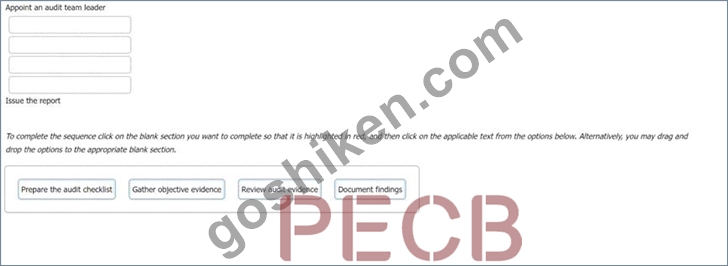
正解:
解説: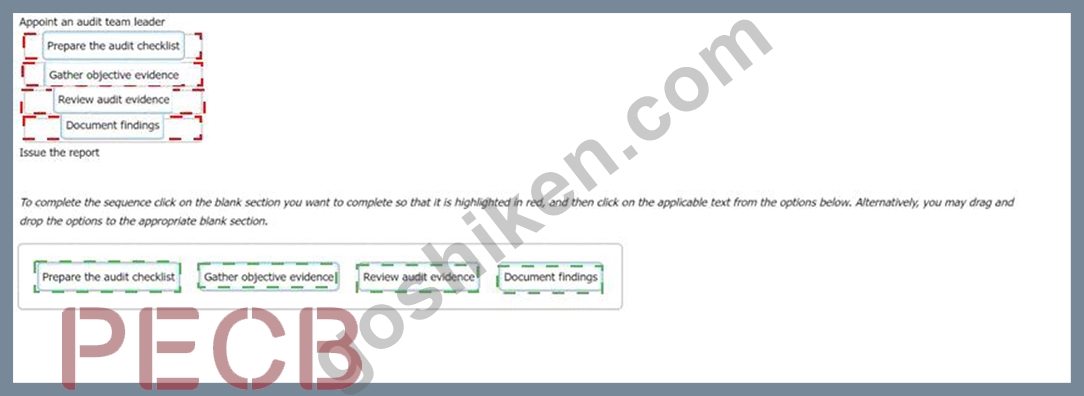
Explanation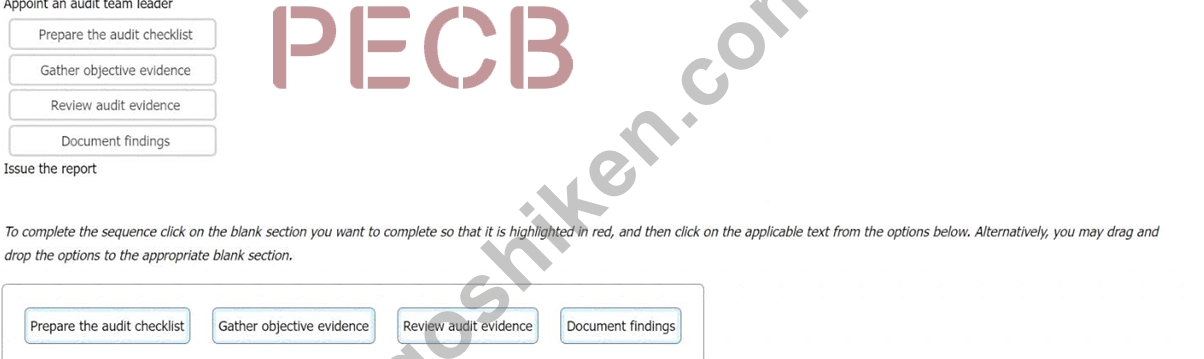
The correct order of the stages is:
* Prepare the audit checklist
* Gather objective evidence
* Review audit evidence
* Document findings
* Audit preparation: This stage involves defining the audit objectives, scope, criteria, and plan. The auditor also prepares the audit checklist, which is a list of questions or topics that will be covered during the audit. The audit checklist helps the auditor to ensure that all relevant aspects of the ISMS are addressed and that the audit evidence is collected in a systematic and consistent manner12.
* Audit execution: This stage involves conducting the audit activities, such as opening meeting, interviews, observations, document review, and closing meeting. The auditor gathers objective evidence, which is any information that supports the audit findings and conclusions. Objective evidence can be qualitative or quantitative, and can be obtained from various sources, such as records, statements, physical objects, or observations123.
* Audit reporting: This stage involves reviewing the audit evidence, evaluating the audit findings, and documenting the audit results. The auditor reviews the audit evidence to determine whether it is sufficient, reliable, and relevant to support the audit findings. The auditor evaluates the audit findings to determine the degree of conformity or nonconformity of the ISMS with the audit criteria. The auditor
* documents the audit results in an audit report, which is a formal record of the audit process and outcomes. The audit report typically includes the following elements123:
* An introduction clarifying the scope, objectives, timing and extent of the work performed
* An executive summary indicating the key findings, a brief analysis and a conclusion
* The intended report recipients and, where appropriate, guidelines on classification and circulation
* Detailed findings and analysis
* Recommendations for improvement, where applicable
* A statement of conformity or nonconformity with the audit criteria
* Any limitations or exclusions of the audit scope or evidence
* Any deviations from the audit plan or procedures
* Any unresolved issues or disagreements between the auditor and the auditee
* A list of references, abbreviations, and definitions used in the report
* A list of appendices, such as audit plan, audit checklist, audit evidence, audit team members, etc.
* Audit follow-up: This stage involves verifying the implementation and effectiveness of the corrective actions taken by the auditee to address the audit findings. The auditor monitors the progress and completion of the corrective actions, and evaluates their impact on the ISMS performance and conformity. The auditor may conduct a follow-up audit to verify the corrective actions on-site, or may rely on other methods, such as document review, remote interviews, or self-assessment by the auditee.
The auditor documents the follow-up results and updates the audit report accordingly123.
References:
* PECB Candidate Handbook ISO 27001 Lead Auditor, pages 19-25
* ISO 19011:2018 - Guidelines for auditing management systems
* The ISO 27001 audit process | ISMS.online
質問 # 106
You are performing an ISMS audit at a European-based residential nursing home called ABC that provides healthcare services. The next step in your audit plan is to verify the effectiveness of the continual improvement process.
During the audit, you learned most of the residents' family members (90%) receive WeCare medical devices promotion advertisements through email and SMS once a week via ABC's healthcare mobile app. All of them do not agree on the use of the collected personal data for marketing or any other purposes than nursing and medical care on the signed service agreement with ABC. They have very strong reason to believe that ABC is leaking residents' and family members' personal information to a non-relevant third party and they have filed complaints.
The Service Manager says that, after investigation, all these complaints have been treated as nonconformities.
The corrective actions have been planned and implemented according to the nonconformity and corrective management procedure (Document reference ID: ISMS_L2_10.1, version 1).
You write a nonconformity which you will follow up on later. Select the words that best complete the sentence: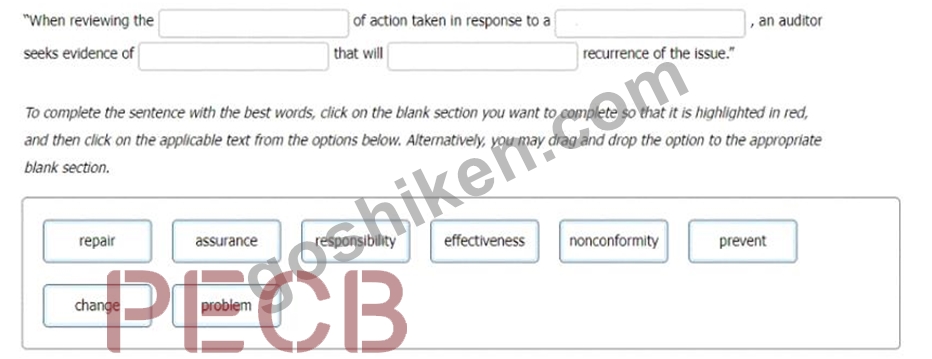
正解:
解説: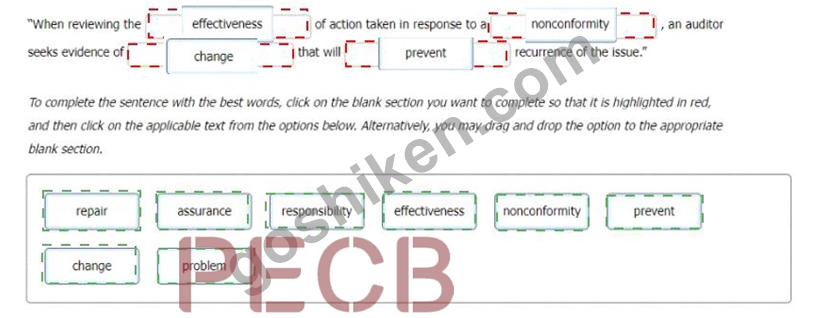
Explanation:
One possible way to complete the sentence is:
"When reviewing the effectiveness of action taken in response to a nonconformity, an auditor seeks evidence of change that will prevent recurrence of the issue." According to ISO/IEC 27001:2022, clause 10.1, the organization shall continually improve the suitability, adequacy, and effectiveness of the ISMS by evaluating the performance and the effectiveness of the ISMS, ensuring that the policy and objectives are aligned with the strategic direction of the organization, and taking actions to achieve the intended outcomes of the ISMS. One of the ways to achieve continual improvement is to identify and correct nonconformities and take actions to eliminate their causes and prevent their recurrence.
Therefore, when reviewing the effectiveness of the corrective actions, an auditor should look for evidence that the organization has analyzed the root cause of the nonconformity, implemented appropriate changes to the ISMS, and verified that the changes have resulted in the desired improvement and prevented the recurrence of the issue. References: = ISO/IEC 27001:2022, clause 10.1, Nonconformity and corrective action ISO/IEC 27001:2022, clause 10.2, Continual improvement PECB Candidate Handbook ISO 27001 Lead Auditor, page 19, Audit Process PECB Candidate Handbook ISO 27001 Lead Auditor, page 21, Audit Findings
質問 # 107
You are carrying out your first third-party ISMS surveillance audit as an Audit Team Leader. You are presently in the auditee's data centre with another member of your audit team.
You are currently in a large room that is subdivided into several smaller rooms, each of which has a numeric combination lock and swipe card reader on the door. You notice two external contractors using a swipe card and combination number provided by the centre's reception desk to gain access to a client's suite to carry out authorised electrical repairs.
You go to reception and ask to see the door access record for the client's suite. This indicates only one card was swiped. You ask the receptionist and they reply, "yes it's a common problem. We ask everyone to swipe their cards but with contractors especially, one tends to swipe and the rest simply 'tailgate' their way in" but we know who they are from the reception sign-in.
Based on the scenario above which one of the following actions would you now take?
- A. Determine whether any additional effective arrangements are in place to verify individual access to secure areas e.g. CCTV
- B. Raise a nonconformity against control A.7.6 'working in secure areas' as security measures for working in secure areas have not been defined
- C. Take no action. Irrespective of any recommendations, contractors will always act in this way
- D. Raise a nonconformity against control A.7.2 'physical entry' as a secure area is not adequately protected
- E. Tell the organisation they must write to their contractors, reminding them of the need to use access cards appropriately
- F. Raise an opportunity for improvement to have a large sign in reception reminding everyone requiring access must use their swipe card at all times
- G. Raise an opportunity for improvement that contractors must be accompanied at all times when accessing secure facilities
- H. Raise a nonconformity against control A.5.20 'addressing information security in supplier relationships' as information security requirements have not been agreed upon with the supplier
正解:D
解説:
Explanation
According to ISO/IEC 27001:2022, which specifies the requirements for establishing, implementing, maintaining and continually improving an information security management system (ISMS), control A.7.2 requires an organization to implement appropriate physical entry controls to prevent unauthorized access to secure areas1. The organization should define and document the criteria for granting and revoking access rights to secure areas, and should monitor and record the use of such access rights1. Therefore, when auditing the organization's application of control A.7.2, an ISMS auditor should verify that these aspects are met in accordance with the audit criteria.
Based on the scenario above, the auditor should raise a nonconformity against control A.7.2, as the secure area is not adequately protected from unauthorized access. The auditor should provide the following evidence and justification for the nonconformity:
* Evidence: The auditor observed two external contractors using a swipe card and combination number provided by the centre's reception desk to gain access to a client's suite to carry out authorized electrical repairs. The auditor checked the door access record for the client's suite and found that only one card was swiped. The auditor asked the receptionist and was told that it was a common problem that contractors tend to swipe one card and tailgate their way in, but they were known from the reception sign-in.
* Justification: This evidence indicates that the organization has not implemented appropriate physical entry controls to prevent unauthorized access to secure areas, as required by control A.7.2. The organization has not defined and documented the criteria for granting and revoking access rights to secure areas, as there is no verification or authorization process for providing swipe cards and combination numbers to external contractors. The organization has not monitored and recorded the use of access rights to secure areas, as there is no mechanism to ensure that each individual swipes their card and enters their combination number before entering a secure area. The organization has relied on the reception sign-in as a means of identification, which is not sufficient or reliable for ensuring information security.
The other options are not valid actions for auditing control A.7.2, as they are not related to the control or its requirements, or they are not appropriate or effective for addressing the nonconformity. For example:
* Take no action: This option is not valid because it implies that the auditor ignores or accepts the nonconformity, which is contrary to the audit principles and objectives of ISO 19011:20182, which provides guidelines for auditing management systems.
* Raise a nonconformity against control A.5.20 'addressing information security in supplier relationships' as information security requirements have not been agreed upon with the supplier: This option is not valid because it does not address the root cause of the nonconformity, which is related to physical entry controls, not supplier relationships. Control A.5.20 requires an organization to agree on information security requirements with suppliers that may access, process, store, communicate or provide IT infrastructure components for its information assets1. While this control may be relevant for ensuring information security in supplier relationships, it does not address the issue of unauthorized access to secure areas by external contractors.
* Raise a nonconformity against control A.7.6 'working in secure areas' as security measures for working in secure areas have not been defined: This option is not valid because it does not address the root cause of the nonconformity, which is related to physical entry controls, not working in secure areas. Control A.7.6 requires an organization to define and apply security measures for working in secure areas1.
While this control may be relevant for ensuring information security when working in secure areas, it does not address the issue of unauthorized access to secure areas by external contractors.
* Determine whether any additional effective arrangements are in place to verify individual access to secure areas e.g. CCTV: This option is not valid because it does not address or resolve the nonconformity, but rather attempts to find alternative or compensating controls that may mitigate its
* impact or likelihood. While additional arrangements such as CCTV may be useful for verifying individual access to secure areas, they do not replace or substitute the requirement for appropriate physical entry controls as specified by control A.7.2.
* Raise an opportunity for improvement that contractors must be accompanied at all times when accessing secure facilities: This option is not valid because it does not address or resolve the nonconformity, but rather suggests a possible improvement action that may prevent or reduce its recurrence or severity.
While accompanying contractors at all times when accessing secure facilities may be a good practice for ensuring information security, it does not replace or substitute the requirement for appropriate physical entry controls as specified by control A.7.2.
* Raise an opportunity for improvement to have a large sign in reception reminding everyone requiring access must use their swipe card at all times: This option is not valid because it does not address or resolve the nonconformity, but rather suggests a possible improvement action that may increase awareness or compliance with the existing controls. While having a large sign in reception reminding everyone requiring access must use their swipe card at all times may be a helpful reminder for ensuring information security, it does not replace or substitute the requirement for appropriate physical entry controls as specified by control A.7.2.
* Tell the organisation they must write to their contractors, reminding them of the need to use access cards appropriately: This option is not valid because it does not address or resolve the nonconformity, but rather instructs the organization to take a corrective action that may not be effective or sufficient for ensuring information security. While writing to contractors, reminding them of the need to use access cards appropriately may be a communication measure for ensuring information security, it does not replace or substitute the requirement for appropriate physical entry controls as specified by control A.7.2.
References: ISO/IEC 27001:2022 - Information technology - Security techniques - Information security management systems - Requirements, ISO 19011:2018 - Guidelines for auditing management systems
質問 # 108
What type of legislation requires a proper controlled purchase process?
- A. Intellectual property rights act
- B. Government information act
- C. Personal data protection act
- D. Computer criminality act
正解:A
解説:
An intellectual property rights act is a type of legislation that requires a proper controlled purchase process. Intellectual property rights are legal rights that protect creations of the mind, such as inventions, literary and artistic works, designs, symbols, names and images. Intellectual property rights can include patents, trademarks, copyrights, trade secrets, etc. A proper controlled purchase process is a process that ensures that the organization obtains valid licenses or permissions from the owners or authorized parties of the intellectual property rights before using or acquiring any intellectual property assets. This process helps to avoid infringing on the intellectual property rights of others, which may result in legal actions, fines, damages or reputational harm. ISO/IEC 27001:2022 requires the organization to comply with relevant legal and contractual obligations related to intellectual property rights (see clause A.18.1.4). Reference: [CQI & IRCA Certified ISO/IEC 27001:2022 Lead Auditor Training Course], ISO/IEC 27001:2022 Information technology - Security techniques - Information security management systems - Requirements, What is Intellectual Property?
質問 # 109
You are an audit team leader conducting a third-party surveillance audit of a telecom services provider. You have assigned responsibility for auditing the organisation's information security objectives to a junior member of your audit team. Before they begin their assessment, you ask them the following question to check their understanding of the requirements of ISO/IEC 27001:2022.
Which four of the following criteria must Information security objectives fulfil?
- A. They must be communicated appropriately
- B. They must always be monitored
- C. They must always be measured
- D. They must be reviewed annually
- E. They must be clear and unambiguous
- F. They must be achievable
- G. They must be available as documented information
- H. They must be consistent with the IS Policy
正解:A、F、G、H
解説:
Explanation
According to ISO/IEC 27001:2022, clause 6.2, information security objectives are the specific results that an organisation intends to achieve with its information security management system (ISMS). The standard specifies that information security objectives must fulfil the following criteria:
They must be communicated appropriately (A): The organisation must ensure that the relevant internal and external parties are informed about the information security objectives and their roles and responsibilities in achieving them. This can help to create awareness, commitment, and accountability for information security. This criterion is related to clause 6.2.2 of ISO/IEC 27001:2022.
They must be available as documented information (B): The organisation must maintain and retain documented information on the information security objectives, including their scope, level, indicators, and time frame. This can help to provide evidence, traceability, and consistency for information security. This criterion is related to clause 6.2.1 of ISO/IEC 27001:2022.
They must be consistent with the IS Policy (G): The organisation must ensure that the information security objectives are aligned with the information security policy, which is the top-level statement of the organisation's intentions and direction for information security. This can help to support the strategic objectives and the context of the organisation. This criterion is related to clause 5.2 of ISO/IEC
27001:2022.
They must be achievable (H): The organisation must ensure that the information security objectives are realistic and attainable, considering the available resources, capabilities, and constraints. This can help to avoid setting unrealistic or unfeasible expectations and to monitor and measure the progress and performance of information security. This criterion is related to clause 6.2.1 of ISO/IEC 27001:2022.
References:
ISO/IEC 27001:2022, Information technology - Security techniques - Information security management systems - Requirements1 PECB Candidate Handbook ISO/IEC 27001 Lead Auditor2 ISO 27001:2022 Lead Auditor - PECB3 ISO 27001:2022 certified ISMS lead auditor - Jisc4 ISO/IEC 27001:2022 Lead Auditor Transition Training Course5 ISO 27001 - Information Security Lead Auditor Course - PwC Training Academy6
質問 # 110
......
ISO-IEC-27001-Lead-Auditor試験問題集でPDF問題とテストエンジン:https://www.goshiken.com/PECB/ISO-IEC-27001-Lead-Auditor-mondaishu.html
ISO-IEC-27001-Lead-Auditor問題集で必ず合格させる試験:https://drive.google.com/open?id=1NfH0Eu9kY9-zr-rkPJJeRgu_g7hUNjQA