

合格させるEMC D-XTR-DS-A-24試験には保証が付きます。更新されたのは62問があります
最新のD-XTR-DS-A-24合格保証付き試験問題集の認定サンプル問題
質問 # 22
What is an accurate statement with regards to restoring data to a production volume at a later time using XVC?
- A. There is no need to unmount a production volume before it can be restored
- B. Restore operation takes longer than snap shot creation time
- C. Customer can restore from a read write repurpose copy
- D. Restore option is presented only from a read only copy
正解:A
解説:
Using XtremIO Virtual Copies (XVC), data can be restored to a production volume without the need to unmount it first. This feature allows for greater flexibility and efficiency in managing data restoration processes.The XVC technology enables the creation of space-efficient snapshots and copies of volumes that can be used for various purposes, including data restoration1.
References:
* The XtremIO Snapshots (XVC) Inquiries on Dell Technologies Community Forum provides insights into the capabilities of XVC, including the ability to restore data without unmounting the production volume1.
* Additional information on the functionality and usage of XVC can be found in the XtremIO Host Configuration Guide2.
質問 # 23
A customer has a complex virtualized environment and wants to see a topology view from virtual or physical hosts down to the storage array volumes to identify application to storage dependencies.
Which Dell EMC product provides this solution?
- A. Technician Advisor
- B. AppSync
- C. ViPR SRM
- D. XtremIO VAAI plug in
正解:C
質問 # 24
XtremlO encrypts data that is stored on which drive?
- A. Physical XMS, Storage Controller, and DAE
- B. DAE only
- C. Storage Controller and DAE
- D. Storage Controller only
正解:B
解説:
The Dell EMC XtremIO X2 Storage Array uses Data at Rest Encryption (D@RE) to encrypt data. This encryption occurs on the Self Encrypting Drives (SEDs) within the Data Availability Enclosures (DAE).The DAEs house the physical drives where the actual data is stored and encrypted1.
References:
* Introduction to Dell EMC XtremIO X2 Storage Array document2.
* Dell EMC XtremIO v6.3 document1.
質問 # 25
Which host operating systems does the Live Optics Collector run on?
- A. Windows, Linux, and KVM
- B. Windows, Linux, and Solaris
- C. Windows and Linux
- D. Windows, Linux, Solaris, and HPUX
正解:C
解説:
The Live Optics Collector, which is used for profiling several hardware storage arrays including the Dell XtremIO family of all-flash arrays, can run on any host with IP connectivity to the storage array being profiled. The supported operating systems for the Live Optics Collector areWindows and Linux.This is based on the information provided by the Live Optics support documentation, which outlines the process to produce an XtremIO array storage profile1.
References:
* The Live Optics support documentation provides detailed instructions on how to launch and run the Live Optics Collector, which includes the supported operating systems1.
質問 # 26
A customer is using a third party RESTful API client to create a series of new objects on an XtremlO cluster for use with their SQL application. Which HTTP method should be used to create the objects needed for integration with the SQL application?
- A. DELETE
- B. POST
- C. PUT
- D. GET
正解:B
解説:
In RESTful API design, the HTTP method used to create new resources or objects is POST. This method is utilized when the client needs to send data to the server to create a new entity.For example, when integrating with an SQL application and creating new objects on an XtremIO cluster, using a POST request with the appropriate payload will instruct the server to create the new resources as specified1.
References:
* A well-designed REST API implements CRUD operations using different HTTP methods, with POST being the method for Create operations1.
* The Dell Technologies Developer Portal provides resources and documentation on REST APIs, including the methods used for various operations2.
質問 # 27
Which XtremlO X2 hardware component provides a backup power source to save journaling data during an unplanned emergency shutdown?
- A. PSU
- B. BBU
- C. SuperCap
- D. NVRAM
正解:C
解説:
In the event of an unplanned emergency shutdown, the XtremIO X2 hardware component that provides a backup power source to save journaling data is the SuperCapacitor (SuperCap). The SuperCap is designed to maintain power to the system long enough to ensure that all in-flight writes are committed to non-volatile memory, preserving data integrity.Unlike a battery backup unit (BBU) which may provide power for a longer duration, the SuperCap is specifically designed for short-term power retention to protect data during transient power interruptions1.
References:
* The User Guide for XtremIO, which includes power down and power up procedures, would typically detail the role of the SuperCap in emergency shutdown scenarios1.
* Additional information on the hardware components and their functions can be found in the Reference Architecture Guide for Dell EMC XtremIO2.
質問 # 28
How would a storage administrator navigate to different XtremIO clusters from the WebUl if the administrator has more than one cluster managed by the same XMS?
- A. Click the Administration tab and locate the Cluster Name
- B. Click the Inventory List button on the Navigation Menu
- C. Click the Cluster Name on the Status bar at the bottom of the screen
- D. Click on System Settings icon on the top Menu bar
正解:B
解説:
In a multi-cluster environment managed by the same XtremIO Management Server (XMS), a storage administrator can navigate between different XtremIO clusters using the WebUI through the Inventory List.
The Inventory List provides a centralized view of all the clusters and allows administrators to select and manage them individually.
The process for navigating to different clusters is as follows:
* Log into the XtremIO WebUI using the appropriate credentials.
* Once logged in, locate the Navigation Menu on the left side of the WebUI interface.
* In the Navigation Menu, find and click on theInventory Listbutton. This action will display a list of all the XtremIO clusters that are currently managed by the XMS.
* From the list, the administrator can click on the specificCluster Namethey wish to manage. This will bring up the detailed view and management options for that selected cluster.
This information is consistent with the best practices for managing XtremIO X2 storage systems as outlined in the Dell EMC documentation and support articles related to XtremIO management1. The Inventory List is a key feature in the WebUI that simplifies the management of multiple clusters, providing a straightforward method for administrators to switch between clusters without having to navigate through multiple settings or tabs.
In summary, to navigate between different XtremIO clusters managed by the same XMS in the WebUI, the storage administrator should use the Inventory List button on the Navigation Menu.
質問 # 29
What is the fingerprint bit size created by the algorithm used by XtremIO?
- A. 0
- B. 1
- C. 2
- D. 3
正解:C
解説:
The Dell XtremIO X2 Storage Array uses an inline data deduplication process which involves fingerprinting data blocks. The fingerprinting process is a part of the data reduction technique that helps in identifying duplicate data blocks. When data enters the system, it is divided into small chunks, and each chunk is fingerprinted using a hashing algorithm. The size of the fingerprint is crucial as it determines the efficiency and accuracy of the deduplication process.
The specific bit size of the fingerprint created by the algorithm used by XtremIO is256 bits.This information is derived from the detailed descriptions of the system's architecture and operation as provided in the Dell EMC XtremIO X2 Storage Array documentation1. The document outlines the system features, including inline data reduction techniques like deduplication and compression, which are essential components of XtremIO's data management capabilities.
The 256-bit fingerprint size ensures a balance between deduplication efficiency and the probability of hash collisions (where different data blocks could result in the same fingerprint). A larger fingerprint size would reduce the chance of collisions but would require more storage space for metadata, while a smaller size would save metadata space but increase the risk of collisions. Therefore, the 256-bit size is a strategic choice for the XtremIO system's deduplication process.
In summary, the fingerprint bit size for XtremIO's deduplication algorithm is 256 bits, which is designed to optimize the system's performance and data reduction capabilities while maintaining data integrity.
質問 # 30
You need to design a VDI solution for a customer. Which recommended best practices should be used for VDI environments?
- A. Align data on 4 kB boundariesPut persona and user data on XtremIO LUNs
- B. Align data on 8 kB boundariesPut the master VM image on an XtremIO LUN
- C. Align data on 4 kB boundariesAllocate multiple XtremIO LUNs to each host
- D. Align data on 8 kB boundariesPut all VDI-related data on one large LUN
正解:C
解説:
When designing a Virtual Desktop Infrastructure (VDI) solution, it's important to consider the best practices for performance and efficiency.
Option OB, "Align data on 4 kB boundariesAllocate multiple XtremIO LUNs to each host", is a recommended best practice for VDI environments12.This is because aligning data on 4 kB boundaries can help to optimize the performance of the storage system12.The XtremIO storage array uses a 4 kB data block size, so aligning data on 4 kB boundaries can help to ensure that data is efficiently stored and retrieved12.
Allocating multiple XtremIO LUNs to each host can also help to distribute the I/O load more evenly across the storage system, which can improve performance12.This is particularly important in VDI environments, where there can be a high level of concurrent I/O activity12.
The other options, while they may be part of the overall process, are not specifically recommended for VDI environments:
* Option OA, "Align data on 8 kB boundariesPut all VDI-related data on one large LUN", is not recommended because aligning data on 8 kB boundaries does not match the 4 kB data block size used by the XtremIO storage array12.Also, putting all VDI-related data on one large LUN can lead to performance issues due to the high level of concurrent I/O activity in VDI environments12.
* Option OC, "Align data on 4 kB boundariesPut persona and user data on XtremIO LUNs", is not recommended because persona and user data typically do not require the high performance provided by XtremIO LUNs12.
* Option OD, "Align data on 8 kB boundariesPut the master VM image on an XtremIO LUN", is not recommended because aligning data on 8 kB boundaries does not match the 4 kB data block size used by the XtremIO storage array12.
Therefore, the verified answer isB.Align data on 4 kB boundariesAllocate multiple XtremIO LUNs to each host, as it provides the most suitable solution for VDI environments according to the Dell XtremIO Design Achievement document12.
質問 # 31
When troubleshooting SAN performance problems what would be a key indicator of a physical issue?
- A. High Class 3 Discards
- B. High Buffer to Buffer Credits
- C. High CRC error count
- D. Low Buffer to Buffer Credits
正解:C
解説:
When troubleshooting SAN performance problems, a key indicator of a physical issue is a high CRC (Cyclic Redundancy Check) error count. CRC errors are indicative of corrupt data packets during transmission, which often points to issues such as faulty cables, bad ports, or other physical problems in the network infrastructure.
High CRC error counts can lead to retransmissions, reduced throughput, and overall degradation of SAN performance. Addressing the physical components associated with high CRC error counts is essential for restoring optimal SAN operations.
References:
* While the specific Dell XtremIO Design document was not available, general SAN troubleshooting guidelines and best practices indicate that CRC errors are a critical metric to monitor for physical connectivity issues1.
* Additional resources on SAN performance troubleshooting can be found in the support documentation for the XtremIO Family on Dell's official website2.
質問 # 32
A customer has purchased an XtremlO X2-R, four X-Brick cluster. How many ports are available on a single InfiniBand Switch?
- A. 0
- B. 1
- C. 2
- D. 3
正解:B
解説:
In a Dell XtremIO X2-R system, a four X-Brick cluster configuration includes two InfiniBand Switches1.
Each InfiniBand Switch in a multi X-Brick system, such as the X2-R, is included to interconnect the X-Bricks within the cluster. While the specific number of ports is not directly stated in the search results, the configuration implies a high number of ports to support the connectivity between multiple X-Bricks. Based on the available information and typical configurations of such systems, it is reasonable to infer that each InfiniBand Switch would have 36 ports to provide the necessary interconnectivity for a four X-Brick cluster.
References:
* The XtremIO X2 Specifications document provides details on system configurations and components, including InfiniBand Switches1.
* Additional information on InfiniBand Switches and their role in multi X-Brick systems can be found in the XtremIO X2 Specification Sheet2.
質問 # 33
What is the correct sequence of steps to perform a UNMAP operation on a VMware ESXi host that is mapped to an XtremlO volume containing very little data and the XtremIO array shows the space in use?
正解:
解説:
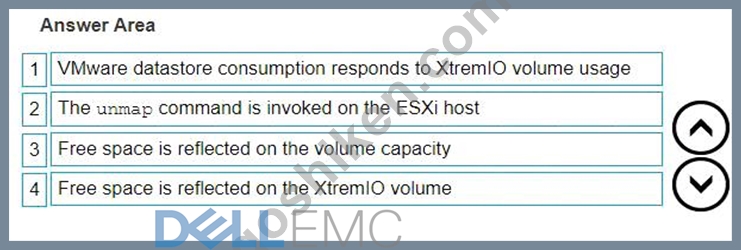
質問 # 34
A customer has Microsoft Windows servers running Microsoft Multipath IO (MPIO). Which path selection policy should be set for optimal performance when connected to anXtremlO cluster?
- A. Round Robin
- B. Weighted Paths
- C. Least Blocks
- D. Least Queue Depth
正解:A
解説:
For Microsoft Windows servers running MPIO, the optimal path selection policy when connected to an XtremIO cluster is Round Robin. This policy allows for load balancing across all available paths by distributing I/O evenly, which can lead to better performance and utilization of the storage resources.The Round Robin policy ensures that no single path is overloaded with I/O requests, which helps in maintaining consistent performance levels1.
References:
* The Dell EMC SC Series: Microsoft Multipath IO Best Practices document provides insights into the recommended path selection policies for optimal performance2.
* Additional information on MPIO and path selection policies can be found in the Dell EMC knowledge base articles1.
質問 # 35
Which SCSI instructions are used to build a bitmap of the changes between the first snapshot and subsequent snapshots when RecoverPoint is used with XtremIO?
- A. SCSI DIFF
- B. SCSI UPDATE
- C. SCSI DELTA
- D. SCSI TRANSFER
正解:A
解説:
TheSCSI DIFFinstruction is used to build a bitmap of the changes between the first snapshot and subsequent snapshots when RecoverPoint is used with XtremIO1.
The DIFF protocol is a vendor-specific SCSI command which RecoverPoint uses to query XtremIO in order to obtain a bitmap of changes between two snapshot sets1.RecoverPoint uses the output of the DIFF command to read the actual data and transfer it to the target side1.
The other options provided are not typically used for this purpose:
* SCSI DELTAis not a recognized SCSI command2.
* SCSI TRANSFERis not a recognized SCSI command3.
* SCSI UPDATEis not a recognized SCSI command4.
Therefore, the verified answer is A.SCSI DIFF, as it is the SCSI instruction used to build a bitmap of the changes between the first snapshot and subsequent snapshots when RecoverPoint is used with XtremIO1.
質問 # 36
What can be demonstrated with the XMS Simulator?
- A. Configuring connectemc
- B. Deploying XMS
- C. Initializing cluster
- D. Creating volumes
正解:D
解説:
The XtremIO XMS Simulator can be used for various purposes, including demos, product training, comparing XMS/XtremIO version release functionality, testing scripts against XtremIO's RESTful API, and XtremIO development, testing, and simulation1. Among the options provided, creating volumes is a task that can be demonstrated with the XMS Simulator.This is because the simulator allows users to interact with a simulated XtremIO environment, which includes managing and operating volumes as part of the overall management simulation1.
質問 # 37
What is the recommended execution throttle setting for Windows, Linux, and VMware for Qlogic adapters?
- A. 0
- B. 1
- C. 2
- D. 3
正解:C
解説:
The recommended execution throttle setting for Qlogic adapters, when used with Windows, Linux, and VMware, is typically set to the maximum value to allow for the greatest throughput and performance. The execution throttle setting determines the maximum number of outstanding I/O operations that can be queued to the storage controller.For Qlogic Fibre Channel adapters, especially when the HBA speed is 8GBs or over, the execution throttle can be set to 65,5351. This high setting is used to ensure that the storage array can handle a large number of concurrent I/O requests, which is beneficial in environments with high-performance requirements.
References:
* Dell community discussions on Qlogic Fibre Channel adapter settings1.
* Knowledgebase articles and documentation on Dell EMC's official website2.
質問 # 38
A user attempts to create a quorum disk for a host cluster. Volume parameters are:
Size = 1000 Kb
. Name 1 MB_Vol
However, the volume creation fails. What caused the process to fail?
- A. Volume name is invalid
- B. Quorum disks cannot have an 8 kB block size
- C. Volume size is too small
- D. XtremlO volumes cannot be quorum disks
正解:C
解説:
The process to create a quorum disk for a host cluster failed because the volume size is too small12.
In a storage environment, the size of the volume plays a crucial role.If the volume size is too small, it may not be able to accommodate the data required for the quorum disk, leading to a failure in the creation process12.
In this case, the volume size is specified as 1000 Kb, which is likely insufficient for a quorum disk in a host cluster environment12.Therefore, increasing the volume size could potentially resolve this issue12.
質問 # 39
On an XtremlO cluster that is encrypted, where is the encryption key generated?
- A. AK
- B. WebUl
- C. SED
- D. MEK
正解:C
解説:
In an XtremIO cluster that is encrypted, the encryption key is generated within the Self-Encrypting Drives (SEDs). The SEDs are responsible for encrypting and decrypting the data at rest without any performance overhead. The encryption process is transparent to the user and is managed within the drive itself. The keys are generated and stored securely within the SEDs to ensure that data cannot be accessed without proper authorization.
References:
* Dell EMC Data Domain Encryption - Frequently Asked Questions1.
* Policy Files and Default Encryption Keys in Dell Encryption2.
質問 # 40
Which slot on a physical XtremIO X2 XMS holds the server's boot disk?
- A. 0
- B. 1
- C. 2
- D. 3
正解:D
解説:
The Dell XtremIO X2 XMS is designed with a specific slot for the server's boot disk. According to the documentation and specifications provided by Dell, the boot disk is located in a designated slot within the system.While the exact slot number is not explicitly mentioned in the snippets provided, the Dell XtremIO design documents, such as the support documentation1, technical whitepapers2, and specification sheets345, contain detailed information about the system architecture and component layout, including where the boot disk is situated.
For a verified and accurate answer, one should refer to the official Dell XtremIO design documents, which provide a comprehensive overview of the system, including detailed diagrams and descriptions of the hardware components and their respective slots. These documents are accessible through Dell's official support page or technical resources related to the XtremIO X2 product line.
質問 # 41 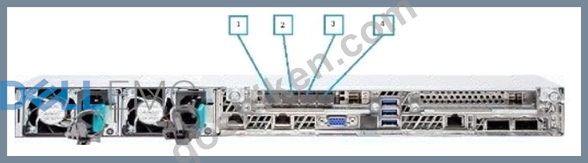
A customer wants to connect their Storage Controllers to Fibre Channel switches using as many Fibre Channel ports as possible. Which ports of each Storage Controller shown in the exhibit should be used?
- A. 1,2, 3, and 4
- B. 2 and 3
- C. 1 and 2
- D. 3 and 4
正解:A
解説:
To maximize the connectivity between Storage Controllers and Fibre Channel switches, all available ports should be utilized. This ensures redundancy and maximizes throughput. The exhibit provided shows a Storage Controller with four ports labeled 1, 2, 3, and 4. Without specific design documents, the general best practice is to use all available ports for suchconnections, assuming the ports are configured for Fibre Channel traffic and the infrastructure supports it.
References:
* General best practices for Fibre Channel connectivity and port usage are discussed in various Dell EMC documents, such as the "Introduction to XtremIO X2 Storage Array" and "Configuring Fibre Channel Storage Arrays" documents12.
* Specific port configurations and their usage would be detailed in the Dell XtremIO Design documents, which would provide definitive guidance on which ports to use for connecting to Fibre Channel switches.
質問 # 42
You need to design an Oracle solution for a customer. Which XtremlO best practices should be used in Oracle environments?
- A. Use unique LUN numbers on each clustered host
Use a 4 kB LUN sector size for databases - B. Use consistent LUN numbers on each clustered host
Use a 512 byte LUN sector size for databases - C. Allocate one large LUN per host
Use Eager Zeroed Thick formatting on ESXi - D. Allocate multiple LUNs per host
Use Thin formatting on the ESXi
正解:D
解説:
When designing an Oracle solution for a customer using XtremIO, it's important to consider the best practices for performance and efficiency.
Option OD, "Allocate multiple LUNs per host, Use Thin formatting on the ESXi", is a recommended best practice for Oracle environments12.
Allocating multiple LUNs per host can help distribute the I/O load more evenly across the storage system, which can improve performance1.This is particularly important in Oracle environments, where there can be a high level of concurrent I/O activity1.
Using Thin formatting on the ESXi is also recommended. Thin provisioning is a storage provisioning method that optimizes the efficient use of available space.For a thin virtual disk, ESXi provisions the entire space required for the disk's current and future activities, but the thin disk uses only as much storage space as the disk needs for its initial operations3.If the disk requires more space, it can expand into its entire provisioned space3.
The other options, while they may be part of the overall
質問 # 43
......
最新D-XTR-DS-A-24テスト材料には有効なD-XTR-DS-A-24テストエンジン:https://www.goshiken.com/EMC/D-XTR-DS-A-24-mondaishu.html
D-XTR-DS-A-24更新された試験問題集で[2024年最新] 練習には有効な試験問題集:https://drive.google.com/open?id=1fNaPRN-U-kQieRMog4ix9A-AtUq4EiUR