

検証済みのFCP_FMG_AD-7.4試験問題集PDF [2025年最新] 成功の秘訣はここにある
ベストを体験せよ!FCP_FMG_AD-7.4試験問題トレーニングを提供していますGoShiken
質問 # 32
An administrator enabled workspace mode and now wants to delete an address object that is currently referenced in a firewall policy. Which two results can the administrator expect? (Choose two.)
- A. FortiManager will not allow the administrator to delete a referenced address object until they lock the ADOM.
- B. FortiManager will disable the status of the address object until the changes are installed.
- C. FortiManager will replace the deleted address object with the none address object in the referenced firewall policy.
- D. FortiManager will temporarily change the status of the referenced firewall policy to disabled.
正解:A、C
解説:
When operating in workspace mode on FortiManager 7.4, the administrator must understand how object references and deletions work:
* Option C- "FortiManager will not allow the administrator to delete a referenced address object until they lock the ADOM":In workspace mode, all changes are managed within an Administrative Domain (ADOM) scope. When an object (like an address object) is referenced in a policy, FortiManager prevents its deletion to maintain configuration integrity. The ADOM must be locked by the administrator to make changes to any referenced objects. This locking mechanism ensures that no unintended deletions or changes occur that could disrupt the policies or configuration.
* FortiManager Reference: "In workspace mode, changes to objects or policies require the ADOM to be locked. If an object is referenced, you must lock the ADOM before deleting or modifying the object." (FortiManager 7.4 Administration Guide, Section on Workspace Mode and ADOM Management)
* Option D- "FortiManager will replace the deleted address object with the none address object in the referenced firewall policy":If the administrator attempts to delete an address object that is currently referenced by a firewall policy, FortiManager will replace the deleted object with the 'none' address object. This is done to maintain the policy structure and avoid policy corruption due to a missing reference. This behavior ensures that the firewall policy remains syntactically correct, even though the specific address object is no longer in use.
* FortiManager Reference: "When a referenced object is deleted, FortiManager will replace it with a 'none' object in the policy. This behavior is to ensure the integrity and continuity of the policy configurations." (FortiManager 7.4 Administration Guide, Object Management and Policy Handling in Workspace Mode)
質問 # 33
What are two outcomes of ADOM revisions? (Choose two.)
- A. ADOM revisions can create System Checkpoints for the FortiManager configuration.
- B. ADOM revisions can significantly increase the size of the configuration backups.
- C. ADOM revisions can save the current state of the whole ADOM.
- D. ADOM revisions can save the current state of all policy packages and objects for an ADOM.
正解:B、D
質問 # 34
Refer to the exhibit. An administrator has created a firewall address object that is used in multiple policy packages for multiple FortiGate devices in an ADOM.
After the installation operation is performed, which IP/netmask will be installed on Local-FortiGate for the LOCAL_SUBNET firewall address object?
- A. 10.0.5.0/24
- B. Local-FortiGate automatically chooses an IP/netmask based on its network interface settings.
- C. 192.168.1.0/24
- D. It will create two firewall address objects on Local-FortiGate with 192.168.1.0/24 and 10.0.5.0/24 values.
正解:C
質問 # 35
Refer to the exhibit.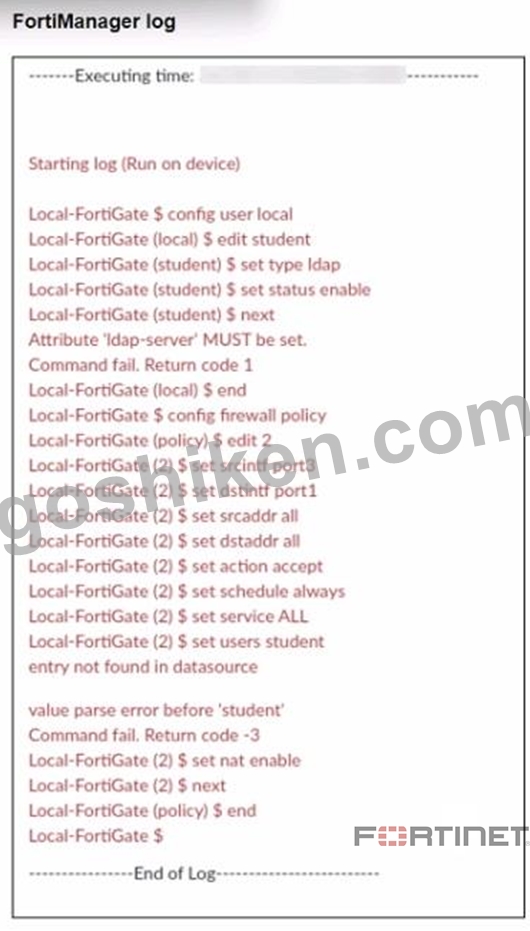
What can you conclude from the failed installation log shown in the exhibit?
- A. Policy ID 2 will not be installed.
- B. Policy ID 2 is installed in the disabled state.
- C. Policy ID 2 is installed without a source address.
- D. Policy ID 2 is installed without the remote user student.
正解:D
解説:
From the log provided in the exhibit, several conclusions can be drawn regarding the installation of Policy ID
2:
* The installation process fails when attempting to set theLDAP user "student". The log shows:
* "Attribute 'ldap-server' MUST be set.": This error indicates that when setting up the LDAP user configuration, a mandatory field (ldap-server) is missing. As a result, the configuration could not be completed for the user.
* "entry not found in datasource"and"value parse error before 'student'": These errors confirm that the user "student" could not be properly added due to a configuration issue (such as the missing LDAP server).
Because of these errors, while other configuration elements (such as source and destination interfaces, actions, and services) are properly set, the user configuration for"student"isnot applied.
Evaluation of the answer options:
* A. Policy ID 2 is installed in the disabled state.
* This isfalse. There is no indication in the log that Policy ID 2 is disabled.
* B. Policy ID 2 is installed without the remote user student.
* This istrue. Due to the failure in setting the"student"user (as indicated by the errors), the policy will be installedwithoutthat user being properly configured.
* C. Policy ID 2 will not be installed.
* This isfalse. The policy is installed, but the user configuration failed. The rest of the policy configuration appears to have proceeded without critical errors that would prevent the installation.
* D. Policy ID 2 is installed without a source address.
* This isfalse. The log shows that the source address is properly set to "all" (set srcaddr all), so this is not the cause of the issue.
From the log exhibit, we see errors related to the "ldap-server" attribute not being set and an error with the entry "student" not being found in the datasource. This indicates that Policy ID 2 will not be installed due to missing or incorrect data required for successful installation. The "Command fail. Return code -3" confirms the installation failure, so the correct answer is C.
Options A, B, and D are incorrect because:
* A suggests the policy is installed in a disabled state, which isn't supported by the log.
* B and D suggest partial installation, but the error messages indicate a complete failure to install Policy ID 2.
FortiManager References:
* Refer to FortiManager 7.4 Troubleshooting Guide: Common Errors and Log Interpretation.
質問 # 36
Exhibit.
Which two statements about the output are true? (Choose two.)
- A. The latest revision history for the managed FortiGate does not match the device-level database.
- B. The latest revision history for the managed FortiGate does match the FortiGate running configuration.
- C. Configuration changes have been installed on FortiGate, which means the FortiGate configuration has been changed.
- D. Configuration changes directly made on FortiGate have been automatically updated to the device-level database.
正解:A、B
質問 # 37
Which output is displayed right after moving the ISFW device from one ADOM to another?
- A.

- B.

- C.

- D.

正解:D
解説:
When a FortiGate device, like the ISFW (Internal Segmentation Firewall), is moved from one ADOM to another in FortiManager, the status of the device in the new ADOM will temporarily show some level of inconsistency or unknown state until the ADOM fully syncs and integrates the device.
In the provided options, we are analyzing the FortiManager diagnose dvm device list output for the ISFW device.
Explanation of the Outputs:
* Option A:
* The output shows that the device has the following status:
* dev-db: not modified
* conf: in sync
* cond: OK
* dm: retrieved
* The key part here is the pkg: [unknown]. This suggests that the configuration package for the ADOM in the new environment is still in anunknown state, which happens right after moving the device to a new ADOM. FortiManager needs time to process the device's configuration before syncing it properly.
* Option B:
* This output shows thepkg: [out-of-sync]. This occursaftersome configuration mismatch is identified, but it is not the immediate output after moving a device to a new ADOM.
* Option C:
* This output showspkg: [never-installed], which indicates that no package was ever installed on the device. This status typically appears when a device is newly added to FortiManager but not immediately after moving it between ADOMs.
* Option D:
* This output showspkg: [imported], which indicates that the device configuration has been successfully imported into the new ADOM. This would occur after the device is fully synced, but not immediately after moving the device to a new ADOM.
Conclusion:
The output that is displayedimmediately after movingthe ISFW device from one ADOM to another isOption A, where the package status is still unknown (pkg: [unknown]) because FortiManager has not yet fully synchronized the device's configuration in the new ADOM.
質問 # 38
Refer to the exhibit. How will FortiManager try to get updates tor antivirus and IPS?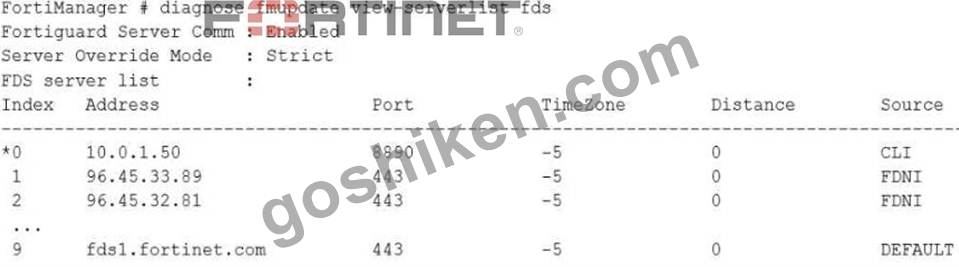
- A. From the default server fds1.fortinet.com
- B. From the list of configured override servers or public FDN servers
- C. From public FDNI server IP address with the fourth highest octet only
- D. From the configured override server IP address 10.0.1.50 only
正解:D
解説:
As the server override mode is strict, there is no fallback. FMG will communicate only with server configure in override server list.
質問 # 39
Exhibit.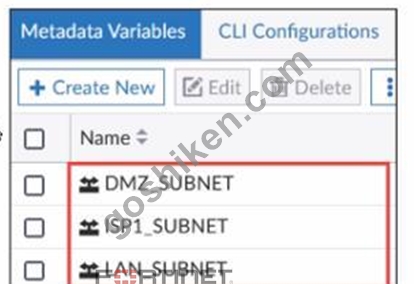
What is true about the objects highlighted in the image?
- A. They are available across all ADOMs by default.
- B. They can be set to optional or required.
- C. They cannot be created in the global database ADOM.
- D. They can be used as variables in scripts.
正解:D
解説:
The objects highlighted in the image (DMZ_SUBNET, ISP1_SUBNET, LAN_SUBNET) aremetadata variables.
* C.They can be used as variables in scripts.
* These metadata variables are placeholders that can be used in FortiManager scripts to dynamically insert specific values, enabling script flexibility and scalability across multiple devices or ADOMs.
Options A, B, and D are incorrect because:
* Asuggests optional or required settings, which do not apply to metadata variables.
* Bimplies they are available across all ADOMs by default, which is not always the case.
* Dstates they cannot be created in the global database ADOM, but metadata variables are typically managed within ADOMs and can be utilized globally based on specific configurations.
FortiManager References:
* Refer to FortiManager 7.4 Administrator Guide: Using Metadata Variables and Script Management.
質問 # 40
Refer to the exhibit.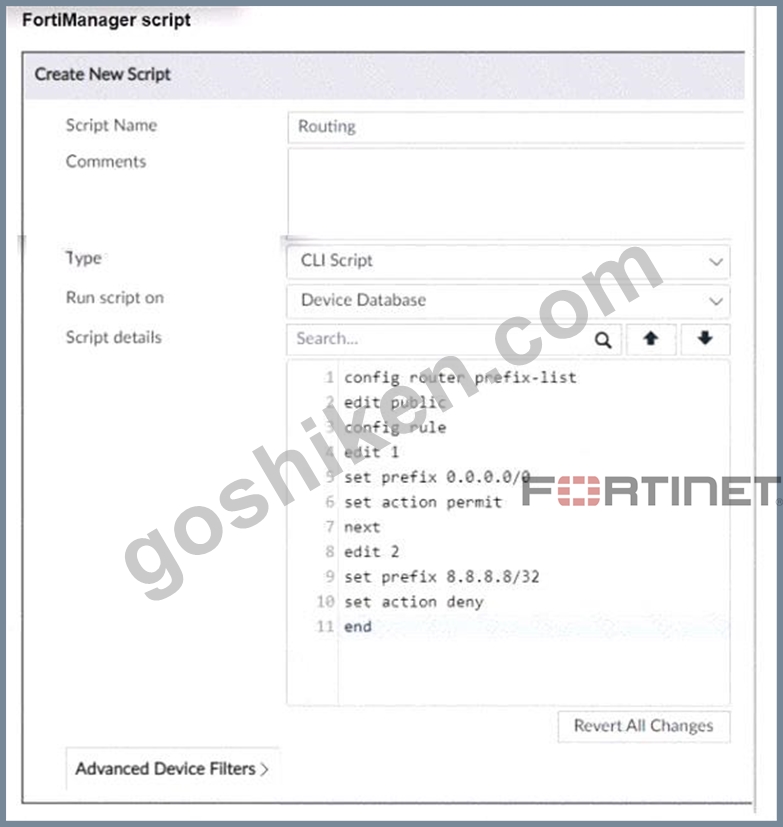
Which two results occur if the script is run using the Device Database option? (Choose two.)
- A. The device Config Status is tagged as Modified.
- B. The script history shows successful installation of the script on the remote FortiGate device.
- C. You must install these changes on a managed device using the Install Wizard.
- D. The successful execution of a script on the Device Database creates a new revision history.
正解:A、C
質問 # 41
An administrator is in the process of copying a system template profile between ADOMs by running the following command: execute fmprofile import-profile ADOM2 3547 /tmp/myfile Where does this command import the system template profile from?
- A. Source ADOM policy database
- B. ADOM2 object database
- C. ADOM2 device database
- D. FortiManager file system
正解:D
解説:
The commandexecute fmprofile import-profile ADOM2 3547 /tmp/myfileis used to import a system template profile from the FortiManager file system. The path/tmp/myfileindicates a location in the FortiManager's local file system, from which the profile will be imported into the specified ADOM.
Options B, C, and D are incorrect because:
* B, C, and Dsuggest importing from different databases, which is not accurate since the command explicitly refers to the file system location.
FortiManager References:
* Refer to FortiManager 7.4 CLI Reference Guide: Commands for Profile Management.
質問 # 42
An administrator, Trainer, who is assigned the Super_User profile, is trying to approve a workflow session that was submitted by another administrator, Student. However, Trainer is unable to approve the workflow session.
What can prevent an admin account that has Super_User rights over the device from approving a workflow session?
- A. Trainer is not a part of workflow approval group.
- B. Trainer must close Student's workflow session before approving the request.
- C. Trainer must first create their own workflow session to approve student session.
- D. Trainer does not have full rights over this ADOM.
正解:A
解説:
An administrator must be part of an approval group, and have rights over the ADOM in which the session was created.
質問 # 43
Which configuration setting for FortiGate is part o an ADOM-level database on FortiManager?
- A. NSX-T Service Template
- B. Routing
- C. Security profiles
- D. SNMP
正解:C
解説:
Security profiles are part of the ADOM-level database in FortiManager. These configurations allow for centralized management of security settings like antivirus, web filtering, application control, and intrusion prevention. Security profiles are created and managed under the Policy & Objects section, which operates at the ADOM level.
質問 # 44
Refer to the exhibit. You are using the Quick Install option to install configuration changes on the managed FortiGate. Which two statements correctly describe the result? (Choose two.)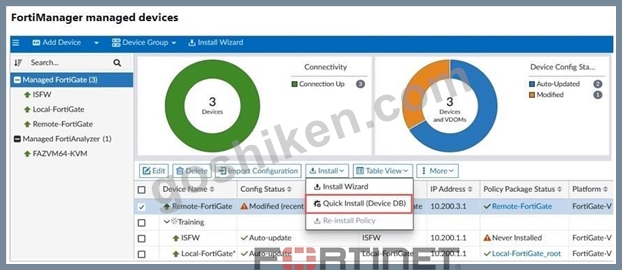
- A. It installs provisioning template changes on the FortiGate device.
- B. It installs all the changes in the device database first and the administrator must reinstall the changes on the FortiGate device.
- C. It installs device-level changes on the FortiGate device without launching the Install Wizard
- D. It provides the option to preview only the policy package changes before installing them.
正解:A、C
質問 # 45
Refer to the exhibit.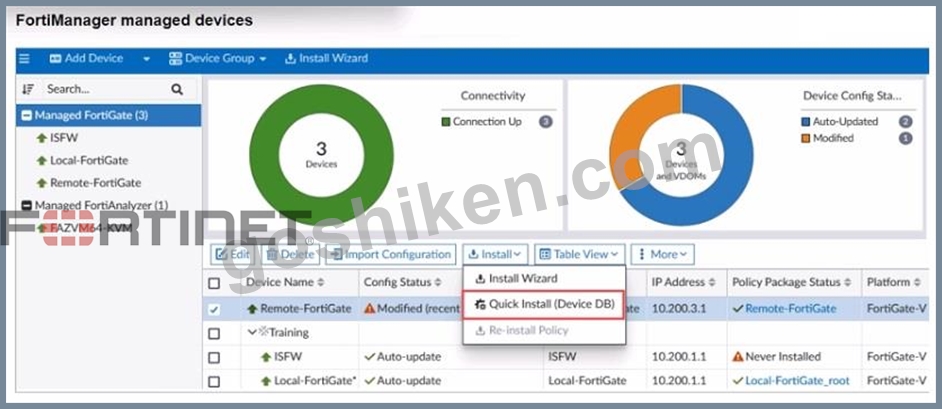
You are using the Quick Install option to install configuration changes on the managed FortiGate.
Which two statements correctly describe the result? (Choose two.)
- A. It provides the option to preview only the policy package changes before installing them.
- B. It installs all the changes in the device database first and the administrator must reinstall the changes on the FortiGate device.
- C. It installs device-level changes on the FortiGate device without launching the Install Wizard
- D. It installs provisioning template changes on the FortiGate device.
正解:A、C
解説:
* Option B: It provides the option to preview only the policy package changes before installing them.This is correct. The Quick Install option in FortiManager provides a preview of policy changes before they are applied, allowing administrators to review and confirm the changes.
* Option D: It installs device-level changes on the FortiGate device without launching the Install Wizard.This is correct. Quick Install allows for the immediate installation of device-level changes, such as interface or routing configurations, directly onto the FortiGate without going through the full Install Wizard.
Explanation of Incorrect Options:
* Option A: It installs provisioning template changes on the FortiGate deviceis incorrect because Quick Install does not specifically deal with provisioning templates.
* Option C: It installs all the changes in the device database first and the administrator must reinstall the changes on the FortiGate deviceis incorrect because Quick Install directly applies changes to the FortiGate device, not requiring a separate reinstall step.
FortiManager References:
* Refer to "FortiManager Administration Guide" for details on "Quick Install" functionality under
"Device Management."
質問 # 46
What is a characteristic of the FortiManager high availability (HA) feature?
- A. When a secondary unit is removed, FortiManager updates the managed devices using TCP port 5199.
- B. The primary unit synchronizes all configuration revision with the seconday units.
- C. All secondary units must be in the same network as the primary unit.
- D. Each cluster member must be upgraded manually, starting with the primary unit.
正解:B
質問 # 47
An administrator has assigned a global policy package to custom ADOM1. Then the administrator creates a new policy package. Fortinet. in the custom ADOM1. What happens to the Fortinet policy package when it is created?
- A. You must reapply the global policy package to ADOM1.
- B. You can select the option to assign the global policies.
- C. You must assign the global policy package from the global ADOM.
- D. The global policy package is automatically assigned.
正解:D
解説:
When a new policy package is created in a custom ADOM that already has a global policy package assigned, the global policy package is automatically assigned to the new policy package. This behavior ensures consistent policy enforcement across different ADOMs.
Options A, C, and D are incorrect because:
* A and C incorrectly suggest that manual reassignment or reapplication is needed.
* D implies optional assignment, whereas it is automatically done.
FortiManager References:
* Refer to FortiManager 7.4 Administrator Guide: Working with Global and Custom ADOM Policy Packages
質問 # 48
Exhibit.
Which two statements about the output are true? (Choose two.)
- A. The latest revision history for the managed FortiGate does not match the device-level database.
- B. Configuration changes have been installed on FortiGate, which means the FortiGate configuration has been changed.
- C. The latest revision history for the managed FortiGate does match the FortiGate running configuration.
- D. Configuration changes directly made on FortiGate have been automatically updated to the device-level database.
正解:A、B
解説:
The output indicates that:
* The device's status is shown as "dev-db: modified" and "conf: in sync," which means that there is a difference between the device-level database on FortiManager and the actual running configuration of the managed FortiGate. Therefore, the latest revision history for the managed FortiGate does not match the device-level database, which confirms statement A as true.
* "dm: retrieved" status indicates that configuration changes have been installed on the FortiGate, confirming statement B as true. It also means that the configuration has been modified, and those changes have been pulled from the FortiGate to the FortiManager.
Statements C and D are incorrect because:
* C is incorrect as it implies an automatic update, whereas "dev-db: modified" indicates changes have been made on the FortiGate device that are not yet reflected in the FortiManager's database.
* D is incorrect because "dev-db: modified" shows that the device-level database and running configuration are not in sync.
FortiManager References:
* Refer to the FortiManager 7.4 Administrator Guide: Device Manager > Device Status to understand the
"dev-db" and "conf" status meanings.
質問 # 49
......
Fortinet FCP_FMG_AD-7.4 認定試験の出題範囲:
| トピック | 出題範囲 |
|---|---|
| トピック 1 |
|
| トピック 2 |
|
| トピック 3 |
|
| トピック 4 |
|
| トピック 5 |
|
最新の100%合格保証付きの素晴らしいFCP_FMG_AD-7.4試験問題PDF:https://www.goshiken.com/Fortinet/FCP_FMG_AD-7.4-mondaishu.html
練習サンプルと問題集と秘訣には2025年最新のFCP_FMG_AD-7.4有効なテスト問題集:https://drive.google.com/open?id=1Yxd0S9nDW8lKnxRINysoFoUZDtGQcmbz