

[2025年更新]合格できるThe Open Group OGEA-103試験最新122問題
ゲット2025年最新の無料The Open Group OGEA-103試験問題 アンサー
質問 # 38
Please read this scenario prior to answering the question
You are the Lead Enterprise Architect at a major agribusiness company. The company's main annual harvest is lentils, a highly valued food grown worldwide. The lentil parasite, broomrape, has been an increasing concern for many years and is now becoming resistant to chemical controls. In addition, changes in climate favor the propagation and growth of the parasite. As a result, the parasite cannot realistically be exterminated, and it has become pandemic, with lentil yields falling globally.
The CEO appreciates the seriousness of the situation and has set out a change in direction that is effectively a new business for the company. There are opportunities for new products, and new markets. The company will use the fields for another harvest and will cease to process third-party lentils. Thus, the target market will change, and the end-products will be different and more varied. This is a major decision and the CEO has stated a desire to repurpose rather than replace so as to manage the risks and limit the costs.
The company has a mature Enterprise Architecture practice based in its headquarters and uses the TOGAF standard as the method and guiding framework. The practice has an established Architecture Capability, and uses iteration for architecture development. The CIO is the sponsor of the activity.
The CIO has assigned the Enterprise Architecture team to this activity. At this stage there is no shared vision, or requirements.
Refer to the scenario
You have been asked to propose the best approach for architecture development to realize the CEO's change in direction for the company.
Based on the TOGAF standard which of the following is the best answer?
- A. You propose that the team focus its iteration cycles on architecture development by going through the architecture definition phases (B-D) with a baseline first approach.This will support the change in direction as stated by the CEO. It will ensure that the change can be defined in a structured manner and address the requirements needed to realize the change.
- B. You propose that this engagement define the baseline Technology Architecture first in order to assess the current infrastructure capacity and capability for the company. Then the focus should be on transition planning and incremental architecture deployment.
This will identify requirements to ensure that the projects are sequenced in an optimal fashion so as to realize the change. - C. You propose that the priority is to understand and bring structure to the definition of the change. The team should focus iteration cycles on a baseline first approach to architecture development, and then transition planning. This will identify what needs to change in order to transition from the baseline to the target, and can be used to work out in detail what the shared vision is for the change.
- D. You propose that the team focus on architecture definition, with emphasis on defining the change parameters to support this new business strategy that the CEO has identified. Once understood, the team will be in the best position to identify the requirements, drivers, issues, and constraints for the change. You would ensure that the architecture development addresses non-functional requirements to assure that the target architecture is robust and secure.
正解:C
解説:
Based on the TOGAF standard, this answer is the best approach for architecture development to realize the CEO's change in direction for the company. The reason is as follows:
* The scenario describes a major business transformation that requires a clear understanding of the current and future states of the enterprise, as well as the gaps and opportunities for change. Therefore, the priority is to understand and bring structure to the definition of the change, rather than focusing on the implementation details or the technology aspects.
* The team should use the TOGAF ADM as the method and guiding framework for architecture development, and adapt it to suit the specific needs and context of the enterprise. The team should also leverage the existing Architecture Capability and the Architecture Repository to reuse and integrate relevant architecture assets and resources.
* The team should focus iteration cycles on a baseline first approach to architecture development, which means starting with the definition of the Baseline Architecture in each domain (Business, Data, Application, and Technology), and then defining the Target Architecture in each domain. This will help to identify the current and desired states of the enterprise, and to perform a gap analysis to determine what needs to change in order to achieve the business goals and objectives.
* The team should then focus on transition planning, which involves identifying and prioritizing the work packages, projects, and activities that will deliver the change. The team should also create an Architecture Roadmap and an Implementation and Migration Plan that will guide the execution and governance of the change.
* The team should use the Architecture Vision phase and the Requirements Management phase to work out in detail what the shared vision is for the change, and to capture and validate the stakeholder requirements and expectations. The team should also use the Architecture Governance framework to ensure the quality, consistency, and compliance of the architecture work.
References: : The TOGAF Standard, Version 9.2 - Architecture Development Method : The TOGAF Standard, Version 9.2 - Architecture Vision : The TOGAF Standard, Version 9.2 - Requirements Management : [The TOGAF Standard, Version 9.2 - Architecture Governance]
質問 # 39
Consider the following ADM phases objectives.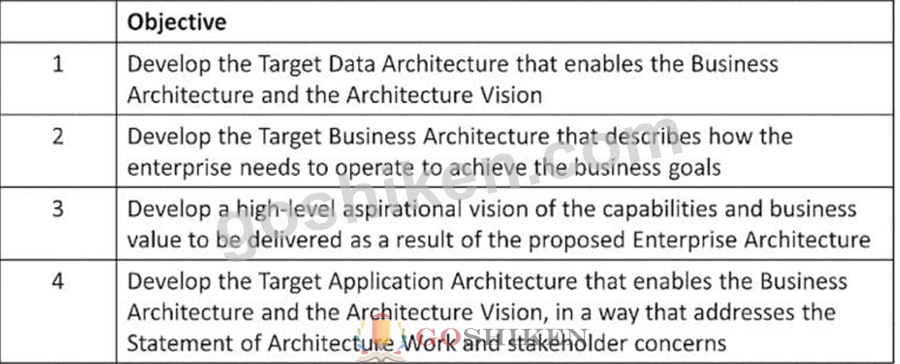
Which phase does each objective match?
- A. 1C-2D-3B-4A
- B. 1B-2D-3A-4C
- C. 1A-2B-3C-4D
- D. 1C-2B-3A-4C
正解:D
解説:
* The objectives listed in the question correspond to the objectives of different phases of the TOGAF ADM (Architecture Development Method), which is a method for developing and managing an enterprise architecture1.
* The ADM consists of nine phases, each with a specific purpose and output. The phases are1:
* Preliminary Phase: To prepare and initiate the architecture development cycle, including defining the architecture framework, principles, and governance.
* Phase A: Architecture Vision: To define the scope, vision, and stakeholders of the architecture initiative, and to obtain approval to proceed.
* Phase B: Business Architecture: To describe the baseline and target business architecture, and to identify the gaps between them.
* Phase C: Information Systems Architectures: To describe the baseline and target data and application architectures, and to identify the gaps between them.
* Phase D: Technology Architecture: To describe the baseline and target technology architecture, and to identify the gaps between them.
* Phase E: Opportunities and Solutions: To identify and evaluate the opportunities and solutions for implementing the target architecture, and to define the work packages and transition architectures.
* Phase F: Migration Planning: To finalize the implementation and migration plan, and to ensure alignment with the enterprise portfolio and project management.
* Phase G: Implementation Governance: To provide architecture oversight and guidance for the implementation projects, and to manage any architecture change requests.
* Phase H: Architecture Change Management: To monitor the changes in the business and technology environment, and to assess the impact and performance of the architecture.
* Based on the above definitions, we can match each objective with the corresponding phase as follows:
* Objective 1: Develop the Target Data Architecture that enables the Business Architecture and the Architecture Vision. This objective is achieved in Phase C: Information Systems Architectures, where the data architecture is defined as a subset of the information systems architecture2.
* Objective 2: Develop the Target Business Architecture that describes how the enterprise needs to operate to achieve the business goals. This objective is achieved in Phase B: Business Architecture, where the business architecture is defined as a subset of the enterprise architecture3.
* Objective 3: Develop a high-level aspirational vision of the capabilities and business value to be delivered as a result of the proposed Enterprise Architecture. This objective is achieved in Phase A: Architecture Vision, where the architecture vision is defined as a high-level description of the target architecture and its benefits4.
* Objective 4: Develop the Target Application Architecture that enables the Business Architecture and the Architecture Vision, in a way that addresses the Statement of Architecture Work and stakeholder concerns. This objective is achieved in Phase C: Information Systems Architectures, where the application architecture is defined as a subset of the information systems architecture2.
References:
* 1: The TOGAF Standard, Version 9.2, Chapter 5: Architecture Development Method (ADM)
* 2: The TOGAF Standard, Version 9.2, Chapter 9: Phase C: Information Systems Architectures
* 3: The TOGAF Standard, Version 9.2, Chapter 8: Phase B: Business Architecture
* 4: The TOGAF Standard, Version 9.2, Chapter 7: Phase A: Architecture Vision
質問 # 40
Which of the following is included as part of Architecture Governance1?
- A. Interacting with the CxO level on Enterprise Architecture
- B. Ensuring compliance with internal and external standards and regulatory obligations
- C. Managing Stakeholders and their requirements
- D. Creating and maintaining the Statement of Architecture Work though out the ADM cycle
正解:B
質問 # 41
You are working as an Enterprise Architect within an Enterprise Architecture (EA) team at a multinational energy company. The company is committed to becoming a net-zero emissions energy business by 2050. To achieve this, the company is focusing on shifting to renewable energy production and adopting eco-friendly practices.
The EA team, which reports to the Chief Technical Officer (CTO), has been tasked with overseeing the transformation to make the company more effective through acquisitions. The company plans to fully integrate these acquisitions, including merging operations and systems.
To address the integration challenges, the EA team leader wants to know how to manage risks and ensure that the company succeeds with the proposed changes. Based on the TOGAF Standard, which of the following is the best answer?
- A. The EA team should evaluate the company's readiness for change by identifying factors that will impact the transformation. These factors will be used to determine initial risks associated with the initiative.
- B. The EA team should develop Business Architecture views that demonstrate how stakeholder concerns are addressed and assess each factor for readiness, urgency, and degree of difficulty.
- C. The EA team should create a Business Scenario to fully describe the business problem that is being addressed by the transformation. Once requirements are identified, they should be evaluated in terms of risks. Any residual risks should be escalated to the Architecture Board.
- D. The EA team should document the risks associated with the transformation in an Implementation Factor Catalog to inform decisions during implementation and deployment.
正解:C
解説:
In TOGAF, creating a Business Scenario is a foundational step in defining and understanding the business problem, especially for complex transformations involving multiple stakeholders andsystems, such as in this scenario. This method aligns with Phase A (Architecture Vision) of the TOGAF Architecture Development Method (ADM). Here's why this approach is the most effective:
Understanding Business Requirements:A Business Scenario provides a structured way to capture and analyze the business requirements, stakeholder concerns, and the contextual elements related to the problem. In this scenario, the company faces challenges in integrating newly acquired companies with existing operations, which includes complex stakeholder concerns across different functional areas. Developing a Business Scenario allows the EA team to break down these complexities into identifiable and manageable parts.
Risk Evaluation and Management:By using the Business Scenario approach, the EA team can not only define the requirements but also assess associated risks systematically. TOGAF emphasizes the importance of risk management through identifying potential risks, evaluating their impact, and defining strategies for handling these risks. The process includes assessing how risks can be avoided, transferred, or reduced-a necessary step in large-scale transformations to ensure that risks are proactively managed.
Residual Risks and Governance:Any risks that cannot be fully resolved should be identified as residual risks and escalated to the Architecture Board, which is aligned with TOGAF's governance approach. The Architecture Board's role in TOGAF is to provide oversight and make critical decisions on risks that exceed the control of the EA team. This ensures that unresolved risks are managed at the appropriate level of the organization.
Alignment with TOGAF ADM Phases:The Business Scenario approach directly aligns with the Preliminary and Architecture Vision phases of the TOGAF ADM, which focuses on establishing a baseline understanding of the business context and the strategic transformation required. The detailed understanding of requirements, stakeholder concerns, and risks identified here will guide the subsequent phases of the ADM, including Business Architecture and Information Systems Architecture.
TOGAF Reference (Section 2.6, ADM Techniques):TOGAF provides guidelines on the creation of Business Scenarios as part of ADM Techniques, highlighting the importance of defining a business problem comprehensively to ensure successful transformation. This method includes identification of stakeholders, business requirements, and associated risks, which aligns well with the company's need for strategic and systematic integration of new business units.
By utilizing a Business Scenario, the EA team ensures that all aspects of the transformation are well understood, risks are identified early, and residual risks are managed effectively, aligning with the company's strategic objectives and the TOGAF framework's guidance on risk management and stakeholder alignment.
質問 # 42
Consider the image showing basic architectural concepts.
What are items A and B?
- A. A-Architecture Viewpoint, B-Architecture View
- B. A-Requirement. B-Candidate Architecture
- C. A-Candidate Architecture, B-Trade-off
- D. A-Architecture Board, B-Architecture Capability
正解:A
解説:
* The image shows a diagram that illustrates the basic concepts of architecture description as defined by the ISO/IEC/IEEE 42010:2011 standard1, which is also adopted by the TOGAF standard2.
* According to the ISO/IEC/IEEE 42010:2011 standard, an architecture description is a work product used to express an architecture, and it consists of one or more architecture views1.
* An architecture view is a representation of a system from the perspective of a related set of concerns, and it conforms to an architecture viewpoint1.
* An architecture viewpoint is a specification of the conventions for constructing and using an architecture view to address specific stakeholder concerns1.
* Therefore, the correct answer is option A, which identifies the items labeled as "A" and "B" in the image as an architecture viewpoint and an architecture view, respectively. References:
* 1: ISO/IEC/IEEE 42010:2011 - Systems and software engineering - Architecture description1
* 2: TOGAF Standard, Version 9.2 - Part IV: Architecture Content Framework - 31. Architectural Artifacts2
質問 # 43
Consider the following statement:
According to the TOGAF Standard a governed approach of a particular deliverable will ensure a system of continuous monitoring to check integrity changes decision-making and audit of all architecture-related activities Which deliverable is being referred to?
- A. The Statement of Architecture Work
- B. An Architecture Contract
- C. The Architecture Vision
- D. The Architecture Definition Document
正解:B
解説:
An Architecture Contract is a deliverable that specifies the responsibilities and obligations of the parties involved in the implementation and governance of an architecture. It ensures a system of continuous monitoring to check integrity changes decision-making and audit of all architecture-related activities. Reference: The TOGAF Standard | The Open Group Website, Section 3.3.4 Architecture Contracts.
質問 # 44
Consider the following statement.
Projects may cycle between ADM phases, in planned cycles covering multiple phases.
What does it illustrate?
- A. Iteration
- B. Requirements management
- C. Implementation governance
- D. Enterprise Architecture
正解:A
解説:
The statement "Projects may cycle between ADM phases, in planned cycles covering multiple phases" illustrates the concept of iteration, which is the process of repeating the ADM phases or steps within a phase to refine the architecture outputs and address the changing requirements and stakeholder concerns. Iteration can occur at different levels of granularity and scope, such as within a single phase, across multiple phases, or across the entire ADM cycle. Iteration can also be applied to different architecture domains, such as business, data, application, and technology. Iteration is a key feature of the ADM that enables the development of architectures that are fit for purpose, adaptable, and responsive to change. References: : The TOGAF Standard, Version 9.2, Part III: ADM Guidelines and Techniques, Chapter 24: Applying Iteration to the ADM
質問 # 45
Which ADM phase focuses on defining the problem to be solved, identifying the stakeholders, their concerns, and requirements?
- A. Preliminary Phase
- B. Phase
- C. Phase
- D. Phase A
正解:D
解説:
Phase A: Architecture Vision is the first phase of the Architecture Development Method (ADM) cycle, which is the core of the TOGAF standard. The main purpose of this phase is to define the scope and approach of the architecture development, and to create the Architecture Vision, which is a high-level description of the desired outcomes and benefits of the proposed architecture. To achieve this purpose, this phase focuses on defining the problem to be solved, identifying the stakeholders, their concerns, and requirements, and establishing the business goals and drivers that motivate the architecture work. This phase also involves obtaining the approval and commitment of the sponsors and other key stakeholders, and initiating the Architecture Governance process.
質問 # 46
What are the four architecture domains that the TOGAF standard deals with?
- A. Application, Data, Information, Knowledge
- B. Capability, Segment, Enterprise, Federated
- C. Baseline, Candidate, Transition, Target
- D. Business, Data, Application, Technology
正解:D
解説:
The TOGAF standard divides Enterprise Architecture into four primary architecture domains: business, data, application, and technology. These domains represent different aspects of an enterprise and how they relate to each other. The business domain defines the business strategy, governance, organization, and key business processes. The data domain describes the structure of the logical and physical data assets and data management resources. The application domain provides a blueprint for the individual applications to be deployed, their interactions, and their relationships to the core business processes. The technology domain describes the logical software and hardware capabilities that are required to support the deployment of business, data, and application services. Other domains, such as motivation, security, or governance, may span across these four primary domains. References:
* The TOGAF Standard, Version 9.2 - Core Concepts
* Domains - The Open Group
* TOGAF Standard - Introduction - Definitions - The Open Group
* The TOGAF Standard, Version 9.2 - Definitions - The Open Group
* TOGAF and the history of enterprise architecture | Enable Architect
質問 # 47
Consider the following statement.
According to the TOGAF standard, a governed approach of a particular deliverable will ensure adherence to the principles, standards, and requirements of the existing or developing architectures.
Which deliverable does this refer to?
- A. The Statement of Architecture Work
- B. An Architecture Contract
- C. The Architecture Vision
- D. The Architecture Definition Document
正解:B
解説:
According to the TOGAF Standard, 10th Edition, an architecture contract is "a formal agreement between a service provider and a service consumer that defines the mutual commitments and expectations for the delivery of an architecture" 1. An architecture contract is a governed approach of a particular deliverable that will ensure adherence to the principles, standards, and requirements of the existing or developing architectures, as it specifies the roles, responsibilities, deliverables, quality criteria, and acceptance criteria for the architecture work 1. The other options are not correct, as they are not governed approaches of a particular deliverable, but rather different types of deliverables within the architecture development process. An architecture vision is "a high-level, aspirational view of the target architecture" 1. A statement of architecture work is "a document that defines the scope and approach that will be used to complete an architecture project" 1. An architecture definition document is "a document that describes the baseline and target architectures for one or more domains" 1. Reference: 1: TOGAF Standard, 10th Edition, Part I: Introduction, Chapter 3: Definitions.
質問 # 48
You are working as an Enterprise Architect at a large company. The company runs many retail stores as well as an online marketplace that allows hundreds of brands to partner with the company. The company has a mature Enterprise Architecture (EA) practice and uses the TOGAF standard for its architecture development method. The EA practice is involved in all aspects of the business, with oversight provided by an Architecture Board with representatives from different parts of the business. The EA program is sponsored by the Chief Information Officer (CIO).
Many of the stores remain open all day and night. Each store uses a standard method to track sales and inventory, which involves sending accurate, timely sales data to a central AI-based inventory management system that can predict demand, adjust stock levels, and automate reordering. The central inventory management system is housed at the company's central data center.
The company has acquired a major rival. The Chief Executive Officer (CEO) believes that the merger will enable growth through combined offerings and cost savings. The decision has been made to fully integrate the two organizations, including merging retail operations and systems. Duplicated systems will be replaced with one standard retail management system. The CIO expects significant savings from these changes across the newly merged company.
The rival company has successfully implemented the use of hand-held devices within stores for both customers and staff, which has increased satisfaction due to time savings. The CIO has approved the rollout of these devices to all stores but has stated that training should be brief, as there are many part-time employees.
You have been asked to confirm the most relevant architecture principles for this transformation. Based on the TOGAF Standard, which of the following is the best answer?
- A. Common Vocabulary and Data Definitions, Compliance with the Law, Requirements Based Change, Responsive Change Management, Data Security
- B. Common Use Applications, Data is an Asset, Data is Accessible, Ease of Use, Business Continuity
- C. Maximize Benefit to the Enterprise, Common Use Applications, Data is an Asset, Responsive Change Management, Technology Independence
- D. Control Technical Diversity, Interoperability, Data is an Asset, Data is Shared, Business Continuity
正解:C
解説:
In this scenario, the enterprise is undergoing significant transformation due to a merger and the adoption of new technology (hand-held devices). Several key principles from TOGAF's ADM Techniques-particularly those focused on promoting enterprise-wide standardization, adaptability, and data utilization-are pertinent here:
* Maximize Benefit to the Enterprise:This principle emphasizes that all architectural decisions should deliver maximum business value. Given that the company is integrating systems to cut costs and improve offerings, maximizing the benefit is crucial. Ensuring that the EA efforts align with enterprise- wide benefits supports the goal of optimizing costs and enhancing offerings, which aligns with the CEO' s vision for the merger.
* Common Use Applications:Standardizing applications across the merged entity will be essential to achieve cost savings and to simplify operations. The goal of reducing the number of applications fits with this principle, ensuring that reusable and widely adopted applications support business functions across the organization. Adopting this principle will also aid in harmonizing the systems from both organizations and avoiding unnecessary diversity.
* Data is an Asset:Data plays a central role in the company's operations, especially with the use of AI- driven inventory management and the integration of systems. Treating data as an asset is essential for reliable and accurate decision-making. This principle ensures that data is viewed as a critical enterprise resource and is managed with care, maintaining integrity, accuracy, and value.
* Responsive Change Management:The organization's ability to adapt quickly and effectively to changes, such as integrating new handheld devices and merging systems, is essential. This principle will facilitate the smooth transition required for integrating the new handheld devices and the merger- related system updates while minimizing disruption to store operations.
* Technology Independence:Since the enterprise will likely encounter varied technologies from the merger, it is crucial to maintain flexibility. This principle advocates for using technology solutions that are adaptable and not bound to a single vendor or specific technology. This ensures that the enterprise can integrate various technological components from both organizations and evolve with minimal constraints.
These principles align well with TOGAF's broader recommendations for guiding architectural changes, as found in Section 2.6 of the TOGAF ADM Techniques. They ensure that the EA practice is aligned with business objectives while maintaining flexibility, data integrity, and a focus on enterprise-wide benefits.
These guiding principles are critical for the successful execution of the integration and adoption of new technologies while achieving cost efficiencies and improving service delivery.
For reference, TOGAF's ADM Techniques highlight the importance of architectural principles in guiding transformational initiatives, ensuring that decisions are made consistently across the enterprise. Each principle supports organizational agility, system integration, and the efficient use of technology resources, all of which are vital for the enterprise's stated objectives.
質問 # 49
Consider the image showing basic architectural concepts.
What are items A and B?
- A. A-Architecture Viewpoint, B-Architecture View
- B. A-Requirement. B-Candidate Architecture
- C. A-Candidate Architecture, B-Trade-off
- D. A-Architecture Board, B-Architecture Capability
正解:A
解説:
The image shows a diagram that illustrates the basic concepts of architecture description as defined by the ISO/IEC/IEEE 42010:2011 standard1, which is also adopted by the TOGAF standard2.
According to the ISO/IEC/IEEE 42010:2011 standard, an architecture description is a work product used to express an architecture, and it consists of one or more architecture views1.
An architecture view is a representation of a system from the perspective of a related set of concerns, and it conforms to an architecture viewpoint1.
An architecture viewpoint is a specification of the conventions for constructing and using an architecture view to address specific stakeholder concerns1.
Therefore, the correct answer is option A, which identifies the items labeled as "A" and "B" in the image as an architecture viewpoint and an architecture view, respectively. Reference:
1: ISO/IEC/IEEE 42010:2011 - Systems and software engineering - Architecture description1
2: TOGAF Standard, Version 9.2 - Part IV: Architecture Content Framework - 31. Architectural Artifacts2
質問 # 50
According to the TOGAF standard, what term describes an individual with an interest in a system?
- A. lead architect
- B. consumer
- C. stakeholder
- D. sponsor
正解:C
解説:
According to the TOGAF Standard, 10th Edition, a stakeholder is "an individual with an interest in a system" 1. A stakeholder can be anyone who is affected by the system, or who can influence or be influenced by the system. Stakeholders can have different roles, perspectives, and concerns regarding the system, and they can be internal or external to the organization. Stakeholder management is a technique that helps to identify, analyze, and engage the stakeholders of an architecture project, and to address their needs and expectations 2. The other options are not correct, as they are not the term used by the TOGAF Standard to describe an individual with an interest in a system. A consumer is "an individual or group that uses a product or service" 1. A lead architect is "an individual who is responsible for leading the development of an architecture" 1. A sponsor is "an individual who provides funding and support for an architecture project" 1. Reference: 1: TOGAF Standard, 10th Edition, Part I: Introduction, Chapter 3: Definitions. 2: TOGAF Standard, 10th Edition, Part III: ADM Guidelines and Techniques, Chapter 24: Stakeholder Management.
質問 # 51
Complete the sentence When considering agile development Architecture to Support Project will identify what products the Enterprise needs the boundary of the products and what constraints a product owner has.
this defines the Enterprise's___________.
- A. workflow management
- B. operations
- C. lifecycle economics
- D. backlog
正解:D
解説:
When considering agile development, Architecture to Support Project will identify what products the enterprise needs, the boundary of the products, and what constraints a product owner has. This defines the enterprise's backlog. A backlog is a list of features or tasks that need to be done to deliver a product or service. It is prioritized by the product owner based on the value and urgency of each item. Reference: The TOGAF Standard | The Open Group Website, Section 3.3.5 Architecture to Support Project.
質問 # 52
Consider the illustration.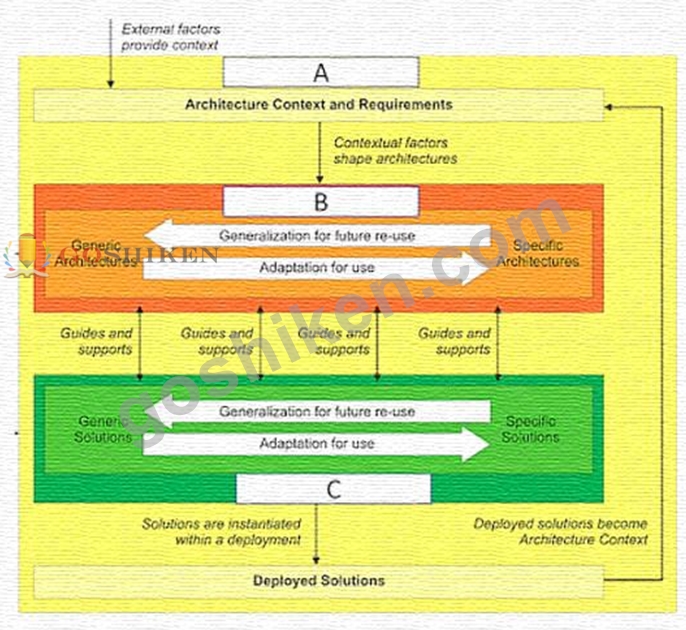
What are the items labelled A, B and C?
- A. A-Enterprise Continuum, B-Architecture Continuum, C-Solutions Continuum
- B. A-Architecture Vision, B-Business Architecture, C-Information Systems Architecture
- C. A-Enterprise Strategic Architecture, B-Segment Architecture, C-Solutions Architecture
- D. A-Enterprise Architecture, B-Architecture Building Blocks, C-Solutions Building Blocks
正解:A
解説:
The illustration shows the relationship between the Enterprise Continuum, the Architecture Continuum, and the Solutions Continuum, which are key concepts in the TOGAF framework. TheEnterprise Continuum is a view of the Architecture Repository that shows how generic foundation architectures can be leveraged and specialized to support the requirements of an individual organization. The Architecture Continuum specifies a structured classification for architectural artifacts, such as models, patterns, and descriptions, that can be reused and adapted across different domains and levels of abstraction. The Solutions Continuum identifies implemented solutions that support various stages of business and IT capability evolution, such as common systems, industry solutions, and organization-specific solutions. The illustration also shows how the architecture context and requirements are influenced by external factors, such as business drivers, stakeholders, and standards, and how they shape the generic and specific architectures and solutions. The illustration also shows how the deployed solutions become part of the architecture context for future iterations of the architecture development cycle. References:
*TOGAF Standard, 10th Edition, Part II: Architecture Development Method, Chapter 6: Architecture Repository, Section 6.2 Enterprise Continuum.
*TOGAF Standard, 10th Edition, Part IV: Architecture Content Framework, Chapter 35: Enterprise Continuum and Tools, Section 35.1 Introduction.
質問 # 53
What is an objective of the ADM Preliminary Phase?
- A. To obtain approval for the Statement of Architecture Work
- B. To develop a vision of the business value to be delivered by the proposed enterprise architecture
- C. To select and implement tools to support the Architecture Capability
- D. To create the initial version of the Architecture Roadmap
正解:C
解説:
Explanation
The Preliminary Phase is the preparatory phase of the Architecture Development Method (ADM) cycle, which sets the context and direction for the architecture work. One of the objectives of this phase is to select and implement tools to support the Architecture Capability, which is the ability of an organization to perform enterprise architecture effectively and efficiently. Tools can include software applications, methods, techniques, standards, and frameworks that assist the architecture development and governance processes. The selection and implementation of tools should be based on the requirements and constraints of the organization, and the alignment with the Architecture Principles and the Architecture Vision3 References: 3: The TOGAF Standard, Version 9.2, Part II: Architecture Development Method (ADM), Chapter 6: Preliminary Phase : The TOGAF Standard, Version 9.2, Part VI: Architecture Capability Framework, Chapter 45: Establishing and Maintaining an Enterprise Architecture Capability : The TOGAF Standard, Version 9.2, Part VI: Architecture Capability Framework, Chapter 46: Tools for Architecture Development
質問 # 54
Which of the following best describes the class of information known as the Reference Library within the Architecture Repository?
- A. Specifications to which architectures must conform
- B. Processes to support governance of the Architecture Repository
- C. A record of the governance activity across the enterprise
- D. Guidelines and templates used to create new architectures
正解:D
解説:
The class of information known as the Reference Library within the Architecture Repository contains guidelines and templates used to create new architectures. The Reference Library provides a set of resources that can be leveraged or customized for specific architecture development purposes. It includes generic building blocks, patterns, models, standards, frameworks, methods, techniques, best practices, etc. Reference: The TOGAF Standard | The Open Group Website, Section 2.4 Architecture Repository.
質問 # 55
Complete the sentence. The four purposes that typically frame the planning horizon, depth and breadth of an Architecture Project, and the contents of the EA Repository are Strategy, Portfolio,
- A. Subordinate, and Superior Architecture.
- B. Discreet, and Cohesive.
- C. Segment, and End-to-end Target Architecture.
- D. Project, and Solution Delivery.
正解:C
解説:
The planning horizon, depth, and breadth of an Architecture Project, along with the contents of the EA Repository, are typically framed by Strategy, Portfolio, Segment, and End-to-end Target Architecture. The 'Segment' refers to a part of the organization, typically addressed in a Segment Architecture, while 'End-to-end Target Architecture' encompasses the complete view of the planned architecture across the entire organization.
質問 # 56
Consider the following descriptions of deliverables consumed and produced across the TOGAF ADM cycle.
Which deliverables match these descriptions?
- A. 1 Request for Architecture Work - 2 Statement of Architecture Work - 3 Architecture Principles - 4 Architecture Requirements Specification
- B. 1 Architecture Requirements Specification - 2 Request for Architecture Work - 3 Statement of Architecture Work - 4 Architecture Principles
- C. 1 Architecture Principles - 2 Architecture Requirements Specification - 3 Request for Architecture Work
- 4 Statement of Architecture Work - D. 1 Statement of Architecture Work - 2 Architecture Principles - 3 Architecture Requirements Specification - 4 Request for Architecture Work
正解:A
解説:
Explanation
The Request for Architecture Work is a deliverable that is sent from the sponsor and triggers the start of an architecture development cycle. It defines the scope, budget, schedule, and deliverables for a specific architecture project. The Statement of Architecture Work is a deliverable that is produced by the architect and defines the approach and resources needed to complete an architecture project. It forms the basis of a contractual agreement between the sponsor and the architecture organization. The Architecture Principles are a deliverable that is produced by the architect and defines the general rules and guidelines for the architecture work. They reflect the business principles, business goals, and business drivers of the organization. The Architecture Requirements Specification is a deliverable that is produced by the architect and defines the requirements that govern the architecture work. It covers both functional and non-functional requirements as well as constraints and assumptions.
質問 # 57
What can architects present to stakeholders to extract hidden agendas, principles, and requirements that could impact the final Target Architecture?
- A. Solutions and Applications
- B. Alternatives and Trade-offs
- C. Architecture Views and Architecture Viewpoints
- D. Business Scenarios and Business Models
正解:C
解説:
According to the TOGAF Standard, Version 9.2, an architecture view is a representation of a system from the perspective of a related set of concerns1. It consists of one or more architecture models that demonstrate how the system addresses the stakeholder concerns1.
An architecture viewpoint is a specification of the conventions for constructing and using an architecture view to address specific stakeholder concerns1. It defines the perspective, scope, notation, and techniques for creating an architecture view of a system1.
Architects can present architecture views and viewpoints to stakeholders to extract hidden agendas, principles, and requirements that could impact the final Target Architecture, because23:
Architecture views and viewpoints help to communicate and visualize the architecture in a way that is meaningful and relevant to different stakeholders, addressing their specific interests and needs.
Architecture views and viewpoints help to elicit and validate the stakeholder concerns and requirements, ensuring that they are aligned with the business goals and objectives, and that they are consistent and feasible within the architecture context.
Architecture views and viewpoints help to identify and resolve any conflicts, gaps, or trade-offs among the stakeholder concerns and requirements, ensuring that they are balanced and prioritized in the architecture design and decision-making.
Architecture views and viewpoints help to demonstrate and verify the value and benefits of the architecture to the stakeholders, ensuring that they are satisfied and committed to the architecture outcome and governance.
1: The TOGAF Standard, Version 9.2, Chapter 22: Architecture Views, Viewpoints, and Stakeholders
2: The TOGAF Standard, Version 9.2, Chapter 4: Introduction to Part II, Section 4.2: What is an Architecture Framework?
3: The TOGAF Standard, Version 9.2, Chapter 31: Architectural Artifacts, Section 31.1: Basic Concepts
質問 # 58
......
高合格率OGEA-103テスト問題集解答と正解122問題と回答:https://www.goshiken.com/TheOpenGroup/OGEA-103-mondaishu.html
OGEA-103問題集PDFとテストエンジン試験問題:https://drive.google.com/open?id=1Xk4BeXGH7FoLzI1LLloZexioJcpzpF8B