

2025年最新の実際に出ると確認された 無料Fortinet NSE6_WCS-7.0試験問題
NSE6_WCS-7.0リアル試験問題解答は無料
Fortinet NSE6_WCS-7.0認定試験は、Fortinetのソリューションを使用してAWSでクラウドベースの環境を保護する個人の能力の厳密かつ包括的な評価です。この認定を達成することにより、個人は自分の専門知識を実証し、クラウドセキュリティでのキャリアを促進することができます。
質問 # 21
Refer to the exhibit.
A customer is using the AWS Elastic Load Balancer.
Which two statements are correct about the Elastic LoadBalancer configuration? (Choose two.)
- A. The DNS name is used to access devices.
- B. The load balancer is configuredfor the internal traffic oftheVPC
- C. The load balancer is configured to load balance traffic between devices in two AZS.
- D. The Amazon resource name is used to access the load balancer node and targets.
正解:A、C
質問 # 22
You want to deploy the Fortinet HA cloud formation template to stage and bootstrap the FortiGate configuration in the same that you created your VPC, Which is Ohio US-East-2.
Based on this information, which statement is correct?
- A. You must create an S3 bucket to stage and bootstrap FortiGate with an FGCP multicast configuration in the Ohio US-East-2 region.
- B. You must create an S3 bucket to stage and bootstrap FortiGate with an FGCP unicast configuration in any region.
- C. The Fortinet HA cloud formation template automatically creates an S3 bucket.
- D. You must create an S3 bucket to stage and bootstrap FortiGate with an FGCP unicast configuration in the Ohio US-East-2 region.
正解:C
質問 # 23
You are troubleshooting network connectivity issues between two VMs deployed in AWS.
One VM is a FortiGate located on subnet "LAN" that is part of the VPC "Encryption". The other VM is a Windows server located on the subnet "servers" which is also in the "Encryption" VPC. You are unable to ping the Windows server from FortiGate.
What are two reasons for this? (Choose two.)
- A. The firewall in the Windows VM is blocking the traffic.
- B. By default, AWS does not allow ICMP traffic between subnets.
- C. The default AWS Network Access Control List (NACL) does not allow this traffic.
- D. Add an inbound allow ICMP rule in the security group attached to the windows server.
正解:A、D
解説:
* Windows Firewall Blocking Traffic:
* The firewall on the Windows VM might be configured to block incoming ICMP traffic (ping requests). By default, Windows Firewall is set to block ICMP traffic, which could be a reason for the connectivity issue (Option A).
* Security Group Configuration:
* AWS Security Groups act as virtual firewalls for instances. If there is no rule allowing ICMP traffic in the security group attached to the Windows server, the ping requests from FortiGate will be blocked. An inbound allow ICMP rule must be added to the security group to permit this traffic (Option D).
* Other Options Analysis:
* Option B is incorrect because the default AWS Network Access Control List (NACL) allows all inbound and outbound traffic.
* Option C is incorrect as AWS does allow ICMP traffic between subnets if properly configured with Security Groups and NACLs.
References:
* AWS Security Groups: AWS Security Groups
* Windows Firewall Configuration: Windows Firewall
質問 # 24
Refer to the exhibit.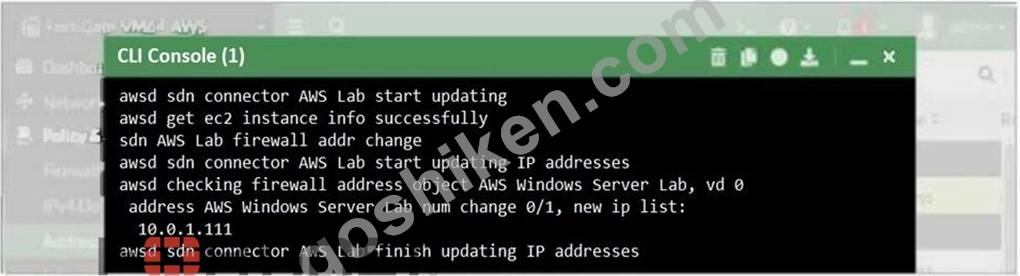
What two conclusions can you draw from the FortiGate debug output? (Choose two.)
- A. The address object AWS Windows Server Lab can be manually changed on FortiGate.
- B. The SDN connector is correctly configured and authorized.
- C. The dynamic address object is automatically updated if the IP changes.
- D. The AWS user account used for software-defined network (SDN) integration must have full administrative rights.
正解:B、C
解説:
* Dynamic Address Object Update:
* The debug output shows that the IP address of the AWS Windows Server Lab has been updated automatically, indicating that the dynamic address object feature is working as intended. This allows FortiGate to adapt to changes in the IP addresses of AWS instances dynamically (Option A).
* SDN Connector Configuration:
* The messages in the debug output confirm that the SDN connector is able to retrieve instance information and update the firewall address objects successfully. This implies that the SDN connector is correctly configured and has the necessary permissions (Option C).
* Manual Change and Permissions:
* Option B is incorrect because while the address object could theoretically be changed manually, this is not inferred from the debug output.
* Option D is incorrect because the debug output does not indicate that the AWS user account must have full administrative rights. The required permissions are typically more scoped to specific actions related to SDN.
References:
* FortiGate AWS Integration Guide: FortiGate on AWS
* AWS IAM Policies for SDN: AWS IAM Policies
質問 # 25
Refer to the exhibit.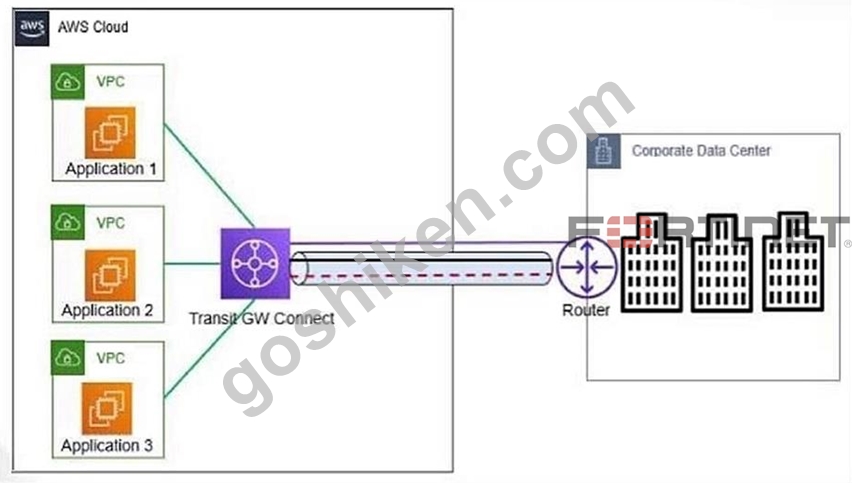
An organization deployed the application servers in the AWS VPC that connects to the corporate data center using Transit Gateway Connect. Demand for the applications has grown and the connection requires more bandwidth.
What is required to achieve higher bandwidth?
- A. Use routable public IP addresses instead of private IP addresses for connectivity.
- B. You add a Transit VPC between the organization's VPCs.
- C. No configuration change is required because GRE tunnels are scaled to provide higher bandwidth.
- D. You cannot increase bandwidth the connection has a fixed limit.
正解:C
解説:
* Understanding Transit Gateway Connect:
* Transit Gateway Connect is a feature of AWS Transit Gateway that simplifies the integration of SD-WAN networks with AWS. It uses Generic Routing Encapsulation (GRE) tunnels to facilitate this connection.
* GRE Tunnels and Bandwidth:
* GRE tunnels can dynamically scale to meet increasing bandwidth demands. They allow multiple tunnels between the same endpoints, which can aggregate bandwidth without requiring additional configuration.
* Scaling Bandwidth with GRE:
* The GRE protocol used by Transit Gateway Connect can support high bandwidth requirements by spreading traffic across multiple tunnels. As demand grows, additional tunnels can be automatically used to handle the increased traffic load.
* Comparison with Other Options:
* Option A suggests using public IP addresses, which is not relevant to bandwidth scaling.
* Option B is incorrect because bandwidth can be increased through GRE scaling.
* Option D suggests adding a Transit VPC, which is unnecessary for increasing bandwidth when using Transit Gateway Connect.
References:
* AWS Transit Gateway Documentation: AWS Transit Gateway
* GRE Tunnels and AWS: AWS GRE Tunnels
質問 # 26
Which features are only available on FortiWeb when compared to Fortinet Managed Rules for AWS WAF?
- A. FortiWeb can scan web application vulnerabilities.
- B. FortiWeb provides a WAF subscription (FortiGuard) option.
- C. FortiWeb meets PCI 6.6 compliance.
- D. FortiWeb provides web application attack signatures.
正解:A
質問 # 27
Refer to the exhibit.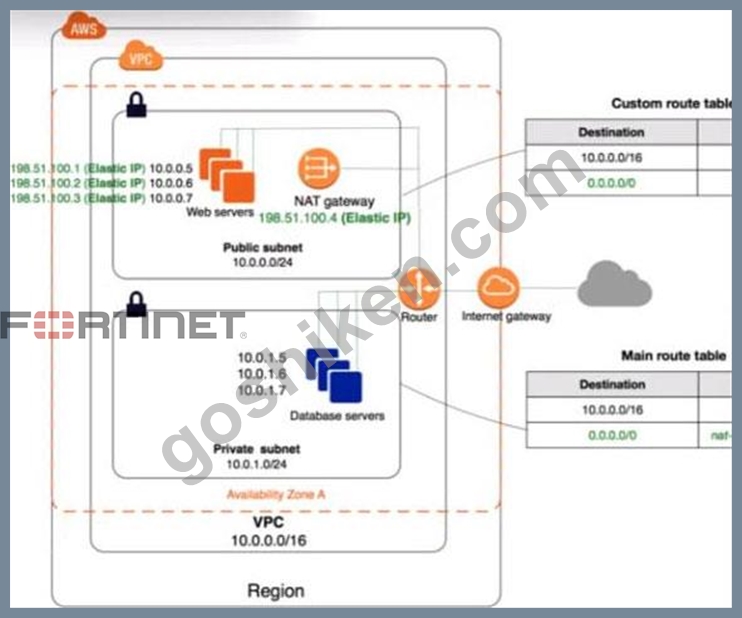
An administrator wants to update the database package from the Internet to a database server configured with IP address Which statement is correct about traffic from server IP address 10.0.1.7 to the internet. based on the diagrarm?
- A. Traffic from server 10.0.1.7 to the internet will hide behind elastic IP 198.51.100 2.
- B. Traffic from server10.0.1.7 to the internet will hide behind elastic IP 198.51.100.4
- C. Traffic from server 10.0.1.7 to the internet will hide behind elastic IP 198.51.100.1
- D. Traffic from server 10.0.1.7 to the internet will hide behind elastic IP 198.51.100.3
正解:B
質問 # 28
An administrator needs to attach an Elastic Network Interface (ENI) to an application instance in a VPC with multiple availability zones. An instance runs in availability zone 1.
Which ENI property must the administrator consider when implementing this requirement?
- A. When you move an ENI, network traffic remains directed to the old instance until you terminate that instance.
- B. An ENI cannot attach to an instance in availability zone 2.
- C. You can detach the primary ENI from an AWS instance.
- D. After the ENI detaches from one instance, it can reattach only to the same instance.
正解:B
解説:
* ENI Attachment Across Availability Zones:
* Elastic Network Interfaces (ENIs) are associated with a specific Availability Zone. They cannot be attached to instances that are in a different Availability Zone than where the ENI was created.
Therefore, an ENI created in Availability Zone 1 cannot be attached to an instance in Availability Zone 2 (Option A).
* ENI Reattachment:
* ENIs can be detached from one instance and reattached to another instance within the same Availability Zone. This flexibility allows for network interface configuration to be preserved across instance changes within the same AZ.
* Other Options Analysis:
* Option B is incorrect because an ENI can be reattached to any instance in the same AZ.
* Option C is incorrect as the primary ENI (eth0) cannot be detached from an instance.
* Option D is incorrect because when an ENI is moved, the traffic is directed to the new instance, and there is no redirection to the old instance.
References:
* AWS ENI Documentation: Elastic Network Interfaces
* AWS Networking Best Practices: AWS Networking
質問 # 29
Refer to the exhibit.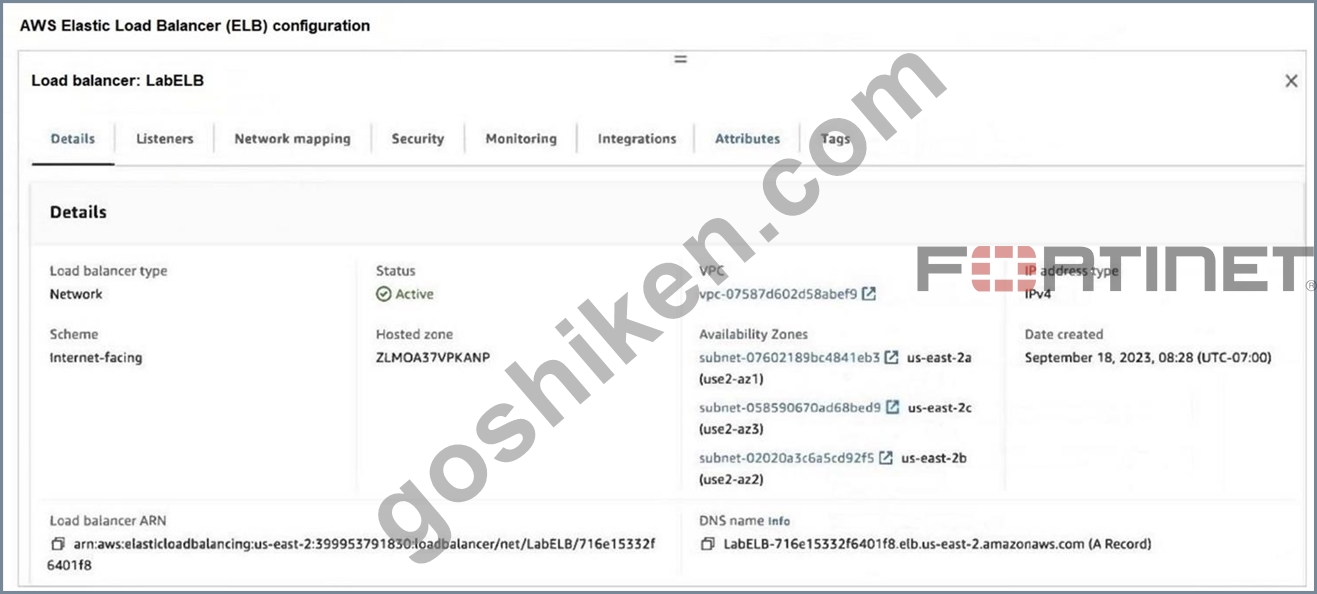
A customer is using the AWS Elastic Load Balancer (ELB).
Which two statements are correct about the ELB configuration? (Choose two.)
- A. The load balancer is configured for the internal traffic of the virtual public cloud (VPC).
- B. You can use the DNS name to reach the targets behind the ELB.
- C. The load balancer is configured to load balance traffic among multiple availability zones.
- D. The Amazon Resource Name is used to access the load balancer node and targets.
正解:B、C
解説:
* Load Balancer Configuration Overview:
* The provided configuration indicates that the ELB is an internet-facing load balancer.
* Multi-AZ Load Balancing:
* The load balancer is configured to distribute traffic across multiple availability zones (A, B, and C), ensuring high availability and fault tolerance (Option A).
* Accessing Targets via DNS:
* The DNS name of the load balancer (LabELB-716e15332f6401f8.elb.us-east-2.amazonaws.com) can be used to reach the targets behind the ELB, facilitating traffic routing to the appropriate instances (Option C).
* Comparison with Other Options:
* Option B is incorrect as the ARN is not used to access the load balancer directly.
* Option D is incorrect because the load balancer is configured for internet-facing traffic, not just internal VPC traffic.
References:
* AWS Elastic Load Balancer Documentation: AWS ELB
* Understanding ELB DNS: AWS ELB DNS
質問 # 30
Refer to the exhibit.
Traffic is initiated from the EC2 instance and is destined for the internet.
Which traffic flow is correct?
- A. There is no route to the internet in the Private Route Table. The traffic does not reach the internet.
- B. EC2 instance > GWLBe > NAT GW > IGW > internet
- C. EC2 instance > GWLBe > internet
- D. EC2 instance > NAT GW > IGW > internet
正解:B
解説:
* Understanding the Architecture:
* The architecture includes an EC2 instance in a private subnet, a Gateway Load Balancer Endpoint (GWLBe), a NAT Gateway (NAT GW), and an Internet Gateway (IGW).
* Route Tables and Routing:
* The private route table for the subnet containing the EC2 instance has a route pointing to the GWLBe for internet-bound traffic.
* The public route table for the subnet containing the NAT Gateway has routes to the IGW.
* Traffic Flow Analysis:
* Traffic initiated from the EC2 instance destined for the internet will first be routed to the GWLBe as per the private route table.
* The GWLBe will forward the traffic to the NAT Gateway.
* The NAT Gateway will then route the traffic to the IGW, which finally sends the traffic to the internet.
* Comparison with Other Options:
* Option A suggests direct routing to the NAT GW from the EC2 instance, which is incorrect.
* Option B incorrectly states there is no route to the internet in the private route table.
* Option D suggests direct routing from GWLBe to the internet, which is not the case.
References:
* AWS Documentation on Route Tables: AWS Route Tables
* Gateway Load Balancer Overview: AWS Gateway Load Balancer
質問 # 31
Refer to the exhibit.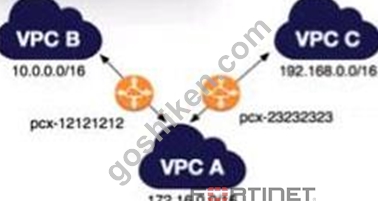
Which statement is correct about the VPC peering connections shown in the exhibit?
- A. You cannot create a VPC peering connection between VPC B and VPC C to route packets directly.
- B. You can associate VPC ID pcx-23232323 with VPC B to form a VPC peering connection between VPC B and VPC C.
- C. TO route packets directly from VPC B to VPC C through VPC A, you must add a route for network 192.168.0.0/16 in the VPC A routing table.
- D. You cannot route packets directly from VPC B to VPC C through VPC A.
正解:D
質問 # 32
You connected to the AWS Management Console at 10:00 AM and verified that there are two FortiGate VMS running, You receive a call from a user reporting about a temporary slow Internet connection that lasted only a few minutes. When you go back to the AWS portal. you notice there are now two additional FortiGate VMS that you did not create. Later that day, the number of VMS returns to two without your intervention. A similar situation occurs several times during the week.
What is the most likely reason for this to happen?
- A. The AWS portal is not refreshed automatically. and another administrator is creating and removing the VMS as needed.
- B. The VMS are in an availability group with dynamic membership.
- C. The user ran a script to create the extra VMS to get faster connectivity.
- D. Autoscaling is configured to act as described in the scenario.
正解:D
質問 # 33
Which three statements are correct about VPC flow logs? (Choose three.)
- A. Flow logs do not capture traffic to and from 169.254.169.254 for instance metadata.
- B. Flow logs can capture real-time log streams for the network interfaces.
- C. Flow logs do not capture DHCP traffic.
- D. Flow logs can capture traffic to the reserved IP address for the default VPC router.
- E. Flow logs can be used as a security tool to monitor the traffic that is reaching the instance.
正解:A、C、E
質問 # 34
An administrator must deploy a web application firewall (WAF) solution to protect the web applications of their organization.
Why would the administrator choose FortiWeb Cloud over AWS WAF with Fortinet managed rules?
- A. Traffic must be inspected for malware.
- B. SSL inspection is a requirement.
- C. The solution must meet PCI 6.6 compliance.
- D. WAF signatures must be manually updated by FortiGuard.
正解:B
解説:
* SSL Inspection Requirement:
* FortiWeb Cloud provides comprehensive SSL inspection capabilities, allowing it to decrypt and inspect HTTPS traffic for threats. This is a crucial feature for many organizations that need to ensure all traffic, including encrypted traffic, is thoroughly inspected (Option C).
* Comparison with AWS WAF:
* While AWS WAF with Fortinet managed rules provides robust protection, it might not offer the same level of SSL inspection capabilities as FortiWeb Cloud.
* Other Considerations:
* Option A (Manual WAF signature updates) is incorrect because FortiWeb Cloud updates signatures automatically.
* Option B (PCI 6.6 compliance) is a general requirement for any WAF solution, not specific to choosing FortiWeb Cloud over AWS WAF.
* Option D (Traffic inspection for malware) is a feature provided by both FortiWeb Cloud and AWS WAF with Fortinet managed rules.
References:
* FortiWeb Cloud Overview: FortiWeb Cloud
* AWS WAF Documentation: AWS WAF
質問 # 35
An administrator is adding a web application to be protected by FortiWeb Cloud.
Which two steps are necessary to successfully onboard the application? (Choose two.) An administrator is adding a web application to be protected by FortiWeb Cloud.
Which two steps are necessary to successfully onboard the application? (Choose two.)
- A. Enable a content delivery network (CDN) in the same region where your application is located.
- B. Create DNS records in the domain server that hosts the application.
- C. Provide a web application name.
- D. Wait for the EC2 instance to be created.
正解:B、C
解説:
* Web Application Name:
* When onboarding a web application to be protected by FortiWeb Cloud, you need to provide a name for the web application. This helps in identifying and managing the application within the FortiWeb Cloud console (Option B).
* DNS Records:
* To ensure that traffic to your web application is correctly routed through FortiWeb Cloud, you must create DNS records in the domain server that hosts your application. This ensures that requests are directed to FortiWeb Cloud for inspection and protection (Option C).
* Other Considerations:
* Option A (Waiting for the EC2 instance) is incorrect as it is not a necessary step for onboarding a web application to FortiWeb Cloud.
* Option D (Enabling a CDN) is not a mandatory step for onboarding but can be part of a broader strategy for improving performance and protection.
References:
* FortiWeb Cloud Documentation: FortiWeb Cloud
質問 # 36
Which statement is true about an Elastic Network Interface (ENI)?
- A. An ENI cannot move between AZs.
- B. You can detach primary ENI from an AWS instance.
- C. When youmove an ENI, network traffic is not redirected to the new instance.
- D. Once ENI detaches from one instance. it cannot reattach to another instance.
正解:A
質問 # 37
An administrator wants to deploy a solution to automatically create firewall rules on FortiGate to accelerate time-to-protection for threats.
Which AWS service can be integrated with FortiGate to accomplish this?
- A. AWS network access control list
- B. AWS Firewall Manager
- C. SDN Connector for AWS
- D. AWS GuardDuty
正解:D
解説:
* AWS GuardDuty Integration:
* AWS GuardDuty is a threat detection service that continuously monitors for malicious activity and unauthorized behavior to protect AWS accounts and workloads. It can generate findings that can be used to create or update firewall rules automatically in FortiGate to enhance security and provide timely protection (Option D).
* Integration with FortiGate:
* GuardDuty findings can be integrated with FortiGate using automation tools and scripts to create firewall rules dynamically, thereby accelerating the time-to-protection against emerging threats.
* Other Options Analysis:
* Option A (AWS Firewall Manager) is more suited for managing rules across multiple accounts but not for dynamic threat response.
* Option B (AWS Network ACL) provides stateless filtering but does not offer automated rule creation.
* Option C (SDN Connector for AWS) helps in integrating SDN capabilities but is not specifically focused on threat-based rule automation.
References:
* AWS GuardDuty: AWS GuardDuty
* FortiGate Integration: Fortinet Integration
質問 # 38
Refer to the exhibit.
Which two statements are true about inbound traffic based on the IGW ingress route table and GWLB deployment shown in the exhibit? (Choose two.)
- A. GWLB forwards traffic to FortiGate without encapsulation in its dedicated subnet.
- B. Inbound traffic is directed to the application subnet through a GWLB endpoint.
- C. GWLB encapsulates traffic with the GENEVE protocol and sends it to FortiGate.
- D. Inbound traffic is directed to the GWLB through a GWLB endpoint.
正解:C、D
解説:
* Traffic Direction through GWLB Endpoint:
* The ingress route table directs inbound traffic to the GWLB through a GWLB endpoint (GWLBe). This endpoint is responsible for directing traffic to the Gateway Load Balancer for further processing (Option B).
* GENEVE Encapsulation:
* The GWLB encapsulates the inbound traffic using the GENEVE protocol. This encapsulated traffic is then sent to FortiGate instances for security inspection. The use of GENEVE ensures that the original traffic context is preserved and can be analyzed by FortiGate (Option D).
* Other Options Analysis:
* Option A is incorrect because GWLB does not forward traffic without encapsulation in its dedicated subnet.
* Option C is incorrect as the inbound traffic is directed to the GWLB endpoint first, not directly to the application subnet.
References:
* AWS Gateway Load Balancer Documentation: AWS GWLB
* GENEVE Protocol Overview: GENEVE Protocol
質問 # 39
An administrator has deployed an environment in AWS and is now trying to send outbound traffic from the web servers to the internet through FortiGate. The FortiGate policies are configured to allow all outbound traffic. however. the traffic is not reaching the FortiGate internal interface.
Which two statements Can be the reasons for this behavior? (Choose two)
- A. FortiGate is not configured as a default gateway tor web servers.
- B. AWS security groups are blocking the traffic.
- C. AWS source destination checks are enabled on the FortiGate internal interfaces.
- D. Internet Gateway (IGW) is not configured for VPC.
正解:B、C
質問 # 40
A global organization with cloud networks deployed in several AWS regions wants to set up next-generation firewall (NGFW) protection using FortiGate Cloud-Native Firewall (CNF).
What are two deployment considerations for the organization? (Choose two.)
- A. They must choose AWS Firewall Manager to provision a CNF instance.
- B. Only one CNF instance is required to protect all AWS regions.
- C. A CNF instance is required for each AWS region that must be protected.
- D. More than one AWS account can be associated with a CNF instance.
正解:C、D
解説:
* Regional Deployment:
* For a global organization with cloud networks in multiple AWS regions, a separate FortiGate Cloud-Native Firewall (CNF) instance is required for each AWS region to provide localized protection and meet compliance requirements. This ensures that each region has its own dedicated NGFW protection tailored to its specific needs (Option B).
* Multi-Account Association:
* FortiGate CNF supports associating multiple AWS accounts with a single CNF instance. This feature is beneficial for organizations that operate in a multi-account setup, allowing centralized management and security policies across different accounts (Option C).
* Other Options Analysis:
* Option A is incorrect because AWS Firewall Manager is a different service and is not required to provision a CNF instance.
* Option D is incorrect because a single CNF instance cannot protect multiple AWS regions due to regional isolation in AWS.
References:
* FortiGate CNF Documentation: FortiGate CNF
* AWS Multi-Account Best Practices: AWS Multi-Account
質問 # 41
You want to deploy the Fortinet HA CloudFormation template to stage and bootstrap the FortiGate configuration in the same region in which you created your VPC, which is Ohio US-East-2.
Based on this information, which statement is correct?
- A. You create an S3 bucket to stage and bootstrap FortiGate with an FGCP unicast configuration. The S3 bucket needs to be hosted in the Ohio US-East-2 region.
- B. You create an S3 bucket to stage and bootstrap FortiGate with an FGCP unicast configuration. The S3 bucket can be hosted in any region.
- C. You create a DynamoDB to stage and bootstrap FortiGate with an FGCP unicast configuration. It needs to be hosted in the Ohio US-East-2 region.
- D. The Fortinet HA cloud formation template automatically creates an S3 bucket.
正解:A
解説:
* Understanding Fortinet HA CloudFormation Template:
* The Fortinet High Availability (HA) CloudFormation template is used to automate the deployment and configuration of FortiGate instances in AWS.
* Staging and Bootstrapping FortiGate:
* Staging involves preparing the necessary configuration files and resources needed for deployment.
* Bootstrapping is the process of automatically configuring FortiGate instances upon deployment.
* S3 Bucket Requirement:
* The configuration files required for staging and bootstrapping are typically stored in an S3 bucket.
* Since the deployment is in the Ohio (US-East-2) region, it is recommended to host the S3 bucket in the same region to minimize latency and ensure regional compliance.
* Comparison with Other Options:
* Option A is incorrect because while an S3 bucket is required, it should be in the same region (US- East-2).
* Option B is incorrect as the template does not automatically create the S3 bucket.
* Option D is incorrect as DynamoDB is not used for staging and bootstrapping in this scenario.
References:
* Fortinet Documentation: FortiGate on AWS
* AWS S3 Documentation: AWS S3
質問 # 42
Refer to the exhibit.
Which two statements are correct about traffic flow in FortiWeb Cloud? (Choose two.)
- A. FortiWeb Cloud filters the incoming traffic from users, blocking the OWASP Top 10 attacks, zero-day threats, and other application layer attacks.
- B. FortiWeb Cloud can protect the application servers only if they are all located in the same virtual public cloud (VPC).
- C. The DNS name for the application servers must point to FortiWeb Cloud.
- D. Step 2 requires an AWS S3 bucket to be created.
正解:A、C
解説:
* DNS Configuration:
* For FortiWeb Cloud to effectively protect web applications, the DNS records for the application servers must be configured to point to FortiWeb Cloud. This ensures that all incoming traffic is routed through FortiWeb Cloud for inspection and protection (Option A).
* Traffic Filtering:
* FortiWeb Cloud provides robust protection by filtering incoming traffic to block the OWASP Top 10 attacks, zero-day threats, and other application layer attacks. This ensures the security and integrity of the web applications it protects (Option B).
* Other Options Analysis:
* Option C is incorrect because FortiWeb Cloud can protect application servers across different VPCs or regions, not just within the same VPC.
* Option D is incorrect because step 2 does not require an AWS S3 bucket; it refers to the inspection and filtering of incoming traffic.
References:
* FortiWeb Cloud Overview: FortiWeb Cloud
* DNS Configuration for Web Applications: DNS Configuration
質問 # 43
Refer to the exhibit.
What occurs during a failover for an active-passive (A-P) cluster that is deployed in two different availability zones? (Choose two.)
- A. The cluster elastic IP address (EIP) is moved from Port1 of FGT-1 to Port1 of FGT-2.
- B. An additional route is added to the route table of the HA Sync AZ2 subnet to forward all traffic to the Internet GW.
- C. The secondary IP address of Port2 of FGT-1 is moved to Port2 of FGT-2.
- D. The default static route in the Private-AZ1 subnet route table is modified to forward all traffic to Port2 of FGT2.
正解:A、C
解説:
* Cluster Elastic IP Address (EIP) Movement:
* During a failover in an active-passive (A-P) cluster, the Elastic IP (EIP) associated with the active FortiGate instance (FGT-1) needs to be moved to the passive instance (FGT-2), which becomes the new active instance. This ensures that the traffic directed to the EIP is now handled by FGT-2 (Option A).
* Secondary IP Address Movement:
* The secondary IP address on Port2 of the current active instance (FGT-1) is moved to the same port on the new active instance (FGT-2). This step is crucial to ensure seamless network traffic redirection and connectivity for the services relying on that IP address (Option B).
* Other Options Analysis:
* Option C is incorrect because the static route modification mentioned is not directly related to the failover process described.
* Option D is incorrect because no additional route needs to be added to the HA Sync AZ2 subnet route table to forward traffic to the Internet Gateway during a failover.
References:
* FortiGate HA Configuration Guide: FortiGate HA
* AWS Elastic IP Documentation: Elastic IP
質問 # 44
......
試験問題集でNSE6_WCS-7.0練習無料最新のFortinet練習テスト:https://www.goshiken.com/Fortinet/NSE6_WCS-7.0-mondaishu.html
NSE6_WCS-7.0試験問題、リアルNSE6_WCS-7.0練習問題集:https://drive.google.com/open?id=1-AxH8lWs95JkdNS2DT2z8zjgTk37t568