

[2025年03月21日] NSE6_WCS-7.0 PDFで最近更新された問題です集試験点数を伸ばそう
NSE6_WCS-7.0完全版問題集には無料PDF問題で合格させる
質問 # 13
An organization has created a VPC with two subnets and deployed a FortiGate-VM (VM04/c4.xlarge) in AWS.
The EC2 instance is initially configured with two Elastic Network Interfaces (ENIs). The primary ENI is configured on the public subnet, and the secondary ENI is configured on the private subnet. To provide internet access for the FortiGate-VM, they now want to associate an EIP to its primary ENI, but the assignment is failing.
Which action would allow the EIP assignment to be successful?
- A. Create and attach a public routing table to the public subnet, associate the public subnet with the primary ENI of the FortiGate VM, and then assign the EIP to the primary ENI.
- B. Shut down the FortiGate VM, if it is running, assign the EIP to the primary ENI, and then power it on.
- C. Create and attach an internet gateway to the VPC, and then assign the EIP to the primary ENI of the FortiGate VM.
- D. Create and associate a public subnet with the primary ENI of the FortiGate VM, and then assign the EIP to the primary ENI.
正解:C
解説:
* Internet Gateway Requirement:
* For an Elastic IP (EIP) to be assigned to an instance's primary ENI, the VPC must have an Internet Gateway (IGW) attached. The IGW enables the VPC to communicate with the internet, allowing the EIP to function properly (Option C).
* Process of Assigning EIP:
* Once the Internet Gateway is attached to the VPC, the EIP can be successfully assigned to the primary ENI of the FortiGate VM, providing it with internet access.
* Other Options Analysis:
* Option A is incorrect because the primary ENI is already in a public subnet.
* Option B is not necessary and may not solve the issue without an attached Internet Gateway.
* Option D is partially correct about the routing table but does not address the primary issue of needing an Internet Gateway.
References:
* AWS Elastic IP Documentation: Elastic IP
* AWS Internet Gateway: Internet Gateway
質問 # 14
An administrator needs to attach an Elastic Network Interface (ENI) to an application instance in a VPC with multiple availability zones. An instance runs in availability zone 1.
Which ENI property must the administrator consider when implementing this requirement?
- A. An ENI cannot attach to an instance in availability zone 2.
- B. After the ENI detaches from one instance, it can reattach only to the same instance.
- C. You can detach the primary ENI from an AWS instance.
- D. When you move an ENI, network traffic remains directed to the old instance until you terminate that instance.
正解:A
解説:
* ENI Attachment Across Availability Zones:
* Elastic Network Interfaces (ENIs) are associated with a specific Availability Zone. They cannot be attached to instances that are in a different Availability Zone than where the ENI was created.
Therefore, an ENI created in Availability Zone 1 cannot be attached to an instance in Availability Zone 2 (Option A).
* ENI Reattachment:
* ENIs can be detached from one instance and reattached to another instance within the same Availability Zone. This flexibility allows for network interface configuration to be preserved across instance changes within the same AZ.
* Other Options Analysis:
* Option B is incorrect because an ENI can be reattached to any instance in the same AZ.
* Option C is incorrect as the primary ENI (eth0) cannot be detached from an instance.
* Option D is incorrect because when an ENI is moved, the traffic is directed to the new instance, and there is no redirection to the old instance.
References:
* AWS ENI Documentation: Elastic Network Interfaces
* AWS Networking Best Practices: AWS Networking
質問 # 15
As part of the security plan you have been tasked with deploying a FortiGate in AWS.
Which two are the security responsibility of the customer in a cloud environment? (Choose two.)
- A. Storage infrastructure
- B. Virtualization platform
- C. Traffic encryption
- D. User management
正解:C、D
質問 # 16
Which features are only available on FortiWeb when compared to Fortinet Managed Rules for AWS WAF?
- A. FortiWeb can scan web application vulnerabilities.
- B. FortiWeb provides a WAF subscription (FortiGuard) option.
- C. FortiWeb provides web application attack signatures.
- D. FortiWeb meets PCI 6.6 compliance.
正解:A
質問 # 17
Which statement is true about an Elastic Network Interface (ENI)?
- A. You can detach primary ENI from an AWS instance.
- B. An ENI cannot move between AZs.
- C. Once ENI detaches from one instance. it cannot reattach to another instance.
- D. When youmove an ENI, network traffic is not redirected to the new instance.
正解:B
質問 # 18
HOW is traffic failover handled in a FortiGate active-active cluster deployed in AWS?
- A. The elastic load balancer handles bi-directional traffic failover using a health probe.
- B. All FortiGate cluster members use unicast FGCP_
- C. The elastic load balancer handles traffic failover using FGCP.
- D. All FortiGate cluster members send health probes using a dedicated interface.
正解:A
質問 # 19
Your organization is deciding between deploying an active-active (A-A) or active-passive (A-P) FortiGate high availability (HA) cluster in AWS cloud.
Which two statements are true about A-A clusters compared to A-P clusters? (Choose two.)
- A. A-A clusters rely on API calls for sfailovers.
- B. For A-A clusters, FortiGate must perform SNAT inbound to ensure symmetric traffic flow.
- C. A-A clusters can use a software-defined network (SDN) to perform a failover.
- D. A-A clusters always require a load balancer.
正解:B、D
解説:
* Symmetric Traffic Flow with SNAT:
* In active-active (A-A) clusters, symmetric traffic flow is essential for maintaining session integrity across multiple instances. Source Network Address Translation (SNAT) is performed inbound to ensure that return traffic is routed correctly (Option A).
* Load Balancer Requirement:
* A-A clusters require a load balancer to distribute incoming traffic evenly across the active instances. This is crucial for balancing the load and providing high availability (Option C).
* API Calls and Failovers:
* Option B is incorrect because failovers in A-A clusters do not typically rely on API calls but are managed by the load balancer and the clustering mechanism itself.
* Software-Defined Network (SDN) Failover:
* Option D is incorrect as SDN is not specifically required for performing failovers in A-A clusters.
The failover mechanism is typically managed by the load balancer and FortiGate's clustering technology.
References:
* FortiGate High Availability on AWS: FortiGate HA
* AWS Elastic Load Balancing: AWS ELB
質問 # 20
An administrator wants to deploy a solution to automatically create firewall rules on FortiGate to accelerate time-to-protection for threats.
Which AWS service can be integrated with FortiGate to accomplish this?
- A. SDN Connector for AWS
- B. AWS network access control list
- C. AWS GuardDuty
- D. AWS Firewall Manager
正解:C
解説:
* AWS GuardDuty Integration:
* AWS GuardDuty is a threat detection service that continuously monitors for malicious activity and unauthorized behavior to protect AWS accounts and workloads. It can generate findings that can be used to create or update firewall rules automatically in FortiGate to enhance security and provide timely protection (Option D).
* Integration with FortiGate:
* GuardDuty findings can be integrated with FortiGate using automation tools and scripts to create firewall rules dynamically, thereby accelerating the time-to-protection against emerging threats.
* Other Options Analysis:
* Option A (AWS Firewall Manager) is more suited for managing rules across multiple accounts but not for dynamic threat response.
* Option B (AWS Network ACL) provides stateless filtering but does not offer automated rule creation.
* Option C (SDN Connector for AWS) helps in integrating SDN capabilities but is not specifically focused on threat-based rule automation.
References:
* AWS GuardDuty: AWS GuardDuty
* FortiGate Integration: Fortinet Integration
質問 # 21
You want to deploy the Fortinet HA cloud formation template to stage and bootstrap the FortiGate configuration in the same that you created your VPC, Which is Ohio US-East-2.
Based on this information, which statement is correct?
- A. You must create an S3 bucket to stage and bootstrap FortiGate with an FGCP unicast configuration in any region.
- B. You must create an S3 bucket to stage and bootstrap FortiGate with an FGCP unicast configuration in the Ohio US-East-2 region.
- C. You must create an S3 bucket to stage and bootstrap FortiGate with an FGCP multicast configuration in the Ohio US-East-2 region.
- D. The Fortinet HA cloud formation template automatically creates an S3 bucket.
正解:D
質問 # 22
Which three statements are correct about AWS security groups? (Choose three)
- A. By default, security groups block all outbound traffic.
- B. By default,security groups allow all inbound traffic.
- C. a Security group rules are always permissive: you cannot create rules that deny access.
- D. When associate multiple security groups With an instance, the rules from each security group are effectively aggregated to create one set Of rules
- E. Security groups are statetul
正解:C、D、E
質問 # 23
Refer to the exhibit.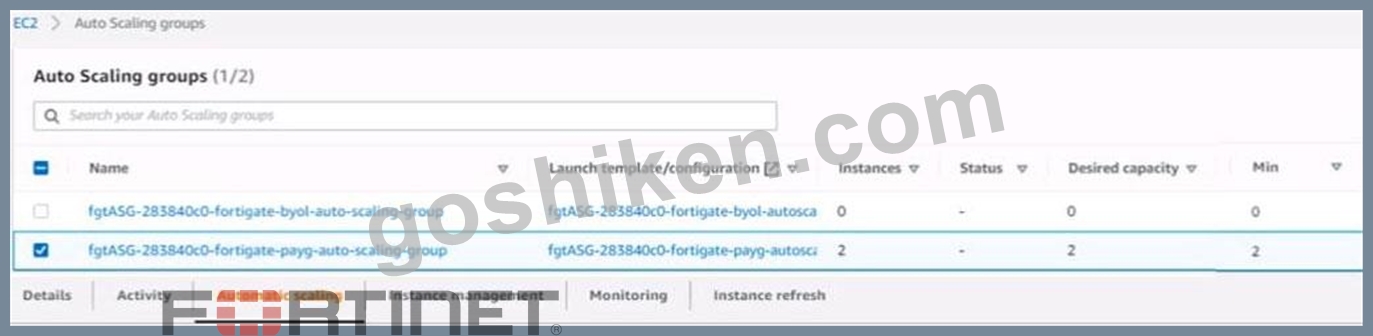
An administrator configured two auto-scaling polices that they now want to test.
What Will be the impact on payg-auto-scaling-group for the FortiGate devices if the administrator executes a scale-in policy?
- A. The scale-in policy will decrease the desired capacity from two to one
- B. The scale-in policy will decrease instances from two to one.
- C. The scale-in policy will decrease the number of maximum instances from four to three.
正解:C
質問 # 24
You need to deploy a new Windows server in AWS to offload web traffic from an existing web server in a different availability zone.
According to the AWS shared responsibility model, what three actions must you take to secure the new EC2 instance? (Choose three.)
- A. Change the existing elastic load balancer (ELB) to a gateway load balancer
- B. Move all web servers into the same availability zone.
- C. Update software on the instance.
- D. Manage the operating system on the instance.
- E. Configure security groups.
正解:C、D、E
解説:
* Update Software:
* As part of the AWS shared responsibility model, it is the customer's responsibility to update and maintain the software running on the EC2 instance, including applying security patches and updates (Option A).
* Configure Security Groups:
* Security groups act as virtual firewalls for instances to control inbound and outbound traffic.
Configuring them correctly is essential for securing the EC2 instance and ensuring only legitimate traffic can reach the server (Option C).
* Manage Operating System:
* Managing the operating system, including user accounts, permissions, and operating system patches, is the responsibility of the customer under the shared responsibility model (Option D).
* Other Options Analysis:
* Option B is incorrect as changing the existing ELB to a gateway load balancer is not necessary for securing the new EC2 instance.
* Option E is incorrect because it is not required to move all web servers into the same availability zone for security purposes.
References:
* AWS Shared Responsibility Model: AWS Shared Responsibility
* EC2 Security Best Practices: AWS EC2 Security
質問 # 25
A customer deployed Fortinet Managed Rules for Amazon Web Services (AWS) Web-Application Firewall (WAF) to protect web application servers from attacks.
Which statement about Fortinet Managed Rules for AWS WAF is correct?
- A. It can provide Layer 7 DOS protection.
- B. It can provide IP Reputation (WAF subscription FortiGuard).
- C. It can perform bot and known search engine identification and protection
- D. It offers a negative security model.
正解:C
質問 # 26
An administrator must deploy a web application firewall (WAF) solution to protect the web applications of their organization.
Why would the administrator choose FortiWeb Cloud over AWS WAF with Fortinet managed rules?
- A. WAF signatures must be manually updated by FortiGuard.
- B. The solution must meet PCI 6.6 compliance.
- C. Traffic must be inspected for malware.
- D. SSL inspection is a requirement.
正解:D
解説:
* SSL Inspection Requirement:
* FortiWeb Cloud provides comprehensive SSL inspection capabilities, allowing it to decrypt and inspect HTTPS traffic for threats. This is a crucial feature for many organizations that need to ensure all traffic, including encrypted traffic, is thoroughly inspected (Option C).
* Comparison with AWS WAF:
* While AWS WAF with Fortinet managed rules provides robust protection, it might not offer the same level of SSL inspection capabilities as FortiWeb Cloud.
* Other Considerations:
* Option A (Manual WAF signature updates) is incorrect because FortiWeb Cloud updates signatures automatically.
* Option B (PCI 6.6 compliance) is a general requirement for any WAF solution, not specific to choosing FortiWeb Cloud over AWS WAF.
* Option D (Traffic inspection for malware) is a feature provided by both FortiWeb Cloud and AWS WAF with Fortinet managed rules.
References:
* FortiWeb Cloud Overview: FortiWeb Cloud
* AWS WAF Documentation: AWS WAF
質問 # 27
Refer to the exhibit.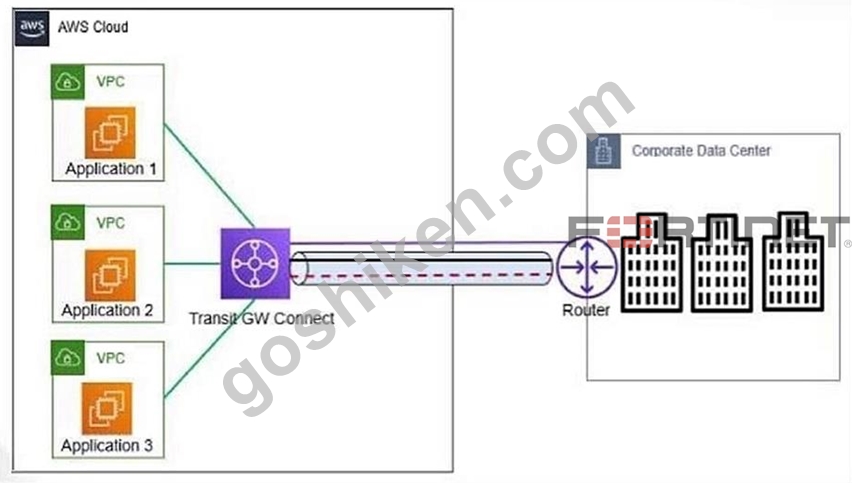
An organization deployed the application servers in the AWS VPC that connects to the corporate data center using Transit Gateway Connect. Demand for the applications has grown and the connection requires more bandwidth.
What is required to achieve higher bandwidth?
- A. No configuration change is required because GRE tunnels are scaled to provide higher bandwidth.
- B. You cannot increase bandwidth the connection has a fixed limit.
- C. You add a Transit VPC between the organization's VPCs.
- D. Use routable public IP addresses instead of private IP addresses for connectivity.
正解:A
解説:
* Understanding Transit Gateway Connect:
* Transit Gateway Connect is a feature of AWS Transit Gateway that simplifies the integration of SD-WAN networks with AWS. It uses Generic Routing Encapsulation (GRE) tunnels to facilitate this connection.
* GRE Tunnels and Bandwidth:
* GRE tunnels can dynamically scale to meet increasing bandwidth demands. They allow multiple tunnels between the same endpoints, which can aggregate bandwidth without requiring additional configuration.
* Scaling Bandwidth with GRE:
* The GRE protocol used by Transit Gateway Connect can support high bandwidth requirements by spreading traffic across multiple tunnels. As demand grows, additional tunnels can be automatically used to handle the increased traffic load.
* Comparison with Other Options:
* Option A suggests using public IP addresses, which is not relevant to bandwidth scaling.
* Option B is incorrect because bandwidth can be increased through GRE scaling.
* Option D suggests adding a Transit VPC, which is unnecessary for increasing bandwidth when using Transit Gateway Connect.
References:
* AWS Transit Gateway Documentation: AWS Transit Gateway
* GRE Tunnels and AWS: AWS GRE Tunnels
質問 # 28
Refer to the exhibit.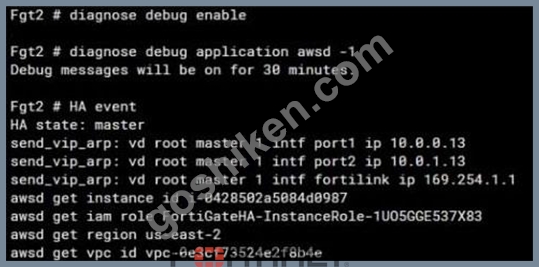
You deployed an active-passive FortiGate HA using a Cloud Formation template on an existing VPC_Now you want to test active-passive FortiGate HA failover by running a debug so you can see the API calls to change the elastic and secondary IP addresses.
Which statement is correct about the output of the debug?
- A. The elastic IP is associated with port1of Fgt2.
- B. The routing table for Fgt2 updated successfully. and port2 will provide internet access to Fgt2.
- C. The elastic IP is associated with port2 of Fgt2. and the secondary IP address for port1and port2 was updated successfully.
- D. IP address 10. O. O. L 3 is now associated with eni-Ob61d8afcOaefb8a2.
正解:D
質問 # 29
Refer to the exhibit.
You deployed an active-passive FortiGate HA cluster using a CloudFormation template on an existing VPC.
Now you want to test active-passive FortiGate HA failover by running a debug so you can see the API calls to change the Elastic and secondary IP addresses.
Which statement is correct about the output of the debug?
- A. The routing table for Fgt2 updated successfully, and port2 will provide internet access to Fgt2.
- B. The Elastic IP is associated with port1 of Fgt2.
- C. The Elastic IP is associated with port2 of Fgt2, and the secondary IP address for port1 and port2 was updated successfully.
- D. IP address 10.0.0.13 is now associated with eni-0b61d8afc0aefb8a2.
正解:B
解説:
* HA Event and Failover:
* The debug output indicates that a failover event occurred and the secondary instance (Fgt2) is now taking over as the master.
* Elastic IP Association:
* The debug output shows the process of moving the Elastic IP (eipalloc-090425f83f912c8d6) to the new master instance. This involves associating the Elastic IP with the appropriate network interface (eni) of the new master.
* Specific IP Address Association:
* The Elastic IP is specifically associated with port1 of Fgt2. The message "associate elastic ip eipalloc-090425f83f912c8d6 to 10.0.0.13 of eni eni-0f6b35f8fccd24eb0" indicates that the Elastic IP is now linked to the primary IP address (10.0.0.13) on port1 of the new master.
* Other Options Analysis:
* Option A is incorrect because the routing table update details are not explicitly stated.
* Option C is incorrect because the IP address association mentioned relates to an Elastic IP, not eni-0b61d8afc0aefb8a2.
* Option D is incorrect because it specifically mentions port2 for the Elastic IP association, which is not indicated in the debug output.
References:
* FortiGate HA Configuration Guide: FortiGate HA
* AWS Elastic IP Documentation: Elastic IP
質問 # 30
A customer is attempting to deploy an active-passive high availability (HA) cluster using the software-defined network (SDN) connector in the AWS cloud.
What is an important consideration to ensure a successful formation of HA, failover, and traffic flow?
- A. Both cluster members must show as healthy in the elastic load balancer (ELB) configuration.
- B. Both cluster members must be in the same availability zone.
- C. Unicast FortiGate Clustering Protocol (FGCP) must be used.
- D. VDOM exceptions must be configured.
正解:C
解説:
* HA Cluster in AWS Cloud:
* Deploying an active-passive HA cluster in AWS requires careful consideration of the clustering protocol used to ensure seamless failover and traffic flow.
* Unicast FortiGate Clustering Protocol (FGCP):
* Unicast FGCP is specifically designed for environments where multicast traffic is not feasible or supported, such as in the AWS cloud. Using unicast FGCP ensures that heartbeat and synchronization traffic between the cluster members are managed correctly over unicast communication, which is suitable for AWS's network infrastructure (Option C).
* Comparison with Other Options:
* Option A is incorrect because while placing both cluster members in the same availability zone might be required for certain configurations, it is not the critical factor for HA formation.
* Option B is incorrect as VDOM exceptions are not directly related to the successful formation of HA.
* Option D is incorrect because the ELB configuration checks are more about ensuring that the load balancer correctly routes traffic but do not specifically ensure HA formation and failover.
References:
* FortiGate HA in AWS Documentation: FortiGate HA
* Fortinet FGCP Details: FGCP Documentation
質問 # 31
Your company deployed a FortiSandbox for AWS.
Which statement is correct about FortiSandbox for AWS?
- A. The FortiSandbox manager is installed on the AWS platform and analyzes the results of the sandboxing process received from on-premises Windows instances.
- B. FortiSandbox for AWS comes as a hybrid solution. The FortiSandbox manager is installed on-premises and analyzes the results of the sandboxing process received from AWS EC2 instances.
- C. FortiSandbox for AWS does not need more resources because it performs only management and analysis tasks.
- D. FortiSandbox deploys new EC2 instances with the custom Windows and Linux VMs, then it sends malware, runs it, and captures the results for analysis.
正解:D
解説:
* FortiSandbox Deployment:
* FortiSandbox for AWS deploys new EC2 instances to create isolated environments where it can safely execute and analyze suspicious files. These instances run custom Windows and Linux virtual machines specifically configured for sandboxing (Option D).
* Sandboxing Process:
* The process involves sending potential malware to these isolated VMs, executing it, and monitoring its behavior to detect malicious activities. The results are then captured and analyzed to provide detailed threat intelligence.
* Other Options Analysis:
* Option A is incorrect because FortiSandbox for AWS operates entirely within the AWS environment and does not require an on-premises manager.
* Option B is incorrect as the FortiSandbox manager is not installed on the AWS platform for managing on-premises instances.
* Option C is incorrect because FortiSandbox requires sufficient resources to perform the actual sandboxing and analysis tasks.
References:
* FortiSandbox for AWS Documentation: FortiSandbox
* Sandboxing Concepts: Sandboxing
質問 # 32
Refer to the exhibit.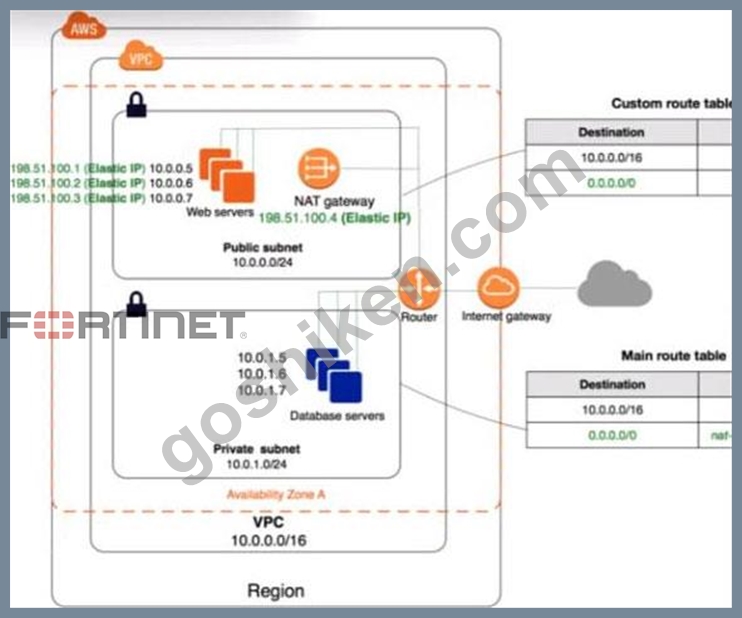
An administrator wants to update the database package from the Internet to a database server configured with IP address Which statement is correct about traffic from server IP address 10.0.1.7 to the internet. based on the diagrarm?
- A. Traffic from server 10.0.1.7 to the internet will hide behind elastic IP 198.51.100.1
- B. Traffic from server 10.0.1.7 to the internet will hide behind elastic IP 198.51.100 2.
- C. Traffic from server10.0.1.7 to the internet will hide behind elastic IP 198.51.100.4
- D. Traffic from server 10.0.1.7 to the internet will hide behind elastic IP 198.51.100.3
正解:C
質問 # 33
......
100%更新されたのはFortinet NSE6_WCS-7.0限定版PDF問題集:https://www.goshiken.com/Fortinet/NSE6_WCS-7.0-mondaishu.html
無料Fortinet NSE 6 NSE6_WCS-7.0公式認定ガイドPDFダウンロード:https://drive.google.com/open?id=1OYb5QH3dXqAC31diQ2nGLQzoUQxgLtPZ