

[2024年03月08日] 無料VCP-NV 2023 2V0-41.23公式認定ガイドPDFダウンロード
VMware 2V0-41.23公式認定ガイドPDF
VMware 2V0-41.23 認定試験の出題範囲:
| トピック | 出題範囲 |
|---|---|
| トピック 1 |
|
| トピック 2 |
|
| トピック 3 |
|
| トピック 4 |
|
| トピック 5 |
|
| トピック 6 |
|
| トピック 7 |
|
| トピック 8 |
|
| トピック 9 |
|
| トピック 10 |
|
| トピック 11 |
|
| トピック 12 |
|
| トピック 13 |
|
| トピック 14 |
|
質問 # 55
Which CLI command does an NSX administrator run on the NSX Manager to generate support bundle logs if the NSX UI Is inaccessible?
- A. set support-bundle file vcpnv.tgz
- B. get support-bundle file vcpnv.tgz
- C. esxcli system syslog config logger set - -id=nsxmanager
- D. vm-support
正解:B
解説:
To generate the support bundle logs on the NSX Manager via API, the NSX administrator needs to use the POST method with the URL https://nsxmgr_ip/api/1.0/appliance-management/techsupportlogs/NSX, where nsxmgr_ip is the IP address of the NSX Manager1. This will create a tech support bundle file with a name like vcpnv.tgz. To download the generated tech support bundle file via CLI, the NSX administrator needs to use the get support-bundle file vcpnv.tgz command on the NSX Manager1. The other commands are incorrect because they either do not generate or download the support bundle logs, or they are not related to the NSX Manager.
質問 # 56
Which TraceFlow traffic type should an NSX administrator use tor validating connectivity between App and DB virtual machines that reside on different segments?
- A. Anycast
- B. Broadcast
- C. Unicast
- D. Multicast
正解:C
解説:
Explanation
Unicast is the traffic type that an NSX administrator should use for validating connectivity between App and DB virtual machines that reside on different segments. According to the VMware documentation1, unicast traffic is the traffic type that is used to send a packet from one source to one destination. Unicast traffic is the most common type of traffic in a network, and it is used for applications such as web browsing, email, file transfer, and so on2. To perform a traceflow with unicast traffic, the NSX administrator needs to specify the source and destination IP addresses, and optionally the protocol and related parameters1. The traceflow will show the path of the packet across the network and any observations or errors along the way3. The other options are incorrect because they are not suitable for validating connectivity between two specific virtual machines. Multicast traffic is the traffic type that is used to send a packet from one source to multiple destinations simultaneously2. Multicast traffic is used for applications such as video streaming, online gaming, and group communication4. To perform a traceflow with multicast traffic, the NSX administrator needs to specify the source IP address and the destination multicast IP address1. Broadcast traffic is the traffic type that is used to send a packet from one source to all devices on the same subnet2. Broadcast traffic is used for applications such as ARP, DHCP, and network discovery. To perform a traceflow with broadcast traffic, the NSX administrator needs to specify the source IP address and the destination MAC address as FF:FF:FF:FF:FF:FF1. Anycast traffic is not a valid option, as it is not supported by NSX Traceflow. Anycast traffic is a traffic type that is used to send a packet from one source to the nearest or best destination among a group of devices that share the same IP address. Anycast traffic is used for applications such as DNS, CDN, and load balancing.
質問 # 57
Which two statements are correct about East-West Malware Prevention? (Choose two.)
- A. An agent must be installed on every NSX Edge node.
- B. NSX Edge nodes must have Internet access.
- C. NSX Application Platform must have Internet access.
- D. A SVM is deployed on every ESXi host.
- E. An agent must be installed on every ESXi host.
正解:B、D
解説:
Explanation
East-West Malware Prevention is a feature of NSX Advanced Threat Prevention that can detect and prevent malicious files in the network traffic between virtual machines (east-west) and between the data center and the external network (north-south). To enable this feature, a Service Virtual Machine (SVM) is deployed on every ESXi host to intercept and analyze the files in the east-west traffic. An agent must also be installed on every NSX Edge node to intercept and analyze the files in the north-south traffic. The NSX Application Platform is a cloud-based service that provides threat intelligence and analysis for the NSX Malware Prevention feature.
The NSX Application Platform must have Internet access to receive updates and send files for analysis. The NSX Edge nodes must also have Internet access to communicate with the NSX Application Platform.
References:
Overview of NSX IDS/IPS and NSX Malware Prevention
Administering NSX Malware Prevention
質問 # 58
Which choice is a valid insertion point for North-South network introspection?
- A. Host Physical NIC
- B. Tier-0 gateway
- C. Guest VM vNIC
- D. Partner SVM
正解:B
解説:
Explanation
A valid insertion point for North-South network introspection is Tier-0 gateway. North-South network introspection is a service insertion feature that allows third-party network services to be integrated with NSX. North-South network introspection enables traffic redirection from the uplink of an NSX Edge node to a service chain that consists of one or more service profiles1. The Tier-0 gateway is the logical router that connects the NSX Edge node to the physical network and provides North-South routing and network services2.
https://docs.vmware.com/en/VMware-NSX/4.1/administration/GUID-D5933474-34A2-4DCE-AE9B-A82FF33E
質問 # 59
Where does an administrator configure the VLANs used In VRF Lite? (Choose two.)
- A. uplink trunk segment
- B. downlink interface of the default Tier-0 gateway
- C. uplink interface of the default Tier-0 gateway
- D. segment connected to the Tler-1 gateway
- E. uplink Interface of the VRF gateway
正解:A、E
解説:
Explanation
According to the VMware NSX Documentation, these are the two places where you need to configure the VLANs used in VRF Lite:
* Uplink trunk segment: This is a segment that connects a tier-0 gateway to a physical network using multiple VLAN tags. You need to configure the VLAN IDs for each VRF on this segment.
* Uplink interface of the VRF gateway: This is an interface that connects a VRF gateway to an uplink trunk segment using a specific VLAN tag. You need to configure the VLAN ID for each VRF on this interface.
質問 # 60
When configuring OSPF on a Tler-0 Gateway, which three of the following must match in order to establish a neighbor relationship with an upstream router? (Choose three.)
- A. MTU of the Uplink
- B. Address of the neighbor
- C. Area ID
- D. Naming convention
- E. Subnet mask
- F. Protocol and Port
正解:A、C、E
解説:
Explanation
ccording to the VMware NSX Documentation, these are the three parameters that must match in order to establish an OSPF neighbor relationship with an upstream router on a tier-0 gateway:
* MTU of the Uplink: The maximum transmission unit (MTU) of the uplink interface must match the MTU of the upstream router interface. Otherwise, OSPF packets may be fragmented or dropped, causing neighbor adjacency issues.
* Subnet mask: The subnet mask of the uplink interface must match the subnet mask of the upstream router interface. Otherwise, OSPF packets may not reach the correct destination or be rejected by the upstream router.
* Area ID: The area ID of the uplink interface must match the area ID of the upstream router interface.
Otherwise, OSPF packets may be ignored or discarded by the upstream router.
質問 # 61
As part of an organization's IT security compliance requirement, NSX Manager must be configured for 2FA (two-factor authentication).
What should an NSX administrator have ready before the integration can be configured? O
- A. VMware Identity Manager with an OAuth Client added
- B. VMware Identity Manager with NSX added as a Web Application
- C. Active Directory LDAP integration with ADFS
- D. Active Directory LDAP integration with OAuth Client added
正解:A
解説:
Explanation
To configure NSX Manager for two-factor authentication (2FA), an NSX administrator must have VMware Identity Manager (vIDM) with an OAuth Client added. vIDM provides identity management services and supports various 2FA methods, such as VMware Verify, RSA SecurID, and RADIUS. An OAuth Client is a configuration entity in vIDM that represents an application that can use vIDM for authentication and authorization. NSX Manager must be registered as an OAuth Client in vIDM before it can use
2FA. References: : VMware NSX-T Data Center Installation Guide, page 19. : VMware NSX-T Data Center Administration Guide, page 102. : VMware Blogs: Two-Factor Authentication with VMware NSX-T
質問 # 62
Refer to the exhibits.
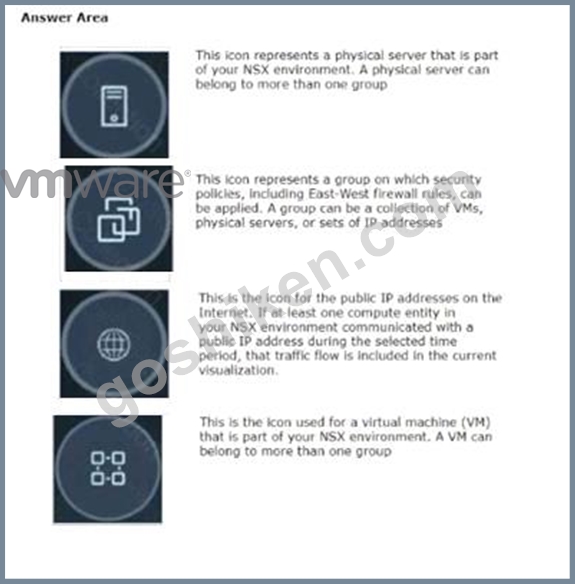
Drag and drop the NSX graphic element icons on the left found in an NSX Intelligence visualization graph to Its correct description on the right.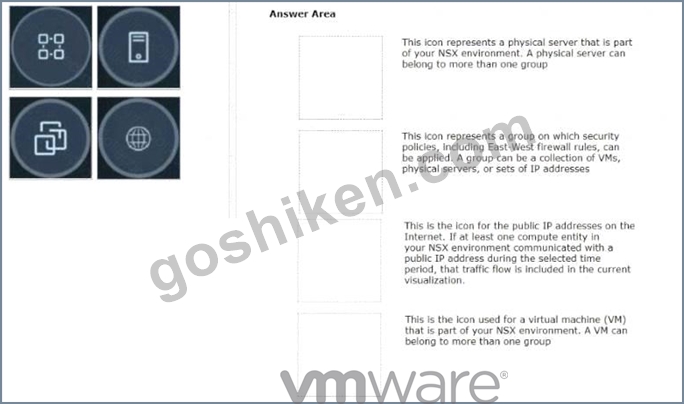
正解:
解説: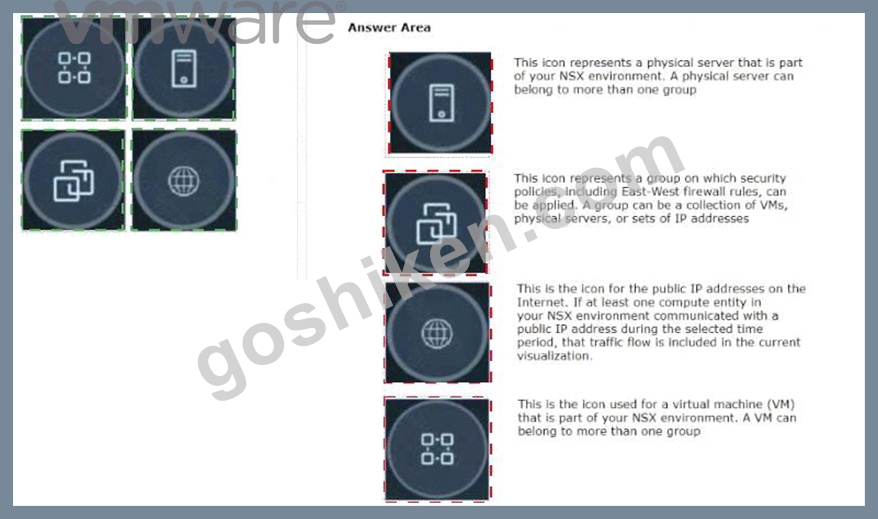
質問 # 63
An administrator has been tasked with implementing the SSL certificates for the NSX Manager Cluster VIP.
Which is the correct way to implement this change?
- A. SSH as admin into the NSX manager with the cluster VIP IP and run nsxcli cluster certificate node install <certificate_id>
- B. SSH as admin into the NSX manager with the cluster VIP IP and run nsxcli cluster certificate vip install
<certificate_id> - C. Send an API call to https://<nsx-mgr>/api/v1/cluster/api-certificate?
action=set_cluster_certificate&certificate_id=<certificate_id> - D. Send an API call to https://<nsx-mgr>/api/v1/node/services/http?
action=apply_certificate&certificate_id=<certificate_id>
正解:C
解説:
Explanation
https://docs.vmware.com/en/VMware-Validated-Design/5.0.1/com.vmware.vvd.sddc-nsxt-domain-deploy.doc/G
質問 # 64
Which command on ESXI is used to verify the Local Control Plane connectivity with Central Control Plane?
- A.

- B.

- C.

- D.

正解:C
解説:
Explanation
According to the web search results, the command that is used to verify the Local Control Plane (LCP) connectivity with Central Control Plane (CCP) on ESXi is get control-cluster status. This command displays the status of the LCP and CCP components on the ESXi host, such as the LCP agent, CCP client, CCP server, and CCP connection. It also shows the IP address and port number of the CCP server that the LCP agent is connected to. If the LCP agent or CCP client are not running or not connected, it means that there is a problem with the LCP connectivity .
質問 # 65
What is the VMware recommended way to deploy a virtual NSX Edge Node?
- A. Through the NSXUI
- B. Through the OVF command line tool
- C. Through automated or Interactive mode using an ISO
- D. Through the vSphere Web Client
正解:A
解説:
Through the NSX UI. According to the VMware NSX Documentation2, you can deploy NSX Edge nodes as virtual appliances through the NSX UI by clicking Add Edge Node and providing the required information. The other options are either outdated or not applicable for virtual NSX Edge nodes.
質問 # 66
What can the administrator use to identify overlay segments in an NSX environment if troubleshooting is required?
- A. Segment ID
- B. Geneve ID
- C. VIAN ID
- D. VNI ID
正解:D
解説:
Explanation
According to the VMware NSX Documentation1, a segment is mapped to a unique Geneve segment that is distributed across the ESXi hosts in a transport zone. The Geneve segment uses a virtual network identifier (VNI) as an overlay network identifier. The VNI ID can be used to identify overlay segments in an NSX environment if troubleshooting is required.
質問 # 67
What are two valid BGP Attributes that can be used to influence the route path traffic will take? (Choose two.)
- A. BFD
- B. AS-Path Prepend
- C. MED
- D. Cost
正解:B、C
解説:
* AS-Path Prepend: This attribute allows you to prepend one or more AS numbers to the AS path of a route, making it appear longer and less preferable to other BGP routers. You can use this attribute to manipulate the inbound traffic from your BGP peers by advertising a longer AS path for some routes and a shorter AS path for others .
* MED: This attribute stands for Multi-Exit Discriminator and allows you to specify a preference value for a route among multiple exit points from an AS. You can use this attribute to manipulate the outbound traffic to your BGP peers by advertising a lower MED value for some routes and a higher MED value for others .
質問 # 68
Which three selections are capabilities of Network Topology? (Choose three.)
- A. Display the uplinks configured on the Tier-1 Gateways.
- B. Display the VMs connected to Segments.
- C. Display how the Physical components ate interconnected.
- D. Display how the different NSX components are interconnected.
- E. Display the uplink configured on the Tier-0 Gateways.
正解:B、D、E
解説:
According to the VMware NSX Documentation, these are three of the capabilities of Network Topology, which is a graphical representation of your network infrastructure in NSX:
Display how the different NSX components are interconnected: You can use Network Topology to view how your segments, gateways, routers, firewalls, load balancers, VPNs, and other NSX components are connected and configured in your network.
Display the uplink configured on the Tier-0 Gateways: You can use Network Topology to view the uplink interface and segment that connect your tier-0 gateways to your physical network. You can also view the VLAN ID and IP address of the uplink interface.
Display the VMs connected to Segments: You can use Network Topology to view the VMs that are attached to your segments. You can also view the IP address and MAC address of each VM.
質問 # 69
Which two of the following are used to configure Distributed Firewall on VDS? (Choose two.)
- A. NSX UI
- B. vCenter API
- C. NSX API
- D. vSphere API
- E. NSX CU
正解:A、C
解説:
According to the VMware NSX Documentation, these are two of the ways that you can use to configure Distributed Firewall on VDS:
NSX API: This is a RESTful API that allows you to programmatically configure and manage Distributed Firewall on VDS using HTTP methods and JSON payloads. You can use tools such as Postman or curl to send API requests to the NSX Manager node.
NSX UI: This is a graphical user interface that allows you to configure and manage Distributed Firewall on VDS using menus, tabs, buttons, and forms. You can access the NSX UI by logging in to the NSX Manager node using a web browser.
質問 # 70
Refer to the exhibits.
Drag and drop the NSX graphic element icons on the left found in an NSX Intelligence visualization graph to Its correct description on the right.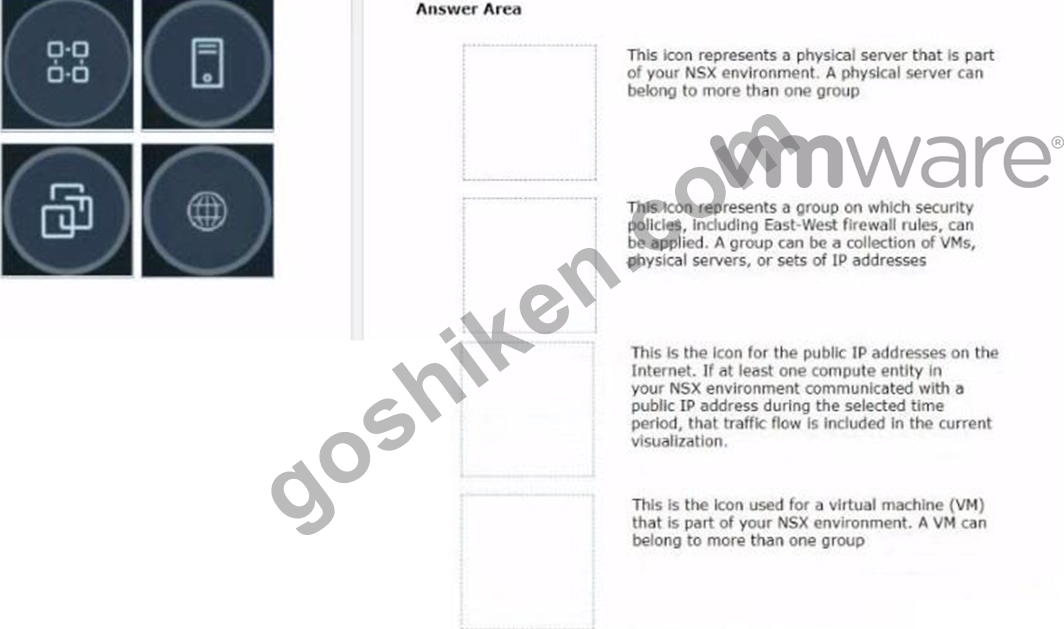
正解:
解説: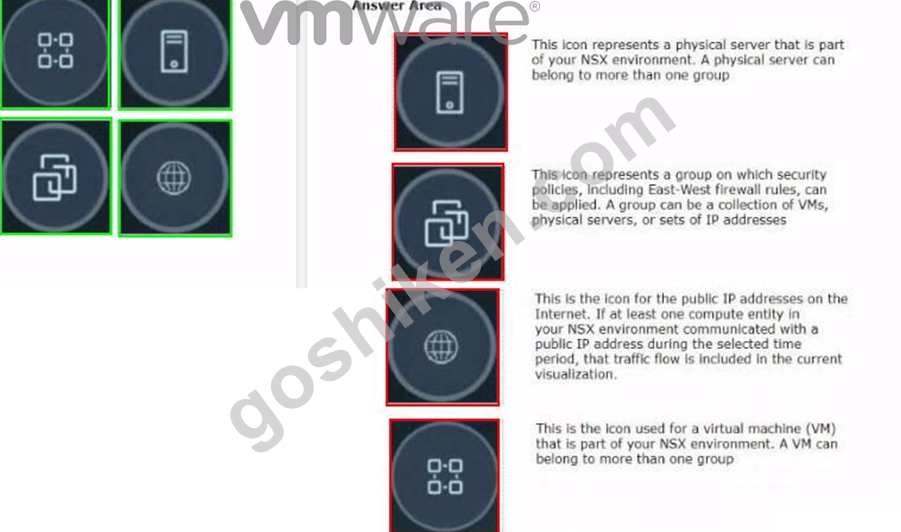
質問 # 71
Sort the rule processing steps of the Distributed Firewall. Order responses from left to right.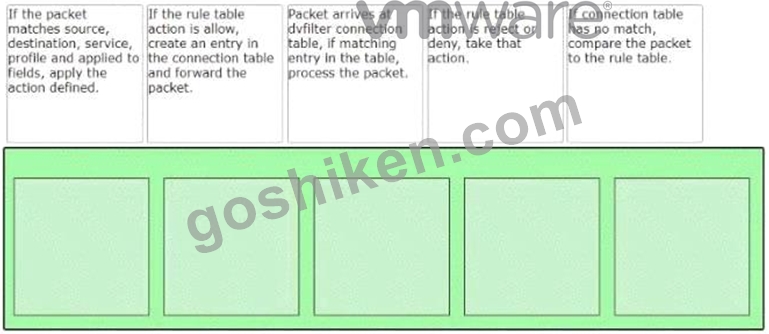
正解:
解説: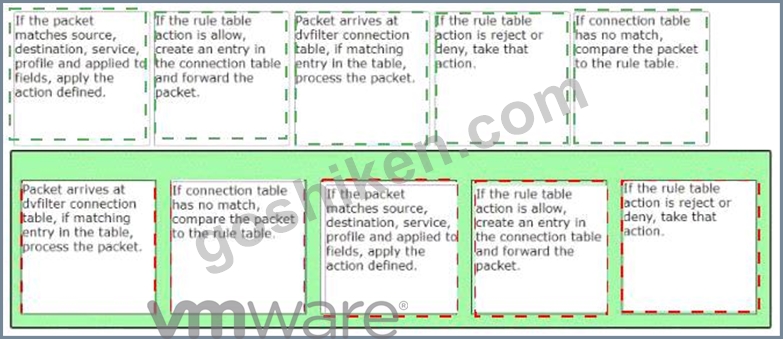
Explanation
The correct order of the rule processing steps of the Distributed Firewall is as follows:
Packet arrives at vfilter connection table. If matching entry in the table, process the packet.
If connection table has no match, compare the packet to the rule table.
If the packet matches source, destination, service, profile and applied to fields, apply the action defined.
If the rule table action is allow, create an entry in the connection table and forward the packet.
If the rule table action is reject or deny, take that action.
This order is based on the description of how the Distributed Firewall works in the web search results1. The first step is to check if there is an existing connection entry for the packet in the vfilter connection table, which is a cache of flow entries for rules with an allow action. If there is a match, the packet is processed according to the connection entry. If there is no match, the packet is compared to the rule table, which contains all the security policy rules. The rules are evaluated from top to bottom until a match is found. The match criteria include source, destination, service, profile and applied to fields. The action defined by the matching rule is applied to the packet. The action can be allow, reject or deny. If the action is allow, a new connection entry is created for the packet and the packet is forwarded to its destination. If the action is reject or deny, the packet is dropped and an ICMP message or a TCP reset message is sent back to the source.
質問 # 72
What needs to be configured on a Tler-0 Gateway lo make NSX Edge Services available to a VM on a VLAN-backed logical switch?
- A. VLAN Uplink
- B. Service Interface
- C. Downlink Interface
- D. Loopback Router Port
正解:B
解説:
Explanation
The service interface is a special-purpose port to enable services for mainly VLAN-based networks.
North-south service insertion is another use case that requires a service interface to connect a partner appliance and redirect north-south traffic for partner services. Service interfaces are supported on both active-standby Tier-0 logical routers and Tier-1 routers. Firewall, NAT, and VPNs are supported on this interface. The service interface is also a downlink
質問 # 73
Which two CLI commands could be used to see if vmnic link status is down? (Choose two.)
- A. excli network nic list
- B. esxcfg-vmsvc/get.network
- C. esxcli network vswitch dvs wmare list
- D. esxcfg-vmknic -1
- E. esxcfg-nics -1
正解:A、E
解説:
Explanation
esxcfg-nics -l and esxcli network nic list are two CLI commands that can be used to see the vmnic link status on an ESXi host. Both commands display information such as the vmnic name, driver, link state, speed, and duplex mode. The link state can be either Up or Down, indicating whether the vmnic is connected or not. For example, the output of esxcfg-nics -l can look like this:
Name PCI Driver Link Speed Duplex MAC Address MTU Description
vmnic0 0000:02:00.0 igbn Up 1000Mbps Full 00:50:56:01:2a:3b 1500 Intel Corporation I350 Gigabit Network Connection vmnic1 0000:02:00.1 igbn Down 0Mbps Half 00:50:56:01:2a:3c 1500 Intel Corporation I350 Gigabit Network Connection
質問 # 74
Which TraceFlow traffic type should an NSX administrator use tor validating connectivity between App and DB virtual machines that reside on different segments?
- A. Anycast
- B. Broadcast
- C. Unicast
- D. Multicast
正解:C
解説:
Unicast is the traffic type that an NSX administrator should use for validating connectivity between App and DB virtual machines that reside on different segments. According to the VMware documentation1, unicast traffic is the traffic type that is used to send a packet from one source to one destination. Unicast traffic is the most common type of traffic in a network, and it is used for applications such as web browsing, email, file transfer, and so on2. To perform a traceflow with unicast traffic, the NSX administrator needs to specify the source and destination IP addresses, and optionally the protocol and related parameters1. The traceflow will show the path of the packet across the network and any observations or errors along the way3. The other options are incorrect because they are not suitable for validating connectivity between two specific virtual machines. Multicast traffic is the traffic type that is used to send a packet from one source to multiple destinations simultaneously2. Multicast traffic is used for applications such as video streaming, online gaming, and group communication4. To perform a traceflow with multicast traffic, the NSX administrator needs to specify the source IP address and the destination multicast IP address1. Broadcast traffic is the traffic type that is used to send a packet from one source to all devices on the same subnet2. Broadcast traffic is used for applications such as ARP, DHCP, and network discovery. To perform a traceflow with broadcast traffic, the NSX administrator needs to specify the source IP address and the destination MAC address as FF:FF:FF:FF:FF:FF1. Anycast traffic is not a valid option, as it is not supported by NSX Traceflow. Anycast traffic is a traffic type that is used to send a packet from one source to the nearest or best destination among a group of devices that share the same IP address. Anycast traffic is used for applications such as DNS, CDN, and load balancing.
質問 # 75
What are two functions of the Service Engines in NSX Advanced Load Balancer? (Choose two.)
- A. It performs application load-balancing operations.
- B. It collects real-time analytics from application traffic flows.
- C. It stores the configuration and policies related to load-balancing services.
- D. It deploys web servers to perform load-balancing operations.
- E. It provides a user interface to perform configuration and management tasks.
正解:A、B
質問 # 76
Which two BGP configuration parameters can be configured in the VRF Lite gateways? (Choose two.)
- A. Graceful Restart
- B. Route Distribution
- C. Route Aggregation
- D. BGP Neighbors
- E. Local AS
正解:B、D
解説:
According to the VMware NSX Documentation1, you can configure BGP neighbors for VRF-Lite by specifying the neighbor IP address, remote AS number, source IP address, and route filter. You can also configure route distribution for VRF-Lite by selecting the route redistribution sources and the route map to apply.
質問 # 77
Which two are requirements for FQDN Analysis? (Choose two.)
- A. The NSX Manager requires access to the Internet to download category and reputation definitions.
- B. A layer 7 gateway firewall rule must be configured on the Tier-0 gateway uplink.
- C. ESXI control panel requires access to the Internet to download category and reputation definitions.
- D. A layer 7 gateway firewall rule must be configured on the Tfer-1 gateway uplink.
- E. The NSX Edge nodes require access to the Internet to download category and reputation definitions.
正解:A、B
解説:
According to the VMware NSX Documentation, these are two of the requirements for FQDN Analysis, which is a feature that allows you to monitor and control the traffic based on the fully qualified domain names (FQDNs) of the websites that your workloads access:
The NSX Manager requires access to the Internet to download category and reputation definitions: The NSX Manager periodically downloads the latest category and reputation definitions from a cloud service provider and distributes them to the NSX Edge nodes. These definitions are used to classify and score the FQDNs based on their content and risk level.
A layer 7 gateway firewall rule must be configured on the Tier-0 gateway uplink: You need to configure a layer 7 gateway firewall rule on the tier-0 gateway uplink interface that matches the traffic that you want to analyze based on FQDNs. You also need to enable FQDN Analysis on the firewall rule and select the categories and reputations that you want to allow or deny.
質問 # 78
When configuring OSPF on a Tler-0 Gateway, which three of the following must match in order to establish a neighbor relationship with an upstream router? (Choose three.)
- A. MTU of the Uplink
- B. Address of the neighbor
- C. Area ID
- D. Naming convention
- E. Subnet mask
- F. Protocol and Port
正解:A、C、E
解説:
Explanation
according to the VMware NSX Documentation, these are the three parameters that must match in order to establish an OSPF neighbor relationship with an upstream router on a tier-0 gateway:
MTU of the Uplink: The maximum transmission unit (MTU) of the uplink interface must match the MTU of the upstream router interface. Otherwise, OSPF packets may be fragmented or dropped, causing neighbor adjacency issues.
Subnet mask: The subnet mask of the uplink interface must match the subnet mask of the upstream router interface. Otherwise, OSPF packets may not reach the correct destination or be rejected by the upstream router.
Area ID: The area ID of the uplink interface must match the area ID of the upstream router interface.
Otherwise, OSPF packets may be ignored or discarded by the upstream router.
https://www.computernetworkingnotes.com/ccna-study-guide/ospf-neighborship-condition-and-requirement.htm
質問 # 79
......
無料2V0-41.23試験問題集試験点数を伸ばそう:https://www.goshiken.com/VMware/2V0-41.23-mondaishu.html
試験2V0-41.23最新ブレーン専門問題集はここGoShiken:https://drive.google.com/open?id=1lxZy3VFzgyhHJ2apZWxl-YyHLfp2WN_b