

[2024年10月23日]JN0-649サンプルには正確で更新された問題
JN0-649試験情報と無料練習テスト
Juniper JN0-649 認定試験に合格するためには、ネットワークの概念やプロトコルについての確固たる理解が必要です。また、Juniper Networks デバイスでの作業経験があり、Junos オペレーティングシステムに精通していることが望ましいです。この試験は、選択肢形式とシミュレーション問題で構成され、受験者は4時間で試験を受けることができます。
質問 # 83
Referring to the exhibit, which two statements are true? (Choose two)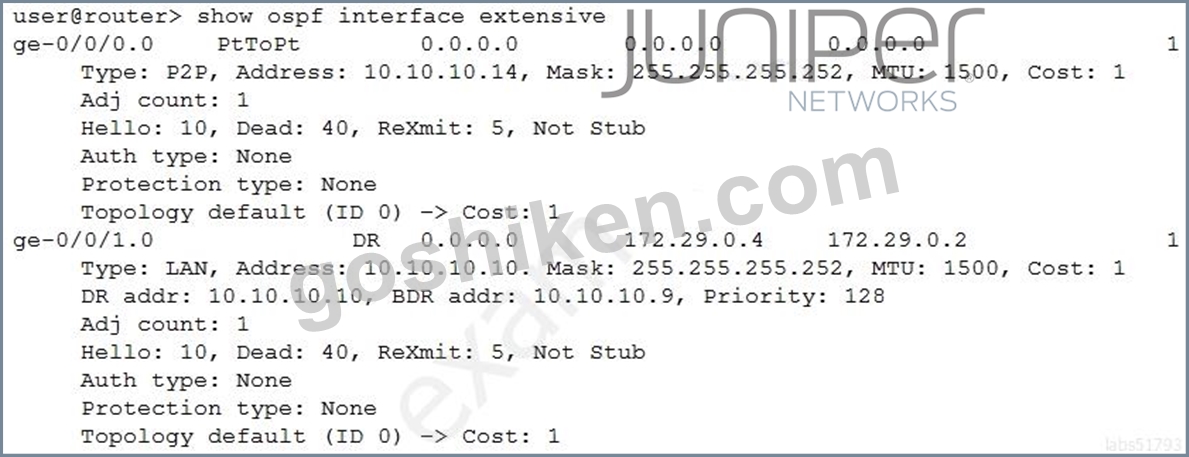
- A. There can be more than one OSPF neighbor on the ge-0/0/0 interface
- B. The DR election process is not finished for the ge-0/0/0 interface
- C. There can be more than one OSPF neighbor on the ge-0/0/1 interface.
- D. There is no need for a DR for the ge-0/0/0 interface.
正解:D
質問 # 84
You are asked to establish interface level authentication for users connecting to your network.
You must ensure that only corporate devices, identified by MAC addresses, are allowed to connect and authenticate. Authentication must be handled by a centralized server to increase scalability. Which authentication method would satisfy this requirement?
- A. captive portal
- B. 802.1X with multiple supplicant mode
- C. MAC RADIUS
- D. 802.1X with single-secure supplicant mode
正解:C
質問 # 85
You ate deploying P|M source-specific multicast (SSM) for a new multicast messaging service You have configured the multicast source to use 236.44.123.100 as the multicast address. You are not able to join the PIM SSM multicast teed Which two solutions would resolve this problem? (Choose two )
- A. Reconfigure the multicast source to use an address in the range of 224.0.0 0 through
224.255.255.255. - B. Reconfigure the multicast source to use an address in the range of 232 0.0 0 through
232.255.255.255 - C. Add the multicast address to the [edit routing-options multicast ssm-groups] stanza.
- D. Add the multicast address to the (edit routing-options multicast ssm-map) stanza.
正解:B、D
質問 # 86
In OSPF, how does a router ensure that LSAs advertised to a neighboring router are received?
- A. LSAs are advertised with an acknowledgement bit.
- B. LSA flooding guarantees that all routers will receive them successfully.
- C. LSAs are sent over a TCP connection.
- D. LSAs are acknowledged by the neighboring router.
正解:D
解説:
Link-state acknowledgment (LSAck)messages provide reliability to the link-state exchange process, by explicitly acknowledging receipt of a Link State Update message. The LSA acknowledgment, explicitly acknowledged, that it have received a LSA, by mirroring it back.
質問 # 87
You are configuring MSTP to prevent loops in your Layer 2 network. After applying the configuration, you notice that MSTO is not working correctly.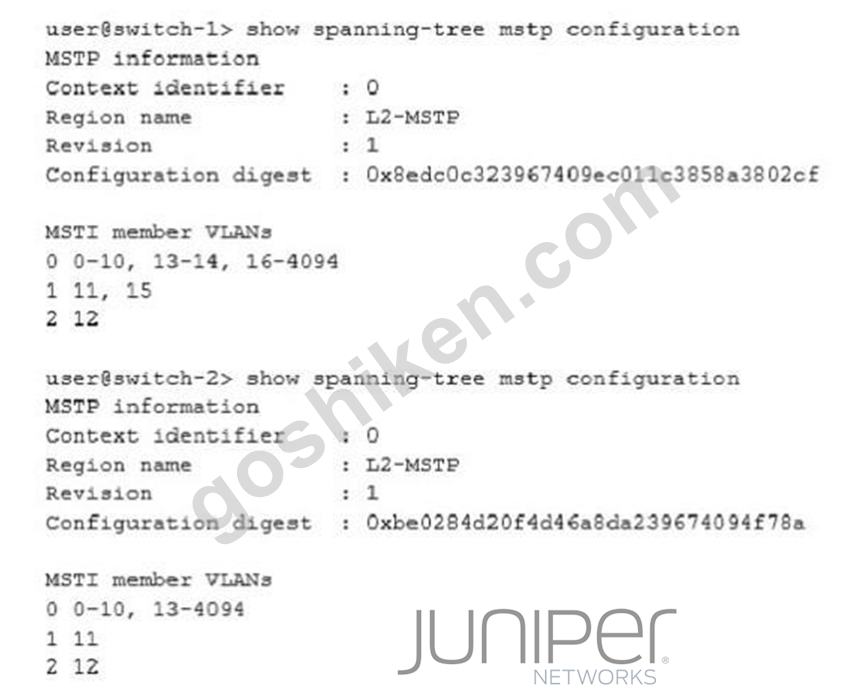
Referring to the exhibit, what is causing the problem?
- A. Incorrect revision number is used.
- B. Context identifier must be specified.
- C. Too many VLANs have been defined.
- D. MSTI-to-VLAN mappings must be the same.
正解:D
質問 # 88
Referring to the exhibit, anycast RP is implemented to ensure multicast service availability. The source is currently sending multicast traffic using group 239.1.1.1 and R3 is receiving PIM register messages, but R2 does not have active source information.
In this scenario, what are two methods to receive the active source information on R2? (Choose two.)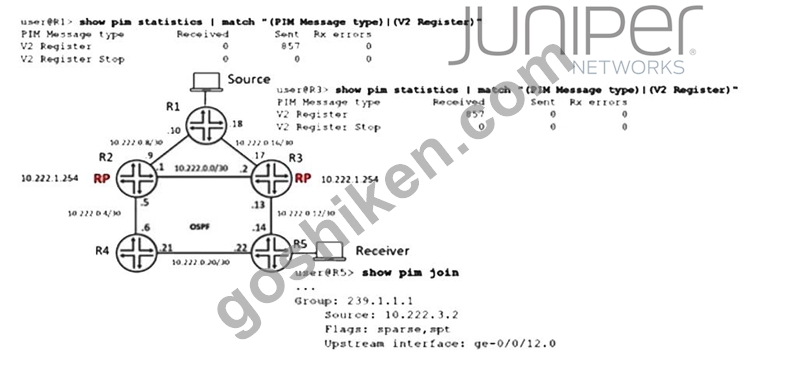
- A. Configure an MSDP protocol between R1 and R2.
- B. Configure an RP set in PIM on R2 and R3, allowing the RPs to forward PIM register messages to the other RPs in the set.
- C. Configure an MSDP protocol between R2 and R3.
- D. Configure an RP set in PIM on R1, allowing R1 to forward PIM register messages to R2 and R3 in the set.
正解:B、D
解説:
https://www.juniper.net/documentation/us/en/software/junos/multicast/topics/ref/statement/rp-set-edit-protocols-pim.html
質問 # 89
You are asked to troubleshoot voice quality issues on your newly implement VoIP network. You notice that the voice packets are being dropped. You have verified that the packets are correctly marked for expedited forwarding queue.
Referring to the exhibit, what must you configure to solve the problem?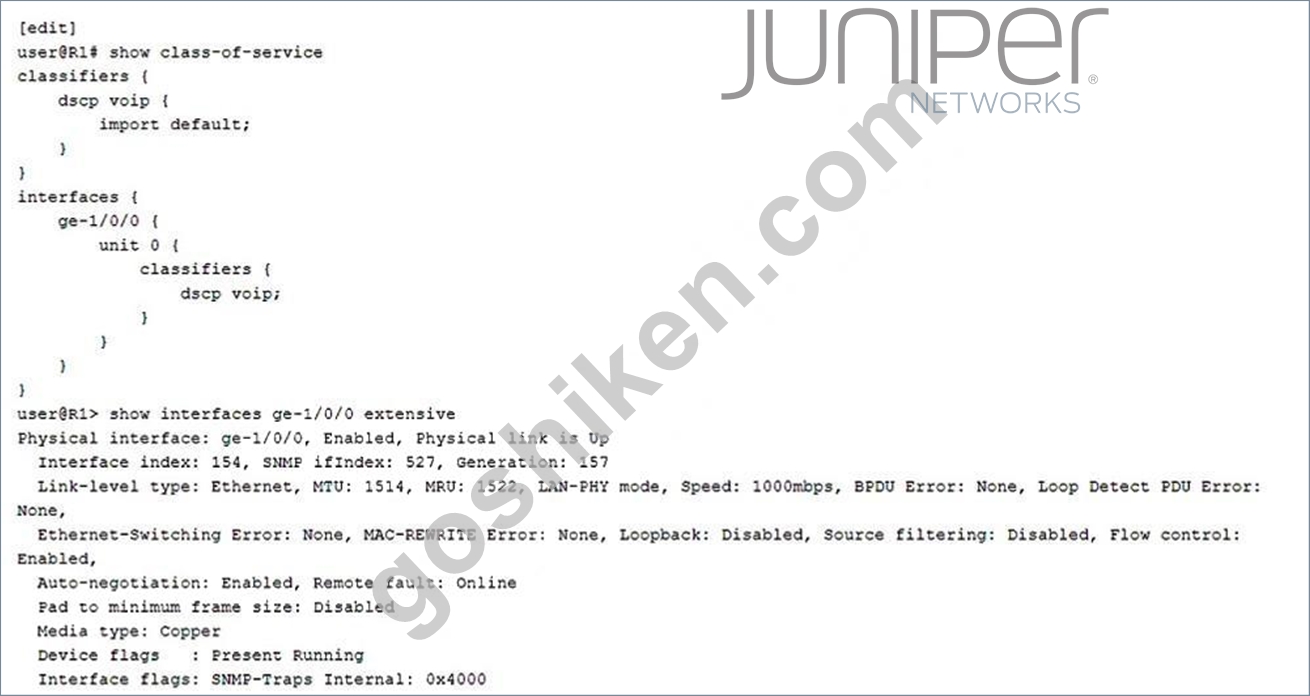
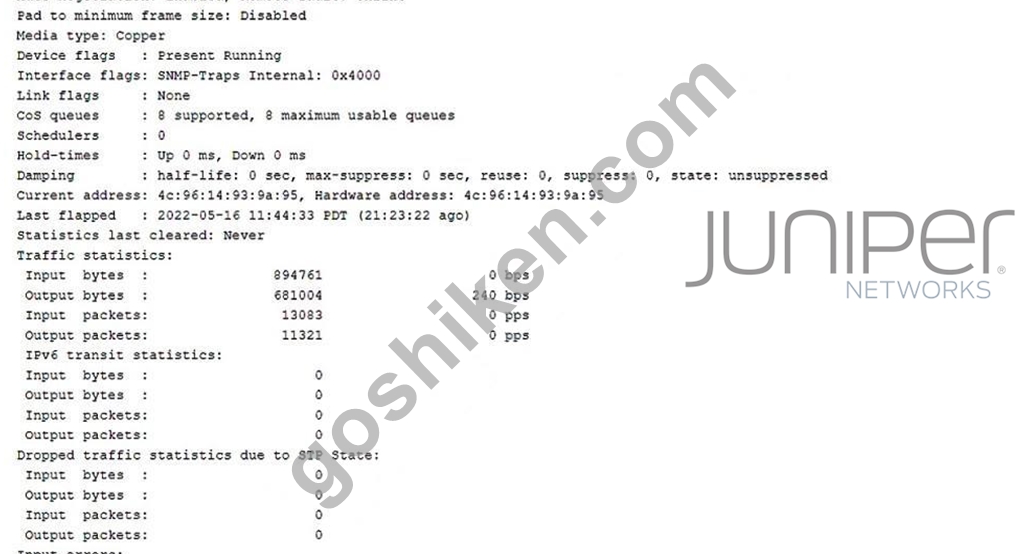
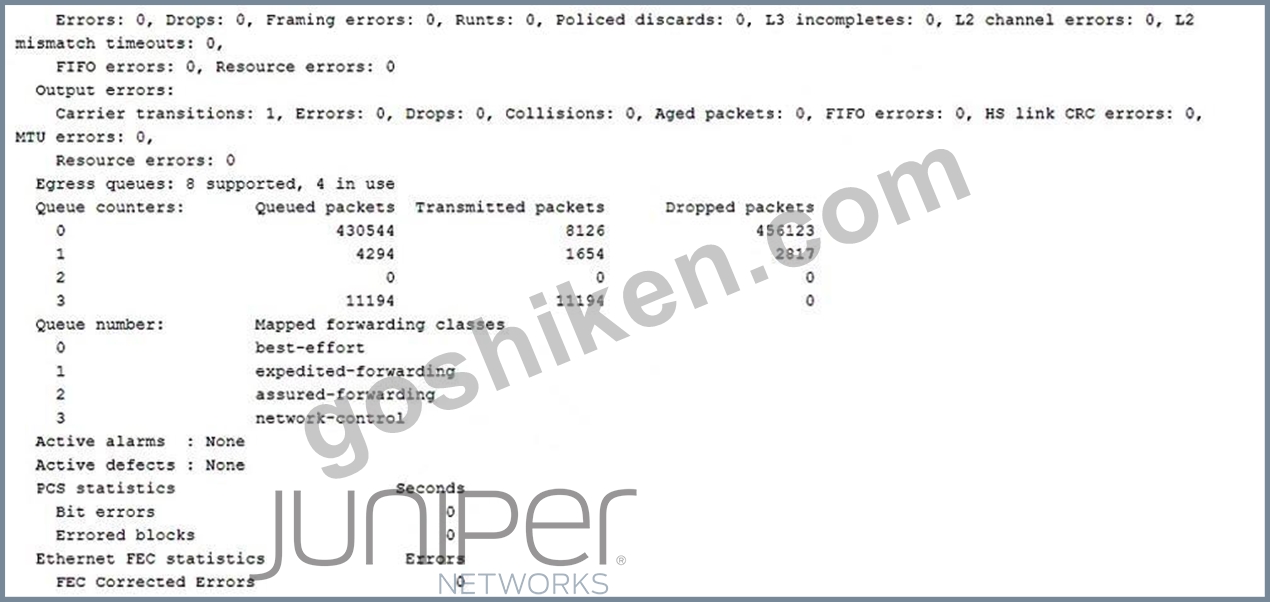
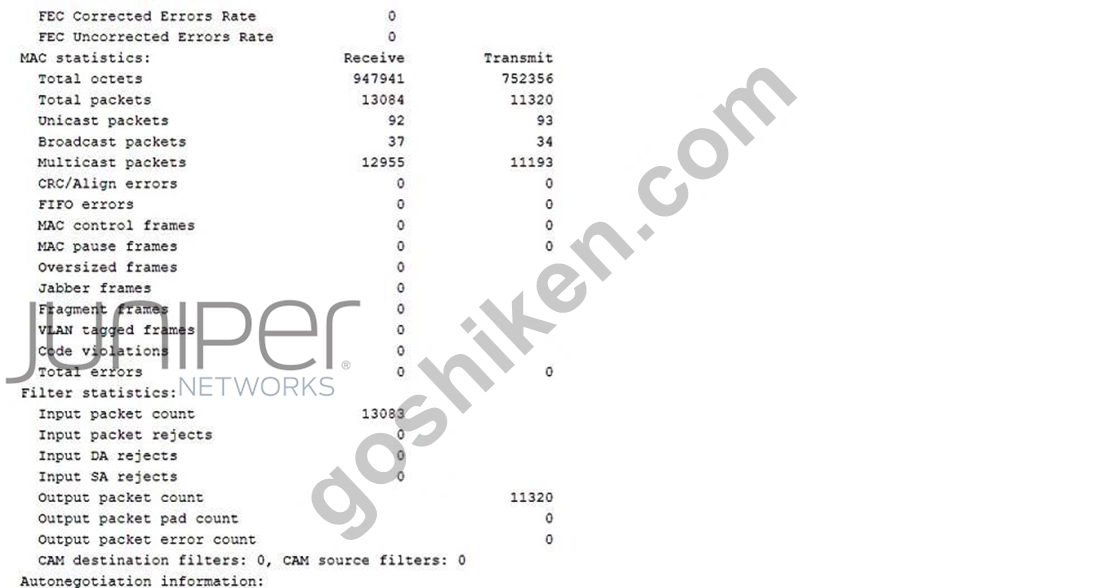
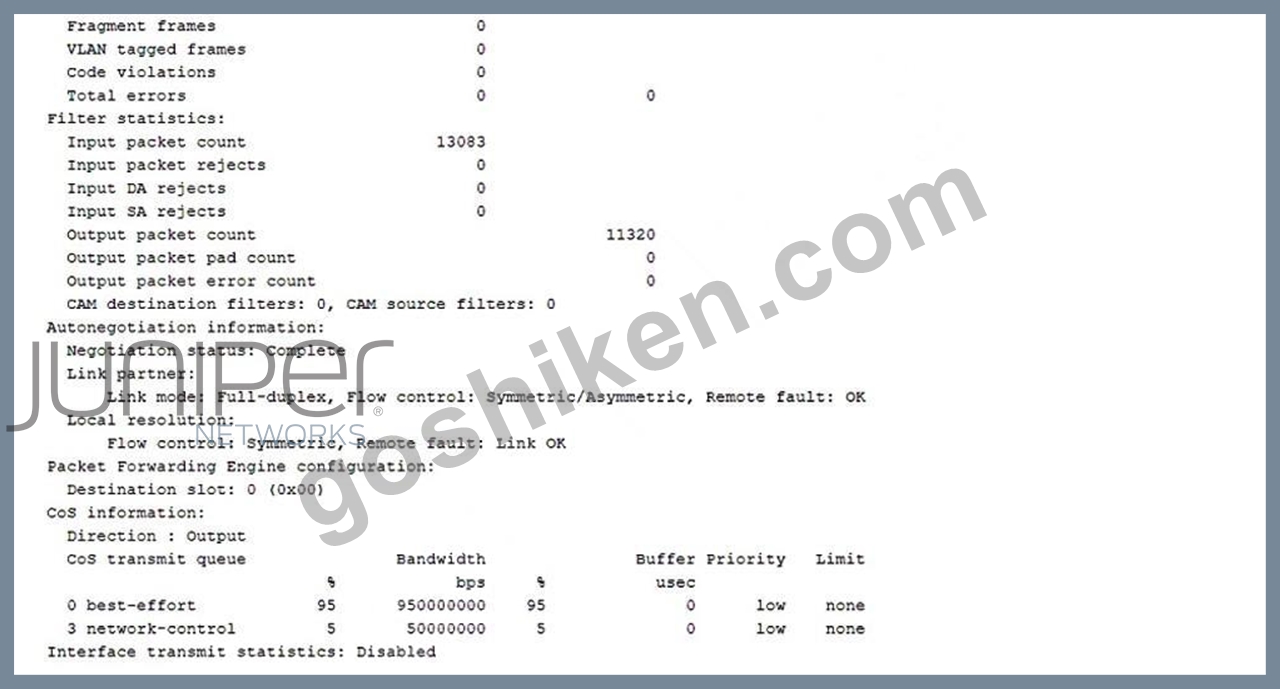
- A. You must configure a scheduler to allocate bandwidth to the expedited forwarding queue.
- B. You must configure a rewrite rule to ensure that the traffic is scheduled properly in the device.
- C. You must configure a multifield classifier to put the VoIP traffic in the correct queue.
- D. You must configure a policer to ensure that the queue is not being starved.
正解:A
解説:
* Understanding the Problem:
* The issue involves voice packets being dropped in a newly implemented VoIP network.
* Voice packets are marked correctly for the expedited forwarding (EF) queue, indicating that classification is working as intended.
* Dropped packets suggest that there may be insufficient resources allocated to handle the traffic in
* the EF queue.
* Key Concepts:
* Classifiers: These are used to mark packets so that they can be placed into the appropriate forwarding class. This step is already correctly implemented as indicated by the problem statement.
* Rewrite Rules: These ensure that packets retain their markings as they transit the network, but this is not the issue here as packets are already marked correctly.
* Policers: These control the rate of traffic to ensure it does not exceed specified limits, but policing is not required here as the issue is with packet drops due to insufficient resources.
* Schedulers: These allocate resources (bandwidth, priority) to different queues to ensure that high-priority traffic (like VoIP) is transmitted with minimal delay and packet loss.
* Solution: Configuring a Scheduler:
* To prevent the EF queue from being starved of resources and to ensure voice packets are not dropped, you need to configure a scheduler. This scheduler will allocate appropriate bandwidth and priority to the EF queue.
* Configuring Scheduler on Juniper Devices:
* Here is a sample configuration to allocate bandwidth to the expedited forwarding queue:
set class-of-service schedulers voip-scheduler transmit-rate percent 20 set class-of-service schedulers voip-scheduler priority strict-high set class-of-service forwarding-classes queue 1 expedited-forwarding set class-of-service forwarding-classes queue 1 scheduler voip-scheduler
* In this configuration:
* The voip-scheduler is set to allocate 20% of the bandwidth and is given strict-high priority to ensure voice packets are transmitted with the highest priority.
* The EF queue (queue 1) is associated with the voip-scheduler.
* Verification:
* Ensure the scheduler is applied and active on the interfaces handling the VoIP traffic.
* Monitor the interface statistics to ensure that packet drops are minimized and voice quality issues are resolved.
References:
* Juniper Networks Documentation on Class of Service
* Configuring Schedulers
質問 # 90
Your enterprise network uses routing instances to support multitenancy. Your Junos devices use BGP to peer to multiple BGP devices. You must ensure that load balancing is achieved within the routing instance.
Which two statements would accomplish this task? (Choose two.)
- A. Configure a load-balance per-packet policy and apply it at the [edit routing-options forwarding-table] hierarchy.
- B. Configure the multipath option at the [edit protocols bgp group] hierarchy.
- C. Configure the multipath option at the [edit routing-instances <instance-name> routing-options] hierarchy.
- D. Configure the multipath option at the [edit protocols bgp group <group-name> neighbor] hierarchy.
正解:A、B
解説:
Fortunately, the Juniper Networks BGP implementation supports the notion of a bandwidth community. This extended community encodes the bandwidth of a given next hop, and when combined with multipath, the load-balancing algorithm distributes flows across the set of next hops proportional to their relative bandwidths. Put another way, if you have a 10-Mbps and a 1-Mbps next hop, on average nine flows will map to the high-speed next hop for every one that uses the low speed.
Use of BGP bandwidth community is supported only with per-packet load balancing.
The configuration task has two parts:
Configure the external BGP (EBGP) peering sessions, enable multipath, and define an import policy to tag routes with a bandwidth community that reflects link speed.
Enable per-packet (really per-flow) load balancing for optimal distribution of traffic.
https://www.juniper.net/documentation/us/en/software/junos/bgp/topics/topic-map/load-balancing-bgp-session.html
質問 # 91
Click the Exhibit button.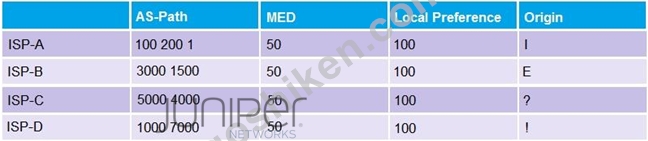
You receive the same 75.100.0.0/16 route from all four ISPs to which you are connected.
Referring to the exhibit, which ISP's route will be selected as active?
- A. ISP-C
- B. ISP-B
- C. ISP-A
- D. ISP-D
正解:D
解説:
https://www.juniper.net/documentation/en_US/junos/topics/reference/general/routing-protocols- address-representation.html
質問 # 92
Referring to the exhibit, which two statements are correct? (Choose two.)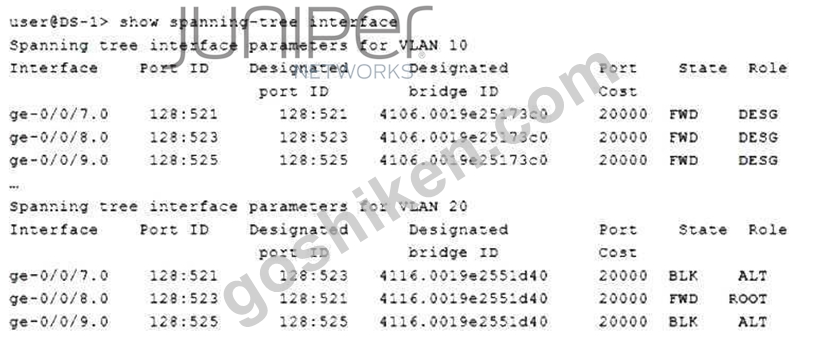
- A. DS-1 is the root bridge for VLAN 10.
- B. Default VSTP bridge priority values are configured.
- C. BPDUs from the root bridge for VLAN 10 have been received on the ge-0/0/7.0 interface.
- D. BPDUs from the root bridge for VLAN 20 have been received on the ge-0/0/7.0 interface.
正解:C、D
質問 # 93
Which two port modes are associated with STP? (Choose two.)
- A. designated
- B. root
- C. alternate port
- D. backup port
正解:A、B
質問 # 94
Referring to the exhibit, a PIM-SM network is set up to enable communication between multicast devices.
Which two statements are true? (Choose two.)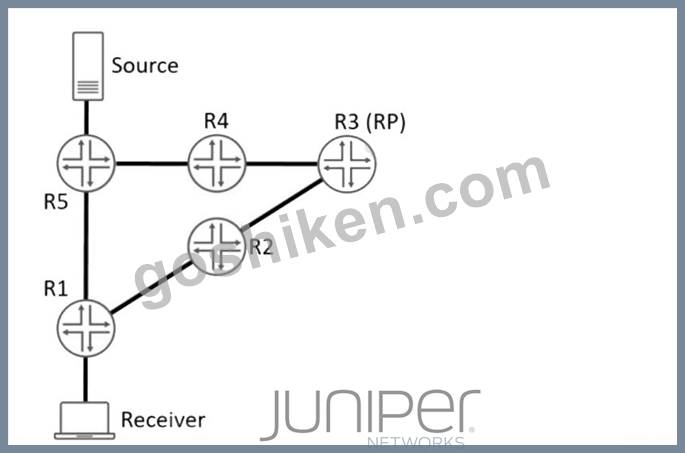
- A. Before the formation of the rendezvous-point tree, an IGMP is sent from the Receiver to R1.
- B. Before the formation of the rendezvous-point tree, a join message is sent from R1 to R5.
- C. Before the formation of the rendezvous-point tree, a join message is sent from R1 to R3.
- D. Before the formation of the rendezvous-point tree, an IGMP is sent from the Source to R5.
正解:A、D
質問 # 95
Which statement is correct about IS-IS?
- A. Level 1 routers route traffic between autonomous systems.
- B. Level 2 routers must share the same area address.
- C. IS-IS uses areas and an autonomous system.
- D. Level 1/2 routers automatically inject a default route to the nearest Level 1 router.
正解:C
解説:
Level 1/2 routers automatically inject a default route to the nearest Level 1 router.
It's the other way around.
質問 # 96
Which statement is correct about CoS policers on Junos devices?
- A. A policer does not alter in-profile traffic.
- B. A policer can assign in-profile traffic to a specific forwarding class.
- C. Traffic that exceeds a policer's traffic profile can be dropped or assigned to a specific drop profile.
- D. Policers can be configured to buffer traffic that exceeds the policer's traffic profile.
正解:C
質問 # 97
Referring to the exhibit, you have placed the cos multifield classifier on all edge interfaces and configured the relevant CoS parameters.
In this scenario, which two statements are correct? (Choose two.)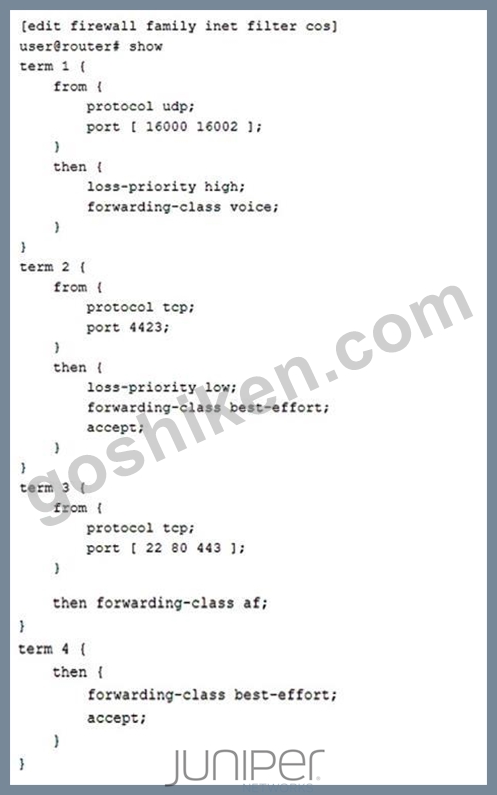
- A. SSH traffic using the default port will be placed in the best-effort forwarding class and accepted.
- B. UDP traffic using the 16000 port will be placed in the best-effort forwarding class and accepted.
- C. SSH traffic using the default port will be placed in the af forwarding class and accepted.
- D. UDP traffic using the 16000 port will be placed in the voice forwarding class and accepted.
正解:C、D
質問 # 98
You are asked to implement fault tolerant RPs in your multicast network.
Which two solutions would accomplish this behavior? (Choose two.)
- A. Use MSDP with statically defined RPs.
- B. Use anycast PIM with statically defined RPs.
- C. Use BFD with statically defined RPs.
- D. Use IGMPv3 with statically defined RPs.
正解:A、B
質問 # 99
Your campus EX9200 core devices are highly oversubscribed on bandwidth ans reporting massive dropped packets.
To immediately address the issue, you decide to implement shaping on all interfaces.
Which action will accomplish?
- A. Apply the shape-rate 5G parameter to all interfaces under the [edit class-of service] hierarchy.
- B. Apply the input-shape-rate 5G parameter to all interfaces under the [edit class-of service] hierarchy.
- C. Define a CoS output traffic control profile with the shape-rate 5G parameter and apply it to all interfaces.
- D. Define a CoS input traffic control profile with the shape-rate 5G parameter and apply it to all interfaces.
正解:C
解説:
https://www.juniper.net/documentation/en_US/junos/topics/task/configuration/cos-shaping-rate- on-physical-interfaces-configuring.html
質問 # 100
Referring to the exhibit, how will router E quickly learn that the remote MAC addresses are no longer reachable through the router attached to the failed link?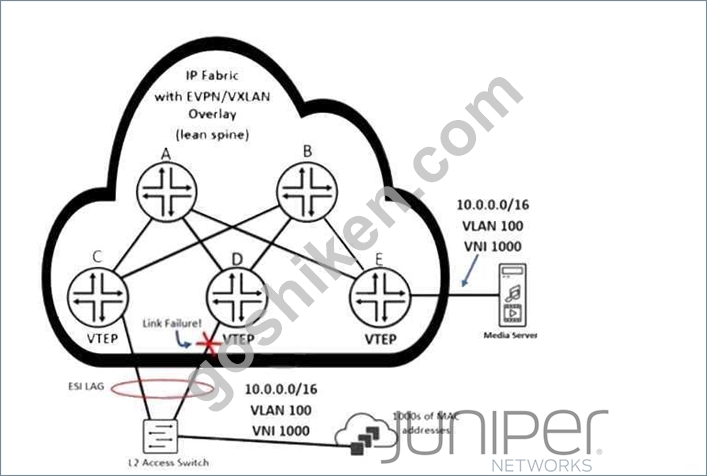
- A. Router E receives Type 1 withdrawal messages from router C.
- B. Router E receives Type 2 withdrawal messages from router D.
- C. Router E receives Type 1 withdrawal messages from router D.
- D. Router E receives Type 2 withdrawal messages from router C.
正解:C
質問 # 101
You are implementing 802.1x access control in your network of EX Series switches. You have some older client devices connecting to your network which do not support 802.1x.
Which statement is true regarding the older devices?
- A. By default, the supplicant will send EAP messages until it reaches a predefined limit, after which it begins to forward traffic.
- B. By default, the supplicant will send EAP messages and keep the port in an unauthorized state.
- C. By default, the authenticator will send EAP messages and keep the port in an unauthorized state.
- D. By default, the authenticator will send EAP messages until it reaches a predefined, after which it begins to forward traffic.
正解:A
質問 # 102
Which two statements are correct regarding the behavior shown in the exhibit? (Choose two.)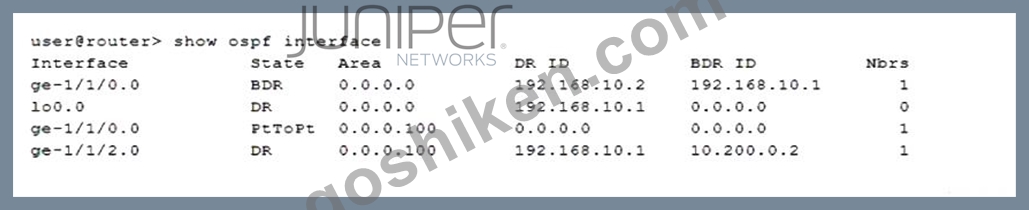
- A. The ge-1/1/0 interface is configured as secondary for Area 100.
- B. The ge-1/1/0 interface is configured as secondary for Area 0.
- C. The router is an ABR.
- D. The router is not an ABR.
正解:A、C
解説:
"Secondary interfaces are supported for LAN interfaces (the primary interface can be a LAN interface, but any secondary interfaces are treated as point-to-point unnumbered links over the LAN). In this scenario, you must ensure that there are only two routing devices on the LAN or that there are only two routing devices on the LAN that have secondary interfaces configured for a specific OSPF area."
[https://www.juniper.net/documentation/us/en/software/junos/ospf/topics/topic-map/configuring-ospf-areas.html
質問 # 103
Which two multicast listener registration protocols are supported in the Junos operating system? (Choose two.)
- A. PIM
- B. DVMRP
- C. MLD
- D. IGMP
正解:C、D
解説:
* Understanding Multicast Listener Registration Protocols:
* Multicast listener registration protocols are used to manage multicast group memberships on a network.
* They allow devices to join or leave multicast groups dynamically.
* Protocols Supported by Junos:
* MLD (Multicast Listener Discovery):
* Used for IPv6 multicast group management. It is the IPv6 equivalent of IGMP.
* MLD allows routers to discover multicast listeners on a network.
* IGMP (Internet Group Management Protocol):
* Used for IPv4 multicast group management.
* IGMP enables hosts to join and leave multicast groups and allows routers to manage multicast group memberships.
* Verification and Configuration in Junos:
* MLD and IGMP are supported on Juniper devices running the Junos operating system.
* Configuration examples:
* IGMP:
shell
Copy code
set protocols igmp interface ge-0/0/1.0
* MLD:
shell
Copy code
set protocols mld interface ge-0/0/1.0
References:
* Juniper IGMP Configuration Guide
* Juniper MLD Configuration Guide
質問 # 104
Referring to the exhibit, which two statements are correct? (Choose two.)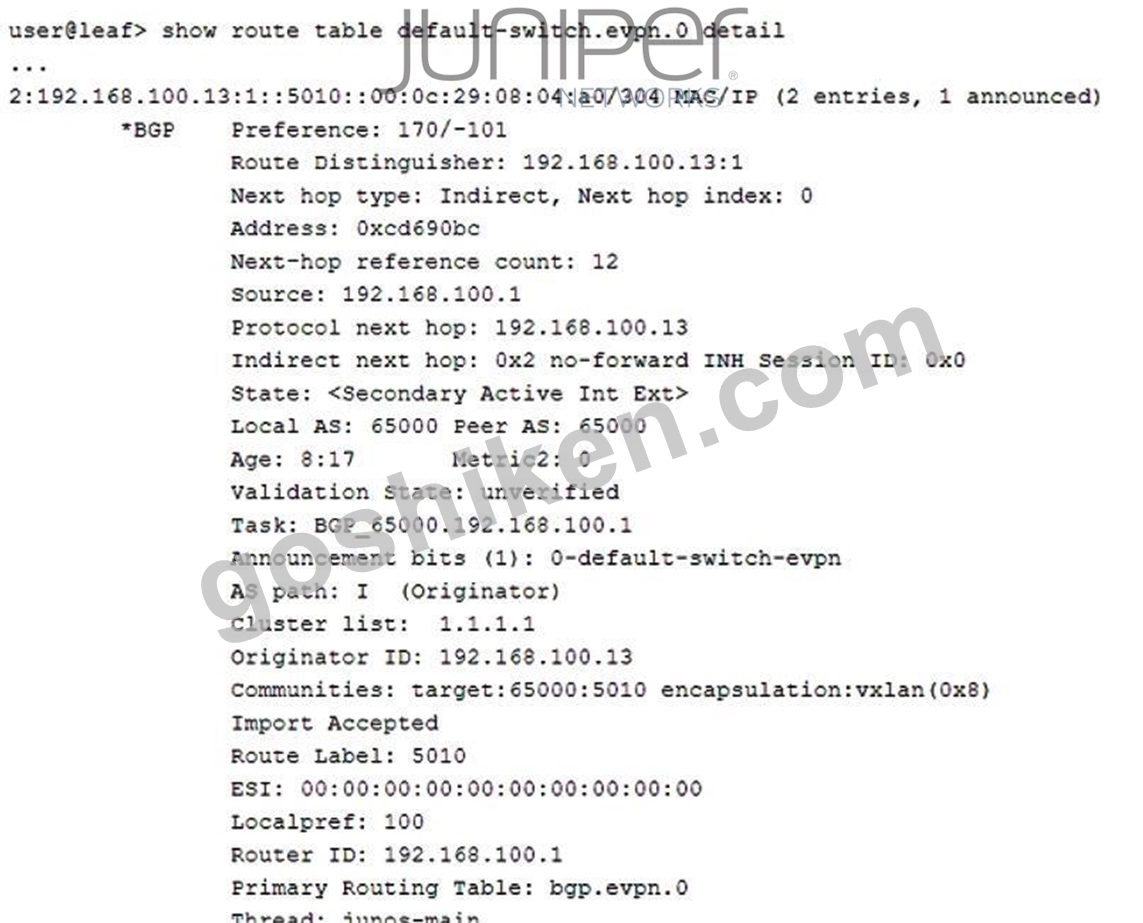
- A. The route is a Type 1 EVPN route.
- B. The host that the route is associated with is single-homed to one leaf node.
- C. The route is a Type 2 EVPN route.
- D. The host that the route is associated with is multihomed to two leaf nodes.
正解:B、C
質問 # 105
You are configuring MVRP for automatic VLAN registration. Which two statements are true?
(Choose two.)
- A. the trunk port must be configured with "vlan all"
- B. the trunk port must not be configured with vlan members
- C. MVRP must be configured on all trunk ports
- D. MVRP must be configured on all access ports
正解:B、C
質問 # 106
......
合格させるJuniper JN0-649プレミアムお試しセットテストエンジンPDFで無料問題集セット:https://www.goshiken.com/Juniper/JN0-649-mondaishu.html
2024年最新の実際に出るJN0-649問題集テストエンジン試験問題はここにある:https://drive.google.com/open?id=1Vb6xcwCrKM633ss9-PfiJeKrx2nBf2JC