

65試験解答はJN0-649最新版 テストエンジン
合格確定JN0-649試験問最新のJN0-649試験問題集PDF2023年更新
JN0-649試験を受けるには、候補者はネットワーキングの基本をしっかりと理解し、Juniper Networksの機器を使用した経験を持っている必要があります。試験は、120分の制限時間内に完了する必要がある65個の多肢選択問題から構成されています。JNCIP-ENT認証を取得するには、65%以上の合格点が必要です。この認証は雇用主に高く評価され、企業ネットワーキング分野でのキャリアアップの多くのドアを開くことができます。熟練したネットワークエンジニアの需要の増加に伴い、JNCIP-ENT認定を取得することは、この分野の専門家に競争優位性を提供することができます。
Juniper JN0-649 Enterprise Routing and Switching、Professional(JNCIP-ENT)試験は、Juniper Networksのルーティングおよびスイッチング技術のスキルと知識を検証したいITプロフェッショナル向けの認定試験です。JNCIP-ENT認定は、JuniperのEnterprise Routing and Switchingトラックの2番目の認定レベルであり、すでにJNCIA-Junos認定を取得している個人を対象としています。JNCIP-ENT試験の成功裏に合格することは、個人がJuniper Networksのルーティングおよびスイッチング技術についての高度な知識を持ち、Juniperの企業向けルーティングおよびスイッチングプラットフォームを構成、トラブルシューティング、およびメンテナンスできる能力を持っていることを示します。
質問 # 38
Referring to the exhibit, which statement is correct?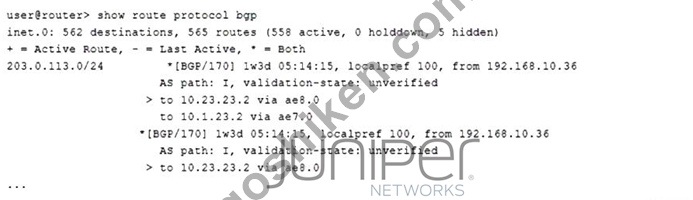
- A. The route is learned from three different neighbors.
- B. The route is learned from a multipath BGP session.
- C. The route is learned from only one neighbor.
- D. The route is learned from a multihop BGP session.
正解:C
質問 # 39
Which three statements are correct about EVPN route types? (Choose three.)
- A. Type 1 routes carry endpoint MAC address information.
- B. Type 2 routes carry endpoint IP address information.
- C. Type 5 routes carry replication information.
- D. Type 3 routes carry replication information.
- E. Type 2 routes carry endpoint MAC address information.
正解:B、D、E
解説:
Cisco explains it better: The EVPN control plane advertises the following types of information:
Route type 1 - This is an Ethernet Auto-Discovery (EAD) route type used to advertise Ethernet segment identifier, Ethernet Tag ID, and EVPN instance information. EAD route advertisements may be sent for each EVPN instance or for each Ethernet segment.
Route type 2 - This advertises endpoint reachability information, including MAC and IP addresses of the endpoints or VTEPs.
Route type 3 - This performs multicast router advertisement, announcing the capability and intention to use ingress replication for specific VNIs.
Route type 4 - This is an Ethernet Segment route used to advertise the Ethernet segment identifier, IP address length, and the originating router's IP address.
Route type 5 - This is an IP prefix route used to advertise internal IP subnet and externally learned routes to a VXLAN network.
質問 # 40
What allows non-Web enabled devices to access the network on a port configured for captive portal?
- A. Authentication credentials for specific devices can be preconfigured on the switch for automatic authentication.
- B. LLDP can be used to query the type of device that is attempting to access the network, and predefined device types can be allowed to bypass the captive portal process.
- C. A MAC address white list can be configured on the switch to allow specific MAC addresses to bypass the captive portal process.
- D. Captive portal can be configured to only prompt for credentials when HTTP or HTTPS traffic is requested on a port to allow on-HTTP enabled devices access to the network.
正解:C
質問 # 41
Referring to the exhibit, which two statements are correct? (Choose two.)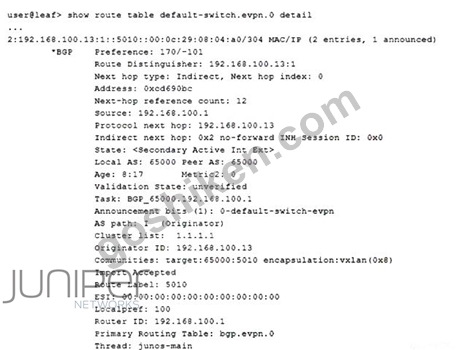
- A. The host that the route is associated with is single-homed to one leaf node.
- B. The route is a Type 1 EVPN route.
- C. The host that the route is associated with is multihomed to two leaf nodes.
- D. The route is a Type 2 EVPN route.
正解:A、D
質問 # 42
Remote branches connect to the corporate WAN through access switches. The access switches connect to access ports on the WAN distribution switch, as shown in the exhibit. L2PT has previously been configured on the tunnel Layer 2 traffic across the WAN. You decide to move the L2PT tunnel endpoints to the access switches. When you apply the L2PT configuration to the access switches, the ports that connect the access switches to the distribution switch shut down.
Which action would solve this problem?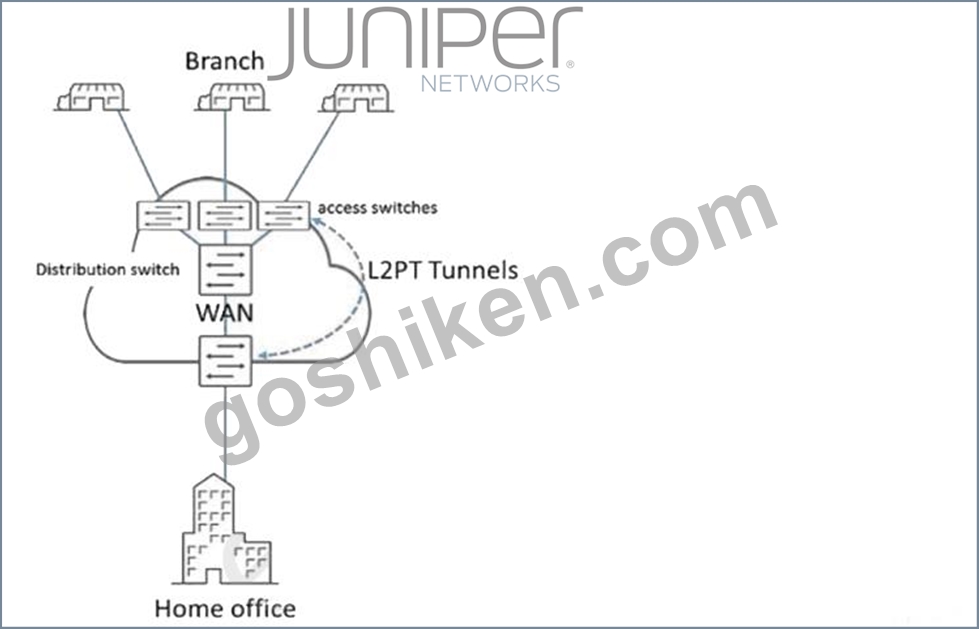
- A. Configure the links between the access switches and the distribution switch as a trunk port.
- B. Disable the BPDU block function on the distribution switch.
- C. Disable the BPDU block function on the access switches.
- D. Configure a GRE tunnel to encapsulate the L2PT traffic across the WAN.
正解:A
解説:
Access interfaces in an L2PT-enabled VLAN should not receive L2PT-tunneled PDUs. If an access interface does receive L2PT-tunneled PDUs, there might be a loop in the network, and the device will shut down the interface. https://www.juniper.net/documentation/us/en/software/junos/multicast-l2/topics/topic-map/layer-2-protocol-tunneling.html
質問 # 43
You are asked to configure 802.1X on your access ports to allow only a single device to authenticate. In this scenario, which configuration would you use?
- A. single supplicant mode
- B. single-secure supplicant mode
- C. multiple supplicant mode
- D. MAC authentication mode
正解:A
質問 # 44
You are troubleshooting an OSPF adjacency issue between R1 and R2.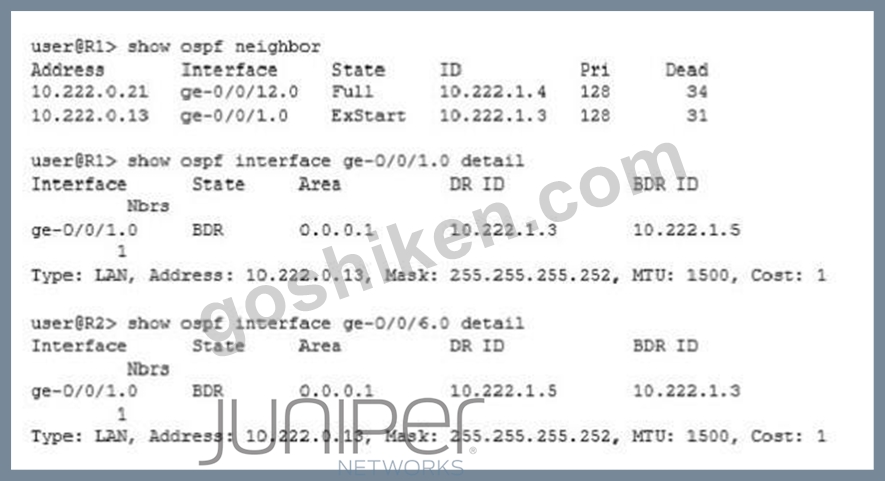
What is the reason for the ExStart state shown in the exhibit?
- A. R2 was elected as the designated router.
- B. R1 was elected as the backup designated router.
- C. The MTU is not the default on R1 and R2.
- D. R1 and R2 are using the same IP address.
正解:D
質問 # 45
You are troubleshooting connectivity between an EVPN spine switch configured as a route reflector and a leaf node with an IP address of 10.30.100.6.
Referring to the exhibit, what is the problem?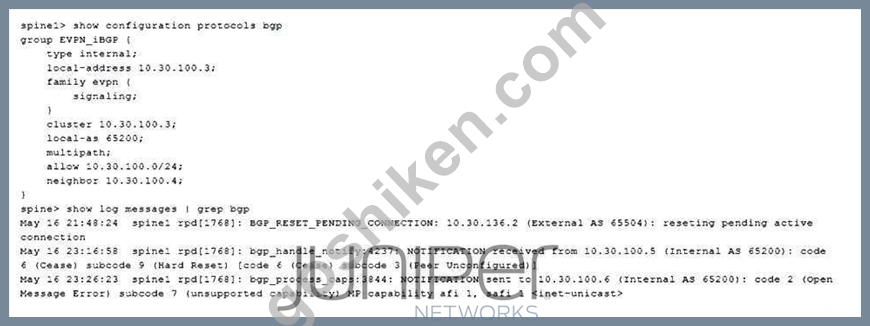
- A. The neighbor 10.30.100.3 statement is missing from leaf1's configuration.
- B. The neighbor 10.30.100.6 statement is missing from spine1's configuration.
- C. The spine node is not configured for the family inet NLRI.
- D. The leaf node is not configured for the family evpn NLRI.
正解:C
質問 # 46
Referring to the exhibit, which two statements are correct? (Choose two.)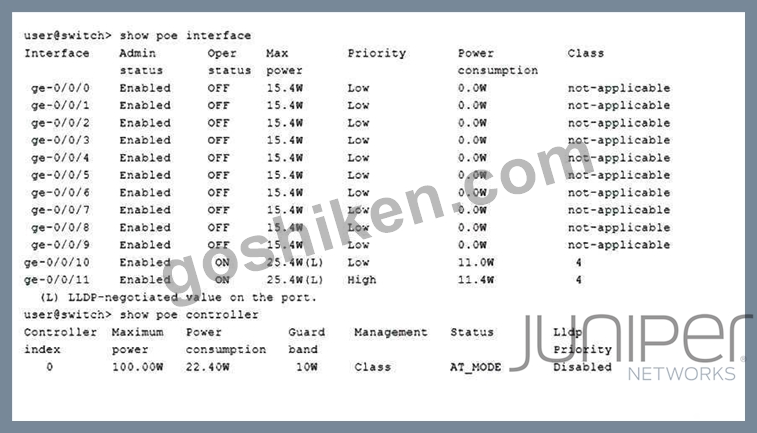
- A. The ge-0/0/10 interface supports PoE+.
- B. PoE is not enabled on the ge-0/0/0 interface.
- C. If the total power consumption exceeds 90 watts, the ge-0/0/11 interface will continue to receive power.
- D. The maximum wattage that this switch can allocate to attached Ethernet devices is 100 watts.
正解:B、D
質問 # 47
Referring to the exhibit, a PIM-SM network is set up to enable communication between multicast devices.
Which two statements are true? (Choose two.)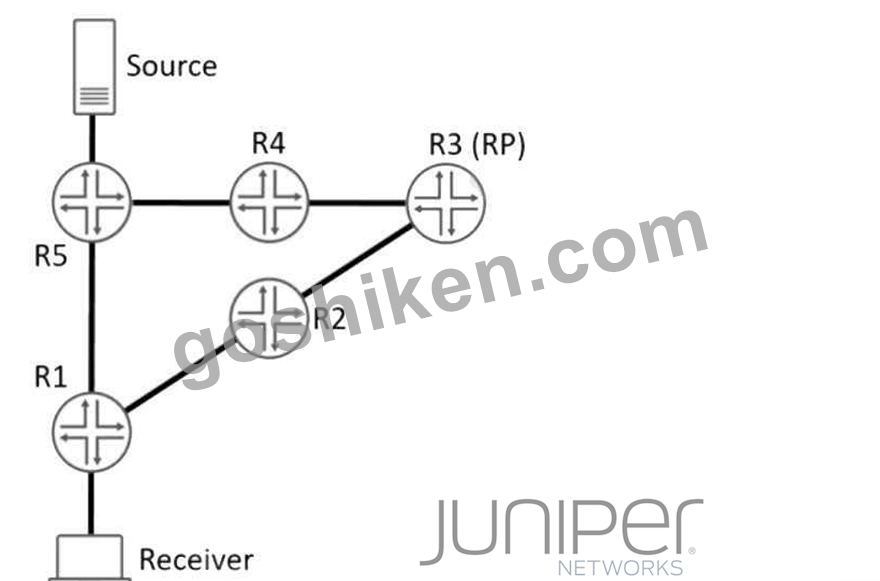
- A. Before the formation of the rendezvous-point tree, an IGMP is sent from the Source to R5.
- B. Before the formation of the rendezvous-point tree, a join message is sent from R1 to R5.
- C. Before the formation of the rendezvous-point tree, an IGMP is sent from the Receiver to R1.
- D. Before the formation of the rendezvous-point tree, a join message is sent from R1 to R3.
正解:A、C
質問 # 48
Which three MSTP parameters must match on all switches in the same MST region? (Choose three.)
- A. forwarding delay
- B. revision number
- C. MSTI-to-VLAN mapping
- D. configuration name
- E. bridge priority
正解:B、D、E
質問 # 49
Your network is multihomed to two ISPs. The BGP sessions are established; however, the ISP peers are not receiving any routes.
Which two statements are correct about troubleshooting your configuration? (Choose two.)
- A. Verify that the BGP routes are active in your routing table.
- B. Verity that the multihop settings are configured on your router.
- C. Verify the export policies on your router.
- D. Verify the import policies on your router.
正解:B、C
質問 # 50
Your IS-IS adjacency is not established as shown in the exhibit. What is the problem?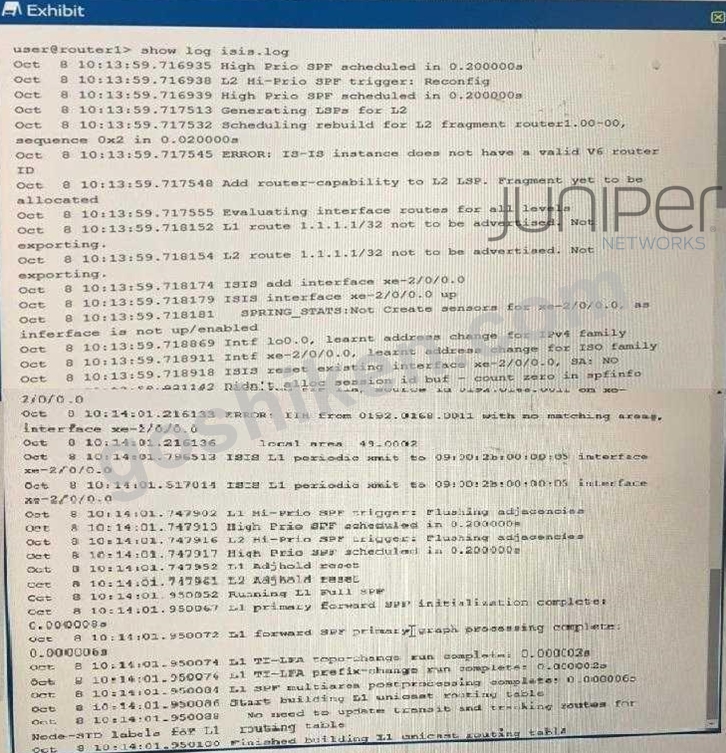
- A. There is an MTU mismatch
- B. There is an invalid IPv6 router ID
- C. There is an invalid IPv4 router ID
- D. There is an area mismatch
正解:D
質問 # 51
Which two statements are true about PIM source-specific multicast (SSM)? (Choose two.)
- A. IGMPv3 is required.
- B. A Different group address must be used by each source.
- C. S, G is always used.
- D. The receiver DR builds a source-base tree to the RP.
正解:A、C
質問 # 52
Which BGP message type contains NLRI information?
- A. open
- B. notification
- C. update
- D. keepalive
正解:C
質問 # 53
You are implementing CoS for a custom application that is labeling its packets with DSCP code- point 101111. You have applied the configuration shown in the exhibit, but not that while some custom application traffic ingressin on ge-0/0/1 transits the SRX Series device successfully, packets ingressing all other ge-* interfaces are being dropped.
Which action should you take to solve this problem?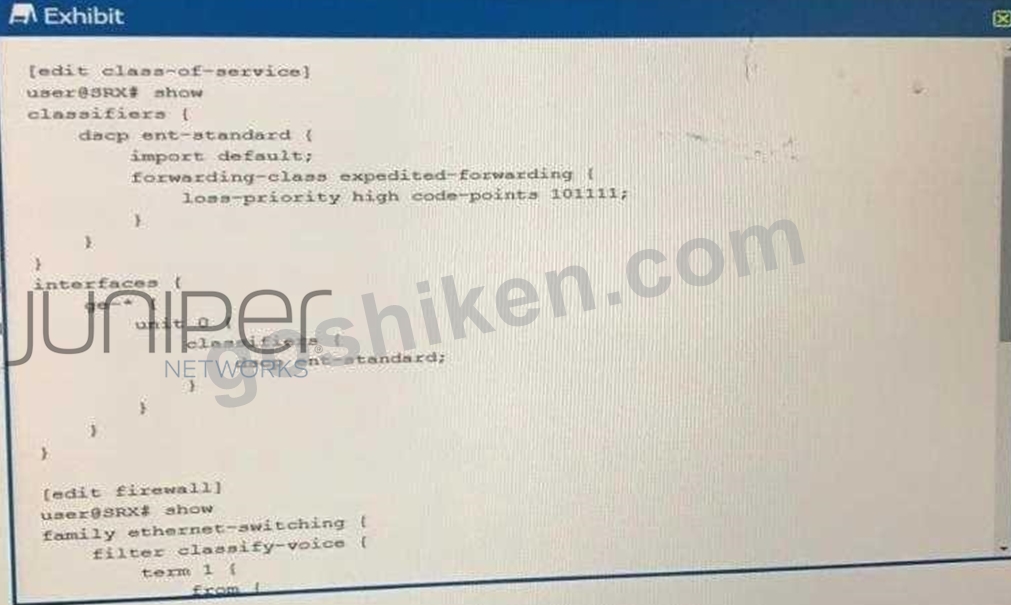
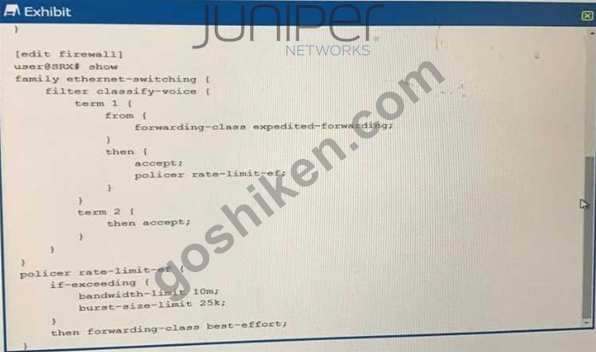
- A. Modify the BA classifier to assign code point 101111 to loss priority low.
- B. Configure a scheduler and scheduler map for expedited-forwarding and apply to all interfaces.
- C. Remove the BA classifier from all ge-interfaces.
- D. Apply the rate-limit-ef policer to all ge-interfaces.
正解:D
質問 # 54
You will to route Layer 3 PVLAN traffic within the secondary VLAN.
What is required to accomplish this task?
- A. an IRB
- B. an isolated VLAN
- C. an FBF policy
- D. a community VIAN
正解:A
質問 # 55
You are running OSPF as your IGP. The interfaces connecting two routers are in the ExStart state. You notice that something is incorrect with the configuration.
Referring to the exhibit, which statement is correct?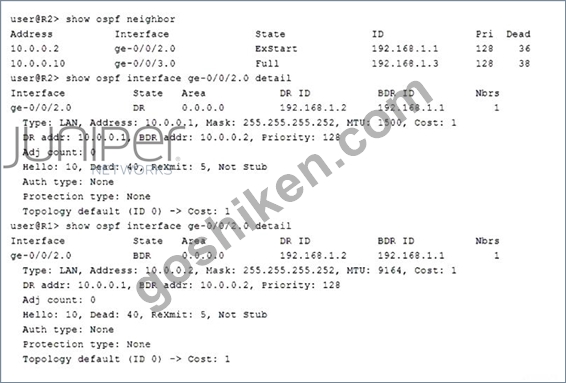
- A. The subnet mask is incorrect.
- B. The IP addresses are incorrect.
- C. The MTU setting are incorrect.
- D. The interface type is incorrect.
正解:C
質問 # 56
Your enterprise network is running BGP VPNs to support multitenancy. Some of the devices with which you peer BGP do not support the VPN NLRI. You must ensure that you do not send BGP VPN routes to the remote peer.
Which two configuration steps will satisfy this requirement? (Choose two.)
- A. Configure an import policy on the remote peer to reject the routes when they are received.
- B. Configure the apply-vpn-export feature on the local BGP peer.
- C. Configure a route reflector for the VPN NLRI.
- D. Configure an export policy on the local BGP peer to reject the VPN routes being sent to the remote peer.
正解:B、D
質問 # 57
Click the Exhibit.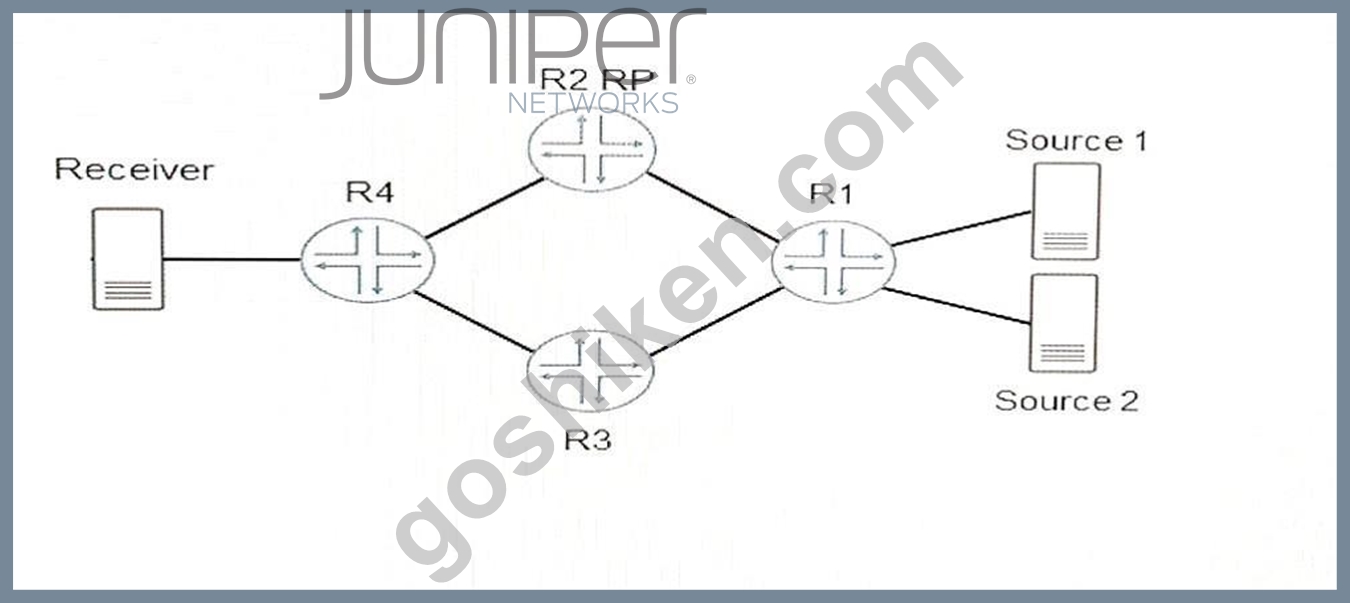
The Receiver is attempting to join two different groups, one from each source. You want to endure that load balancing is taking place.
Referring to the exhibit, which statement is true?
- A. R1 must have join-load-balance configured under protocol PIM.
- B. R4 must have join-load-balance configured under protocol PIM.
- C. R2 must have join-load-balance configured under protocol PIM.
- D. R3 must have join-load-balance configured under protocol PIM.
正解:B
解説:
https://www.juniper.net/documentation/en_US/junos/topics/task/configuration/mcast-pim-join- load-balance.html
質問 # 58
Click the Exhibit.

You have just configured on an OSPF adjacency between two routers. After you commit the configuration, you notice that your adjacency is not up.
Referring to the exhibit, what would cause the problem?
- A. You must configure hello and dead intervals on R1.
- B. You must configure lo on R2.
- C. You must configure on interface-type o n R2.
- D. You must configure bfd on R2.
正解:C
質問 # 59
Referring to the exhibit, which two statements are true? (Choose two)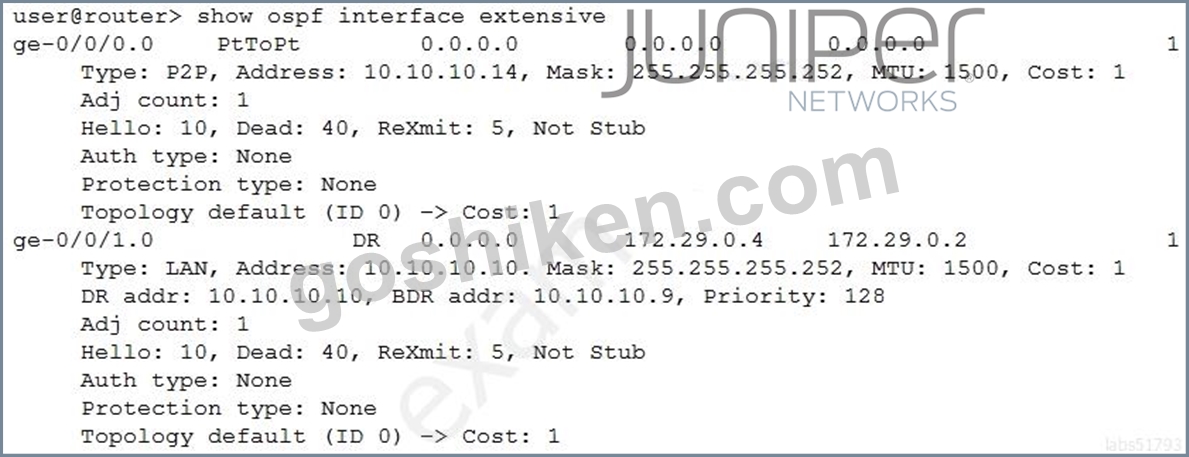
- A. There is no need for a DR for the ge-0/0/0 interface.
- B. There can be more than one OSPF neighbor on the ge-0/0/1 interface.
- C. The DR election process is not finished for the ge-0/0/0 interface
- D. There can be more than one OSPF neighbor on the ge-0/0/0 interface
正解:A
質問 # 60
Which three configuration parameters must match on all switches within the same MSTP region? (Choose three.)
- A. VLAN to instance mapping
- B. configuration name
- C. revision level
- D. bridge priority
- E. region name
正解:A、C、E
解説:
When enabling MSTP, you define one or more MSTP regions. An MSTP region defines a logical domain where multiple spanning-tree instances (MSTIs) can be administered independently of MSTIs in other regions, setting the boundary for bridge protocol data units (BPDUs) sent by one MSTI. An MSTP region is a group of switches that is defined by three parameters:
Region name-User-defined alphanumeric name for the region.
Revision level-User-defined value that identifies the region.
Mapping table-Numerical digest of VLAN-to-instance mappings.
https://www.juniper.net/documentation/us/en/software/junos/stp-l2/topics/topic-map/spanning-tree-configuring-mstp.html
質問 # 61
You are designing a multicast topology to support IPv4 IPTV broadcasts in your organization. The design should support multiple multicast senders with overlapping group addresses while preventing interference between them. Client devices currently do not support IGMPv3.
Which approach would fulfill these requirements?
- A. Implement MLD
- B. Assign group addresses in the 224/4 range and implement PIM-DM
- C. Implement bidirectional PIM
- D. Implement PIM-SM and SSM with SSM maps to support IGMPv2 clients
正解:B
質問 # 62
Referring to the exhibit, how will router E quickly learn that the remote MAC addresses are no longer reachable through the router attached to the failed link?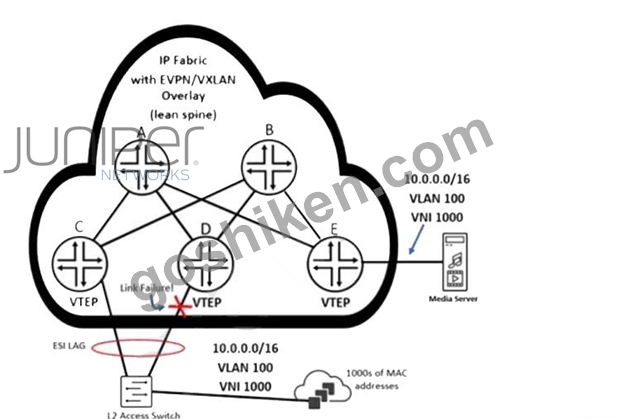
- A. Router E receives Type 2 withdrawal messages from router C.
- B. Router E receives Type 1 withdrawal messages from router D.
- C. Router E receives Type 2 withdrawal messages from router D.
- D. Router E receives Type 1 withdrawal messages from router C.
正解:B
質問 # 63
......
JN0-649試験問題集無料サンプル365日更新:https://www.goshiken.com/Juniper/JN0-649-mondaishu.html
まもなく無料セール終了!- リアルJN0-649のPDF解答を試そう:https://drive.google.com/open?id=1weV1W0ViWn24HM4cZAv4JTuzMEKpTmXT