

[2024年11月15日]JN0-649練習試験問題集で試験99%合格率があります
最新の検証済みJN0-649問題と解答、合格保証もしくは全額返金
JN0-649認証試験は、技術的能力の挑戦的で厳密なテストであり、ルーティングとスイッチングテクノロジー、ネットワークセキュリティと自動化を深く理解する必要があります。ただし、適切な準備と研究により、試験に合格してこの貴重な認証を取得できます。 Juniper Networksは、インストラクター主導のコース、自己ペースの学習モジュール、練習試験など、さまざまなトレーニングおよび学習リソースを提供し、JN0-649試験の準備を支援し、エンタープライズネットワーキングのキャリアを促進します。
質問 # 45
You are running OSPF as your IGP. The interfaces connecting two routers are in the ExStart state. You notice that something is incorrect with the configuration.
Referring to the exhibit, which statement is correct?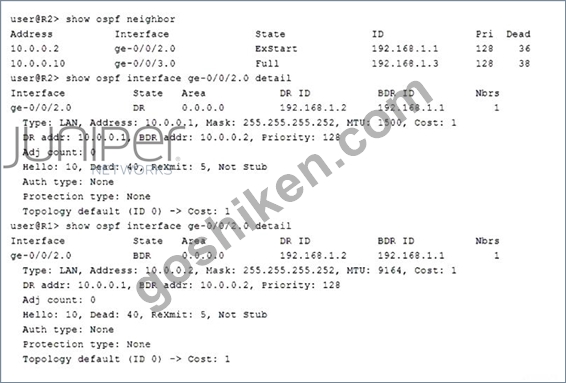
- A. The interface type is incorrect.
- B. The subnet mask is incorrect.
- C. The MTU setting are incorrect.
- D. The IP addresses are incorrect.
正解:C
質問 # 46
Your enterprise network uses routing instances to support multitenancy. Your Junos devices use BGP to peer to multiple BGP devices. You must ensure that load balancing is achieved within the routing instance.
Which two statements would accomplish this task? (Choose two.)
- A. Configure the multipath option at the [edit protocols bgp group <group-name> neighbor] hierarchy.
- B. Configure a load-balance per-packet policy and apply it at the [edit routing-options forwarding- table] hierarchy.
- C. Configure the multipath option at the [edit routing-instances <instance-name> routing-options] hierarchy.
- D. Configure the multipath option at the [edit protocols bgp group] hierarchy.
正解:B、C
解説:
To enable these features on a Layer 3 VPN routing instance, include the vpn-unequal-cost equal- external-internal statement at the [edit routing-instances routing-instance-name routing-options multipath] hierarchy level and the vrf-table-label statement at the [edit routing-instances routing- instance-name] hierarchy level.
https://www.juniper.net/documentation/us/en/software/junos/vpn-l3/topics/ref/statement/multipath- edit-routing-options.html
質問 # 47
You are running OSPF as your IGP. The interfaces connecting two routers are in the ExStart state. You notice that something is incorrect with the configuration. Referring to the exhibit, which statement is correct?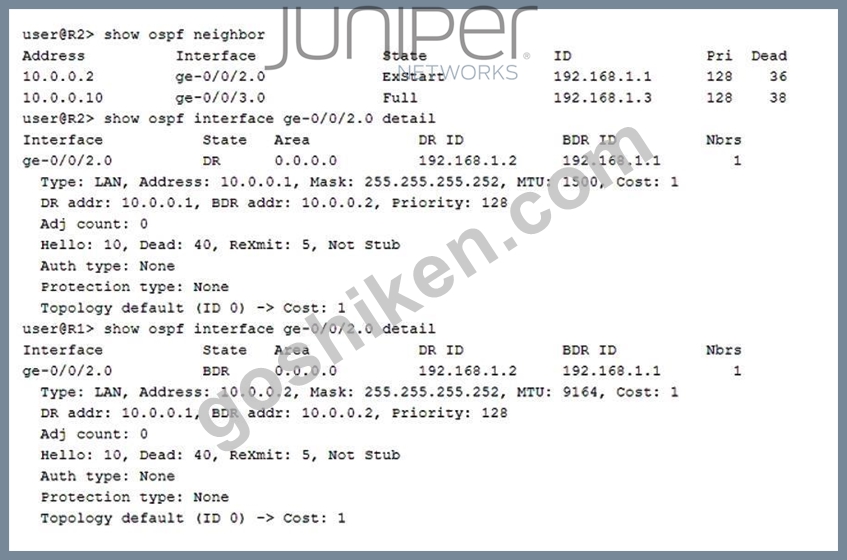
- A. The interface type is incorrect.
- B. The subnet mask is incorrect.
- C. The MTU setting are incorrect.
- D. The IP addresses are incorrect.
正解:C
質問 # 48
Referring to the exhibit, which two statements are correct? (Choose two.)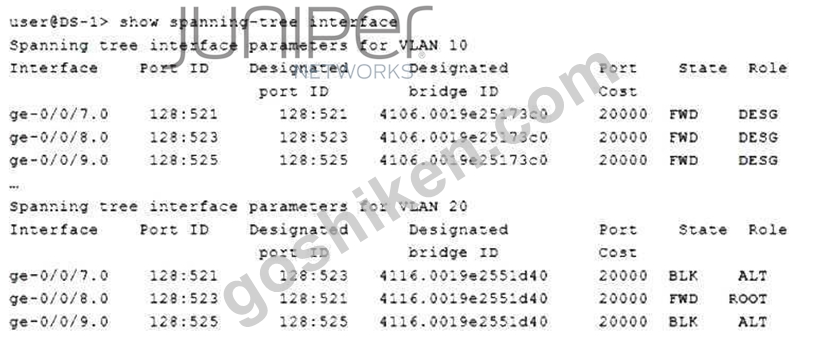
- A. BPDUs from the root bridge for VLAN 10 have been received on the ge-0/0/7.0 interface.
- B. BPDUs from the root bridge for VLAN 20 have been received on the ge-0/0/7.0 interface.
- C. DS-1 is the root bridge for VLAN 10.
- D. Default VSTP bridge priority values are configured.
正解:A、B
質問 # 49
Referring to the exhibit, which statement is true?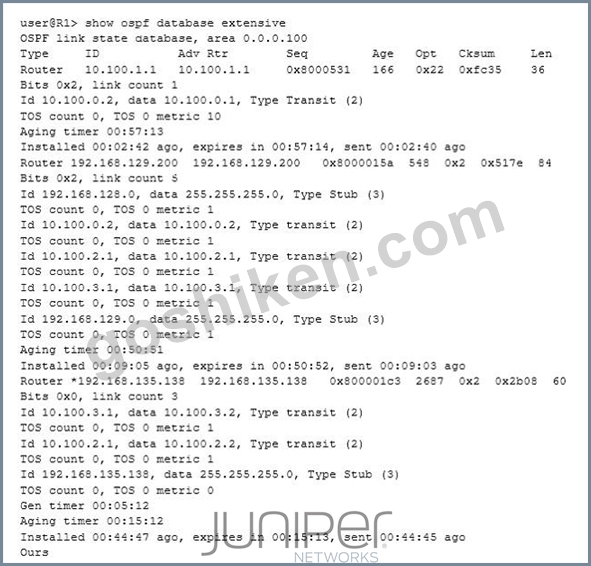
- A. R1 is a backbone router.
- B. R1 is an ABR.
- C. R1 is an ASBR.
- D. R1 has the B bit set.
正解:C
質問 # 50
Your network has an unmanaged switch between the hosts and your EX Series switch. After the traffic enters the EX Series switch, each host must be on a separate VLAN.
How would you accomplish this task?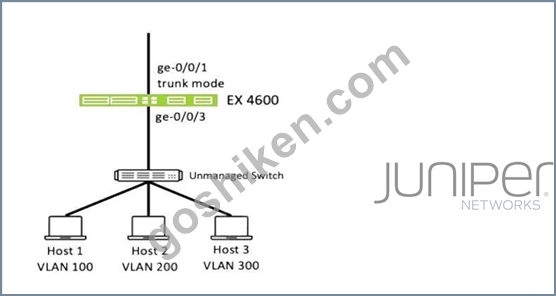
- A. Configure an input firewall filter on interface ge-0/0/3 to match the source MAC or IP address of the hosts to assign the VLANs.
- B. Configure an output firewall filter on interface ge-0/0/1 to match the destination MAC or IP address of the hosts to assign the VLANs.
- C. Configure interface ge-0/0/3 to a mode trunk to assign the VLANs.
- D. Configure VSTP on interface ge-0/0/1 to assign the VLANs.
正解:C
質問 # 51
Referring to the exhibit, you have placed the cos multifield classifier on all edge interfaces and configured the relevant CoS parameters.
In this scenario, which two statements are correct? (Choose two.)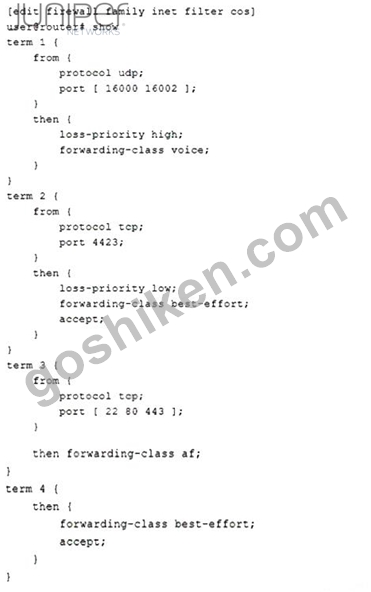
- A. SSH traffic using the default port will be placed in the best-effort forwarding class and accepted.
- B. UDP traffic using the 16000 port will be placed in the best-effort forwarding class and accepted.
- C. SSH traffic using the default port will be placed in the af forwarding class and accepted.
- D. UDP traffic using the 16000 port will be placed in the voice forwarding class and accepted.
正解:C、D
質問 # 52
You are asked to establish full connectivity between all devices in the BGP network.
Referring to the exhibit, which two configuration changes will allow BGP route advertisements? (Choose two.)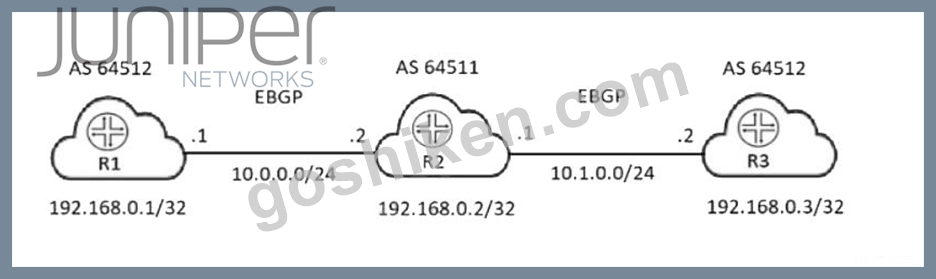
- A. On R1 and R3, include the loops 2 statement at the [edit protocols bgp family inet unicast] hierarchy.
- B. On R2, include the advertise-peer-as statement at the [edit protocols bgp group external] hierarchy.
- C. On R2, include the loops 2 statement at the [edit protocols bgp family inet unicast] hierarchy.
- D. On R1 and R3, include the advertise-peer-as statement at the [edit protocols bgp group external] hierarchy.
正解:A、B
解説:
https://www.juniper.net/documentation/us/en/software/junos/bgp/topics/ref/statement/advertise-peer-as-edit-protocols-bgp.html
質問 # 53
Click the Exhibit button.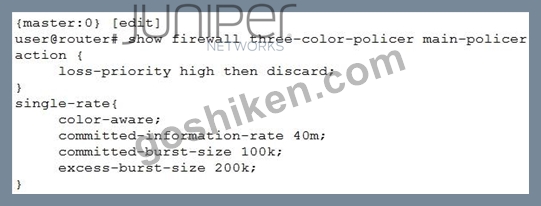
You have configured and applied the policer shown in the exhibit to your Junos device.
Which statement is true in this scenario?
- A. Traffic exceeding the committed-burst size will be discarded.
- B. Traffic exceeding the excess-burst size will be discarded.
- C. Traffic exceeding the committed-information-rate will be rate limited.
- D. Traffic exceeding the committed-burst size will be marked with a loss priority of high.
正解:B
解説:
Red--Traffic that exceeds the burst size for peak traffic (EBS), single-rate marks packets with an implicit loss priority of high and, optionally, discards the packets.
https://www.juniper.net/documentation/en_US/junos/topics/topic-map/policer-single-rate-three- color.html
https://www.juniper.net/documentation/us/en/software/junos/routing-policy/topics/topic- map/policer-single-rate-three-color.html
質問 # 54
You are troubleshooting an EVPN-VXLAN IP fabric and observe the loop shown in the exhibit.
Which two steps would you take to further troubleshoot this problem? (Choose two.)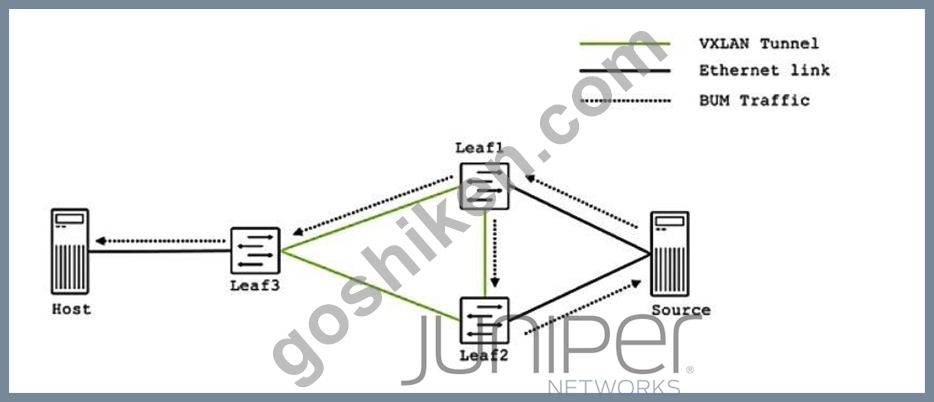
- A. Issue the show route table bgp.evpn.0 command on Leaf2 and verify that Type 4 routes are present.
- B. Issue the show route table bgp.evpn.0 command on Leaf2 and verify that Type 3 routes are present.
- C. Verify that the same ESI is configured on the link from the host and that it matches the source.
- D. Verify that the same ESI is configured on the two links from the source.
正解:A、B
解説:
Type 2 route, MAC with IP advertisement route-Type 2 routes are per-VLAN routes, so only PEs that are part of a VNI need these routes. EVPN allows an end host's IP and MAC addresses to be advertised within the EVPN Network Layer reachability information (NLRI). This allows for control plane learning of ESI MAC addresses. Because there are many Type 2 routes, a separate route- target auto-derived per VNI helps to confine their propagation. This route type is supported by all EVPN switches and routers.
Type 5 route, IP prefix Route-An IP prefix route provides encoding for inter-subnet forwarding.
In the control plane, EVPN Type 5 routes are used to advertise IP prefixes for inter-subnet connectivity across data centers. To reach a tenant using connectivity provided by the EVPN Type 5 IP prefix route, data packets are sent as Layer 2 Ethernet frames encapsulated in the VXLAN header over the IP network across the data centers.
質問 # 55
Referring to the exhibit, which statement is correct when a failure exists on the link between host2 and switch5 on this EVPN-VXLAN fabric?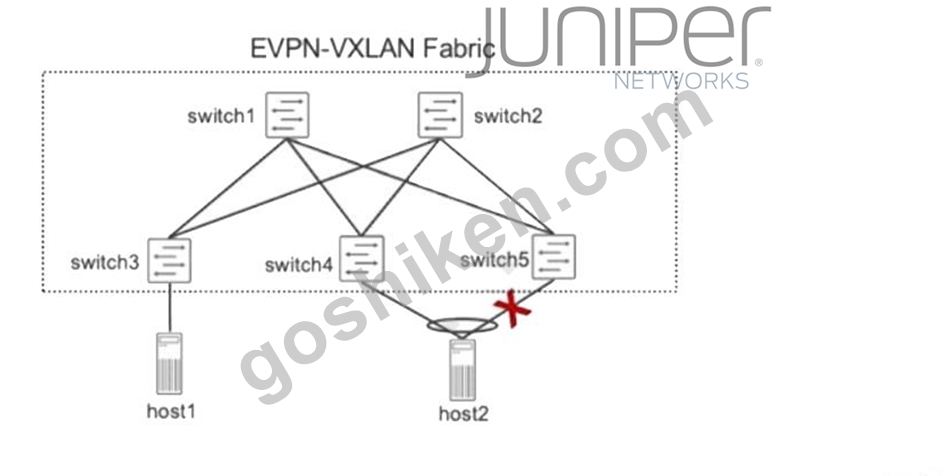
- A. The switch5 device will send a Type 2 route to all peers.
- B. The switch5 device will send a Type 4 route to all peers.
- C. The switch5 device will send a Type 3 route to all peers.
- D. The switch5 device will send a Type 1 route to all peers.
正解:D
解説:
Type 1 routes are used for per-ES auto-discovery (A-D) to advertise EVPN multi-homing mode. Remote ToR leaf devices in the EVPN network use the EVPN Type 1 route type functionality to learn the EVPN Type 2 MAC routes from other leaf devices. In this route type ESI and the Ethernet Tag ID are considered to be part of the prefix in the NLRI. Upon a link failure between ToR leaf and end server VTEP withdraws Ethernet Auto-Discovery routes (Type 1) per ES. The Juniper EVPN multi-homing Ethernet Tag value is set to the VLAN ID for ES auto-discovery/ES route types. Mass Withdrawal - Used for fast convergence during link failure scenarios between leaf devices to the end server using Type 1 EAD/ES routes.
質問 # 56
There are two BGP routes to 10.200.200.0/24 received from two external peers. Route 1 comes from a neighbor with a router ID of 10.10.100.1 and a peer IP address of 10.10.30.1, and route 2 comes from a neighbor with a router ID of 10.10.200.1 and a peer IP address of 10.10.50.1. Both routes have the same MED value, origin value, AS path length, and local preference number. In this scenario, which statement is correct about the active route?
- A. Route 2 will be active because of the router ID.
- B. Route 2 will be active because of the peer IP address.
- C. Route 1 will be active because of the router ID.
- D. Route 1 will be active because of the peer IP address.
正解:C
解説:
The router determines the router ID for each peer that advertised a path to the route destination.
A lower router ID value is preferred over a higher router ID value.
The router determines the peer ID for each peer that advertised a path to the router destination. A lower peer ID value is preferred over a higher peer ID value. The peer ID is the IP address of the established BGP peering session.
質問 # 57
You have scheduled maintenance operations for one of the devices in your OSPF network.
Referring to the exhibit, which three statements are correct? (Choose three.)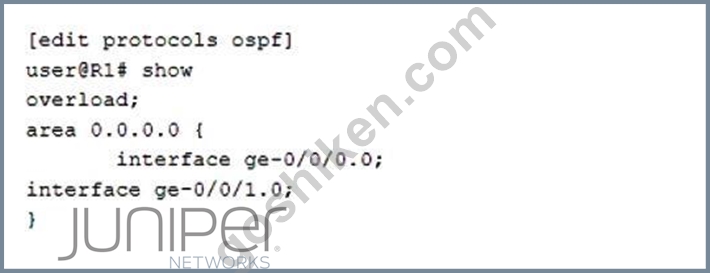
- A. Any traffic destined for networks that terminate on R1 will still be forwarded to R1.
- B. R1 does not participate in OSPF routing.
- C. R1 does not send or receive transit traffic during the maintenance window even if no alternative paths exist to the given destination.
- D. R1 participates in OSPF routing but does not send or receive transit traffic.
- E. The metrics for all transit interfaces on R1 is set to the maximum value of 65,535.
正解:A、D、E
質問 # 58
A customer requires that the switch responds to an ARP request only if the source and target IP address are on different subnets.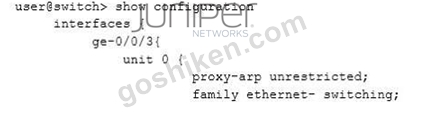
Referring to the Exhibit, how would you accomplish this task?
- A. Change the proxy ARP parameter setting to restricted.
- B. Remove the proxy ARP setting and clear the entry.
- C. Create a static ARP entry for the host.
- D. Enable the no-gratuitous-arp request command under the interface hierarchy.
正解:A
質問 # 59
You enable the Multiple VLAN Registration Protocol (MVRP) to automate the creation and management of virtual LANs.
Which statement is correct in this scenario?
- A. Timers dictate when link state changes are propagated.
- B. When enabled, MVRP affects all interfaces.
- C. The forbidden mode does not register or declare VLANs.
- D. MVRP works with RSTP and VSTP.
正解:C
解説:
The forbidden mode does not register or declare VLANs. You can change the registration mode of a specific interface to forbidden. An interface in forbidden registration mode does not participate in MVRP even if MVRP is enabled on the switch.
https://www.juniper.net/documentation/us/en/software/junos/multicast-l2/topics/topic-map/mvrp.html MVRP is disabled by default on the switches and, when enabled, affects only trunk interfaces. Once you enable MVRP, all VLAN interfaces on the switch belong to MVRP (the default normal registration mode) and those interfaces accept PDU messages and send their own PDU messages. forbidden-The interface does not register or declare VLANS (except statically configured VLANs).
質問 # 60
You are troubleshooting a BGP connection.
Referring to the exhibit, which two statements are correct? (Choose two.)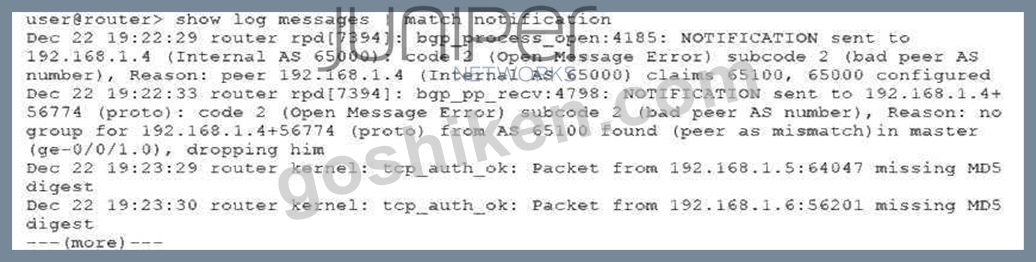
- A. The 192.168.1.4 peer has a misconfigured autonomous system number.
- B. The ge-0/0/1 interface is disabled.
- C. Packet fragmentation is preventing the session from establishing.
- D. The 192.168.1.5 peer has a misconfigured MD5 key.
正解:B、C
質問 # 61
Referring to the exhibit, which two statements are true with regards to deploying CoS? (Choose two.)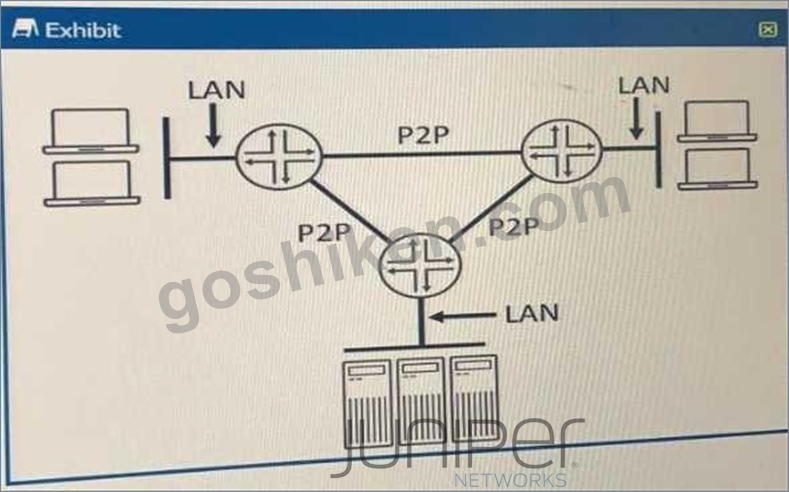
- A. You should apply MF classifiers on the LAN-facing interfaces of the routers
- B. You should apply BA classifiers on the LAN-facing interfaces of the routers
- C. You should apply MF classifiers on the point-to-point interfaces of the routers
- D. You should apply BA classifiers on the point-to point interfaces of the routers.
正解:A、D
質問 # 62
......
JN0-649 認定試験は、レイヤー 2 スイッチング技術、レイヤー 3 ルーティング技術、BGP プロトコル、IP マルチキャスト、セキュリティ機能、高可用性機能など、広範なトピックをカバーしています。認定試験に合格したプロフェッショナルは、Juniper のエンタープライズルーティングおよびスイッチング技術と、実際のシナリオでのその適用について、十分な理解を持っていることを証明します。また、Juniper の技術を使用する複雑なネットワークの設定およびトラブルシューティングが可能になります。
JN0-649リアル有効かつ正確な問題集195問題と解答が待ってます:https://www.goshiken.com/Juniper/JN0-649-mondaishu.html
JN0-649認証と実際の解答があります:https://drive.google.com/open?id=1_TArYN_UqeYn0meI6cOdMzENgQ3N8Fv6