

[2024年12月] 更新されたのはJuniper JN0-649問題集PDFオンラインエンジン
JN0-649.PDFで問題解答PDFサンプル問題は信頼され続ける
Juniper JN0-649試験は、キャリアを進めたいITプロフェッショナルにとって優れた機会です。この試験に合格し、JNCIP-ENT認定を取得することで、候補者のJuniper Networksのエンタープライズルーティングおよびスイッチングプラットフォームにおけるスキルと専門知識が証明され、どんな組織でも貴重なエージェントとなることができます。試験は多言語で提供され、世界中のテストセンターで受験することができ、候補者は自分の知識をグローバルに証明することができます。
質問 # 21
Referring to the exhibit, a RMSM network is set up to enable communication between multicast devices.
Which statement is true in this scenario?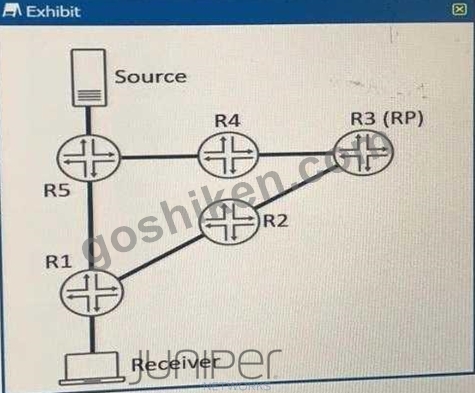
- A. After the formation of the shortest-path tree, a join message is sent from R1 to R5
- B. After the formation of the shortest-path free, a prune message is sent from R1 to R5.
- C. After the formation of the shortest-path tree, a join message is sent from R2 to R1.
- D. After the formation of the shortest-path tree, a prune message is sent from R1 to R2.
正解:D
質問 # 22
Referring to the outputs shown in the exhibit, which two statements are correct about the IS-IS adjacency? (Choose two.)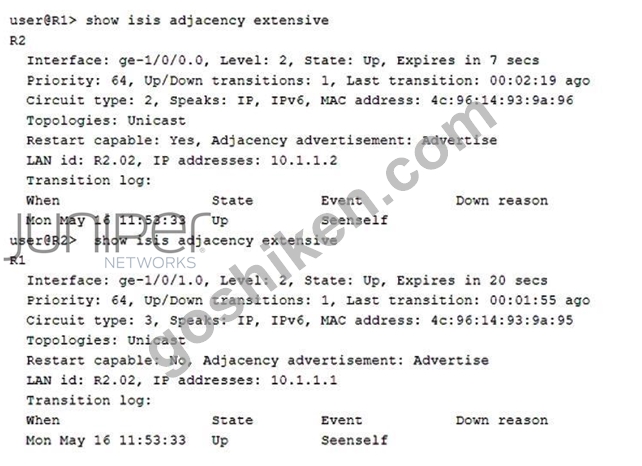
- A. R1 is configured to participate in both Level 1 and Level 2.
- B. R2 is configured to participate in Level 2 only.
- C. R1 is configured to participate in Level 2 only.
- D. R2 is configured to participate in both Level 1 and Level 2.
正解:A、B
解説:
R2 has circuit type 2 which means that R2 is configured to participate in Level 2 only, answer D is correct.
R1 has circuit type 3 which means that R1 is configured to participate in both Level 1 and Level 2, answer A is correct.
質問 # 23
You recently committed a change to a router to reject OSPF routes sourced from area 10. However, you are still seeing area 10 routes in the routing table.
Referring to the exhibit, which statement is correct?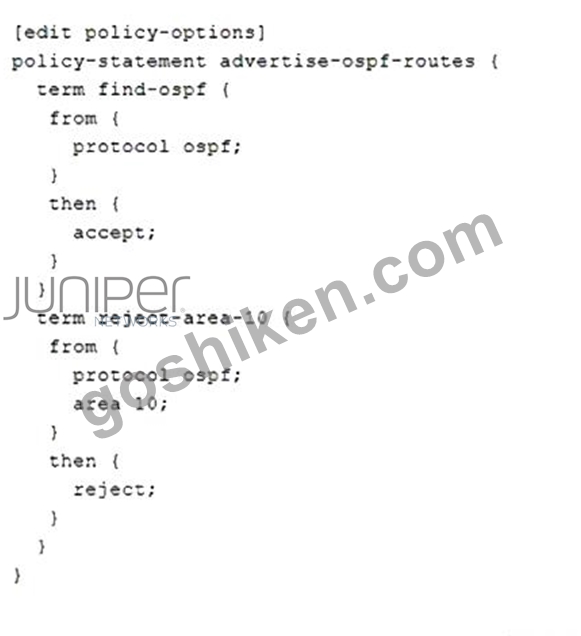
- A. The routes remain in the table until the device is rebooted.
- B. The OSPF protocol is first matched by find-ospf and accepted.
- C. The routes remain in the table until the routing daemon is restarted.
- D. The routes only timeout after 24 hours.
正解:B
質問 # 24
Click the exhibit.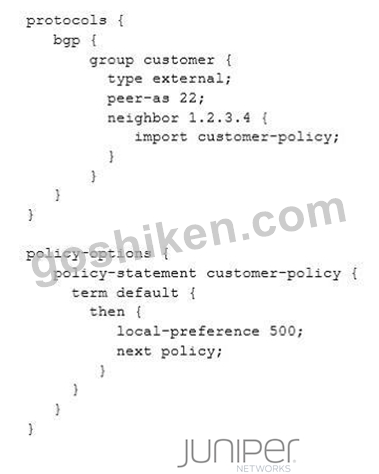
Where is the policy shown in the exhibit enforced?
- A. Between the BGP peer and the RIB-In table
- B. Between the RIB-IN and the RIB-LOCAL tables
- C. Between the RIB-OUT table and the BGP peer
- D. Between the RIB-LOCAL and the RIB-OUT tables
正解:B
質問 # 25
You are implementing 802.1x access control in your network of EX Series switches. You have some older client devices connecting to your network which do not support 802.1x.
Which statement is true regarding the older devices?
- A. By default, the authenticator will send EAP messages until it reaches a predefined, after which it begins to forward traffic.
- B. By default, the supplicant will send EAP messages and keep the port in an unauthorized state.
- C. By default, the authenticator will send EAP messages and keep the port in an unauthorized state.
- D. By default, the supplicant will send EAP messages until it reaches a predefined limit, after which it begins to forward traffic.
正解:D
質問 # 26
You want to provide Layer 2 connectivity between campus sites using Ethernet switches through a metro Ethernet service provider who is using Q-in-Q tagging on their network.
Referring to the exhibit, what are two design considerations in this environment? (Choose two.)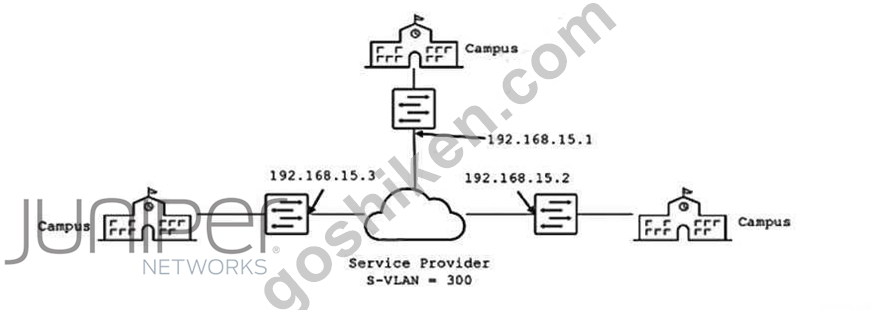
- A. L2PT is required on the SP network to support the spanning tree protocol.
- B. VXLAN could be implemented on your network across this service provider network.
- C. Each campus switch shown must have a C-Tag 300 configured.
- D. Each campus switch shown must have S-Tag 300 configured.
正解:A、D
質問 # 27
You have scheduled maintenance operations for one of the devices in your OSPF network.
Referring to the exhibit, which three statements are correct? (Choose three.)
- A. R1 does not send or receive transit traffic during the maintenance window even if no alternative paths exist to the given destination.
- B. Any traffic destined for networks that terminate on R1 will still be forwarded to R1.
- C. The metrics for all transit interfaces on R1 is set to the maximum value of 65,535.
- D. R1 does not participate in OSPF routing.
- E. R1 participates in OSPF routing but does not send or receive transit traffic.
正解:B、C、E
質問 # 28
Which three configuration parameters must match on all switches within the same MSTP region?
(Choose three.)
- A. bridge priority
- B. configuration name
- C. region name
- D. revision level
- E. VLAN to instance mapping
正解:C、D、E
解説:
When enabling MSTP, you define one or more MSTP regions. An MSTP region defines a logical domain where multiple spanning-tree instances (MSTIs) can be administered independently of MSTIs in other regions, setting the boundary for bridge protocol data units (BPDUs) sent by one MSTI. An MSTP region is a group of switches that is defined by three parameters:
Region name - User-defined alphanumeric name for the region.
Revision level - User-defined value that identifies the region.
Mapping table - Numerical digest of VLAN-to-instance mappings.
https://www.juniper.net/documentation/us/en/software/junos/stp-l2/topics/topic-map/spanning- tree-configuring-mstp.html
質問 # 29
You receive the same 100.200.0/16 route from all four ISPs to which you are connected.
Referring to the exhibit, which ISP's route will be selected as active?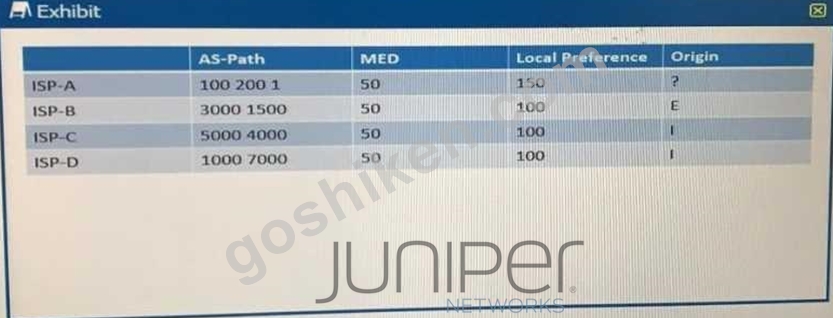
- A. ISP-D
- B. ISP-A
- C. ISP-B
- D. ISP-C
正解:B
質問 # 30
You are asked to configure 802.1X on your access ports to allow only a single device to authenticate.
In this scenario, which configuration would you use?
- A. single supplicant mode
- B. multiple supplicant mode
- C. MAC authentication mode
- D. single-secure supplicant mode
正解:D
解説:
Single supplicant mode authenticates only the first end device that connects to an authenticator port. All other end devices connecting to the authenticator port after the first has connected successfully, whether they are
802.1X-enabled or not, are permitted access to the port without further authentication. If the first authenticated end device logs out, all other end devices are locked out until an end device authenticates. Single-secure supplicant mode authenticates only one end device to connect to an authenticator port. No other end device can connect to the authenticator port until the first logs out
質問 # 31
You must ensure that all routes in the 10.0.0/8 address range are not advertised outside of your AS. Which well-known BGP community should be assigned to these addresses to accomplish this task?
- A. no-peer
- B. no-export
- C. no-advertise
- D. internet
正解:B
解説:
For specifying the BGP community attribute only, you also can specify community-ids as one of the following well-known community names defined in RFC 1997:
no-advertise - Routes containing this community name are not advertised to other BGP peers.
no-export - Routes containing this community name are not advertised outside a BGP confederation boundary.
no-export-subconfed - Routes containing this community are advertised to IBGP peers with the same AS number, but not to members of other confederations.
llgr-stale - Adds a community to a long-lived stale route when it is readvertised.
no-llgr - Marks routes which a BGP speaker does not want to be retained by LLGR. The Notification message feature does not have any associated configuration parameters.
https://www.juniper.net/documentation/us/en/software/junos/bgp/topics/ref/statement/community- edit-routing-options.html
質問 # 32
You are troubleshooting a BGP connection.
Referring to the exhibit, which two statements are correct? (Choose two.)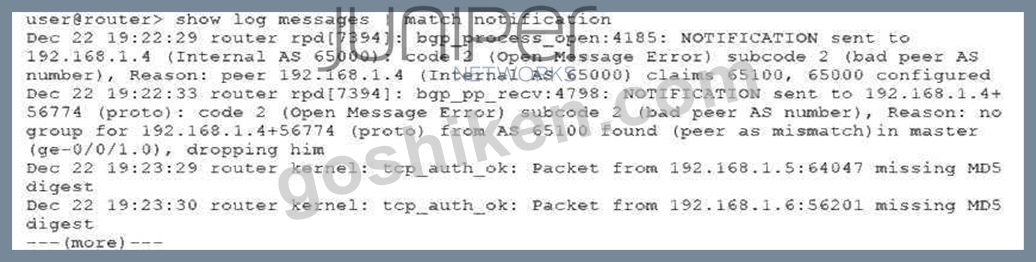
- A. The ge-0/0/1 interface is disabled.
- B. The 192.168.1.5 peer has a misconfigured MD5 key.
- C. Packet fragmentation is preventing the session from establishing.
- D. The 192.168.1.4 peer has a misconfigured autonomous system number.
正解:A、C
質問 # 33
Referring to the exhibit, how will router E quickly learn that the remote MAC addresses are no longer reachable through the router attached to the failed link?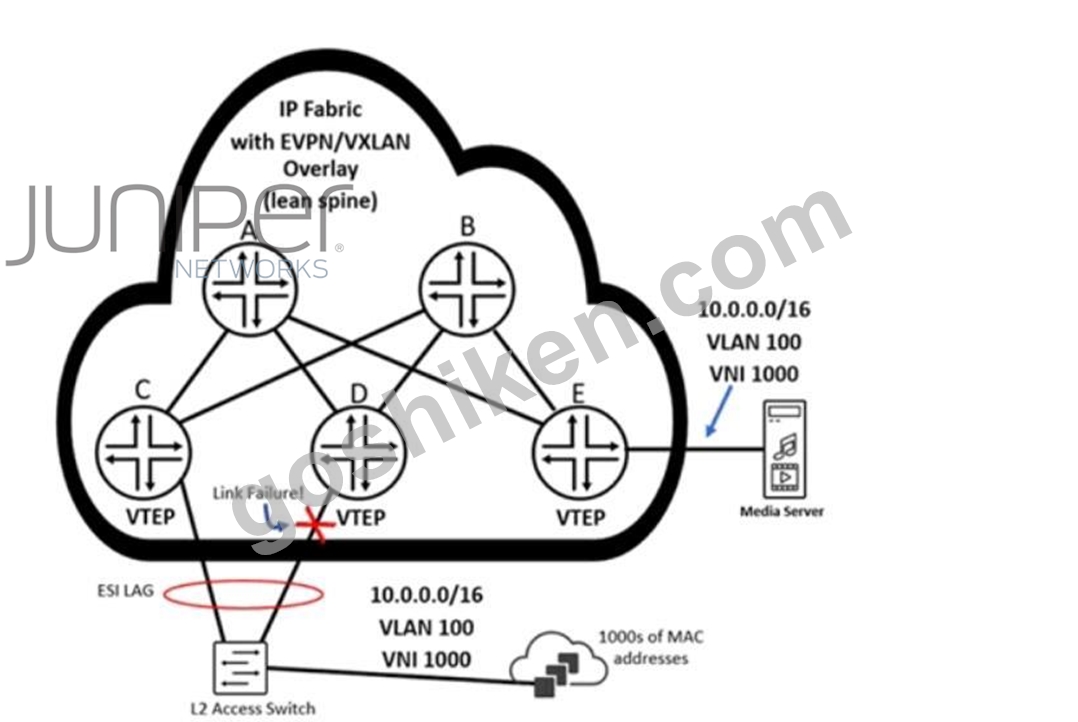
- A. Router E receives Type 1 withdrawal messages from router D.
- B. Router E receives Type 2 withdrawal messages from router C.
- C. Router E receives Type 1 withdrawal messages from router C.
- D. Router E receives Type 2 withdrawal messages from router D.
正解:A
質問 # 34
Which statement is correct about IS-IS?
- A. Level 2 routers must share the same area address.
- B. IS-IS uses areas and an autonomous system.
- C. Level 1 routers route traffic between autonomous systems.
- D. Level 1/2 routers automatically inject a default route to the nearest Level 1 router.
正解:B
解説:
Level 1/2 routers automatically inject a default route to the nearest Level 1 router. It's the other way around
質問 # 35
Which two statements are true about IS-IS levels? (Choose two.)
- A. Level 1 system only from adjacencies with other systems that have different area IDs.
- B. Level 2 systems do not advertise Level 2 routes into a Level area by default.
- C. Level 2 systems must use the loopback address as a part of the ISO network address.
- D. Level 1 systems use a default route to reach AS external routes located in other areas.
正解:D
質問 # 36
You are troubleshooting an EVPN-VXLAN IP fabric and observe the loop shown in the exhibit.
Which two steps would you take to further troubleshoot this problem? (Choose two.)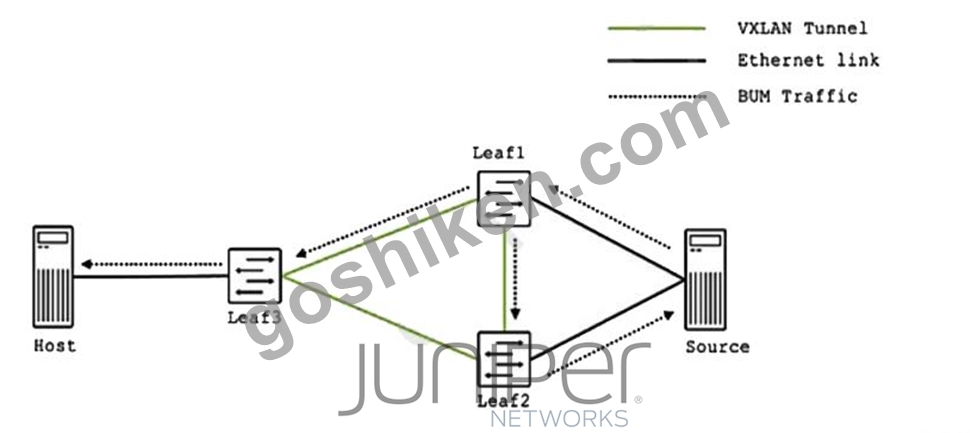
- A. Verify that the same ESI is configured on the link from the host and that it matches the source.
- B. Issue the show route table bgp.evpn.0 command on Leaf2 and verify that Type 4 routes are present.
- C. Verify that the same ESI is configured on the two links from the source.
- D. Issue the show route table bgp.evpn.0 command on Leaf2 and verify that Type 3 routes are present.
正解:B、D
解説:
Type 2 route, MAC with IP advertisement route-Type 2 routes are per-VLAN routes, so only PEs that are part of a VNI need these routes. EVPN allows an end host's IP and MAC addresses to be advertised within the EVPN Network Layer reachability information (NLRI). This allows for control plane learning of ESI MAC addresses. Because there are many Type 2 routes, a separate route-target auto-derived per VNI helps to confine their propagation. This route type is supported by all EVPN switches and routers. Type 5 route, IP prefix Route-An IP prefix route provides encoding for inter-subnet forwarding. In the control plane, EVPN Type 5 routes are used to advertise IP prefixes for inter-subnet connectivity across data centers. To reach a tenant using connectivity provided by the EVPN Type 5 IP prefix route, data packets are sent as Layer 2 Ethernet frames encapsulated in the VXLAN header over the IP network across the data centers.
質問 # 37
You have multiple BGP routes to the same prefix with equal local-preference values and AS-path lengths.
In this scenario, which route will be preferred in the route selection process?
- A. The route with the least preferred origin value.
- B. The route with the lowest MED value.
- C. The route with the most preferred origin value.
- D. The route with the highest MED value.
正解:C
解説:
https://www.juniper.net/documentation/en_US/junos/topics/reference/general/routing-protocols- address-representation.html
質問 # 38
You recently implemented the configurations shown in the exhibit. After committing these changes, the community devices connected to AS-1 are not able to communication with the appropriate community devices connected to AS-2.
What must be to allow these community devices to communicate?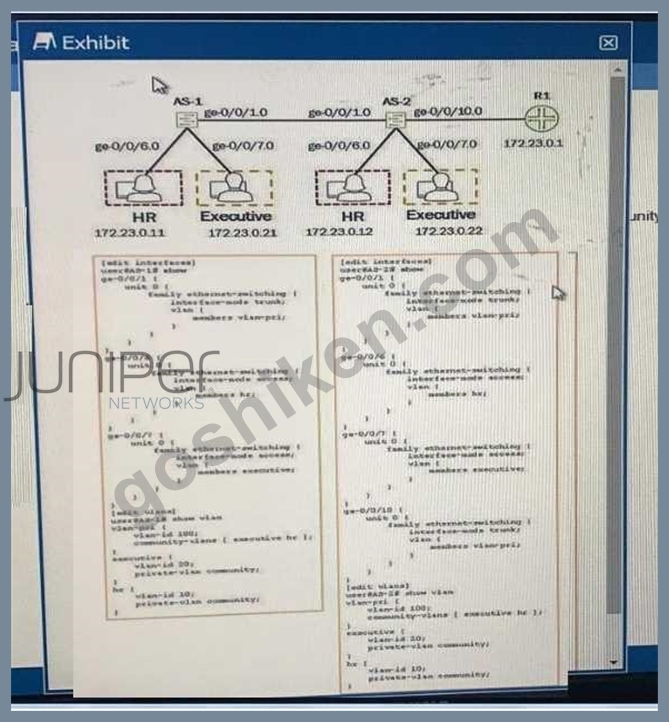
- A. You must configure the ge-0/0/1 interface on both switches the inter-switch links.
- B. You must configure an isolation VLAN ID under the vlan-pri VLAN on both switches.
- C. You must configure an isolation VLAN ID under the vlan-pri vlan on the AS-2 switch.
- D. You must configure the ge-0/0/10 interface on AS-1 as the inter-switch link.
- E. You must configure to allow the ge-0/0/1 interface on AS-1 as the inter-switch.
正解:A
質問 # 39
A BGP network has been designed to provide resiliency and redundancy to a multihomed customer network.
Which two statements are correct in this scenario? (Choose two.)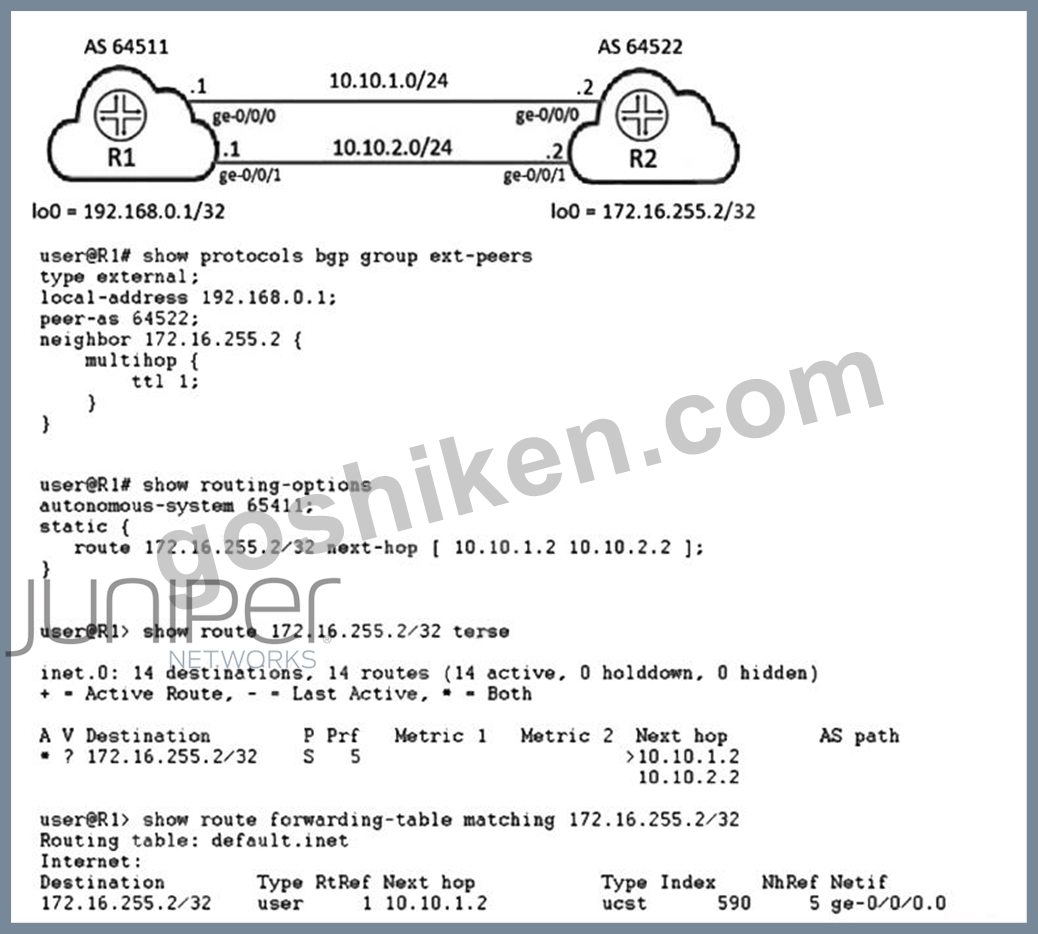
- A. The ttl statement must be configured to accommodate peering to a loopback address of a directly connected peer.
- B. A routing policy will be required to forward traffic to both next hops.
- C. The TTL value of 1 is set to limit the scope of the EBGP session.
- D. Both the next hops will be used to forward traffic to R2.
正解:B、C
解説:
B - because only one next hop in forwarding table C- becuse TTL=1 limiting bgp connection to be established only over loopbacks interface
https://www.juniper.net/documentation/us/en/software/junos/bgp/topics/topic-map/multihop-sessions.html Use the multihop statement to alter the default use of the neighbor's physical address. In addition, you can also specify a time-to-live (TTL) value in the BGP packets to control how far they propagate. We use a TTL value of 1 to ensure that the session cannot be established across any other backdoor links in the network.
質問 # 40
Referring to the outputs shown in the exhibit, which two statements are correct about the IS-IS adjacency? (Choose two.)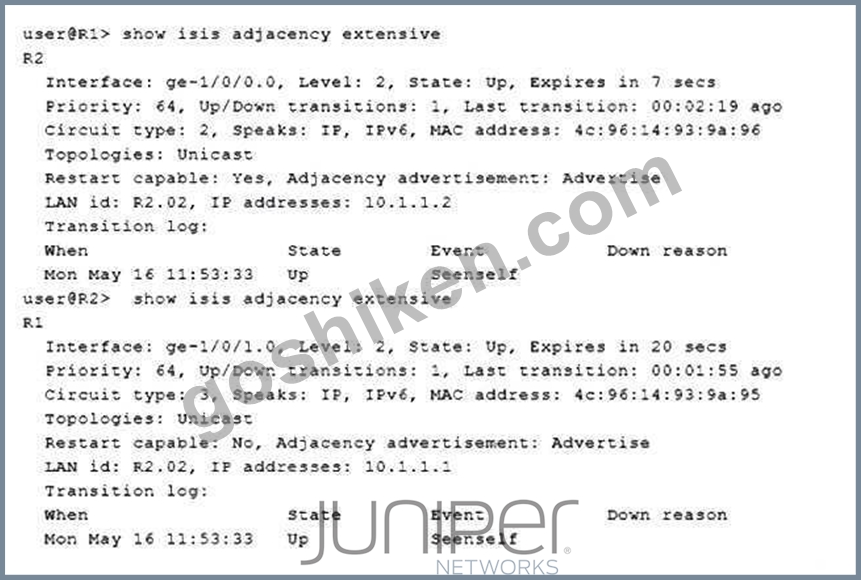
- A. R1 is configured to participate in Level 2 only.
- B. R1 is configured to participate in both Level 1 and Level 2.
- C. R2 is configured to participate in both Level 1 and Level 2.
- D. R2 is configured to participate in Level 2 only.
正解:A、C
質問 # 41
What are two supported PoE management modes? (Choose two.)
- A. static
- B. standalone
- C. class
- D. mixed
正解:A、C
質問 # 42
......
Juniper JN0-649問題集PDFのベストを目指すなら問題集を使おう 目指そう高得点:https://www.goshiken.com/Juniper/JN0-649-mondaishu.html
JNCIP-ENT JN0-649試験と認定テストエンジン:https://drive.google.com/open?id=1hrt_7m_Q9x5Z5FQ9WTaQgkrTnHz3BnIk