

[2025年05月15日] 検証済みのL4M2問題集と239格別な問題
L4M2問題集合格保証付きの合格できるL4M2試験2025年更新
Defining Business Needsモジュールは、調達および供給のレベル4ディプロマの重要な構成要素です。このモジュールは、ビジネスニーズを効果的に特定および分析するために必要なスキルと知識をプロフェッショナルに提供します。このモジュールは、自組織内で調達および供給チェーン活動に責任を持つプロフェッショナルや、調達および供給チェーン管理のキャリアを追求したいと考えている人々に関連しています。
質問 # 109
Which of the following activities are considered as primary activities of an organization according to Porter's value chain? Select TWO that apply:
- A. Assembly design
- B. Picking and delivery components
- C. Trainees recruitment
- D. Maintenance
- E. Sourcing transportation services
正解:B、D
解説:
Primary activities consist of inbound logistics, operations, outbound logistics, sales & marketing, service.
Second activities consist of firm infrastructure, human resource management, technology development and procurement The following graph illustrate the value chain (Source: Smartsheet)
Picking and delivery components is inbound logistics.
Maintenance is an example of operations activity.
Sourcing transportation services is an activity of procurement
Assembly design is an activity in research and development (Technology) Recruiting is an activity of human resource management Reference:
LO 2, AC 2.1
質問 # 110
GE has developed TurboProp engine that is made from over 850 metal parts. These parts are sourced from many suppliers. Value of spend on these parts make up 73% of total spend. Any delay in receiving a part will cause a bottleneck around the production of the engine. Which of the following should be the best course of action of GE's CPO?
- A. Reduce delivery cost
- B. Part standardisation
- C. Increase production
- D. Drive down prices by using market competition
正解:B
解説:
In this scenario, the final product has vast range of parts. The second problem is lacking any part can cause disruption to the production process. So GE has 2 things to do: to reduce the part varie-ties, and secure the supply. Part standardisation is the best option here. It can simplify the range of parts or materials used, and simultaneously, it expands the supply base of GE. If a supplier fails to deliver the part, the company always has other options to replace.
Costs are also a concern, but bottleneck in production imposes a serious risk to the organisation. Driving down costs using market competition cannot be a foremost priority.
Increasing production may help to reduce bottleneck. However, it will also increase the inventory of finished products and unnecessary upkeep costs.
LO 3, AC 3.4
質問 # 111
Which of the following are typical benefits of through-life asset management to buying organisa-tion? Select the TWO that apply.
- A. Shorter specifications
- B. Lower total cost of ownership
- C. Lower risks as there are many suppliers accountable for costs and service over the life of the asset
- D. Greater supplier's bargaining power
- E. Better capability of supplier over time
正解:B、E
解説:
According to Andrew Graves, "Through-life Management involves the life-cycle management of the products, services and activities required to deliver a fully integrated capability to the customer, while reducing the cost of ownership for the customer." Benefits of through-life asset management can be:
- Lower total life-cycle costs
- Better match between the asset and end-user's needs
- Better supplier capabilities over time because it gains experience of buying organisation's needs.
Reference:
LO 3, AC 3.2
質問 # 112
When procuring a machinery, at which stage buyer must check whether it is working to the stand-ards set out in the design specification?
- A. Installation
- B. Customer support
- C. Maintenance and repair activities
- D. Manufacture
正解:A
解説:
Through-life Management involves the life-cycle management of the products, services and activities required to deliver a fully integrated capability to the customer, while reducing the cost of ownership for the customer.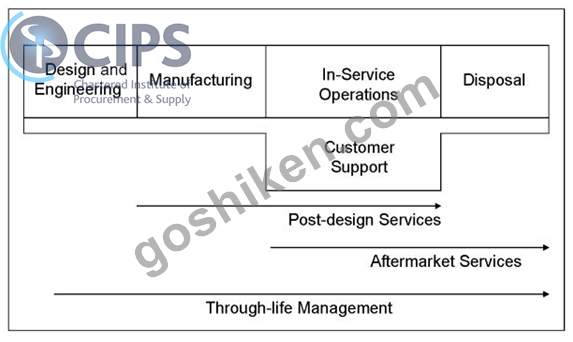
Source: Andrew Graves
The installation stage occurs in In-Service Operations. At this stage, the machinery is shipped and installed on the buyer's premises and check to ensure that it is working to the standards set out in the design specification.
Reference:
LO 3, AC 3.2
質問 # 113
A procurement team is categorising their purchased items into four quadrants of Kraljic's supply chain portfolio matrix. They realise that there are some low-value items which come from very few suppliers in the market. The organisation is critically dependent on these suppliers. The team plans to reduce the dependence by finding alternative sources. Is this a right course of action?
- A. Yes, this action will dramatically increase the supplier's bargaining power
- B. Yes, the organisation needs to reduce the supply risks
- C. No, there is no way to escape this dependency
- D. No, the organisation should run competitive biddings to exploit the competition
正解:B
解説:
According to Kraljic portfolio matrix, the low-value items with high supply risk are bottleneck items.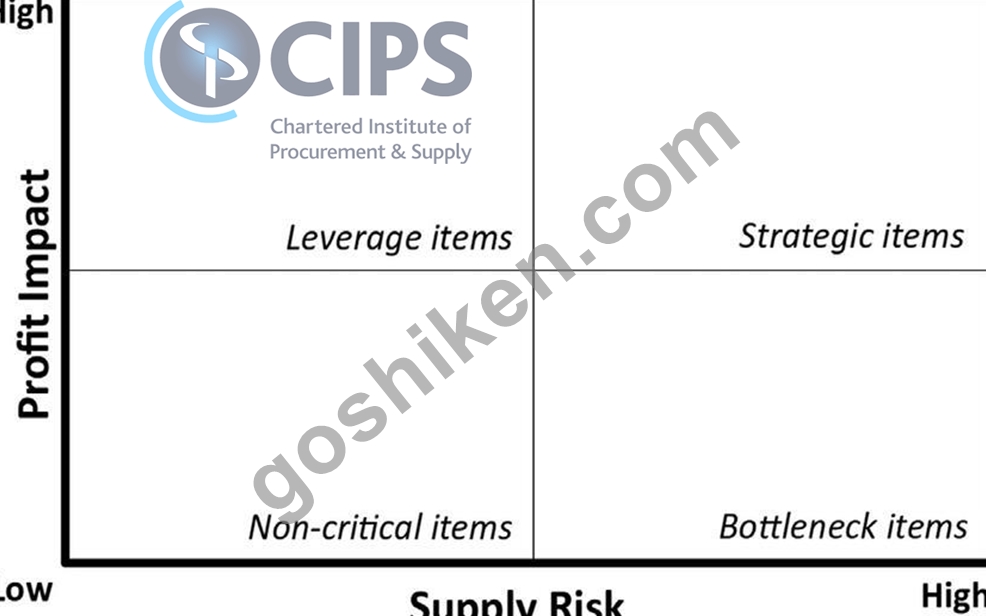
The purchasing strategy that is commonly recommended for these products is primarily based on acceptance of the dependence and reduction of the negative effects of the unfavourable position. An alternative strategy suggested by purchasing practitioners is to find other suppliers and move towards the non-critical quadrant.
- Accept dependence, reduce negative consequences: The main focus of this strategy is to assure supply, if necessary even at additional cost. Examples of this strategy are keeping extra stocks of the materials concerned or developing consigned stock agreements with suppliers. By performing a risk analysis firms can identify the most important bottleneck products and consider the implications. A possible action for dealing with unexpected bad dependence positions for certain products is to employ contingency planning.
- Reduce dependence and risk, find other solutions: This strategy is geared towards reducing the dependence on the supplier. The most common way to achieve this is to broaden the specifications of the product or to search for new suppliers.
The procurement team in the scenario has selected reducing dependency by finding alternatives. This is a right strategy for bottleneck item.
質問 # 114
An IT department has tasked procurement to help produce a conformance specification for new company laptops. Which factor is common within a conformance specification?
- A. Tends to be short and specific
- B. Allows flexibility in the offering
- C. Meets the operational requirements
- D. Meets the specification standard
正解:D
解説:
Detailed Explanation:Conformance specifications outline specific technical standards or requirements that a product must meet. These ensure uniformity and compliance but do not allow flexibility for suppliers to innovate. Reference: CIPS Level 4, Specification Standards.
質問 # 115
Which of the following specific markets is most likely to have product shortage by nature?
- A. Construction
- B. Retail
- C. Financial
- D. Agriculture
- E. Services
正解:D
解説:
Products used in agriculture can be subject to shortage due to natural disasters.
質問 # 116
A construction company requires a specification that details the exact composition of the concrete mix and the exact methods of construction required for its use. Which specification should it adopt?
- A. Design specification
- B. Functional specification
- C. Performance specification
- D. Ergonomic specification
正解:A
質問 # 117
Which of the following problems may be identified as closed problems? Select TWO that apply:
- A. The suppliers don't comply with the company's policy on underage labour.
- B. A cyber attack takes down whole company's IT system
- C. There are not enough data for procurement analytics
- D. Shortage of key medicines in healthcare industry
- E. Logistics costs incur a large portion in wholesale prices
正解:B、D
解説:
Closed problem is something happens that should not have happened. To solve this type of prob-lem, procurement professional should find a way to correct the situation or try to adapt to it. On the other hand, open ended problem is a obstacle to your short-term objective. You will need to overcome this obstacle.
Shortage of key medicines is a situation in which procurement must find a substitution or try to save the current stock.
In case of cyber attack, procurement should find a way to recover the IT system as soon as possible.
Otherwise, 'There are not enough data for procurement analytics' is an open-ended problem be-cause it prevents company to conduct procurement analytics (an objective).
'Logistics costs incur a large portion in wholesale prices': In this situation, logistics costs are hur-dles that prevent companies to reach lower wholesale.
'The suppliers don't comply with the company's policy on underage labour': In this situation, pro-curement should seek ways to help supplier comply with the company's labour policy.
LO 1, AC 1.1
質問 # 118
What are the direct risks that can result from procurement receiving inadequate specifications from a research and development department?
- A. Increased labour costs
- B. Under or over statement of need
- C. Under or over delivery of goods
- D. Increased business size
正解:C
質問 # 119
A purchaser is looking for alternative supplies if there is a major disruption to their supply chain, including logistics, manufacturing and all support services. Which of the following method is that purchaser applying?
- A. Treat the risk
- B. Transfer the risk
- C. Terminate the risk
- D. Tolerate the risk
正解:A
解説:
Risk control is the process by which an organization reduces the likelihood of a risk event occurring or mitigates the effects that risk should it occur. CIPS preferred way to determine your risk control strategy is to use the four T's Process:
Transferring Risk can be achieved through the use of various forms of insurance, or the payment to third parties who are prepared to take the risk on behalf of the organization Tolerating Risk is where no action is taken to mitigate or reduce a risk. This may be because the cost of instituting risk reduction or mitigation activity is not cost-effective or the risks of impact are at so low that they are deemed acceptable to the business. Even when these risks are tolerated they should be monitored because future changes may make it no longer tolerable.
Treating Risk is a method of controlling risk through actions that reduce the likelihood of the risk occurring or minimize its impact prior to its occurrence. Also, there are contingent measures that can be developed to reduce the impact of an event once it has occurred. Finding an alternative sup-plier is an example of treating the risk.
Terminating Risk is the simplest and most often ignored method of dealing with risk. It is the ap-proach that should be most favored where possible and simply involves risk elimination. This can be done by altering an inherently risky process or practice to remove the risk. The same can be used when reviewing practices and processes in all areas of the business.
If an item presents a risk and can be changed or removed without it materially affecting the busi-ness, then removing the risk should be the first option considered; rather than attempting the treat, tolerate or transfer it.
質問 # 120
Daytona Ltd is developing a new product which is more environmental friendly. Though the objectives are set, the project team has no idea on which functions will be customers' favourites. Which of the following will help them decide the 'should-have' functions of the new product?
- A. Taguchi method
- B. Kano model
- C. Thomas-Kilmann model
- D. Six Sigma
正解:B
解説:
The Kano model is useful in gaining a thorough understanding of a customer's needs. You can translate and transform the resulting verbatims using the voice of the customer table that, subse-quently, becomes an excellent input as the whatsin a quality function deployment (QFD) House of Quality.
The model involves two dimensions:
Achievement (the horizontal axis), which goes from the supplier didn't do it at all to the supplier did it very well.
Satisfaction (the vertical axis), which goes from total dissatisfaction with the product or service to total satisfaction with the product or service.
Dr. Noriaki Kano isolated and identified three levels of customer expectations: that is, what it takes to positively impact customer satisfaction. The figure below portrays the three levels of need: expected, normal, and exciting.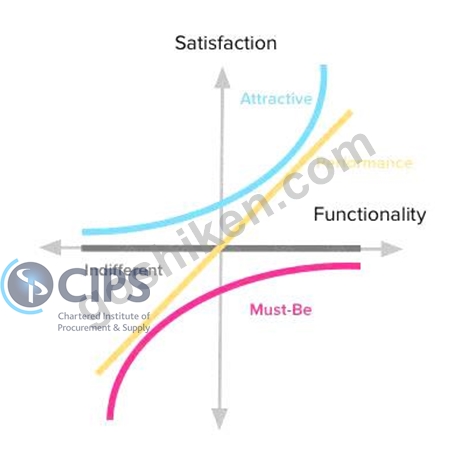
The Thomas-Kilmann Conflict Mode Instrument (TKI) is a conflict style inventory, which is a tool developed to measure an individual's response to conflict situations.
Genichi Taguchi, a Japanese engineer, proposed several approaches to experimental designs that are sometimes called "Taguchi Methods." These methods utilize two-, three-, and mixed-level fractional factorial designs. Large screening designs seem to be particularly favored by Taguchi adherents.
Six Sigma is a method that provides organizations tools to improve the capability of their business processes.
This increase in performance and decrease in process variation helps lead to defect re-duction and improvement in profits, employee morale, and quality of products or services.
Source:
- CIPS study guide page 171-172
- WHAT IS THE KANO MODEL?
LO 3, AC 3.4
質問 # 121
To strengthen its market presence, ABC Group decided to develop a new product. A cross-functional team was formed to discuss the scope and the functions of the product. They will also survey the potential customers to see what they like, what they love, and what they dislike. What is this process called?
- A. Value analysis
- B. Cash flow analysis
- C. Value engineering
- D. Product standardisation
正解:C
解説:
As you can see from the scenario, ABC Group is developing the new product. It might be using value engineering. The latter sentences confirm this: the cross-functional team in ABC is mapping the functions and surveying the customers. Their method is known as Kano model.
Reference:
LO 3, AC 3.4
質問 # 122
GSC Ltd is a manufacturer of car parts. To accommodate growing demands of electric cars, the company is developing a new component which requires different type of steel. The project team estimates that the component will be ready for production in 1.5 years. Until then, they need to keep the production busy.
After checking the inventory records, the production team sees that the company has 3 months of stock. The lead time for each batch is two months. Which of the following should be a priority ac-tion of the company?
- A. Standardise the specification
- B. Make a call-off order to current supplier
- C. Create new specification to current supplier
- D. Create new specification to new supplier
正解:B
解説:
The scenario is very long with many distracting data. Students need to read carefully and use their experience to solve this problem.
The company is developing a new component which requires different type of material. But this component will not be available for mass production in 1.5 years. This means the company still needs to produce the current components with current materials until the development is finished. They must continue purchase the materials from current supplier through call-off orders. This situation is an example of straight re-buy.
質問 # 123
A buyer can use sources of information to review indirect costs associated with the manufacture of goods to support supplier negotiations. Is this statement true?
- A. Yes, because the buyer can understand the cost build-up of the goods
- B. No, because the supplier's quotation is the only source of information
- C. Yes, because indirect costs are always variable
- D. No, because the only information available is for direct costs
正解:A
解説:
Detailed Explanation:Analyzing both direct and indirect costs helps buyers understand cost structures and negotiate effectively. Indirect costs, like overheads, can be identified through supplier data and market benchmarks, aiding in cost transparency. Reference: CIPS Level 4, Cost Management and Negotiation.
質問 # 124
To improve the productivity, Plantation Ltd is planning to purchase a tractor, which it has never bought before. The project must be quick to catch up with the next growing season. Leanne, a jun-ior procurement staff at the company, assumes that she could skip market analysis stage to save time. Is this assumption reasonable?
- A. Yes, the company has extensive experience in purchasing tractor
- B. No, market analysis will inform the company of the pricing as well as latest technology trends
- C. Yes, Leanne just needs to purchase the tractor from her friend's company
- D. No, the company assesses supplier's performance solely based on market analysis
正解:B
解説:
Market analysis is a stage in CIPS Procurement and Supply Cycle. This stage informs the purchaser about the number of suppliers, the average pricing, and product trends. Even urgent purchase should undergo market analysis. Without undertaking this stage, the buying organisation may not purchase the right product, or they may purchase at higher price.
質問 # 125
The procurement team of a global supermarket has created a business case for a corporate social responsibility (CSR) sourcing strategy to meet the corporate objective of sustainability. This would require sourcing only from suppliers who meet ethical standards, a reduction in plastic, and using recycled material where possible. Which of the following business benefits would be mentioned in the business case? Select TWO that apply:
- A. Reduced cost
- B. Leverage of technology
- C. Increased capacity
- D. Fulfilment of a business objective
- E. Improved brand equity
正解:D、E
解説:
Detailed Explanation:
* A (Fulfilment of business objective): Aligning procurement practices with sustainability goals supports the overall corporate strategy.
* D (Improved brand equity): Sustainable practices enhance reputation and consumer trust.Other options, like increased capacity or reduced costs, are secondary or unrelated to CSR initiatives.
Reference: CIPS Level 4, CSR and Sustainability.
質問 # 126
A procurement manager is discussing with other stakeholders about the scope and the implementation of the upcoming construction project. A stakeholder argues that the construction projects are often risky as the overall scope of the work can't be accurately estimated from the beginning. Furthermore, the project spans over a long period, the costs of materials can fluctuate widely. The procurement manager suggests that the pricing structure should be able to cover the supplier's costs plus 10% markup on total costs. This arrangement is known as...?
- A. Cost-plus award fee
- B. Cost-plus Fixed percentage
- C. Cost-plus incentive fee contracts
- D. Cost-plus fixed-fee
正解:B
解説:
As you can see from the scenario, the procurement manager is suggesting to use cost plus pricing arrangement.
A cost-plus contract is an agreement to reimburse a company for expenses incurred plus a specific amount of profit, usually stated as a percentage of the contract's full price. These type of contracts are primarily used in construction where the buyer assumes some of the risk but also provides a degree of flexibility to the contractor.
Cost-plus contracts can be separated into four categories. They each allow for the reimbursement of costs as well as an additional amount for profit:
1. Cost-plus award fee contracts allow the contractor to be awarded a fee usually for good per-formance.
2. Cost-plus fixed-fee contracts cover both direct and indirect costs, in addition to a fixed fee.
3. Cost-plus incentive fee contracts happen when the contractor is given a fee if his or her perfor-mance meets or exceeds expectations.
4. Cost-plus percent-of-cost contracts allow the amount of reimbursement to rise if the contrac-tor's costs rise.
In the scenario, the procurement manager suggests a pricing structure that covers supplier's costs and adds
10% markup. This is cost-plus fixed-percentage.
質問 # 127
......
最新100%合格率保証付きの素晴らしいL4M2試験問題PDF:https://www.goshiken.com/CIPS/L4M2-mondaishu.html
L4M2試験問題集を試そう!ベストL4M2試験問題:https://drive.google.com/open?id=1Ex_c2sVmLbfNDWAgpBSI1TZcEwl2jtD_