

最適な練習法にはDP-100問題集で素晴らしいDP-100試験問題PDF
更新された検証済みの合格させるDP-100試験リアル問題と解答があります
Microsoft DP-100 (Azure上でのデータサイエンスソリューションの設計と実装)試験は、Azureテクノロジーを使用してデータサイエンスソリューションを設計および実装するために必要なスキルと知識を評価する認定試験です。この試験は、データサイエンスの分野で専門知識を示し、キャリアの展望を広げたいプロフェッショナルに最適です。
質問 # 134
You create an Azure Machine Learning pipeline named pipeline1 with two steps that contain Python scripts. Data processed by the first step is passed to the second step.
You must update the content of the downstream data source of pipeline1 and run the pipeline again You need to ensure the new run of pipeline1 fully processes the updated content.
Solution: Set the allow_reuse parameter of the PythonScriptStep object of both steps to False Does the solution meet the goal?
- A. Yes
- B. No
正解:B
質問 # 135
You create an Azure Machine Learning workspace. You use the Azure Machine Learning Python SDK v2 to create a compute cluster.
The compute cluster must run a training script. Costs associated with running the training script must be minimized.
You need to complete the Python script to create the compute cluster.
How should you complete the script? To answer, select the appropriate options in the answer area.
NOTE: Each correct selection is worth one point.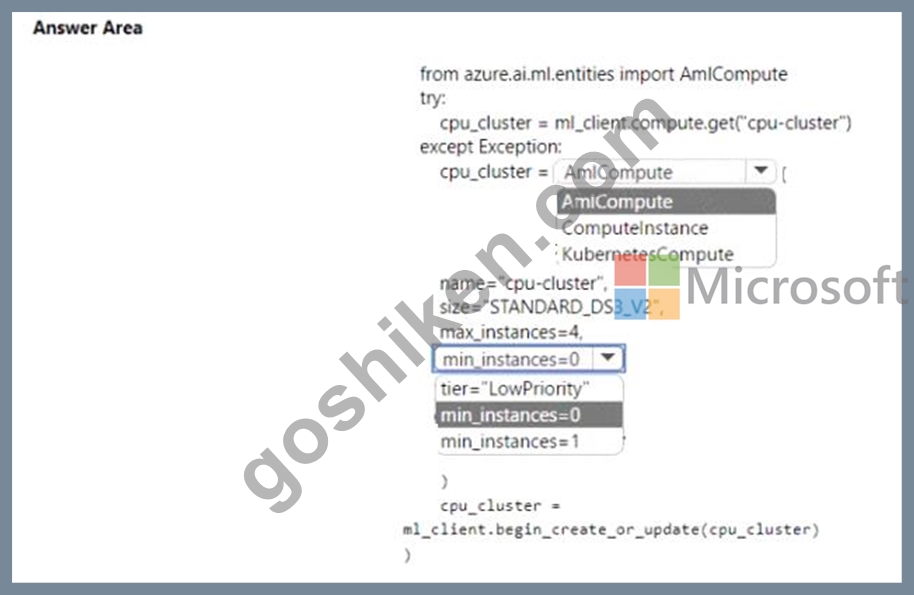
正解:
解説: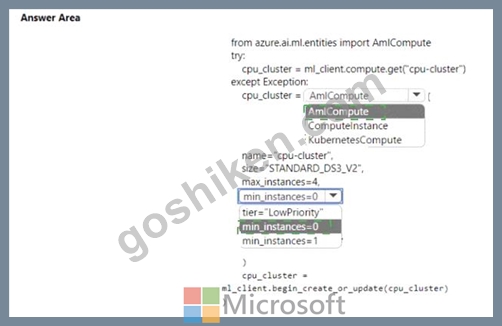
Explanation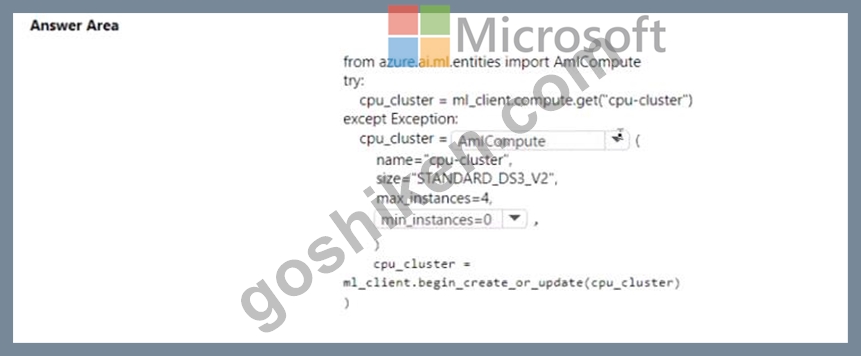
質問 # 136
You are using the Hyperdrive feature in Azure Machine Learning to train a model.
You configure the Hyperdrive experiment by running the following code: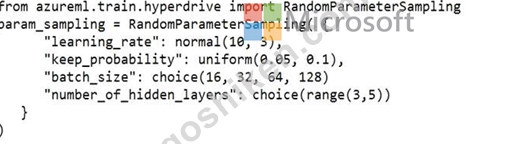
For each of the following statements, select Yes if the statement is true. Otherwise, select No.
NOTE: Each correct selection is worth one point.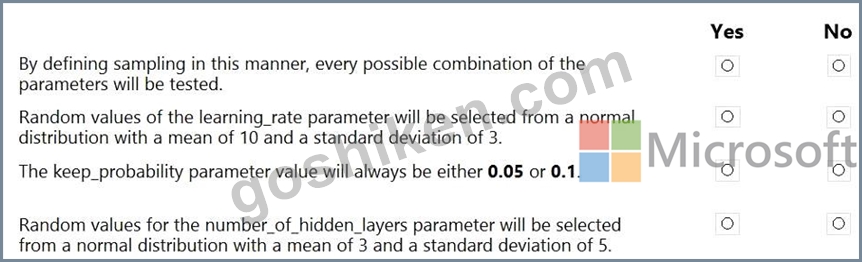
正解:
解説: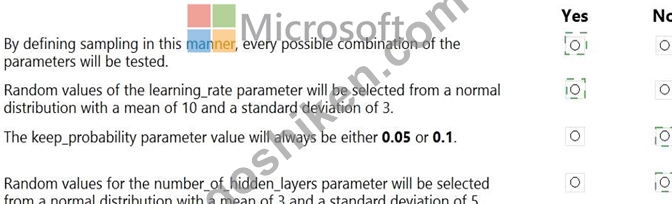
Explanation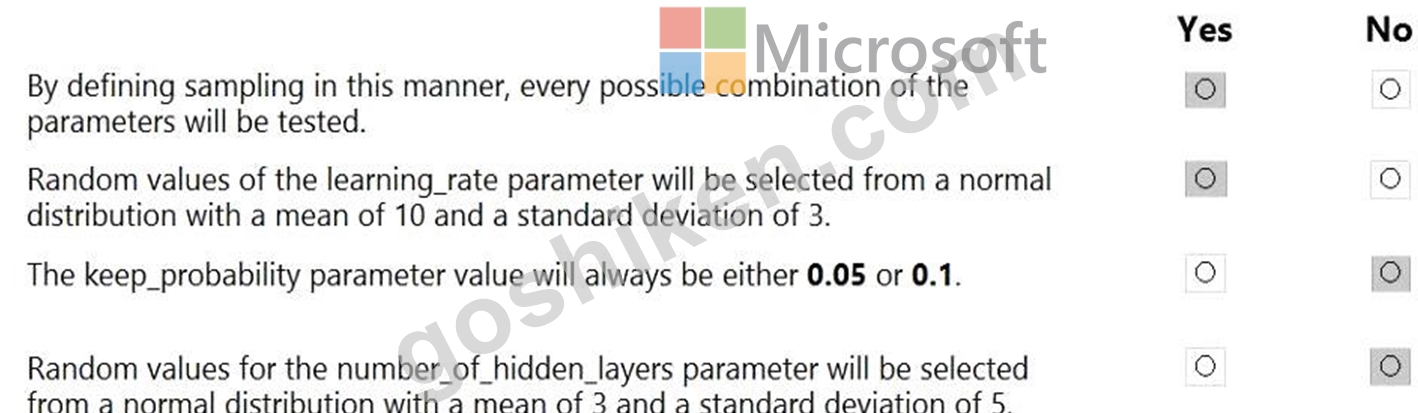
Box 1: Yes
In random sampling, hyperparameter values are randomly selected from the defined search space. Random sampling allows the search space to include both discrete and continuous hyperparameters.
Box 2: Yes
learning_rate has a normal distribution with mean value 10 and a standard deviation of 3.
Box 3: No
keep_probability has a uniform distribution with a minimum value of 0.05 and a maximum value of 0.1.
Box 4: No
number_of_hidden_layers takes on one of the values [3, 4, 5].
Reference:
https://docs.microsoft.com/en-us/azure/machine-learning/how-to-tune-hyperparameters
質問 # 137
You create a binary classification model using Azure Machine Learning Studio.
You must use a Receiver Operating Characteristic (RO C) curve and an F1 score to evaluate the model.
You need to create the required business metrics.
How should you complete the experiment? To answer, select the appropriate options in the dialog box in the answer area.
NOTE: Each correct selection is worth one point.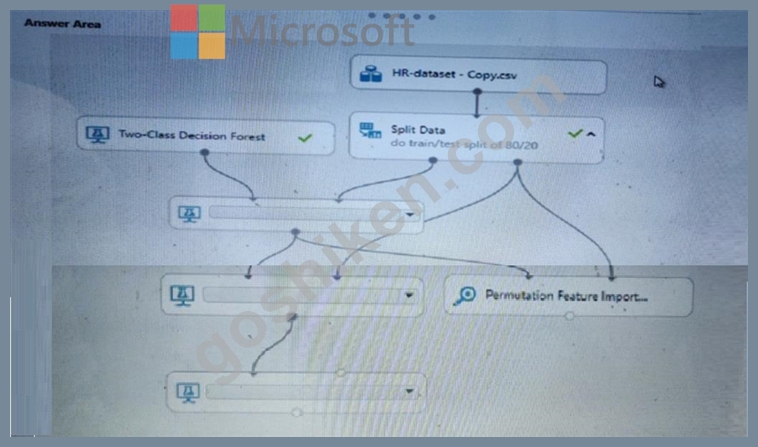
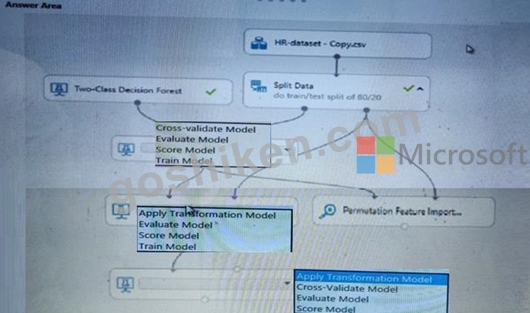
正解:
解説: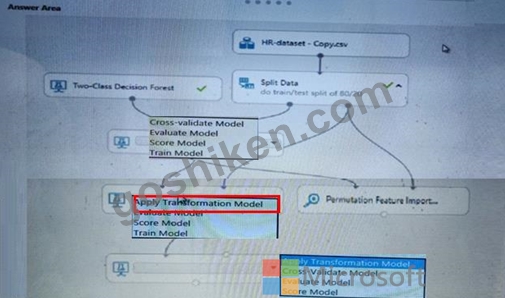
質問 # 138
You have a dataset created for multiclass classification tasks that contains a normalized numerical feature set with 10,000 data points and 150 features.
You use 75 percent of the data points for training and 25 percent for testing. You are using the scikit-learn machine learning library in Python. You use X to denote the feature set and Y to denote class labels.
You create the following Python data frames:
You need to apply the Principal Component Analysis (PCA) method to reduce the dimensionality of the feature set to 10 features in both training and testing sets.
How should you complete the code segment? To answer, select the appropriate options in the answer area.
NOTE: Each correct selection is worth one point.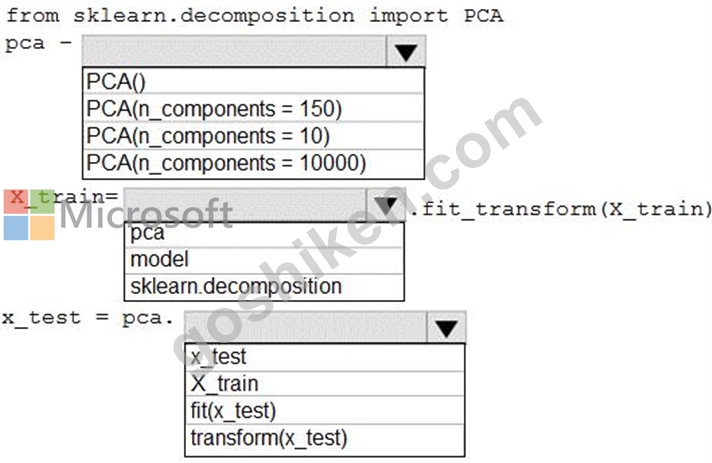
正解:
解説: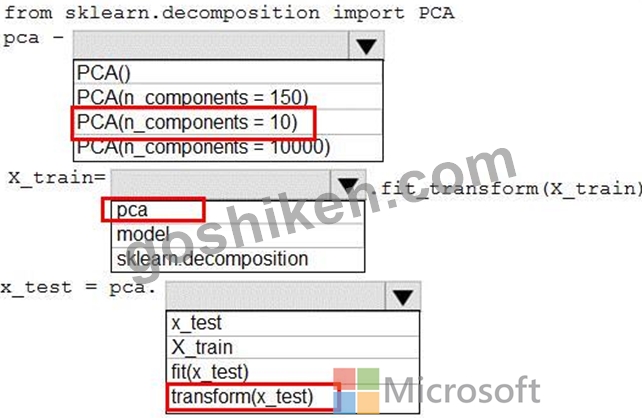
Reference:
https://scikit-learn.org/stable/modules/generated/sklearn.decomposition.PCA.html
質問 # 139
You have a feature set containing the following numerical features: X, Y, and Z.
The Poisson correlation coefficient (r-value) of X, Y, and Z features is shown in the following image:
Use the drop-down menus to select the answer choice that answers each question based on the information presented in the graphic.
NOTE: Each correct selection is worth one point.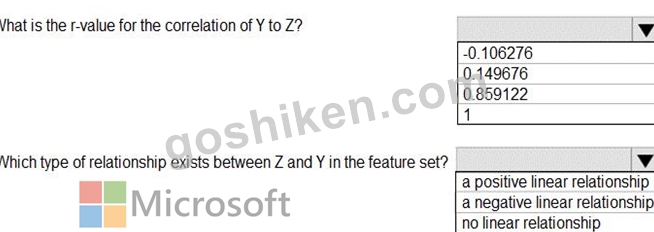
正解:
解説: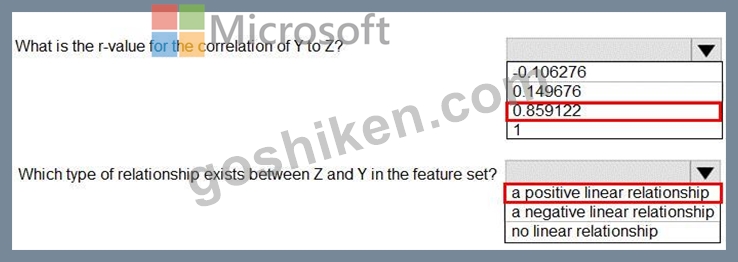
Explanation:
Box 1: 0.859122
Box 2: a positively linear relationship
+1 indicates a strong positive linear relationship
-1 indicates a strong negative linear correlation
0 denotes no linear relationship between the two variables.
References:
https://docs.microsoft.com/en-us/azure/machine-learning/studio-module-reference/compute-linear-correlation
質問 # 140
You have a dataset created for multiclass classification tasks that contains a normalized numerical feature set with 10,000 data points and 150 features.
You use 75 percent of the data points for training and 25 percent for testing. You are using the scikit-learn machine learning library in Python. You use X to denote the feature set and Y to denote class labels.
You create the following Python data frames: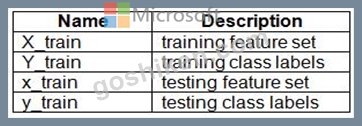
You need to apply the Principal Component Analysis (PCA) method to reduce the dimensionality of the feature set to 10 features in both training and testing sets.
How should you complete the code segment? To answer, select the appropriate options in the answer area.
NOTE: Each correct selection is worth one point.
正解:
解説: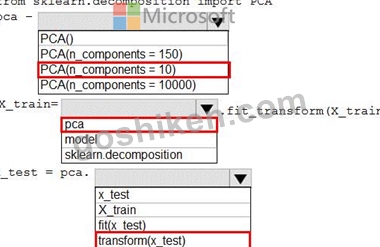
Explanation:
Box 1: PCA(n_components = 10)
Need to reduce the dimensionality of the feature set to 10 features in both training and testing sets.
Example:
from sklearn.decomposition import PCA
pca = PCA(n_components=2) ;2 dimensions
principalComponents = pca.fit_transform(x)
Box 2: pca
fit_transform(X[, y])fits the model with X and apply the dimensionality reduction on X.
Box 3: transform(x_test)
transform(X) applies dimensionality reduction to X.
References:
https://scikit-learn.org/stable/modules/generated/sklearn.decomposition.PCA.html
質問 # 141
You need to implement early stopping criteria as suited in the model training requirements.
Which three code segments should you use to develop the solution? To answer, move the appropriate code segments from the list of code segments to the answer area and arrange them in the correct order.
NOTE: More than one order of answer choices is correct. You will receive credit for any of the correct orders you select.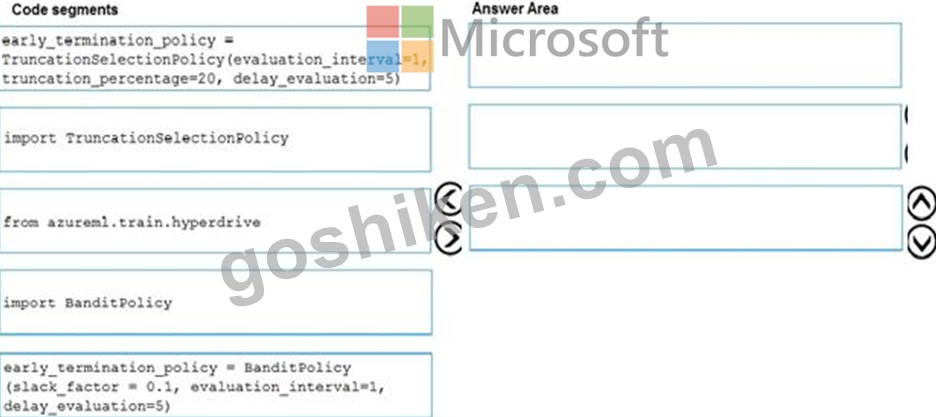
正解:
解説: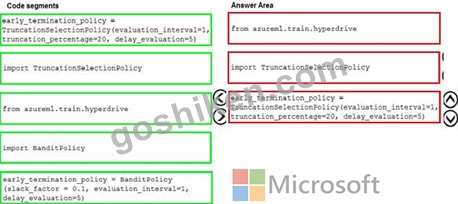
Explanation:
You need to implement an early stopping criterion on models that provides savings without terminating promising jobs.
Truncation selection cancels a given percentage of lowest performing runs at each evaluation interval. Runs are compared based on their performance on the primary metric and the lowest X% are terminated.
Example:
from azureml.train.hyperdrive import TruncationSelectionPolicy
early_termination_policy = TruncationSelectionPolicy(evaluation_interval=1, truncation_percentage=20, delay_evaluation=5) Incorrect Answers:
Bandit is a termination policy based on slack factor/slack amount and evaluation interval. The policy early terminates any runs where the primary metric is not within the specified slack factor / slack amount with respect to the best performing training run.
Example:
from azureml.train.hyperdrive import BanditPolicy
early_termination_policy = BanditPolicy(slack_factor = 0.1, evaluation_interval=1, delay_evaluation=5 References:
https://docs.microsoft.com/en-us/azure/machine-learning/service/how-to-tune-hyperparameters
質問 # 142
space and set up a development environment. You plan to train a deep neural network (DNN) by using the Tensorflow framework and by using estimators to submit training scripts.
You must optimize computation speed for training runs.
You need to choose the appropriate estimator to use as well as the appropriate training compute target configuration.
Which values should you use? To answer, select the appropriate options in the answer area.
NOTE: Each correct selection is worth one point.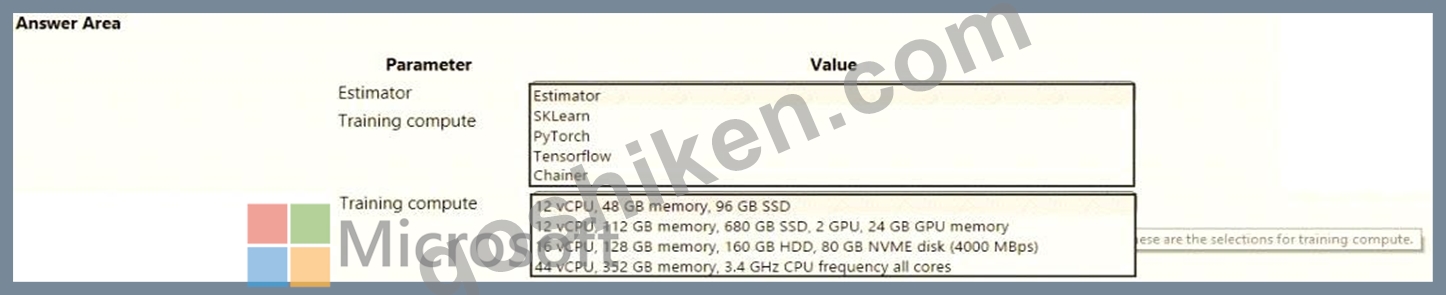
正解:
解説: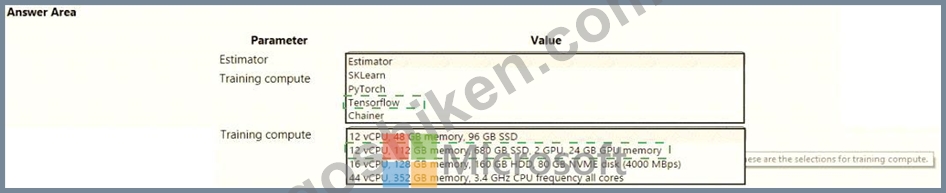
Explanation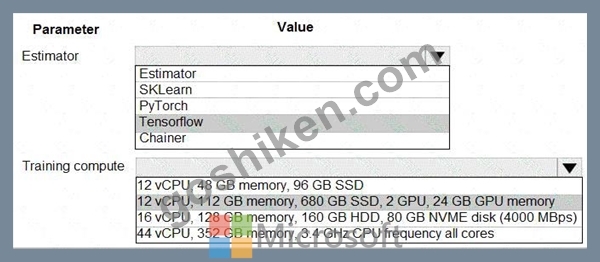
Box 1: Tensorflow
TensorFlow represents an estimator for training in TensorFlow experiments.
Box 2: 12 vCPU, 112 GB memory..,2 GPU,..
Use GPUs for the deep neural network.
Reference:
https://docs.microsoft.com/en-us/python/api/azureml-train-core/azureml.train.dnn
質問 # 143
Note: This question is part of a series of questions that present the same scenario. Each question in the series contains a unique solution that might meet the stated goals. Some question sets might have more than one correct solution, while others might not have a correct solution.
After you answer a question in this section, you will NOT be able to return to it. As a result, these questions will not appear in the review screen.
You are using Azure Machine Learning to run an experiment that trains a classification model.
You want to use Hyperdrive to find parameters that optimize the AUC metric for the model. You configure a HyperDriveConfig for the experiment by running the following code: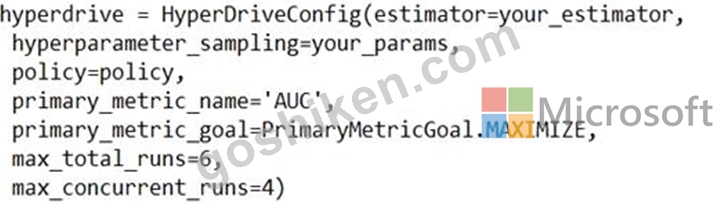
You plan to use this configuration to run a script that trains a random forest model and then tests it with validation dat a. The label values for the validation data are stored in a variable named y_test variable, and the predicted probabilities from the model are stored in a variable named y_predicted.
You need to add logging to the script to allow Hyperdrive to optimize hyperparameters for the AUC metric.
Solution: Run the following code: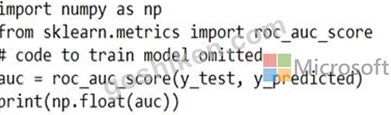
Does the solution meet the goal?
- A. Yes
- B. No
正解:B
解説:
Explanation
Use a solution with logging.info(message) instead.
Note: Python printing/logging example:
logging.info(message)
Destination: Driver logs, Azure Machine Learning designer
Reference:
https://docs.microsoft.com/en-us/azure/machine-learning/how-to-debug-pipelines
質問 # 144
An organization uses Azure Machine Learning service and wants to expand their use of machine learning.
You have the following compute environments. The organization does not want to create another compute environment.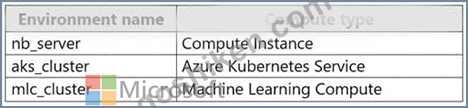
You need to determine which compute environment to use for the following scenarios.
Which compute types should you use? To answer, drag the appropriate compute environments to the correct scenarios. Each compute environment may be used once, more than once, or not at all. You may need to drag the split bar between panes or scroll to view content.
NOTE: Each correct selection is worth one point.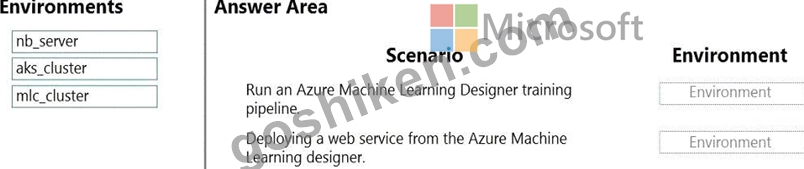
正解:
解説: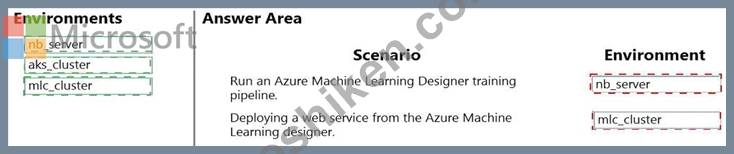
Explanation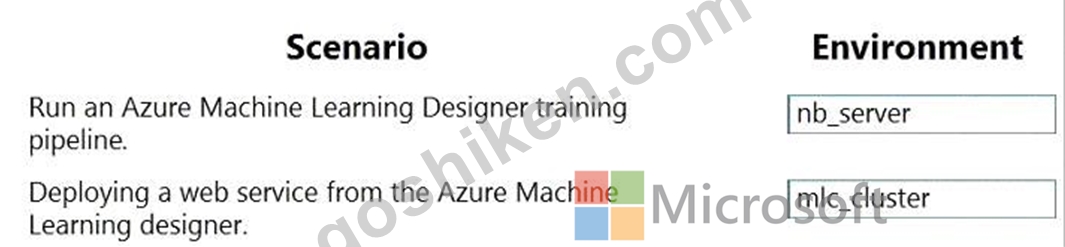
Box 1: nb_server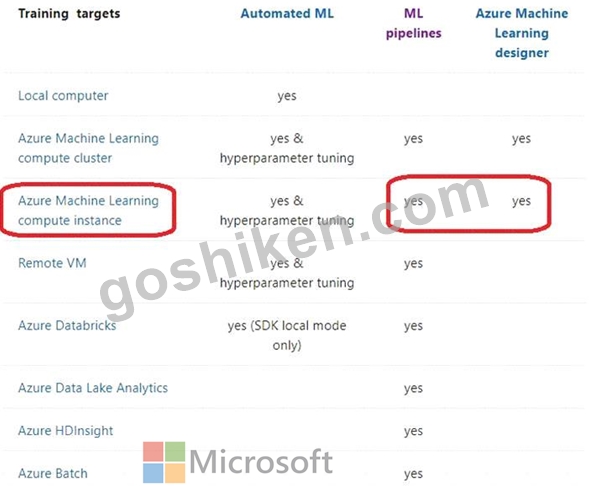
Box 2: mlc_cluster
With Azure Machine Learning, you can train your model on a variety of resources or environments, collectively referred to as compute targets. A compute target can be a local machine or a cloud resource, such as an Azure Machine Learning Compute, Azure HDInsight or a remote virtual machine.
Reference:
https://docs.microsoft.com/en-us/azure/machine-learning/concept-compute-target
https://docs.microsoft.com/en-us/azure/machine-learning/how-to-set-up-training-targets
質問 # 145
You need to use the Python language to build a sampling strategy for the global penalty detection models.
How should you complete the code segment? To answer, select the appropriate options in the answer area.
NOTE: Each correct selection is worth one point.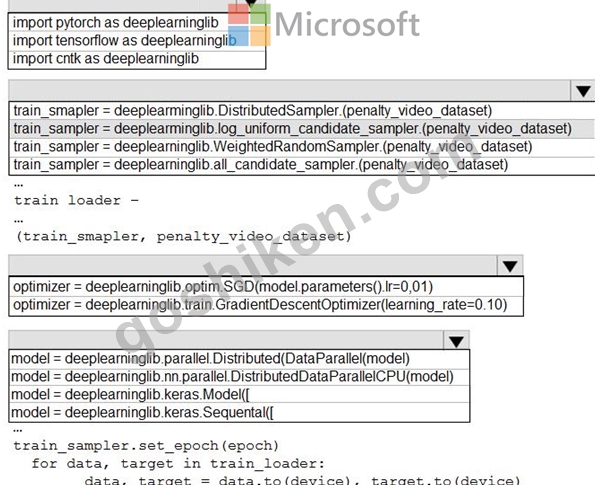
正解:
解説: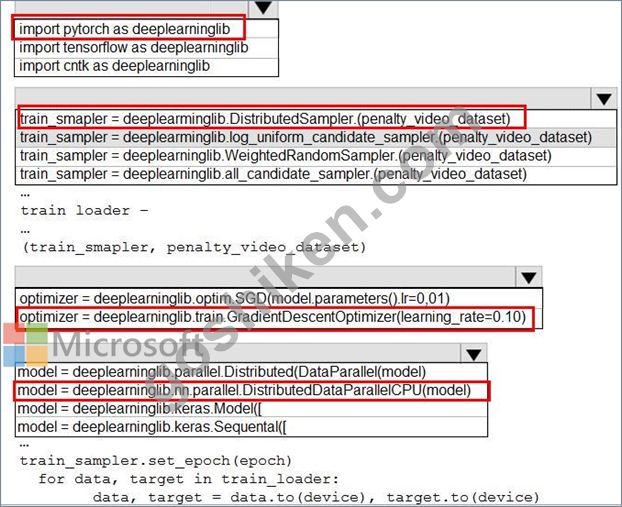
Reference:
https://github.com/pytorch/pytorch/blob/master/torch/utils/data/distributed.py
質問 # 146
You are using C-Support Vector classification to do a multi-class classification with an unbalanced training dataset. The C-Support Vector classification using Python code shown below:
You need to evaluate the C-Support Vector classification code.
Which evaluation statement should you use? To answer, select the appropriate options in the answer area.
NOTE: Each correct selection is worth one point.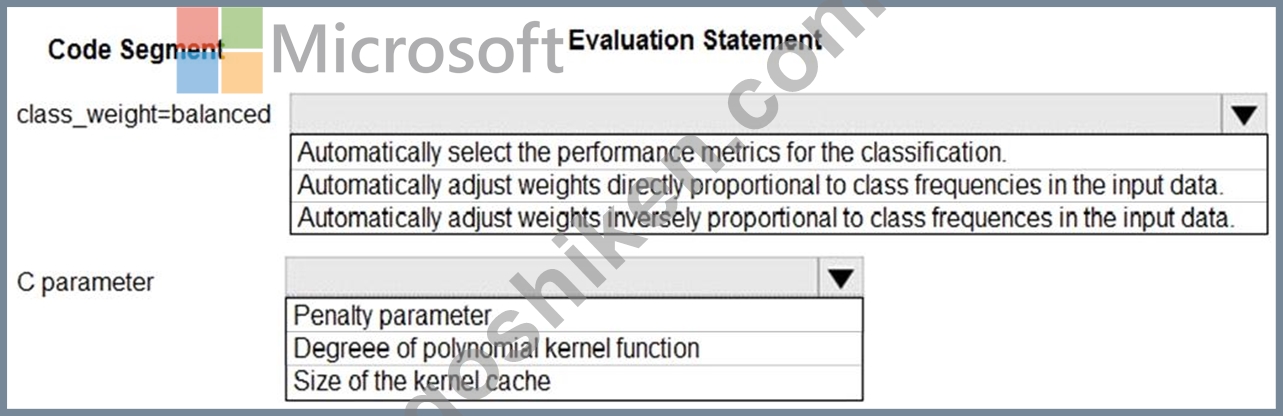
正解:
解説: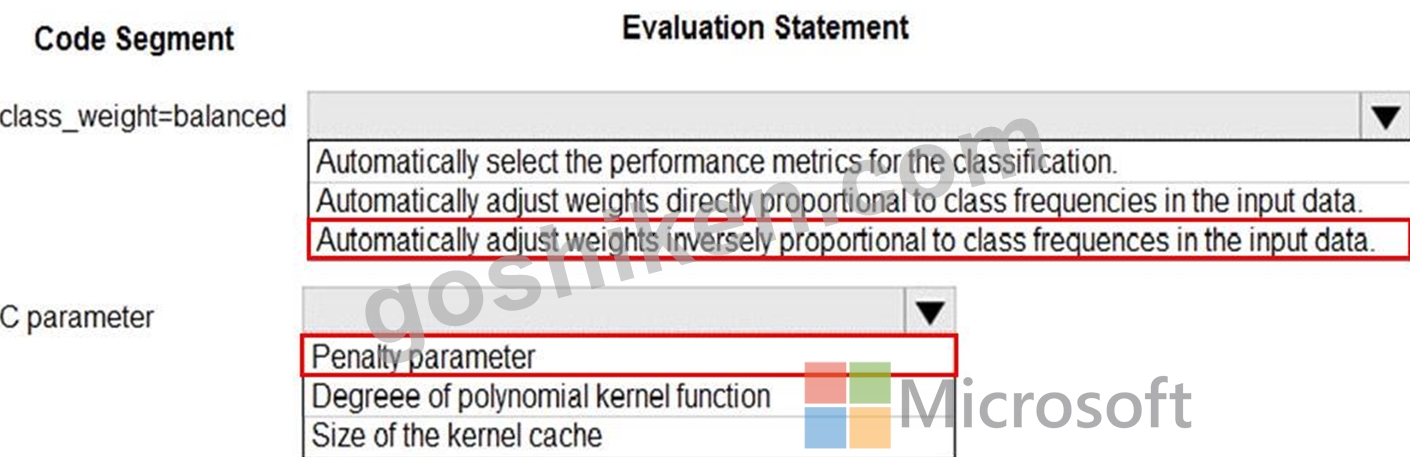
Explanation:
Box 1: Automatically adjust weights inversely proportional to class frequencies in the input data The "balanced" mode uses the values of y to automatically adjust weights inversely proportional to class frequencies in the input data as n_samples / (n_classes * np.bincount(y)).
Box 2: Penalty parameter
Parameter: C : float, optional (default=1.0)
Penalty parameter C of the error term.
References:
https://scikit-learn.org/stable/modules/generated/sklearn.svm.SVC.html
質問 # 147
You use the Azure Machine learning SDK foe Python to create a pipeline that includes the following step:
The output of the step run must be cached and reused on subsequent runs when the source.directory value has not changed.
You need to define the step.
What should you include in the step definition?
- A. version
- B. hash_path
- C. allow.reuse
- D. data-as_input(name-..)
正解:C
質問 # 148
You train a machine learning model by using Aunt Machine Learning.
You use the following training script m Python to log an accuracy value.
You must use a Python script to define a sweep job.
You need to provide the primary metric and goal you want hyper parameter tuning to optimize.
How should you complete the Python script? To answer select the appropriate options in the answer area NOTE: Each correct selection is worth one point.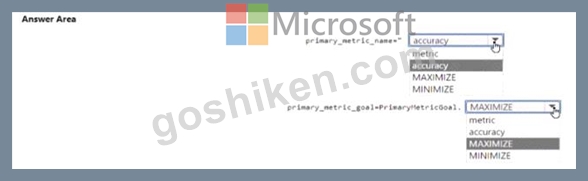
正解:
解説: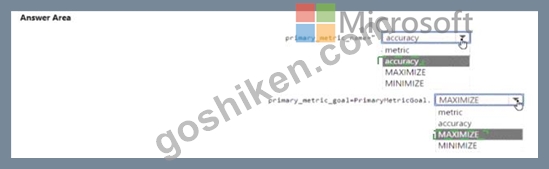
Explanation:
質問 # 149
Note: This question is part of a series of questions that present the same scenario. Each question in the series contains a unique solution that might meet the stated goals. Some question sets might have more than one correct solution, while others might not have a correct solution.
After you answer a question in this section, you will NOT be able to return to it. As a result, these questions will not appear in the review screen.
You train and register a machine learning model.
You plan to deploy the model as a real-time web service. Applications must use key-based authentication to use the model.
You need to deploy the web service.
Solution:
Create an AksWebservice instance.
Set the value of the auth_enabled property to True.
Deploy the model to the service.
Does the solution meet the goal?
- A. No
- B. Yes
正解:B
解説:
Explanation
Key-based authentication.
Web services deployed on AKS have key-based auth enabled by default. ACI-deployed services have key-based auth disabled by default, but you can enable it by setting auth_enabled = TRUE when creating the ACI web service. The following is an example of creating an ACI deployment configuration with key-based auth enabled.
deployment_config <- aci_webservice_deployment_config(cpu_cores = 1,
memory_gb = 1,
auth_enabled = TRUE)
Reference:
https://azure.github.io/azureml-sdk-for-r/articles/deploying-models.html
質問 # 150
Note: This question is part of a series of questions that present the same scenario. Each question in the series contains a unique solution that might meet the stated goals. Some question sets might have more than one correct solution, while others might not have a correct solution.
After you answer a question in this section, you will NOT be able to return to it. As a result, these questions will not appear in the review screen.
You are creating a new experiment in Azure Machine Learning Studio.
One class has a much smaller number of observations than the other classes in the training set.
You need to select an appropriate data sampling strategy to compensate for the class imbalance.
Solution: You use the Stratified split for the sampling mode.
Does the solution meet the goal?
- A. Yes
- B. No
正解:B
解説:
Explanation
Instead use the Synthetic Minority Oversampling Technique (SMOTE) sampling mode.
Note: SMOTE is used to increase the number of underepresented cases in a dataset used for machine learning.
SMOTE is a better way of increasing the number of rare cases than simply duplicating existing cases.
References:
https://docs.microsoft.com/en-us/azure/machine-learning/studio-module-reference/smote
質問 # 151
You have a feature set containing the following numerical features: X, Y, and Z.
The Poisson correlation coefficient (r-value) of X, Y, and Z features is shown in the following image:
Use the drop-down menus to select the answer choice that answers each question based on the information presented in the graphic.
NOTE: Each correct selection is worth one point.
正解:
解説: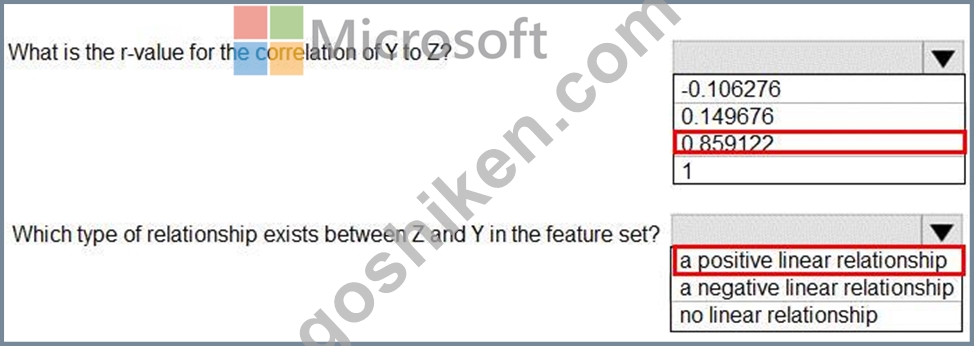
Reference:
https://docs.microsoft.com/en-us/azure/machine-learning/studio-module-reference/compute-linear-correlation
質問 # 152
You need to implement source control for scripts in an Azure Machine Learning workspace. You use a terminal window in the Azure Machine Learning Notebook tab You must authenticate your Git account with SSH.
You need to generate a new SSH key.
Which four actions should you perform in sequence? To answer, move the appropriate actions from the list of actions to the answer area and arrange them m the correct order.
正解:
解説:
Explanation:
質問 # 153
You create a multi-class image classification deep learning experiment by using the PyTorch framework. You plan to run the experiment on an Azure Compute cluster that has nodes with GPU's.
You need to define an Azure Machine Learning service pipeline to perform the monthly retraining of the image classification model. The pipeline must run with minimal cost and minimize the time required to train the model.
Which three pipeline steps should you run in sequence? To answer, move the appropriate actions from the list of actions to the answer area and arrange them in the correct order.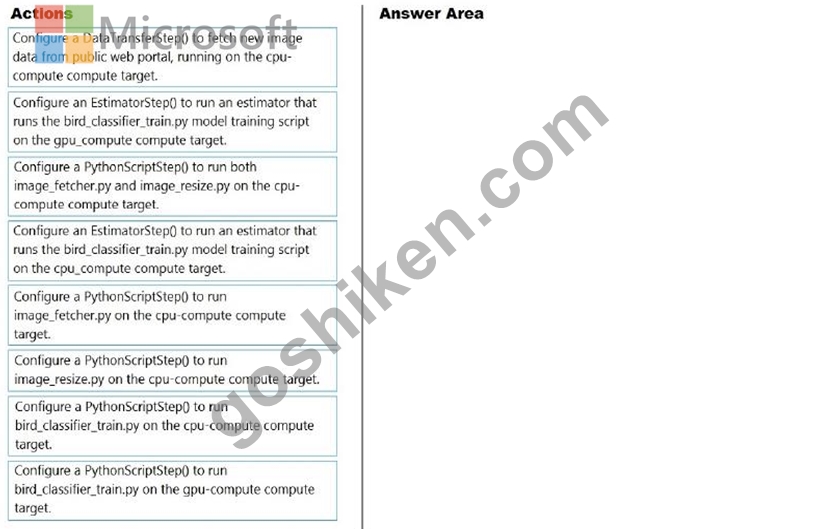
正解:
解説: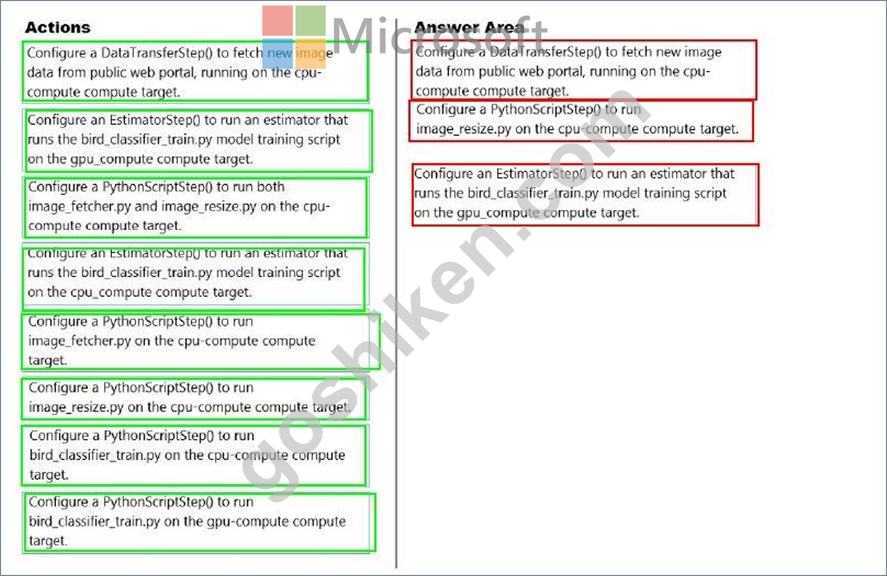
Reference:
https://docs.microsoft.com/en-us/azure/machine-learning/how-to-train-pytorch
質問 # 154
You are performing feature scaling by using the scikit-learn Python library for x.1 x2, and x3 features.
Original and scaled data is shown in the following image.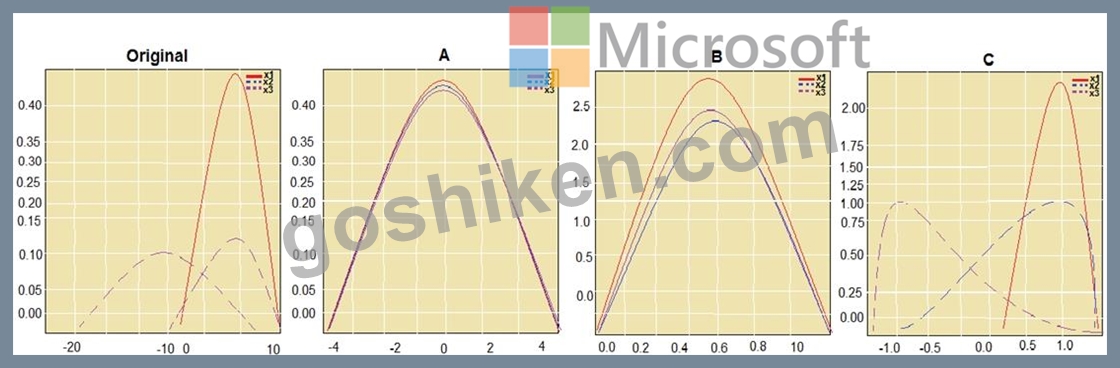
Use the drop-down menus to select the answer choice that answers each question based on the information presented in the graphic.
NOTE: Each correct selection is worth one point.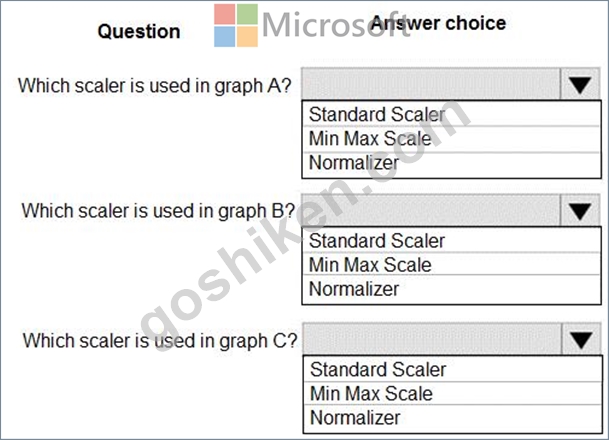
正解:
解説: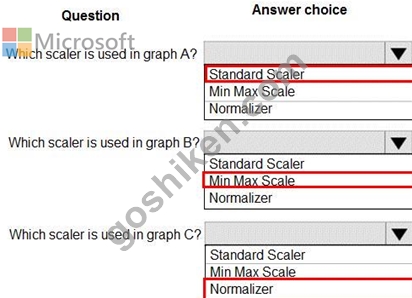
Reference:
http://benalexkeen.com/feature-scaling-with-scikit-learn/
質問 # 155
You are preparing to build a deep learning convolutional neural network model for image classification. You create a script to train the model using CUDA devices.
You must submit an experiment that runs this script in the Azure Machine Learning workspace.
The following compute resources are available:
a Microsoft Surface device on which Microsoft Office has been installed. Corporate IT policies prevent the installation of additional software a Compute Instance named in the workspace with 2 CPUs and 8 GB of memory an Azure Machine Learning compute target named with eight CPU-based nodes an Azure Machine Learning compute target named with four CPU and GPU-based nodes You need to specify the compute resources to be used for running the code to submit the experiment, and for running the script in order to minimize model training time.
Which resources should the data scientist use? To answer, select the appropriate options in the answer area.
NOTE: Each correct selection is worth one point.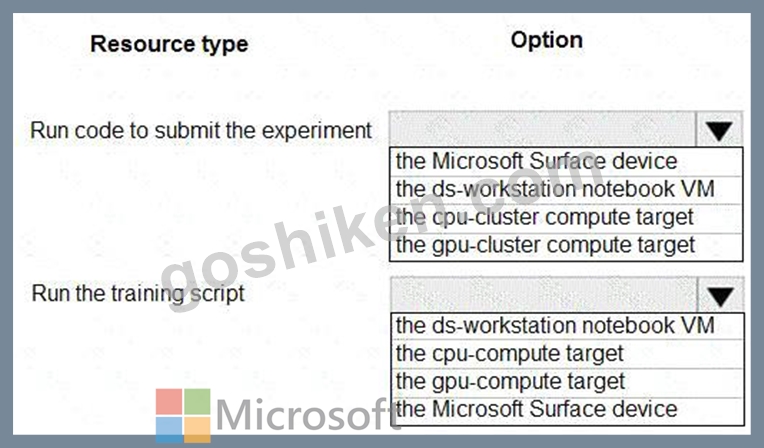
正解:
解説: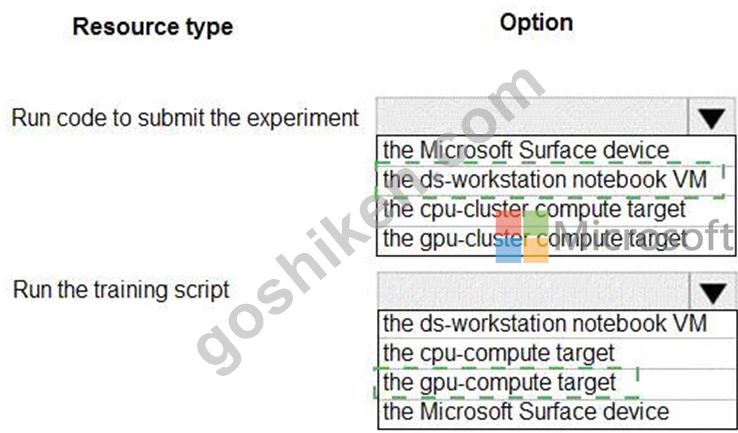
Explanation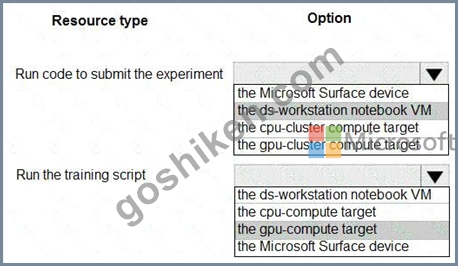
質問 # 156
A biomedical research company plans to enroll people in an experimental medical treatment trial.
You create and train a binary classification model to support selection and admission of patients to the trial.
The model includes the following features: Age, Gender, and Ethnicity.
The model returns different performance metrics for people from different ethnic groups.
You need to use Fairlearn to mitigate and minimize disparities for each category in the Ethnicity feature.
Which technique and constraint should you use? To answer, select the appropriate options in the answer area.
NOTE: Each correct selection is worth one point.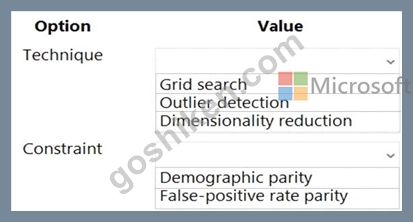
正解:
解説: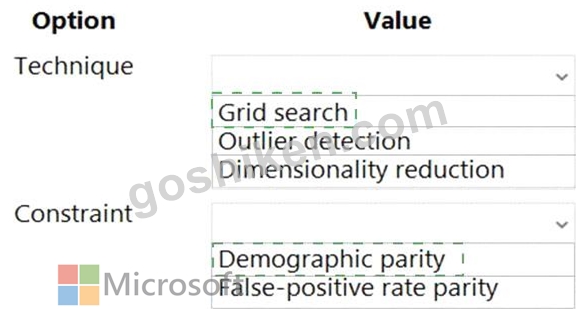
Explanation
Graphical user interface, text, application, chat or text message Description automatically generated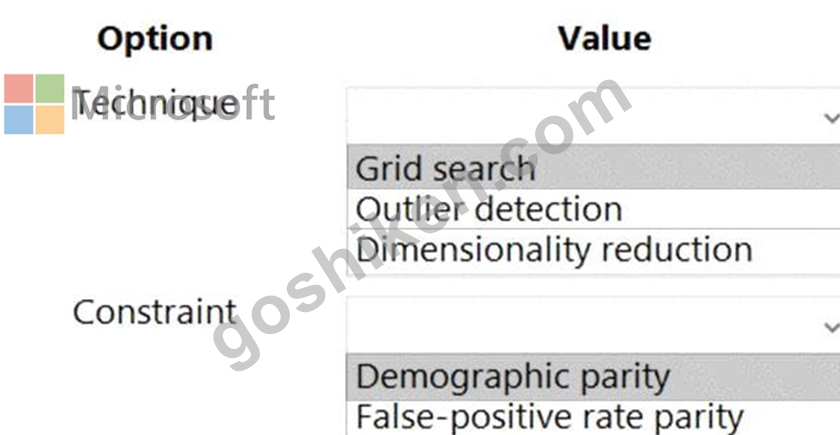
Box 1: Grid Search
Fairlearn open-source package provides postprocessing and reduction unfairness mitigation algorithms:
ExponentiatedGradient, GridSearch, and ThresholdOptimizer.
Note: The Fairlearn open-source package provides postprocessing and reduction unfairness mitigation algorithms types:
Reduction: These algorithms take a standard black-box machine learning estimator (e.g., a LightGBM model) and generate a set of retrained models using a sequence of re-weighted training datasets.
Post-processing: These algorithms take an existing classifier and the sensitive feature as input.
Box 2: Demographic parity
The Fairlearn open-source package supports the following types of parity constraints: Demographic parity, Equalized odds, Equal opportunity, and Bounded group loss.
Reference:
https://docs.microsoft.com/en-us/azure/machine-learning/concept-fairness-ml
質問 # 157
You need to implement early stopping criteria as suited in the model training requirements.
Which three code segments should you use to develop the solution? To answer, move the appropriate code segments from the list of code segments to the answer area and arrange them in the correct order.
NOTE: More than one order of answer choices is correct. You will receive credit for any of the correct orders you select.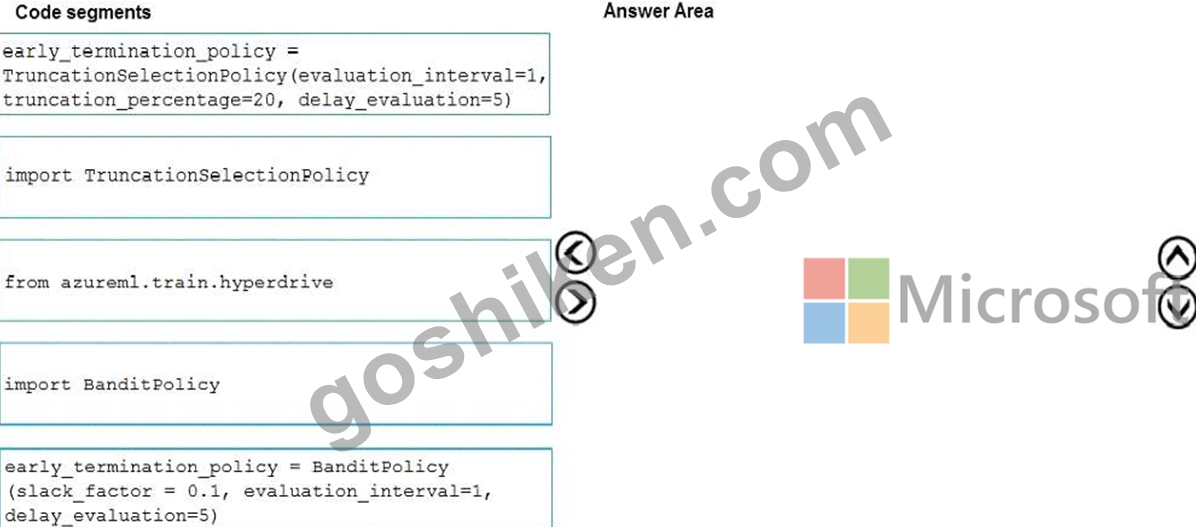
正解:
解説: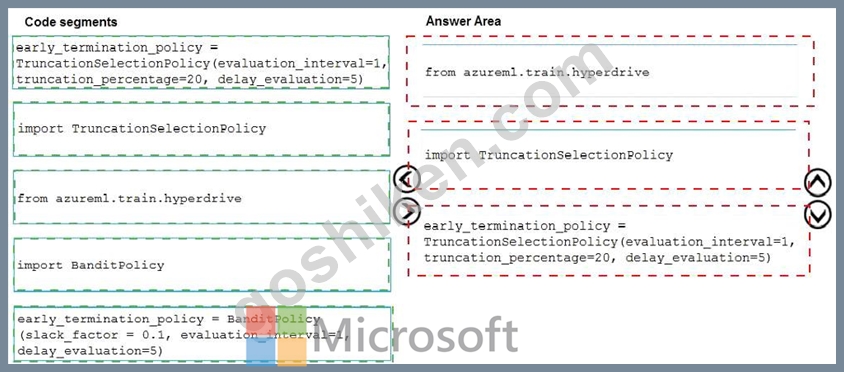
Explanation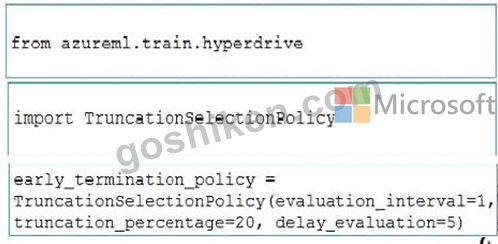
You need to implement an early stopping criterion on models that provides savings without terminating promising jobs.
Truncation selection cancels a given percentage of lowest performing runs at each evaluation interval. Runs are compared based on their performance on the primary metric and the lowest X% are terminated.
Example:
from azureml.train.hyperdrive import TruncationSelectionPolicy
early_termination_policy = TruncationSelectionPolicy(evaluation_interval=1, truncation_percentage=20, delay_evaluation=5)
質問 # 158
......
更新されたPDF(2025年最新)実際にある DP-100試験問題:https://www.goshiken.com/Microsoft/DP-100-mondaishu.html
問題集返金保証付きのDP-100公式問題集:https://drive.google.com/open?id=1nhIVEHmylMVKqV8phTzAkmKEBWcpqsAi