

結果を保証するには最新2024年03月無料Microsoft DP-100で練習しよう
有効な問題最新版を無料で試そうDP-100試験問題集解答
質問 # 63
You have an Azure Machine learning workspace. The workspace contains a dataset with data in a tabular form.
You plan to use the Azure Machine Learning SDK for Python vl to create a control script that will load the dataset into a pandas dataframe in preparation for model training The script will accept a parameter designating the dataset You need to complete the script.
How should you complete the script? To answer, select the appropriate options in the answer area.
NOTE: Each correct selection is worth one point.
正解:
解説: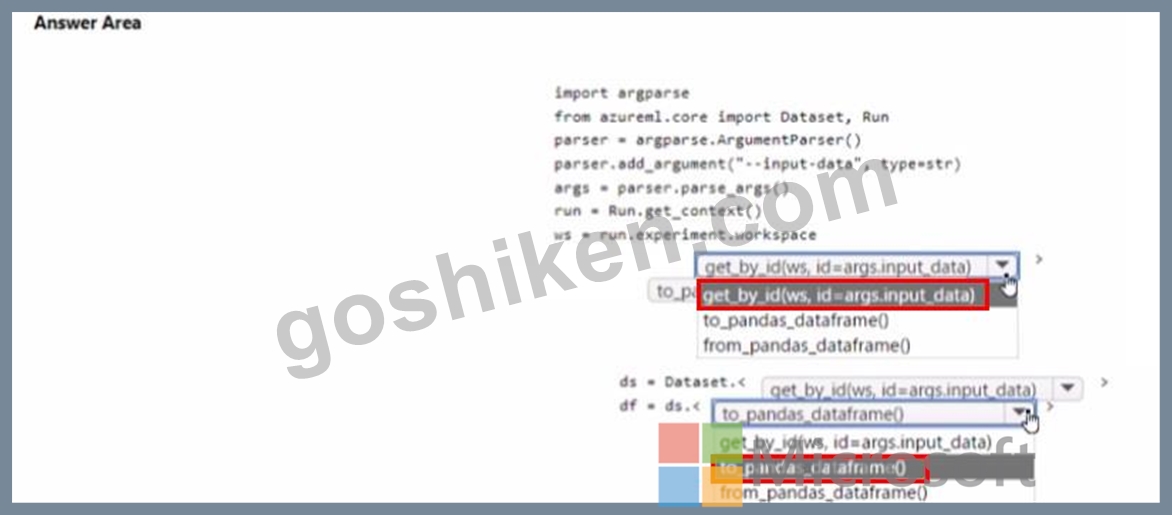
質問 # 64
You create an experiment in Azure Machine Learning Studio. You add a training dataset that contains 10,000 rows. The first 9,000 rows represent class 0 (90 percent).
The remaining 1,000 rows represent class 1 (10 percent).
The training set is imbalances between two classes. You must increase the number of training examples for class 1 to 4,000 by using 5 data rows. You add the Synthetic Minority Oversampling Technique (SMOTE) module to the experiment.
You need to configure the module.
Which values should you use? To answer, select the appropriate options in the dialog box in the answer area.
NOTE: Each correct selection is worth one point.
正解:
解説: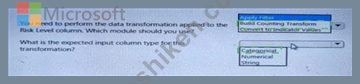
Explanation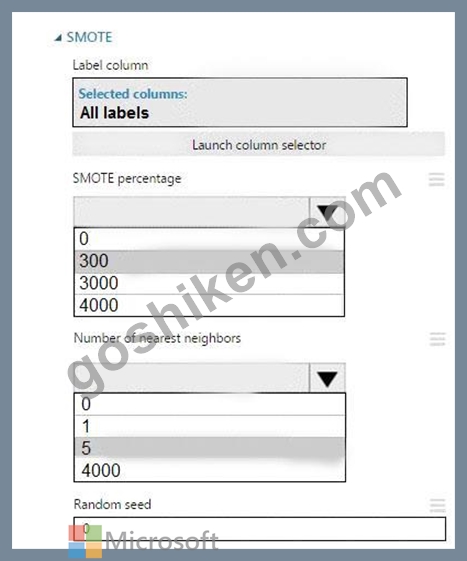
Box 1: 300
You type 300 (%), the module triples the percentage of minority cases (3000) compared to the original dataset (1000).
Box 2: 5
We should use 5 data rows.
Use the Number of nearest neighbors option to determine the size of the feature space that the SMOTE algorithm uses when in building new cases. A nearest neighbor is a row of data (a case) that is very similar to some target case. The distance between any two cases is measured by combining the weighted vectors of all features.
By increasing the number of nearest neighbors, you get features from more cases.
By keeping the number of nearest neighbors low, you use features that are more like those in the original sample.
References:
https://docs.microsoft.com/en-us/azure/machine-learning/studio-module-reference/smote
質問 # 65
You are working on a classification task. You have a dataset indicating whether a student would like to play soccer and associated attributes. The dataset includes the following columns: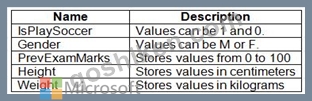
You need to classify variables by type.
Which variable should you add to each category? To answer, select the appropriate options in the answer area.
NOTE: Each correct selection is worth one point.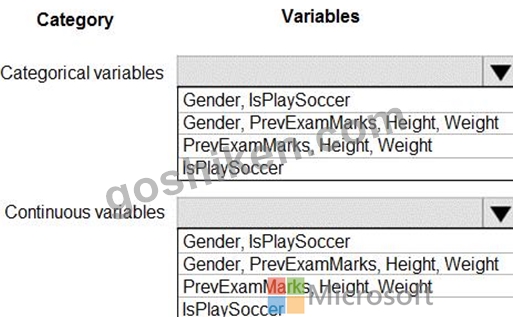
正解:
解説:
Explanation:
References:
https://www.edureka.co/blog/classification-algorithms/
質問 # 66
Note: This question is part of a series of questions that present the same scenario. Each question in the series contains a unique solution that might meet the stated goals. Some question sets might have more than one correct solution, while others might not have a correct solution.
After you answer a question in this section, you will NOT be able to return to it. As a result, these questions will not appear in the review screen.
You create a model to forecast weather conditions based on historical data.
You need to create a pipeline that runs a processing script to load data from a datastore and pass the processed data to a machine learning model training script.
Solution: Run the following code: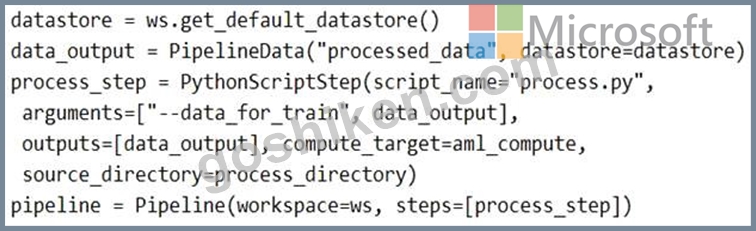
Does the solution meet the goal?
- A. No
- B. Yes
正解:A
解説:
Explanation
train_step is missing.
Reference:
https://docs.microsoft.com/en-us/python/api/azureml-pipeline-core/azureml.pipeline.core.pipelinedata?view=azu
質問 # 67
Note: This question is part of a series of questions that present the same scenario. Each question in the series contains a unique solution that might meet the stated goals. Some question sets might have more than one correct solution, while others might not have a correct solution.
After you answer a question in this section, you will NOT be able to return to it. As a result, these questions will not appear in the review screen.
You are using Azure Machine Learning to run an experiment that trains a classification model.
You want to use Hyperdrive to find parameters that optimize the AUC metric for the model. You configure a HyperDriveConfig for the experiment by running the following code: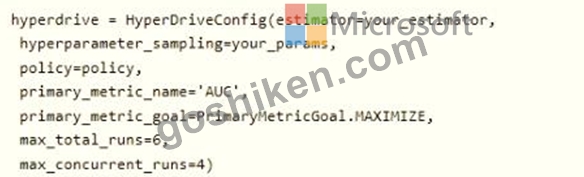
You plan to use this configuration to run a script that trains a random forest model and then tests it with validation data. The label values for the validation data are stored in a variable named y_test variable, and the predicted probabilities from the model are stored in a variable named y_predicted.
Solution: Run the following code: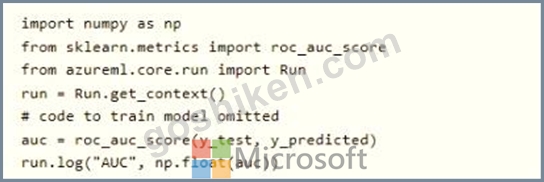
Does the solution meet the goal?
- A. Yes
- B. No
正解:A
質問 # 68
The finance team asks you to train a model using data in an Azure Storage blob container named finance-data.
You need to register the container as a datastore in an Azure Machine Learning workspace and ensure that an error will be raised if the container does not exist.
How should you complete the code? To answer, select the appropriate options in the answer area.
NOTE: Each correct selection is worth one point.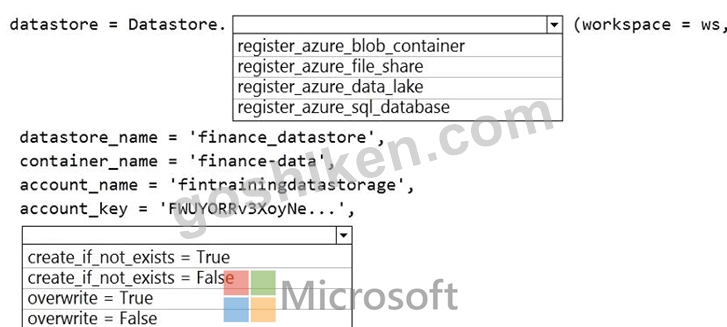
正解:
解説:
Explanation:
Box 1: register_azure_blob_container
Register an Azure Blob Container to the datastore.
Box 2: create_if_not_exists = False
Create the file share if it does not exists, defaults to False.
Reference:
https://docs.microsoft.com/en-us/python/api/azureml-core/azureml.core.datastore.datastore
質問 # 69
You are using a decision tree algorithm. You have trained a model that generalizes well at a tree depth equal to
10.
You need to select the bias and variance properties of the model with varying tree depth values.
Which properties should you select for each tree depth? To answer, select the appropriate options in the answer area.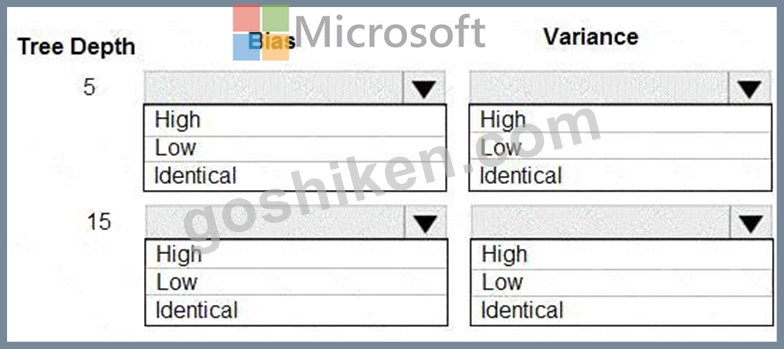
正解:
解説: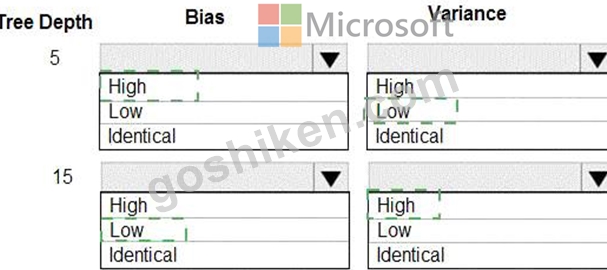
Explanation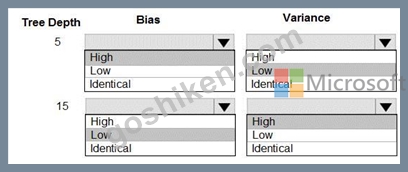
In decision trees, the depth of the tree determines the variance. A complicated decision tree (e.g. deep) has low bias and high variance.
Note: In statistics and machine learning, the bias-variance tradeoff is the property of a set of predictive models whereby models with a lower bias in parameter estimation have a higher variance of the parameter estimates across samples, and vice versa. Increasing the bias will decrease the variance. Increasing the variance will decrease the bias.
References:
https://machinelearningmastery.com/gentle-introduction-to-the-bias-variance-trade-off-in-machine-learning/
質問 # 70
You are a lead data scientist for a project that tracks the health and migration of birds. You create a multi-image classification deep learning model that uses a set of labeled bird photos collected by experts. You plan to use the model to develop a cross-platform mobile app that predicts the species of bird captured by app users.
You must test and deploy the trained model as a web service. The deployed model must meet the following requirements:
An authenticated connection must not be required for testing.
The deployed model must perform with low latency during inferencing.
The REST endpoints must be scalable and should have a capacity to handle large number of requests when multiple end users are using the mobile application.
You need to verify that the web service returns predictions in the expected JSON format when a valid REST request is submitted.
Which compute resources should you use? To answer, select the appropriate options in the answer area.
NOTE: Each correct selection is worth one point.
正解:
解説: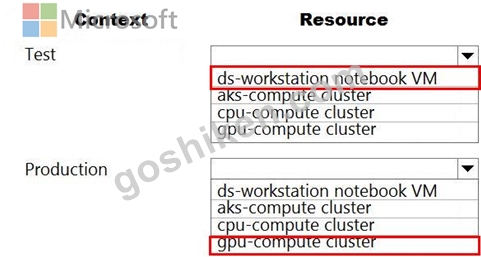
Reference:
https://docs.microsoft.com/en-us/azure/machine-learning/data-science-virtual-machine/dsvm-common-identity
https://docs.microsoft.com/en-us/azure/architecture/reference-architectures/ai/training-deep-learning
質問 # 71
Note: This question is part of a series of questions that present the same scenario. Each question in the series contains a unique solution that might meet the stated goals. Some question sets might have more than one correct solution, while others might not have a correct solution.
After you answer a question in this section, you will NOT be able to return to it. As a result, these questions will not appear in the review screen.
An IT department creates the following Azure resource groups and resources: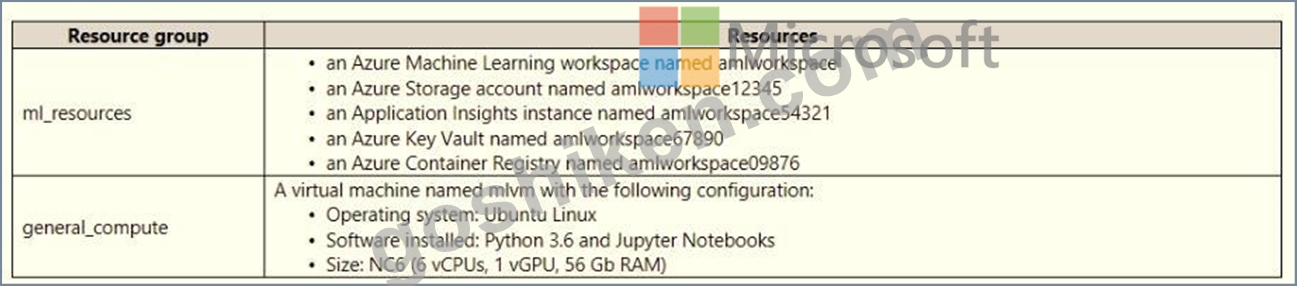
The IT department creates an Azure Kubernetes Service (AKS)-based inference compute target named aks-cluster in the Azure Machine Learning workspace. You have a Microsoft Surface Book computer with a GPU. Python 3.6 and Visual Studio Code are installed.
You need to run a script that trains a deep neural network (DNN) model and logs the loss and accuracy metrics.
Solution: Install the Azure ML SDK on the Surface Book. Run Python code to connect to the workspace. Run the training script as an experiment on the aks-cluster compute target.
Does the solution meet the goal?
- A. No
- B. Yes
正解:A
解説:
Explanation
Need to attach the mlvm virtual machine as a compute target in the Azure Machine Learning workspace.
Reference:
https://docs.microsoft.com/en-us/azure/machine-learning/concept-compute-target
質問 # 72
You create an Azure Machine Learning workspace and an Azure Synapse Analytics workspace with a Spark pool. The workspaces are contained within the same Azure subscription.
You must manage the Synapse Spark pool from the Azure Machine Learning workspace.
You need to attach the Synapse Spark pool in Azure Machine Learning by usinq the Python SDK v2.
Which three actions should you perform in sequence? To answer move the appropriate actions from the list of actions to the answer area and arrange them in the correct order.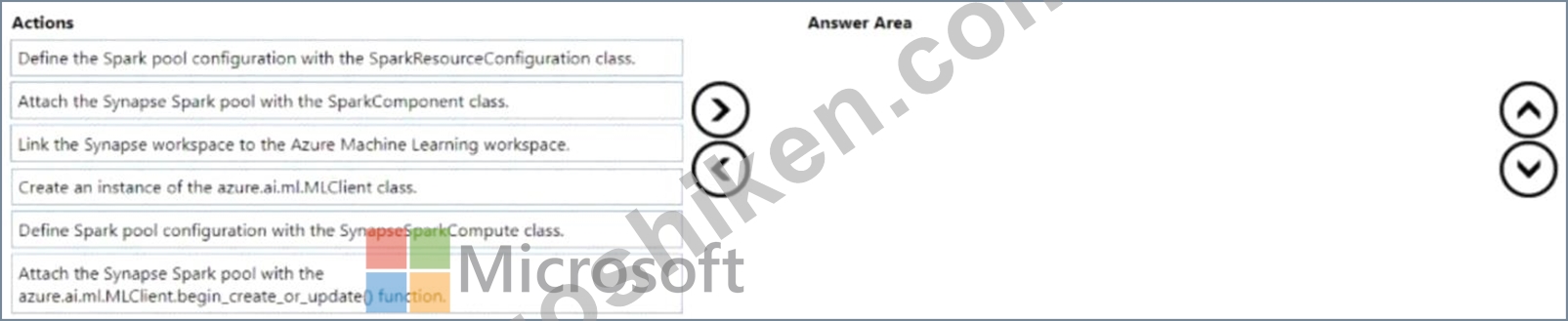
正解:
解説: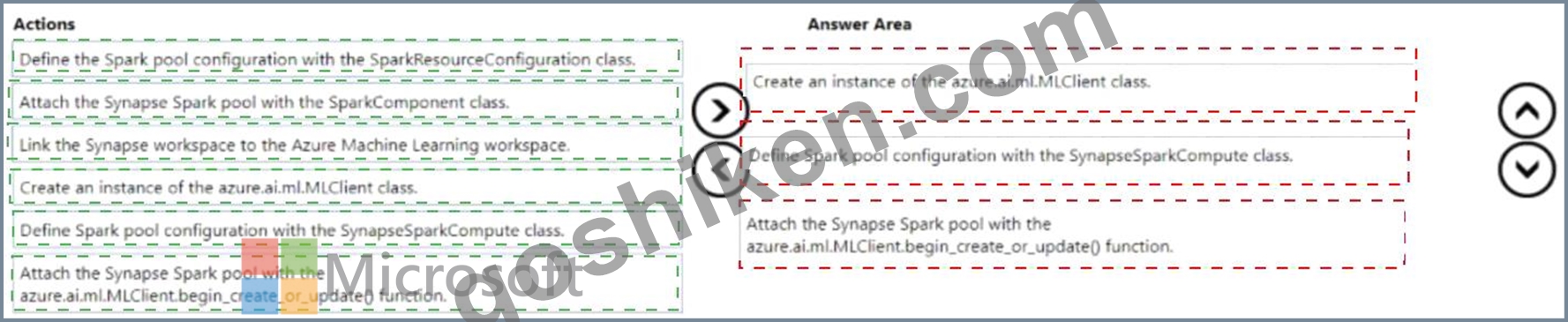
Explanation
質問 # 73
You are performing sentiment analysis using a CSV file that includes 12,000 customer reviews written in a short sentence format. You add the CSV file to Azure Machine Learning Studio and configure it as the starting point dataset of an experiment. You add the Extract N-Gram Features from Text module to the experiment to extract key phrases from the customer review column in the dataset.
You must create a new n-gram dictionary from the customer review text and set the maximum n-gram size to trigrams.
What should you select? To answer, select the appropriate options in the answer area.
NOTE: Each correct selection is worth one point.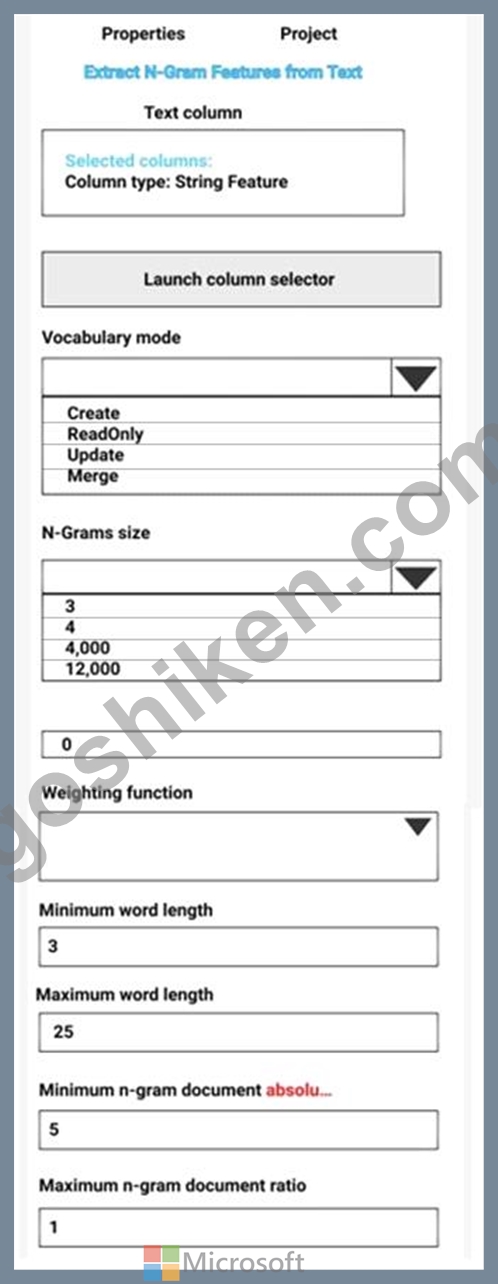
正解:
解説: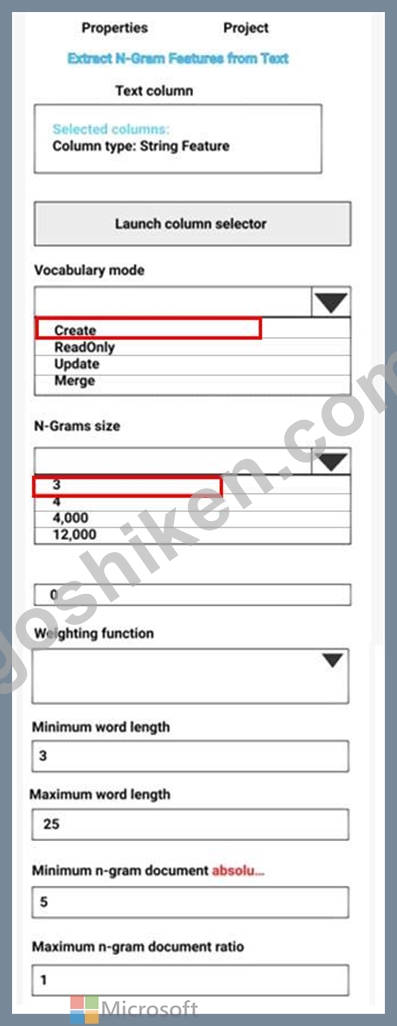
Explanation:
Vocabulary mode: Create
For Vocabulary mode, select Create to indicate that you are creating a new list of n-gram features.
N-Grams size: 3
For N-Grams size, type a number that indicates the maximum size of the n-grams to extract and store. For example, if you type 3, unigrams, bigrams, and trigrams will be created.
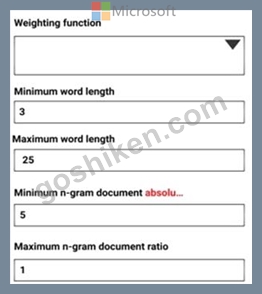
Weighting function: Leave blank
The option, Weighting function, is required only if you merge or update vocabularies. It specifies how terms in the two vocabularies and their scores should be weighted against each other.
References:
https://docs.microsoft.com/en-us/azure/machine-learning/studio-module-reference/extract-n-gram-features-from-text
質問 # 74
Note: This question is part of a series of questions that present the same scenario. Each question in the series contains a unique solution that might meet the stated goals. Some question sets might have more than one correct solution, while others might not have a correct solution.
After you answer a question in this section, you will NOT be able to return to it. As a result, these questions will not appear in the review screen.
You plan to use a Python script to run an Azure Machine Learning experiment. The script creates a reference to the experiment run context, loads data from a file, identifies the set of unique values for the label column, and completes the experiment run: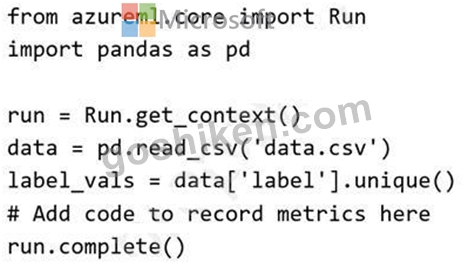
The experiment must record the unique labels in the data as metrics for the run that can be reviewed later.
You must add code to the script to record the unique label values as run metrics at the point indicated by the comment.
Solution: Replace the comment with the following code:
run.log_list('Label Values', label_vals)
Does the solution meet the goal?
- A. Yes
- B. No
正解:A
解説:
run.log_list log a list of values to the run with the given name using log_list.
Example: run.log_list("accuracies", [0.6, 0.7, 0.87])
Note:
Data= pd.read_csv('data.csv')
Data is read into a pandas.DataFrame, which is a two-dimensional, size-mutable, potentially heterogeneous tabular data.
label_vals =data['label'].unique
label_vals contains a list of unique label values.
Reference:
https://www.element61.be/en/resource/azure-machine-learning-services-complete-toolbox-ai
https://docs.microsoft.com/en-us/python/api/azureml-core/azureml.core.run(class)
https://pandas.pydata.org/docs/reference/api/pandas.DataFrame.html
質問 # 75
You need to use the Python language to build a sampling strategy for the global penalty detection models.
How should you complete the code segment? To answer, select the appropriate options in the answer area.
NOTE: Each correct selection is worth one point.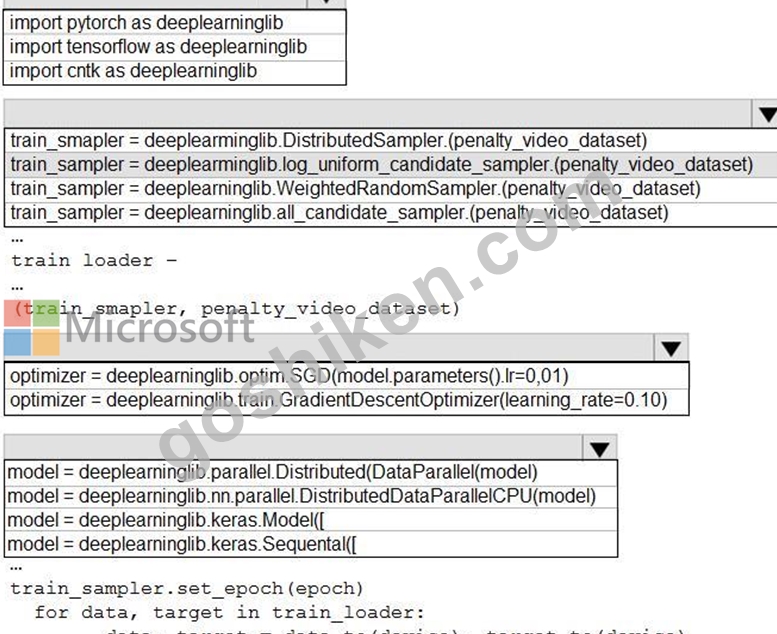
正解:
解説: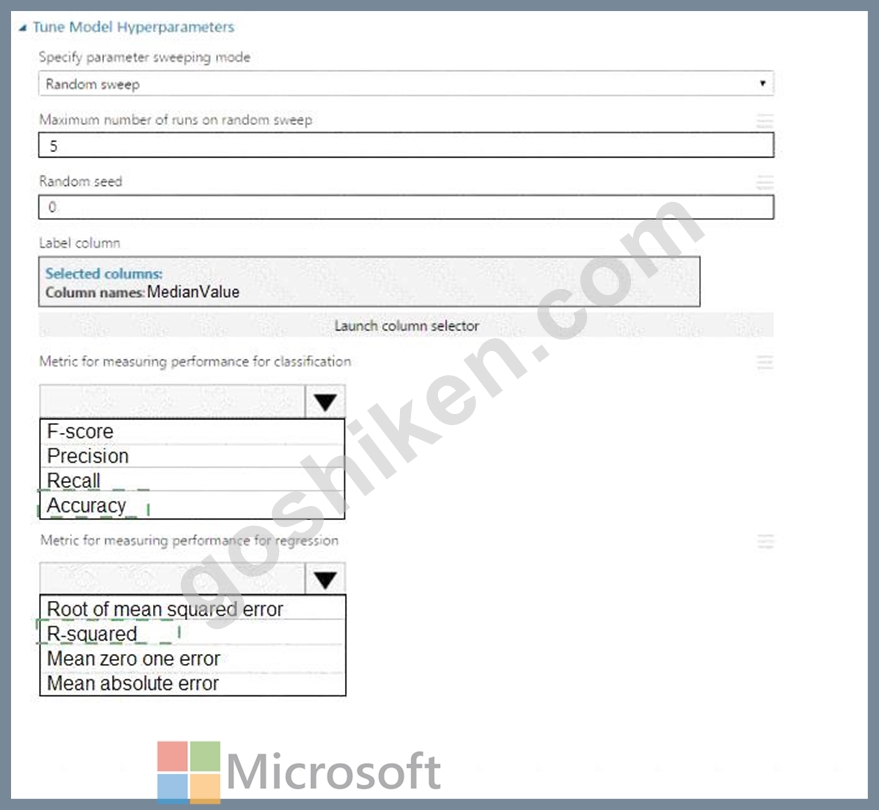
Explanation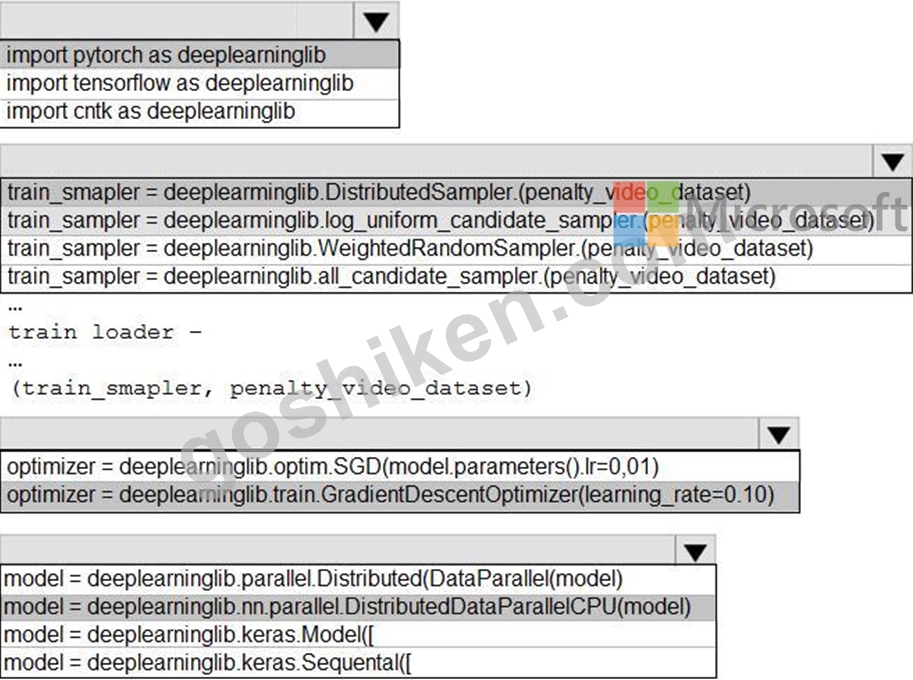
Box 1: import pytorch as deeplearninglib
Box 2: ..DistributedSampler(Sampler)..
DistributedSampler(Sampler):
Sampler that restricts data loading to a subset of the dataset.
It is especially useful in conjunction with class:`torch.nn.parallel.DistributedDataParallel`. In such case, each process can pass a DistributedSampler instance as a DataLoader sampler, and load a subset of the original dataset that is exclusive to it.
Scenario: Sampling must guarantee mutual and collective exclusively between local and global segmentation models that share the same features.
Box 3: optimizer = deeplearninglib.train. GradientDescentOptimizer(learning_rate=0.10)
質問 # 76
You are preparing to use the Azure ML SDK to run an experiment and need to create compute. You run the following code: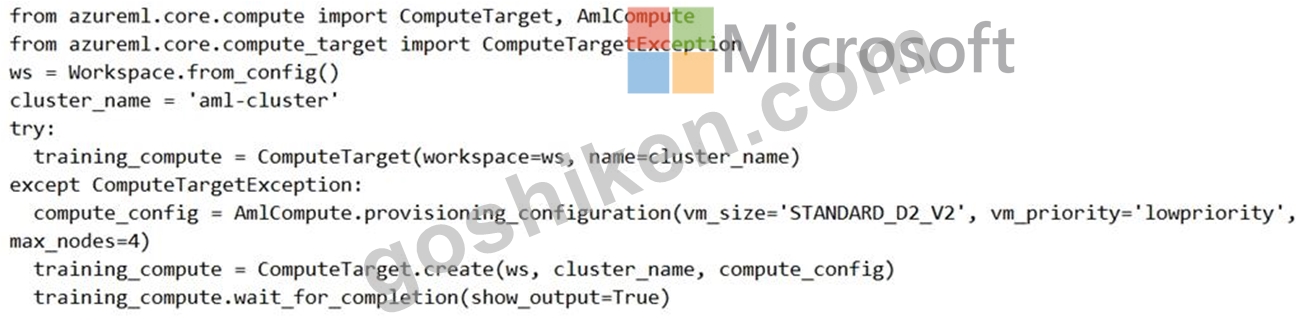
For each of the following statements, select Yes if the statement is true. Otherwise, select No.
NOTE: Each correct selection is worth one point.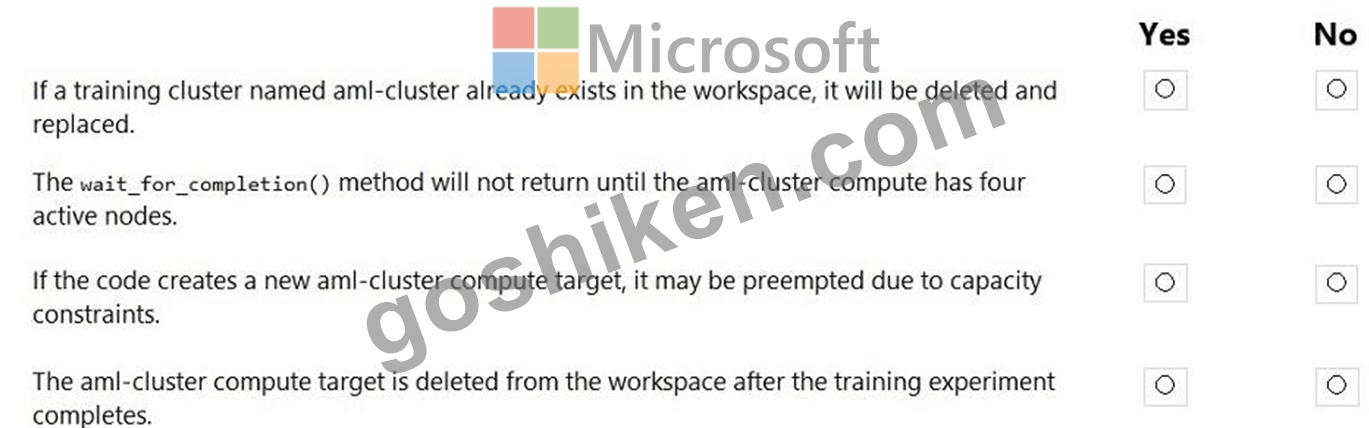
正解:
解説: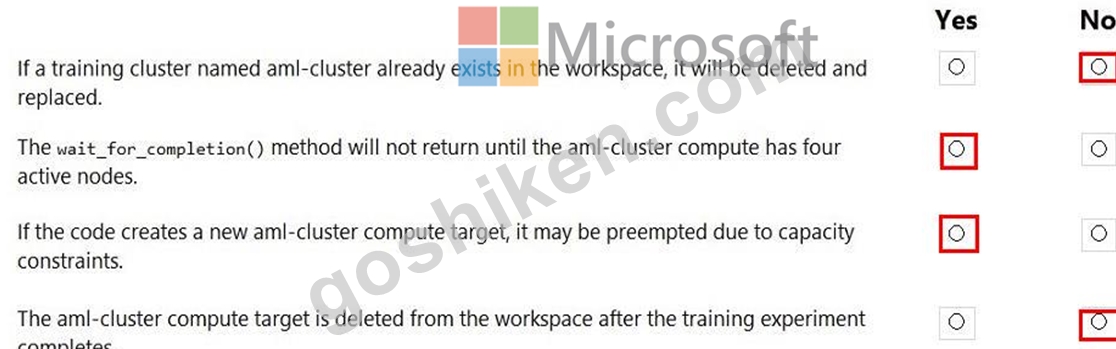
Reference:
https://notebooks.azure.com/azureml/projects/azureml-getting-started/html/how-to-use-azureml/training/train-on-amlcompute/train-on-amlcompute.ipynb
https://docs.microsoft.com/en-us/python/api/azureml-core/azureml.core.compute.computetarget
質問 # 77
You have a feature set containing the following numerical features: X, Y, and Z.
The Poisson correlation coefficient (r-value) of X, Y, and Z features is shown in the following image:
Use the drop-down menus to select the answer choice that answers each question based on the information presented in the graphic.
NOTE: Each correct selection is worth one point.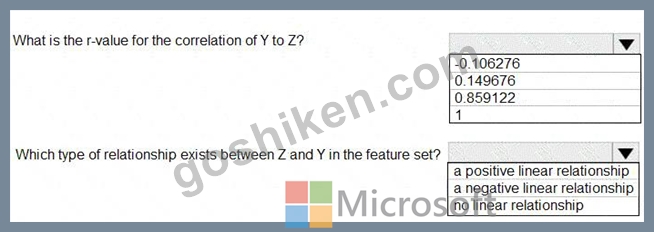
正解:
解説: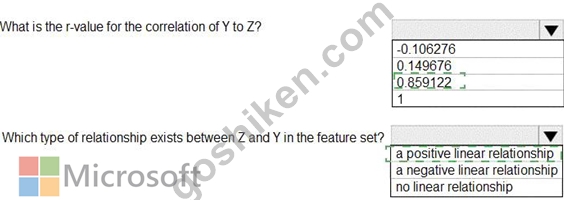
Explanation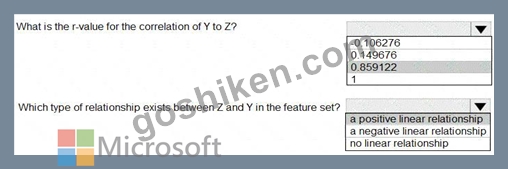
Box 1: 0.859122
Box 2: a positively linear relationship
+1 indicates a strong positive linear relationship
-1 indicates a strong negative linear correlation
0 denotes no linear relationship between the two variables.
References:
https://docs.microsoft.com/en-us/azure/machine-learning/studio-module-reference/compute-linear-correlation
質問 # 78
You need to set up the Permutation Feature Importance module according to the model training requirements.
Which properties should you select? To answer, select the appropriate options in the answer area.
NOTE: Each correct selection is worth one point.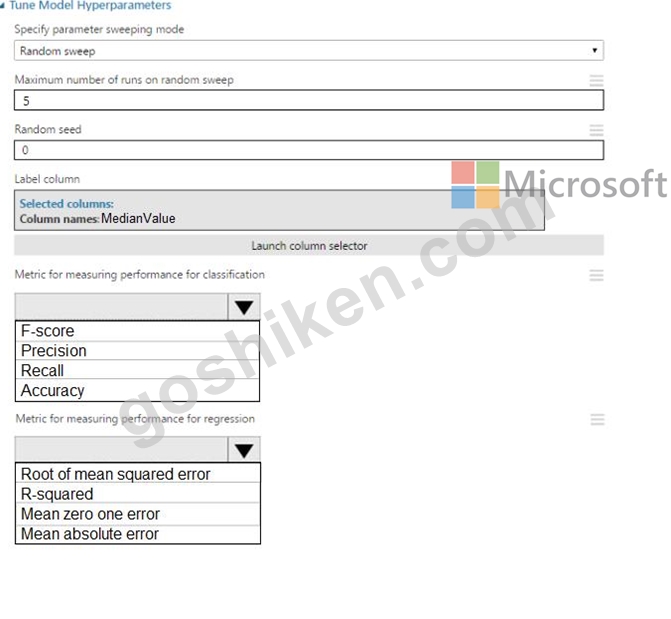
正解:
解説: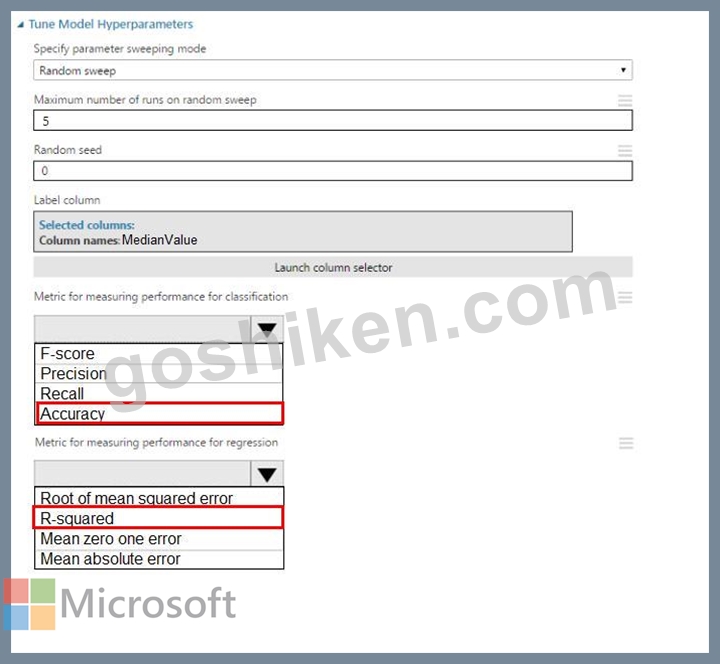
質問 # 79
You use Data Science Virtual Machines (DSVMs) for Windows and Linux in Azure.
You need to access the DSVMs.
Which utilities should you use? To answer, select the appropriate options in the answer area.
NOTE: Each correct selection is worth one point.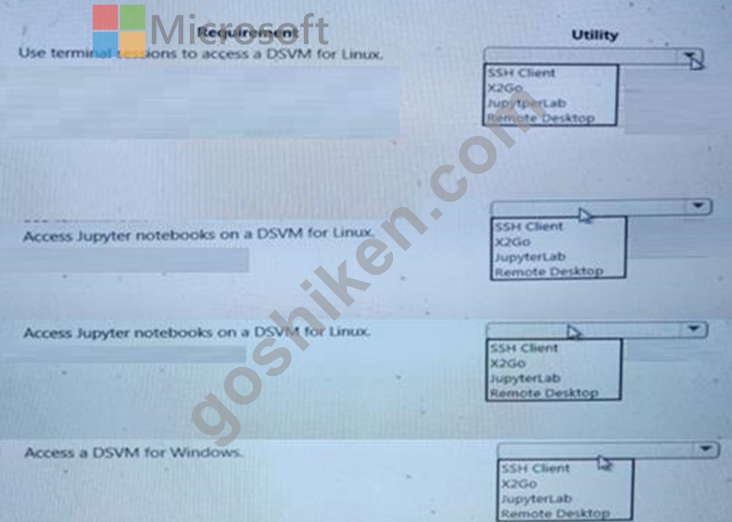
正解:
解説: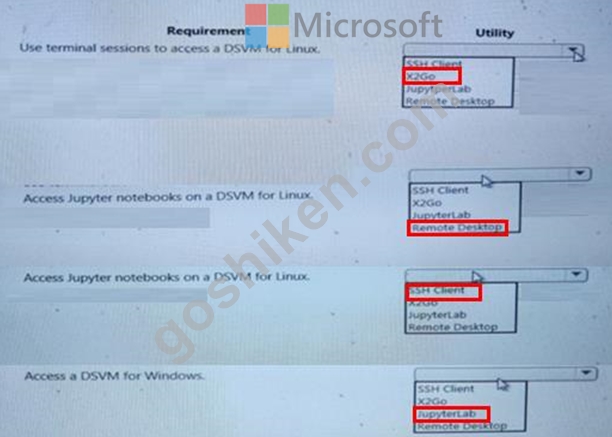
質問 # 80
You create an Azure Machine Learning workspace
You are developing a Python SDK v2 notebook to perform custom model training in the workspace. The notebook code imports all required packages.
You need to complete the Python SDK v2 code to include a training script. environment, and compute information.
How should you complete ten code? To answer, select the appropriate options in the answer area.
NOTE: Each correct selection is worth one point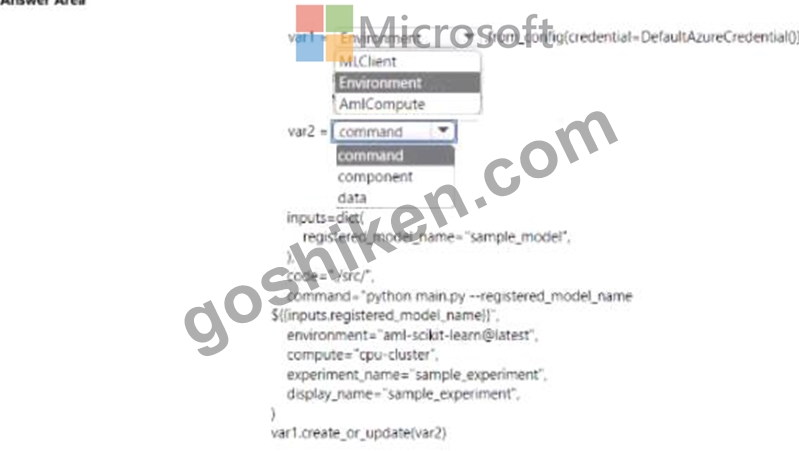
正解:
解説: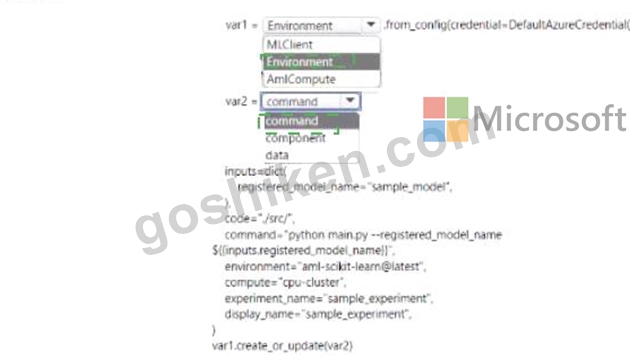
Explanation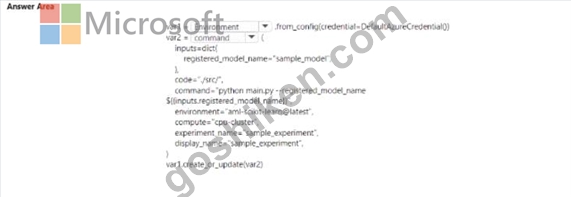
質問 # 81
You are building a binary classification model by using a supplied training set.
The training set is imbalanced between two classes.
You need to resolve the data imbalance.
What are three possible ways to achieve this goal? Each correct answer presents a complete solution NOTE: Each correct selection is worth one point.
- A. Use accuracy as the evaluation metric of the model.
- B. Normalize the training feature set.
- C. Resample the data set using under sampling or oversampling
- D. Generate synthetic samples in the minority class.
- E. Penalize the classification
正解:A、C、D
質問 # 82
You need to use the Python language to build a sampling strategy for the global penalty detection models.
How should you complete the code segment? To answer, select the appropriate options in the answer area.
NOTE: Each correct selection is worth one point.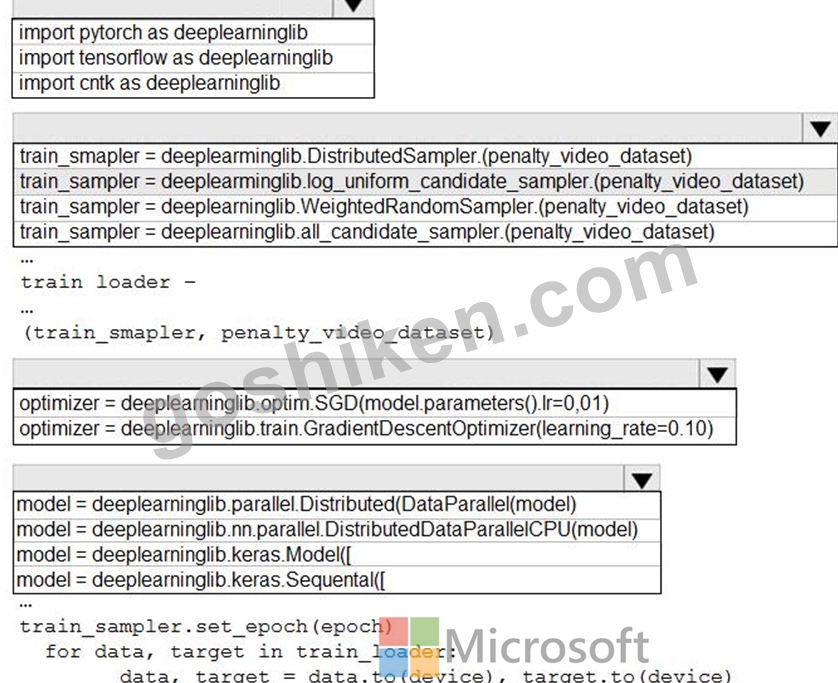
正解:
解説: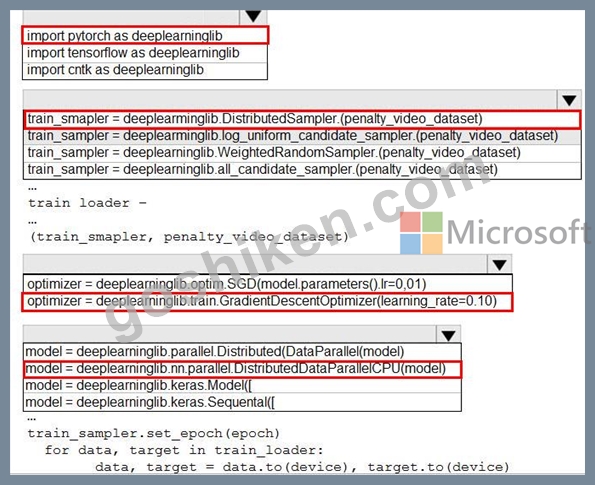
Explanation:
Box 1: import pytorch as deeplearninglib
Box 2: ..DistributedSampler(Sampler)..
DistributedSampler(Sampler):
Sampler that restricts data loading to a subset of the dataset.
It is especially useful in conjunction with class:`torch.nn.parallel.DistributedDataParallel`. In such case, each process can pass a DistributedSampler instance as a DataLoader sampler, and load a subset of the original dataset that is exclusive to it.
Scenario: Sampling must guarantee mutual and collective exclusively between local and global segmentation models that share the same features.
Box 3: optimizer = deeplearninglib.train. GradientDescentOptimizer(learning_rate=0.10) Incorrect Answers: ..SGD..
Scenario: All penalty detection models show inference phases using a Stochastic Gradient Descent (SGD) are running too slow.
Box 4: .. nn.parallel.DistributedDataParallel..
DistributedSampler(Sampler): The sampler that restricts data loading to a subset of the dataset.
It is especially useful in conjunction with :class:`torch.nn.parallel.DistributedDataParallel`.
References:
https://github.com/pytorch/pytorch/blob/master/torch/utils/data/distributed.py
質問 # 83
You have an Azure Machine Learning workspace that contains a training cluster and an inference cluster.
You plan to create a classification model by using the Azure Machine Learning designer.
You need to ensure that client applications can submit data as HTTP requests and receive predictions as responses.
Which three actions should you perform in sequence? To answer, move the appropriate actions from the list of actions to the answer area and arrange them in the correct order.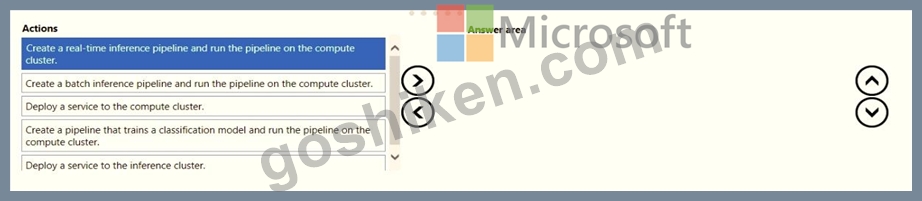
正解:
解説: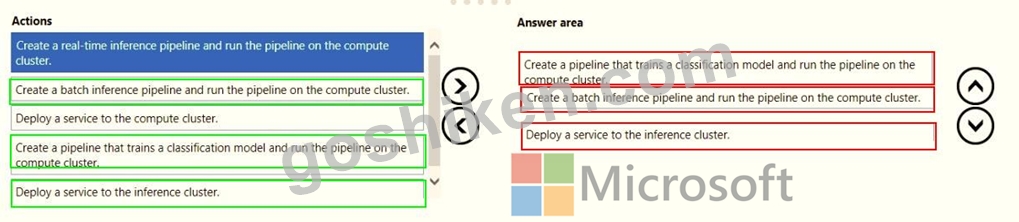
質問 # 84
......
DP-100ブレーン問題集PDF、Microsoft DP-100試験問題詰合せ:https://www.goshiken.com/Microsoft/DP-100-mondaishu.html
2024年最新のDP-100サンプル問題は信頼され続けるDP-100テストエンジン:https://drive.google.com/open?id=1zhNJ-lq0fsS1rOtGcXE_Kf_0Y-BbR3JQ