

GoShiken DP-100リアル試験問題解答は更新された[2024年10月30日]
お手軽に合格させる 最新Microsoft DP-100問題集には431問があります
質問 # 239
You plan to use a Deep Learning Virtual Machine (DLVM) to train deep learning models using Compute Unified Device Architecture (CUDA) computations.
You need to configure the DLVM to support CUDA.
What should you implement?
- A. Graphic Processing Unit (GPU)
- B. Intel Software Guard Extensions (Intel SGX) technology
- C. Solid State Drives (SSD)
- D. High Random Access Memory (RAM) configuration
- E. Computer Processing Unit (CPU) speed increase by using overcloking
正解:A
解説:
Explanation
A Deep Learning Virtual Machine is a pre-configured environment for deep learning using GPU instances.
References:
https://azuremarketplace.microsoft.com/en-au/marketplace/apps/microsoft-ads.dsvm-deep-learning
質問 # 240
You need to define an evaluation strategy for the crowd sentiment models.
Which three actions should you perform in sequence? To answer, move the appropriate actions from the list of actions to the answer area and arrange them in the correct order.
正解:
解説:
Explanation:
Step 1: Define a cross-entropy function activation
When using a neural network to perform classification and prediction, it is usually better to use cross-entropy error than classification error, and somewhat better to use cross-entropy error than mean squared error to evaluate the quality of the neural network.
Step 2: Add cost functions for each target state.
Step 3: Evaluated the distance error metric.
References:
https://www.analyticsvidhya.com/blog/2018/04/fundamentals-deep-learning-regularization-techniques/
質問 # 241
You create an Azure Machine Learning workspace. You are training a classification model with no-code AutoML in Azure Machine Learning studio.
The model must predict if a client of a financial institution will subscribe to a fixed-term deposit. You must preview the data profile in Azure Machine Learning studio once the dataset is created.
You need to train the model.
Which four actions should you perform in sequence? To answer, move the appropriate actions from the list of actions to the answer area and arrange them in the correct order.
正解:
解説:
1 - Create a file dataset.
2 - Create a compute cluster.
3 - Create an experiment.
4 - Create an automated ML job.
質問 # 242
Note: This question is part of a series of questions that present the same scenario. Each question in the series contains a unique solution that might meet the stated goals. Some question sets might have more than one correct solution, while others might not have a correct solution.
After you answer a question in this section, you will NOT be able to return to it. As a result, these questions will not appear in the review screen.
You are using Azure Machine Learning to run an experiment that trains a classification model.
You want to use Hyperdrive to find parameters that optimize the AUC metric for the model. You configure a HyperDriveConfig for the experiment by running the following code:
You plan to use this configuration to run a script that trains a random forest model and then tests it with validation data. The label values for the validation data are stored in a variable named y_test variable, and the predicted probabilities from the model are stored in a variable named y_predicted.
You need to add logging to the script to allow Hyperdrive to optimize hyperparameters for the AUC metric.
Solution: Run the following code:
Does the solution meet the goal?
- A. No
- B. Yes
正解:A
解説:
Explanation
Use a solution with logging.info(message) instead.
Note: Python printing/logging example:
logging.info(message)
Destination: Driver logs, Azure Machine Learning designer
Reference:
https://docs.microsoft.com/en-us/azure/machine-learning/how-to-debug-pipelines
質問 # 243
You create an Azure Machine Learning compute target named ComputeOne by using the STANDARD_D1 virtual machine image.
You define a Python variable named was that references the Azure Machine Learning workspace. You run the following Python code:
For each of the following statements, select Yes if the statement is true. Otherwise, select No.
NOTE: Each correct selection is worth one point.
正解:
解説:
Reference:
https://docs.microsoft.com/en-us/python/api/azureml-core/azureml.core.compute.computetarget
質問 # 244
You manage an Azure Machine Learning workspace. You submit a training job with the Azure Machine Learning Python SDK v2. You must use MLflow to log metrics, model parameters, and mode! artifacts automatically when training a model.
You start by writing the following code segment:
For each of the following statements, select Yes If the statement is true. Otherwise, select No.
正解:
解説:
質問 # 245
You are analyzing the asymmetry in a statistical distribution.
The following image contains two density curves that show the probability distribution of two datasets.
Use the drop-down menus to select the answer choice that answers each question based on the information presented in the graphic.
NOTE: Each correct selection is worth one point.
正解:
解説:
Box 1: Positive skew
Reference:
https://docs.microsoft.com/en-us/azure/machine-learning/studio-module-reference/compute-elementary-statistics
質問 # 246
You are developing a linear regression model in Azure Machine Learning Studio. You run an experiment to compare different algorithms.
The following image displays the results dataset output:
Use the drop-down menus to select the answer choice that answers each question based on the information presented in the image.
NOTE: Each correct selection is worth one point.
正解:
解説:
Reference:
https://docs.microsoft.com/en-us/azure/machine-learning/studio-module-reference/evaluate-model
https://docs.microsoft.com/en-us/azure/machine-learning/studio-module-reference/linear-regression
質問 # 247
You create an experiment in Azure Machine Learning Studio. You add a training dataset that contains 10,000 rows. The first 9,000 rows represent class 0 (90 percent).
The remaining 1,000 rows represent class 1 (10 percent).
The training set is imbalances between two classes. You must increase the number of training examples for class 1 to 4,000 by using 5 data rows. You add the Synthetic Minority Oversampling Technique (SMOTE) module to the experiment.
You need to configure the module.
Which values should you use? To answer, select the appropriate options in the dialog box in the answer area.
NOTE: Each correct selection is worth one point.
正解:
解説: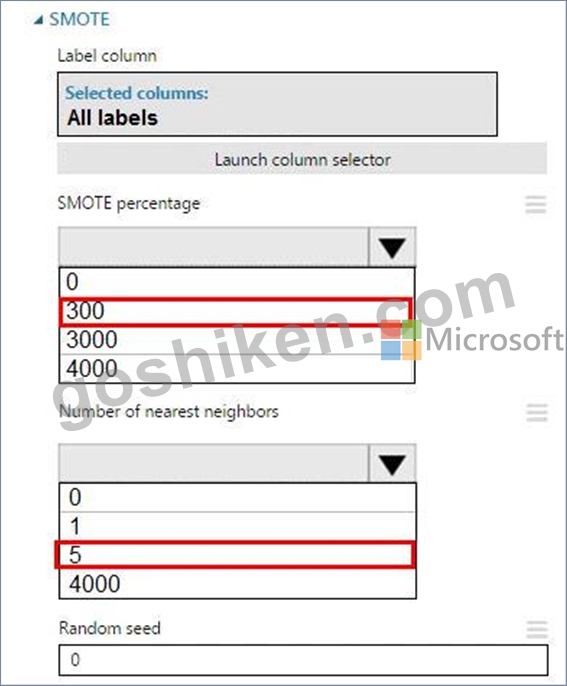
References:
https://docs.microsoft.com/en-us/azure/machine-learning/studio-module-reference/smote
質問 # 248
You are creating a machine learning model that can predict the species of a penguin from its measurements. You have a file that contains measurements for free species of penguin in comma delimited format.
The model must be optimized for area under the received operating characteristic curve performance metric averaged for each class.
You need to use the Automated Machine Learning user interface in Azure Machine Learning studio to run an experiment and find the best performing model.
Which five actions should you perform in sequence? To answer, move the appropriate actions from the list of actions to the answer area and arrange them in the collect order.
正解:
解説:
1 - Create and select a new dataset...
2 - Select the Classification task type.
3 - Set the Primary metric configuration setting to Accuracy.
4 - Configure the automated machine learning...
5 - Run the automated machine learning experiment and review the results.
質問 # 249 
For each of the following statements, select Yes if the statement is true. Otherwise, select No. NOTE: Each correct selection is worth one point.
正解:
解説:
質問 # 250
You are a lead data scientist for a project that tracks the health and migration of birds. You create a multi-image classification deep learning model that uses a set of labeled bird photos collected by experts. You plan to use the model to develop a cross-platform mobile app that predicts the species of bird captured by app users.
You must test and deploy the trained model as a web service. The deployed model must meet the following requirements:
* An authenticated connection must not be required for testing.
* The deployed model must perform with low latency during inferencing.
* The REST endpoints must be scalable and should have a capacity to handle large number of requests when multiple end users are using the mobile application.
You need to verify that the web service returns predictions in the expected JSON format when a valid REST request is submitted.
Which compute resources should you use? To answer, select the appropriate options in the answer area.
NOTE: Each correct selection is worth one point.
正解:
解説:
Explanation
Box 1: ds-workstation notebook VM
An authenticated connection must not be required for testing.
On a Microsoft Azure virtual machine (VM), including a Data Science Virtual Machine (DSVM), you create local user accounts while provisioning the VM. Users then authenticate to the VM by using these credentials.
Box 2: gpu-compute cluster
Image classification is well suited for GPU compute clusters
Reference:
https://docs.microsoft.com/en-us/azure/machine-learning/data-science-virtual-machine/dsvm-common-identity
https://docs.microsoft.com/en-us/azure/architecture/reference-architectures/ai/training-deep-learning
質問 # 251
You create a multi-class image classification deep learning model.
The model must be retrained monthly with the new image data fetched from a public web portal. You create an Azure Machine Learning pipeline to fetch new data, standardize the size of images, and retrain the model.
You need to use the Azure Machine Learning SDK to configure the schedule for the pipeline.
Which four actions should you perform in sequence? To answer, move the appropriate actions from the list of actions to the answer area and arrange them in the correct order.
正解:
解説:
Explanation
Step 1: Publish the pipeline.
To schedule a pipeline, you'll need a reference to your workspace, the identifier of your published pipeline, and the name of the experiment in which you wish to create the schedule.
Step 2: Retrieve the pipeline ID.
Needed for the schedule.
Step 3: Create a ScheduleRecurrence..
To run a pipeline on a recurring basis, you'll create a schedule. A Schedule associates a pipeline, an experiment, and a trigger.
First create a schedule. Example: Create a Schedule that begins a run every 15 minutes:
recurrence = ScheduleRecurrence(frequency="Minute", interval=15)
Step 4: Define an Azure Machine Learning pipeline schedule..
Example, continued:
recurring_schedule = Schedule.create(ws, name="MyRecurringSchedule",
description="Based on time",
pipeline_id=pipeline_id,
experiment_name=experiment_name,
recurrence=recurrence)
Reference:
https://docs.microsoft.com/en-us/azure/machine-learning/how-to-schedule-pipelines
質問 # 252
Note: This question is part of a series of questions that present the same scenario. Each question in the series contains a unique solution that might meet the stated goals. Some question sets might have more than one correct solution, while others might not have a correct solution.
After you answer a question in this section, you will NOT be able to return to it. As a result, these questions will not appear in the review screen.
You create a model to forecast weather conditions based on historical data.
You need to create a pipeline that runs a processing script to load data from a datastore and pass the processed data to a machine learning model training script.
Solution: Run the following code:
Does the solution meet the goal?
- A. No
- B. Yes
正解:A
解説:
Explanation
Explanation:
train_step is missing.
Reference:
https://docs.microsoft.com/en-us/python/api/azureml-pipeline-core/azureml.pipeline.core.pipelinedata?
view=azure-ml-py
質問 # 253
You are using a decision tree algorithm. You have trained a model that generalizes well at a tree depth equal to
10.
You need to select the bias and variance properties of the model with varying tree depth values.
Which properties should you select for each tree depth? To answer, select the appropriate options in the answer area.
正解:
解説:
Explanation
In decision trees, the depth of the tree determines the variance. A complicated decision tree (e.g. deep) has low bias and high variance.
Note: In statistics and machine learning, the bias-variance tradeoff is the property of a set of predictive models whereby models with a lower bias in parameter estimation have a higher variance of the parameter estimates across samples, and vice versa. Increasing the bias will decrease the variance. Increasing the variance will decrease the bias.
References:
https://machinelearningmastery.com/gentle-introduction-to-the-bias-variance-trade-off-in-machine-learning/
質問 # 254
You are using the Azure Machine Learning Service to automate hyperparameter exploration of your neural network classification model.
You must define the hyperparameter space to automatically tune hyperparameters using random sampling according to following requirements:
The learning rate must be selected from a normal distribution with a mean value of 10 and a standard deviation of 3.
Batch size must be 16, 32 and 64.
Keep probability must be a value selected from a uniform distribution between the range of 0.05 and 0.1.
You need to use the param_sampling method of the Python API for the Azure Machine Learning Service.
How should you complete the code segment? To answer, select the appropriate options in the answer area.
NOTE: Each correct selection is worth one point.
正解:
解説:
Reference:
https://docs.microsoft.com/en-us/azure/machine-learning/service/how-to-tune-hyperparameters
質問 # 255
You plan to use a Data Science Virtual Machine (DSVM) with the open source deep learning frameworks Caffe2 and PyTorch.
You need to select a pre-configured DSVM to support the frameworks.
What should you create?
- A. Data Science Virtual Machine for Linux (Ubuntu)
- B. Data Science Virtual Machine for Linux (CentOS)
- C. Data Science Virtual Machine for Windows 2016
- D. Geo AI Data Science Virtual Machine with ArcGIS
- E. Data Science Virtual Machine for Windows 2012
正解:A
解説:
Caffe2 and PyTorch is supported by Data Science Virtual Machine for Linux.
Microsoft offers Linux editions of the DSVM on Ubuntu 16.04 LTS and CentOS 7.4.
Only the DSVM on Ubuntu is preconfigured for Caffe2 and PyTorch.
Incorrect Answers:
D: Caffe2 and PytOCH are only supported in the Data Science Virtual Machine for Linux.
References:
https://docs.microsoft.com/en-us/azure/machine-learning/data-science-virtual-machine/overview Prepare data for modeling Testlet 1 Case study Overview You are a data scientist in a company that provides data science for professional sporting events. Models will use global and local market data to meet the following business goals:
* Understand sentiment of mobile device users at sporting events based on audio from crowd reactions.
* Assess a user's tendency to respond to an advertisement.
* Customize styles of ads served on mobile devices.
* Use video to detect penalty events
Current environment
* Media used for penalty event detection will be provided by consumer devices. Media may include images and videos captured during the sporting event and shared using social media. The images and videos will have varying sizes and formats.
* The data available for model building comprises of seven years of sporting event media. The sporting event media includes; recorded video transcripts or radio commentary, and logs from related social media feeds captured during the sporting events.
* Crowd sentiment will include audio recordings submitted by event attendees in both mono and stereo formats.
Penalty detection and sentiment
* Data scientists must build an intelligent solution by using multiple machine learning models for penalty event detection.
* Data scientists must build notebooks in a local environment using automatic feature engineering and model building in machine learning pipelines.
* Notebooks must be deployed to retrain by using Spark instances with dynamic worker allocation.
* Notebooks must execute with the same code on new Spark instances to recode only the source of the data.
* Global penalty detection models must be trained by using dynamic runtime graph computation during training.
* Local penalty detection models must be written by using BrainScript.
* Experiments for local crowd sentiment models must combine local penalty detection data.
* Crowd sentiment models must identify known sounds such as cheers and known catch phrases. Individual crowd sentiment models will detect similar sounds.
* All shared features for local models are continuous variables.
* Shared features must use double precision. Subsequent layers must have aggregate running mean and standard deviation metrics available.
Advertisements
During the initial weeks in production, the following was observed:
* Ad response rated declined.
* Drops were not consistent across ad styles.
* The distribution of features across training and production data are not consistent Analysis shows that, of the 100 numeric features on user location and behavior, the 47 features that come from location sources are being used as raw features. A suggested experiment to remedy the bias and variance issue is to engineer 10 linearly uncorrelated features.
* Initial data discovery shows a wide range of densities of target states in training data used for crowd sentiment models.
* All penalty detection models show inference phases using a Stochastic Gradient Descent (SGD) are running too slow.
* Audio samples show that the length of a catch phrase varies between 25%-47% depending on region
* The performance of the global penalty detection models shows lower variance but higher bias when comparing training and validation sets. Before implementing any feature changes, you must confirm the bias and variance using all training and validation cases.
* Ad response models must be trained at the beginning of each event and applied during the sporting event.
* Market segmentation models must optimize for similar ad response history.
* Sampling must guarantee mutual and collective exclusively between local and global segmentation models that share the same features.
* Local market segmentation models will be applied before determining a user's propensity to respond to an advertisement.
* Ad response models must support non-linear boundaries of features.
* The ad propensity model uses a cut threshold is 0.45 and retrains occur if weighted Kappa deviated from
0.1 +/- 5%.
* The ad propensity model uses cost factors shown in the following diagram:
* The ad propensity model uses proposed cost factors shown in the following diagram:
* Performance curves of current and proposed cost factor scenarios are shown in the following diagram:
質問 # 256
You configure a Deep Learning Virtual Machine for Windows.
You need to recommend tools and frameworks to perform the following:
Build deep neural network (DNN) models
Perform interactive data exploration and visualization
Which tools and frameworks should you recommend? To answer, drag the appropriate tools to the correct tasks. Each tool may be used once, more than once, or not at all. You may need to drag the split bar between panes or scroll to view content.
NOTE: Each correct selection is worth one point.
正解:
解説:
Reference:
https://docs.microsoft.com/en-us/azure/machine-learning/studio-module-reference/train-vowpal-wabbit-version-8-model
https://docs.microsoft.com/en-us/azure/architecture/data-guide/scenarios/interactive-data-exploration
質問 # 257
You use Data Science Virtual Machines (DSVMs) for Windows and Linux in Azure.
You need to access the DSVMs.
Which utilities should you use? To answer, select the appropriate options in the answer area.
NOTE: Each correct selection is worth one point.
正解:
解説:
質問 # 258
You create an Azure Machine Learning workspace and a new Azure DevOps organization. You register a model in the workspace and deploy the model to the target environment.
All new versions of the model registered in the workspace must automatically be deployed to the target environment.
You need to configure Azure Pipelines to deploy the model.
Which four actions should you perform in sequence? To answer, move the appropriate actions from the list of actions to the answer area and arrange them in the correct order.
正解:
解説:
Explanation
Graphical user interface, text, application, email Description automatically generated
Step 1: Create an Azure DevOps project
Step 2: Create a release pipeline
Sign in to your Azure DevOps organization and navigate to your project.
Go to Pipelines, and then select New pipeline.
Step 3: Install the Machine Learning extension for Azure Pipelines
You must install and configure the Azure CLI and ML extension.
Step 4: Create a service connection
How to set up your service connection
Graphical user interface, text, application, email Description automatically generated
Select AzureMLWorkspace for the scope level, then fill in the following subsequent parameters.
Graphical user interface, text, application Description automatically generated
Note: How to enable model triggering in a release pipeline
Go to your release pipeline and add a new artifact. Click on AzureML Model artifact then select the appropriate AzureML service connection and select from the available models in your workspace.
Enable the deployment trigger on your model artifact as shown here. Every time a new version of that model is registered, a release pipeline will be triggered.
Reference:
https://marketplace.visualstudio.com/items?itemName=ms-air-aiagility.vss-services-azureml
https://docs.microsoft.com/en-us/azure/devops/pipelines/targets/azure-machine-learning
質問 # 259
You create an Azure Machine Learning workspace and install the MLflow library.
You need to tog different types of data by using the MLflow library.
Which method should you use? To answer, select the appropriate options in the answer area.
NOTE: Each correct selection is worth one point.
正解:
解説:
質問 # 260
You create a script for training a machine learning model in Azure Machine Learning service.
You create an estimator by running the following code:
For each of the following statements, select Yes if the statement is true. Otherwise, select No.
NOTE: Each correct selection is worth one point.
正解:
解説:
Explanation:
Box 1: Yes
Parameter source_directory is a local directory containing experiment configuration and code files needed for a training job.
Box 2: Yes
script_params is a dictionary of command-line arguments to pass to the training script specified in entry_script.
Box 3: No
Box 4: Yes
The conda_packages parameter is a list of strings representing conda packages to be added to the Python environment for the experiment.
質問 # 261
......
最新のDP-100学習ガイド2024年最新の- 提供するのはテストエンジンとPDF:https://www.goshiken.com/Microsoft/DP-100-mondaishu.html
最新版を今すぐ試そうDP-100練習テスト問題解答:https://drive.google.com/open?id=1HuZoUNVThVDBMg4tkF1a1nC8YwLCPbt9