

[2022年02月] 学習材料には有効なDP-100効率的問題集!
最新のDP-100テストエンジンPDF無料問題集保証!
質問 121
You need to define a modeling strategy for ad response.
Which three actions should you perform in sequence? To answer, move the appropriate actions from the list of actions to the answer area and arrange them in the correct order.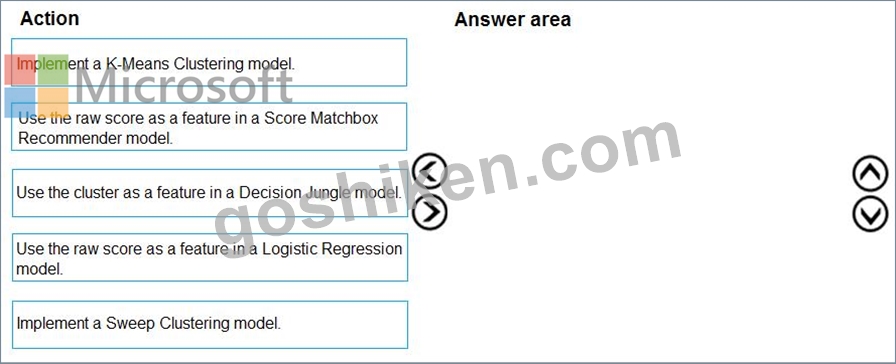
正解:
解説: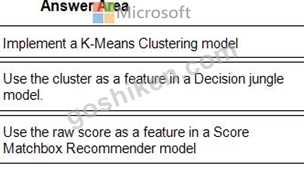
1 - Implement a K-Means Clustering model
2 - Use the cluster as a feature in a Decision jungle model.
3 - Use the raw score as a feature in a Score Matchbox Recommender model Reference:
https://docs.microsoft.com/en-us/azure/machine-learning/studio-module-reference/multiclass-decision-jungle
https://docs.microsoft.com/en-us/azure/machine-learning/studio-module-reference/score-matchbox-recommender
質問 122
Note: This question is part of a series of questions that present the same scenario. Each question in the series contains a unique solution that might meet the stated goals. Some question sets might have more than one correct solution, while others might not have a correct solution.
After you answer a question in this section, you will NOT be able to return to it. As a result, these questions will not appear in the review screen.
You are using Azure Machine Learning to run an experiment that trains a classification model.
You want to use Hyperdrive to find parameters that optimize the AUC metric for the model. You configure a HyperDriveConfig for the experiment by running the following code: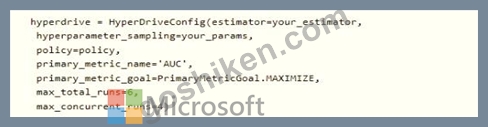
You plan to use this configuration to run a script that trains a random forest model and then tests it with validation data. The label values for the validation data are stored in a variable named y_test variable, and the predicted probabilities from the model are stored in a variable named y_predicted.
You need to add logging to the script to allow Hyperdrive to optimize hyperparameters for the AUC metric. Solution: Run the following code: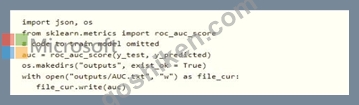
Does the solution meet the goal?
- A. No
Explanation
Use a solution with logging.info(message) instead.
Note: Python printing/logging example:
logging.info(message)
Destination: Driver logs, Azure Machine Learning designer - B. Yes
正解: A
解説:
Reference:
https://docs.microsoft.com/en-us/azure/machine-learning/how-to-debug-pipelines
質問 123
You create a binary classification model.
You need to evaluate the model performance.
Which two metrics can you use? Each correct answer presents a complete solution.
NOTE: Each correct selection is worth one point.
- A. accuracy
- B. mean absolute error
- C. precision
- D. relative absolute error
- E. coefficient of determination
正解: A,C
解説:
The evaluation metrics available for binary classification models are: Accuracy, Precision, Recall, F1 Score, and AUC.
Note: A very natural question is: 'Out of the individuals whom the model, how many were classified correctly (TP)?' This question can be answered by looking at the Precision of the model, which is the proportion of positives that are classified correctly.
References:
https://docs.microsoft.com/en-us/azure/machine-learning/studio/evaluate-model-performance
質問 124
Note: This question is part of a series of questions that present the same scenario. Each question in the series contains a unique solution that might meet the stated goals. Some question sets might have more than one correct solution, while others might not have a correct solution.
After you answer a question in this section, you will NOT be able to return to it. As a result, these questions will not appear in the review screen.
You have a Python script named train.py in a local folder named scripts. The script trains a regression model by using scikit-learn. The script includes code to load a training data file which is also located in the scripts folder.
You must run the script as an Azure ML experiment on a compute cluster named aml-compute.
You need to configure the run to ensure that the environment includes the required packages for model training. You have instantiated a variable named aml-compute that references the target compute cluster.
Solution: Run the following code: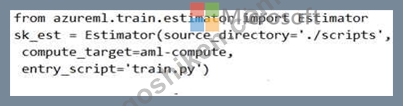
Does the solution meet the goal?
- A. No
- B. Yes
正解: A
解説:
There is a missing line: conda_packages=['scikit-learn'], which is needed.
Correct example:
sk_est = Estimator(source_directory='./my-sklearn-proj',
script_params=script_params,
compute_target=compute_target,
entry_script='train.py',
conda_packages=['scikit-learn'])
Note:
The Estimator class represents a generic estimator to train data using any supplied framework.
This class is designed for use with machine learning frameworks that do not already have an Azure Machine Learning pre-configured estimator. Pre-configured estimators exist for Chainer, PyTorch, TensorFlow, and SKLearn.
Example:
from azureml.train.estimator import Estimator
script_params = {
# to mount files referenced by mnist dataset
'--data-folder': ds.as_named_input('mnist').as_mount(),
'--regularization': 0.8
}
Reference:
https://docs.microsoft.com/en-us/python/api/azureml-train-core/azureml.train.estimator.estimator
質問 125
You train a classification model by using a decision tree algorithm.
You create an estimator by running the following Python code. The variable feature_names is a list of all feature names, and class_names is a list of all class names.
from interpret.ext.blackbox import TabularExplainer
You need to explain the predictions made by the model for all classes by determining the importance of all features.
For each of the following statements, select Yes if the statement is true. Otherwise, select No.
NOTE: Each correct selection is worth one point.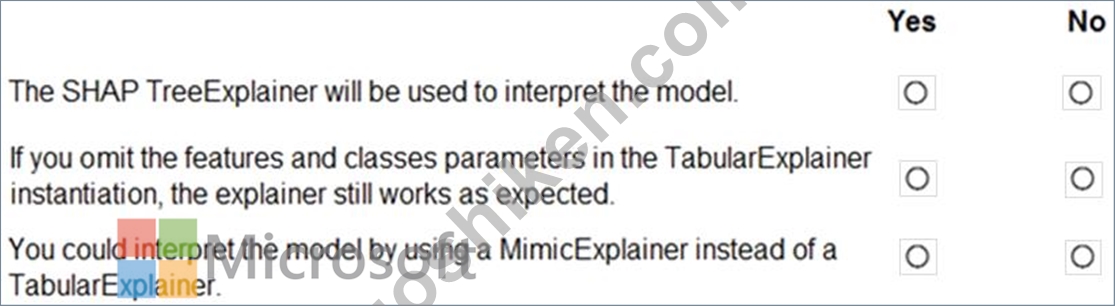
正解:
解説: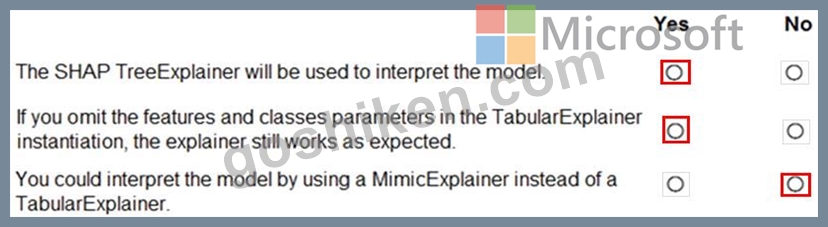
Reference:
https://docs.microsoft.com/en-us/azure/machine-learning/how-to-machine-learning-interpretability-aml
質問 126
You plan to provision an Azure Machine Learning Basic edition workspace for a data science project.
You need to identify the tasks you will be able to perform in the workspace.
Which three tasks will you be able to perform? Each correct answer presents a complete solution.
NOTE: Each correct selection is worth one point.
D
- A. Create a Compute Instance and use it to run code in Jupyter notebooks.
- B. Create a tabular dataset that supports versioning.
- C. Use the designer to train a model by dragging and dropping pre-defined modules.
- D. Create an Azure Kubernetes Service (AKS) inference cluster.
- E. Use the Automated Machine Learning user interface to train a model.
正解: A,B,D
解説:
Reference:
https://azure.microsoft.com/en-us/pricing/details/machine-learning/
質問 127
You need to select a feature extraction method.
Which method should you use?
- A. Pearson's correlation
- B. Spearman correlation
- C. Mann-Whitney test
- D. Mutual information
正解: B
解説:
Spearman's rank correlation coefficient assesses how well the relationship between two variables can be described using a monotonic function.
Note: Both Spearman's and Kendall's can be formulated as special cases of a more general correlation coefficient, and they are both appropriate in this scenario.
Scenario: The MedianValue and AvgRoomsInHouse columns both hold data in numeric format. You need to select a feature selection algorithm to analyze the relationship between the two columns in more detail.
References:
https://docs.microsoft.com/en-us/azure/machine-learning/studio-module-reference/feature-selection-modules Mix Questions
質問 128
You plan to create a speech recognition deep learning model.
The model must support the latest version of Python.
You need to recommend a deep learning framework for speech recognition to include in the Data Science Virtual Machine (DSVM).
What should you recommend?
- A. TensorFlow
- B. Rattle
- C. Weka
- D. Scikit-learn
正解: A
解説:
TensorFlow is an open source library for numerical computation and large-scale machine learning. It uses Python to provide a convenient front-end API for building applications with the framework TensorFlow can train and run deep neural networks for handwritten digit classification, image recognition, word embeddings, recurrent neural networks, sequence-to-sequence models for machine translation, natural language processing, and PDE (partial differential equation) based simulations.
Incorrect Answers:
A: Rattle is the R analytical tool that gets you started with data analytics and machine learning.
C: Weka is used for visual data mining and machine learning software in Java.
D: Scikit-learn is one of the most useful library for machine learning in Python. It is on NumPy, SciPy and matplotlib, this library contains a lot of effiecient tools for machine learning and statistical modeling including classification, regression, clustering and dimensionality reduction.
Reference:
https://www.infoworld.com/article/3278008/what-is-tensorflow-the-machine-learning-library-explained.html
質問 129
You have an Azure Machine Learning workspace that contains a training cluster and an inference cluster.
You plan to create a classification model by using the Azure Machine Learning designer.
You need to ensure that client applications can submit data as HTTP requests and receive predictions as responses.
Which three actions should you perform in sequence? To answer, move the appropriate actions from the list of actions to the answer area and arrange them in the correct order.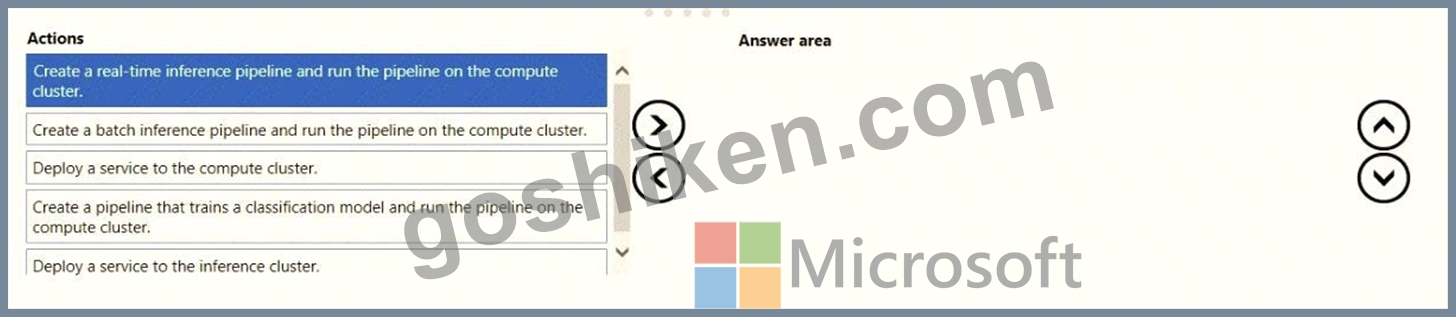
正解:
解説: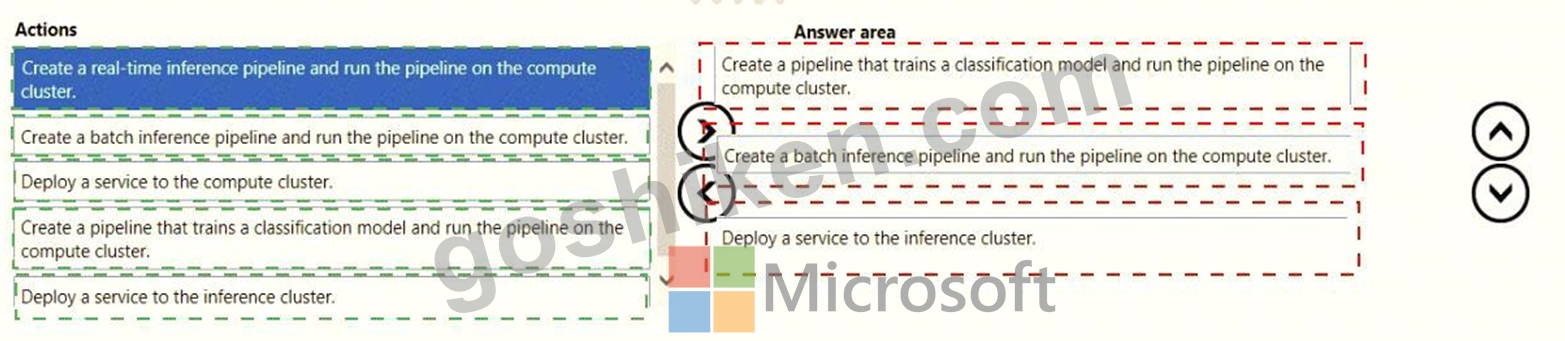
質問 130
You are performing sentiment analysis using a CSV file that includes 12.0O0 customer reviews written in a short sentence format. You add the CSV file to Azure Machine Learning Studio and Configure it as the starting point dataset of an experiment. You add the Extract N-Gram Features from Text module to the experiment to extract key phrases from the customer review column in the dataset.
You must create a new n-gram text dictionary from the customer review text and set the maximum n-gram size to trigrams.
You need to configure the Extract N Gram features from Text module.
What should you select? To answer, select the appropriate options in the answer area.
NOTE: Each correct selection is worth one point.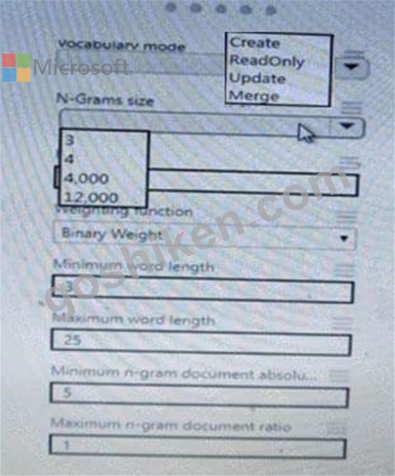
正解:
解説: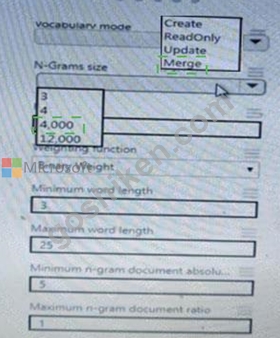
質問 131
You are using Azure Machine Learning to train machine learning models. You need a compute target on which to remotely run the training script. You run the following Python code:

正解:
解説:
Reference:
https://docs.microsoft.com/en-us/python/api/azureml-core/azureml.core.compute.amlcompute.amlcomputeprovisioningconfiguration
https://docs.microsoft.com/en-us/azure/machine-learning/how-to-create-attach-compute-studio
質問 132
Note: This question is part of a series of questions that present the same scenario. Each question in the series contains a unique solution that might meet the stated goals. Some question sets might have more than one correct solution, while others might not have a correct solution.
After you answer a question in this section, you will NOT be able to return to it. As a result, these questions will not appear in the review screen.
An IT department creates the following Azure resource groups and resources: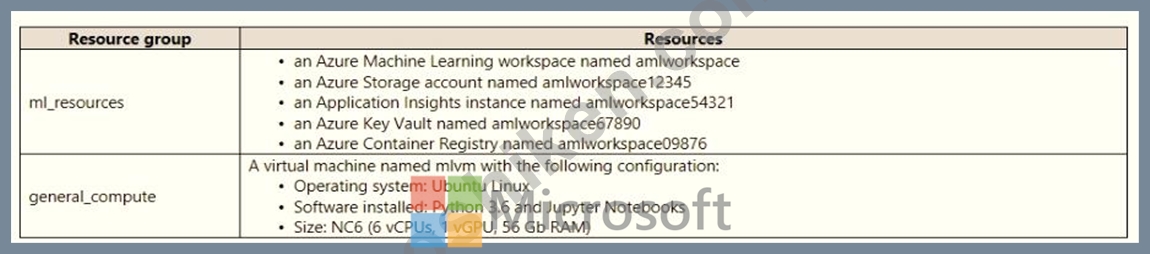
The IT department creates an Azure Kubernetes Service (AKS)-based inference compute target named aks-cluster in the Azure Machine Learning workspace. You have a Microsoft Surface Book computer with a GPU. Python 3.6 and Visual Studio Code are installed.
You need to run a script that trains a deep neural network (DNN) model and logs the loss and accuracy metrics.
Solution: Install the Azure ML SDK on the Surface Book. Run Python code to connect to the workspace. Run the training script as an experiment on the aks-cluster compute target.
Does the solution meet the goal?
- A. No
- B. Yes
正解: A
解説:
Need to attach the mlvm virtual machine as a compute target in the Azure Machine Learning workspace.
Reference:
https://docs.microsoft.com/en-us/azure/machine-learning/concept-compute-target
質問 133
You are performing a filter-based feature selection for a dataset to build a multi-class classifier by using Azure Machine Learning Studio.
The dataset contains categorical features that are highly correlated to the output label column.
You need to select the appropriate feature scoring statistical method to identify the key predictors.
Which method should you use?
- A. Chi-squared
- B. Kendall correlation
- C. Spearman correlation
- D. Pearson correlation
正解: D
解説:
Pearson's correlation statistic, or Pearson's correlation coefficient, is also known in statistical models as the r value. For any two variables, it returns a value that indicates the strength of the correlation Pearson's correlation coefficient is the test statistics that measures the statistical relationship, or association, between two continuous variables. It is known as the best method of measuring the association between variables of interest because it is based on the method of covariance. It gives information about the magnitude of the association, or correlation, as well as the direction of the relationship.
Incorrect Answers:
C: The two-way chi-squared test is a statistical method that measures how close expected values are to actual results.
Reference:
https://docs.microsoft.com/en-us/azure/machine-learning/studio-module-reference/filter-based-feature-selection
https://www.statisticssolutions.com/pearsons-correlation-coefficient/
質問 134
You need to replace the missing data in the AccessibilityToHighway columns.
How should you configure the Clean Missing Data module? To answer, select the appropriate options in the answer area.
NOTE: Each correct selection is worth one point.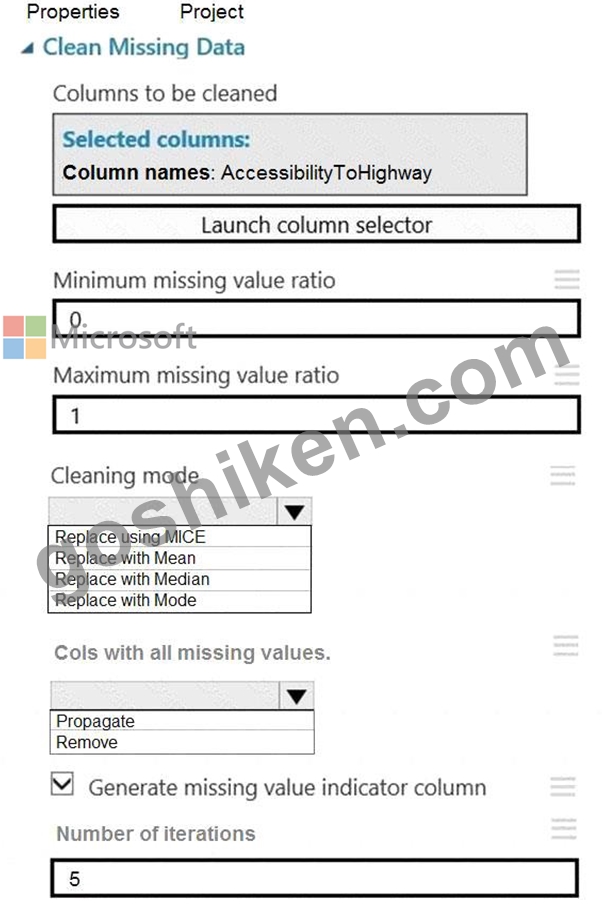
正解:
解説: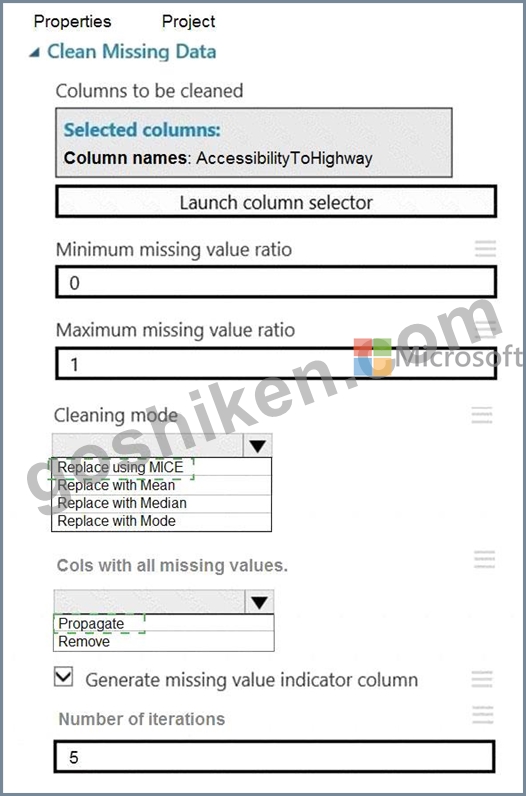
Explanation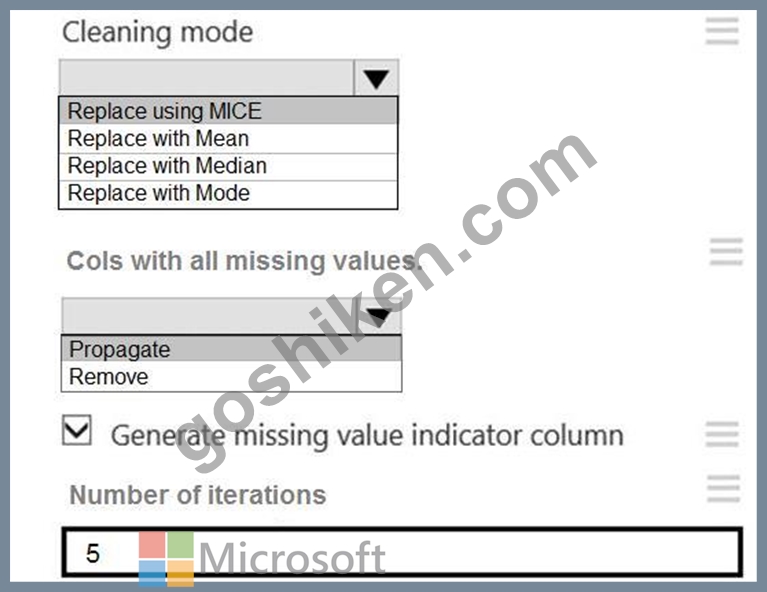
Box 1: Replace using MICE
Replace using MICE: For each missing value, this option assigns a new value, which is calculated by using a method described in the statistical literature as "Multivariate Imputation using Chained Equations" or
"Multiple Imputation by Chained Equations". With a multiple imputation method, each variable with missing data is modeled conditionally using the other variables in the data before filling in the missing values.
Scenario: The AccessibilityToHighway column in both datasets contains missing values. The missing data must be replaced with new data so that it is modeled conditionally using the other variables in the data before filling in the missing values.
Box 2: Propagate
Cols with all missing values indicate if columns of all missing values should be preserved in the output.
References:
https://docs.microsoft.com/en-us/azure/machine-learning/studio-module-reference/clean-missing-data
質問 135
You previously deployed a model that was trained using a tabular dataset named training-dataset, which is based on a folder of CSV files.
Over time, you have collected the features and predicted labels generated by the model in a folder containing a CSV file for each month. You have created two tabular datasets based on the folder containing the inference data: one named predictions-dataset with a schema that matches the training data exactly, including the predicted label; and another named features-dataset with a schema containing all of the feature columns and a timestamp column based on the filename, which includes the day, month, and year.
You need to create a data drift monitor to identify any changing trends in the feature data since the model was trained. To accomplish this, you must define the required datasets for the data drift monitor.
Which datasets should you use to configure the data drift monitor? To answer, drag the appropriate datasets to the correct data drift monitor options. Each source may be used once, more than once, or not at all. You may need to drag the split bar between panes or scroll to view content.
NOTE: Each correct selection is worth one point.
正解:
解説:
Reference:
https://docs.microsoft.com/en-us/azure/machine-learning/how-to-monitor-datasets
質問 136
You are creating an experiment by using Azure Machine Learning Studio.
You must divide the data into four subsets for evaluation. There is a high degree of missing values in the data.
You must prepare the data for analysis.
You need to select appropriate methods for producing the experiment.
Which three modules should you run in sequence? To answer, move the appropriate actions from the list of actions to the answer area and arrange them in the correct order.
NOTE: More than one order of answer choices is correct. You will receive credit for any of the correct orders you select.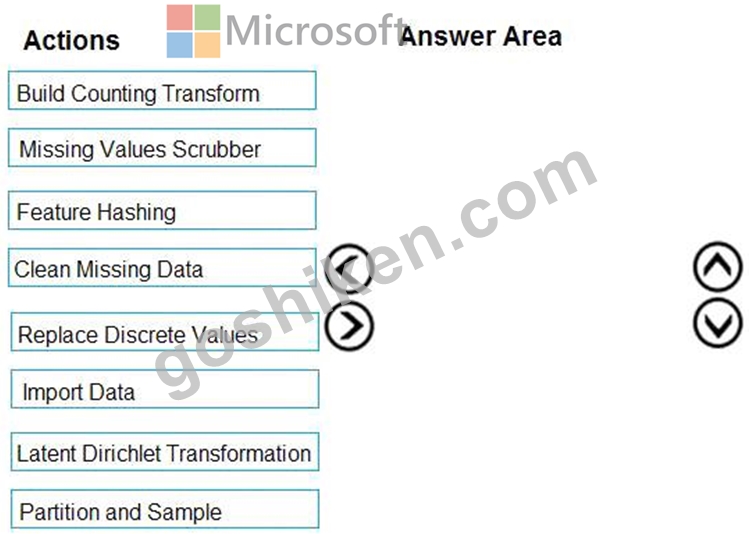
正解:
解説: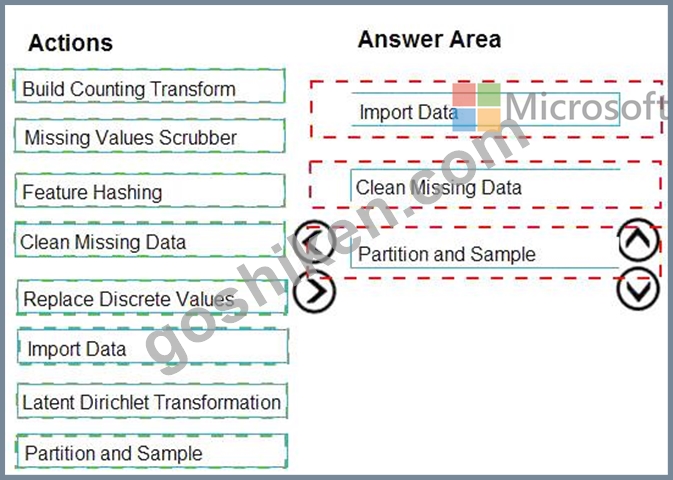
Explanation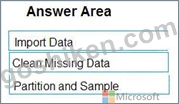
The Clean Missing Data module in Azure Machine Learning Studio, to remove, replace, or infer missing values.
質問 137
You use the Two-Class Neural Network module in Azure Machine Learning Studio to build a binary classification model. You use the Tune Model Hyperparameters module to tune accuracy for the model.
You need to select the hyperparameters that should be tuned using the Tune Model Hyperparameters module.
Which two hyperparameters should you use? Each correct answer presents part of the solution.
NOTE: Each correct selection is worth one point.
- A. The type of the normalizer
- B. Number of learning iterations
- C. Learning Rate
- D. Number of hidden nodes
- E. Hidden layer specification
正解: B,E
解説:
D: For Number of learning iterations, specify the maximum number of times the algorithm should process the training cases.
E: For Hidden layer specification, select the type of network architecture to create.
Between the input and output layers you can insert multiple hidden layers. Most predictive tasks can be accomplished easily with only one or a few hidden layers.
Reference:
https://docs.microsoft.com/en-us/azure/machine-learning/studio-module-reference/two-class-neural-network
質問 138
You have a feature set containing the following numerical features: X, Y, and Z.
The Poisson correlation coefficient (r-value) of X, Y, and Z features is shown in the following image:
Use the drop-down menus to select the answer choice that answers each question based on the information presented in the graphic.
NOTE: Each correct selection is worth one point.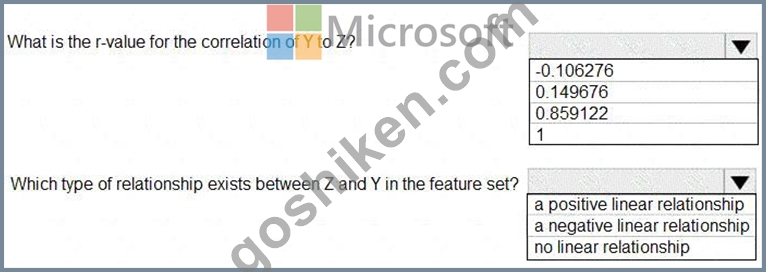
正解:
解説: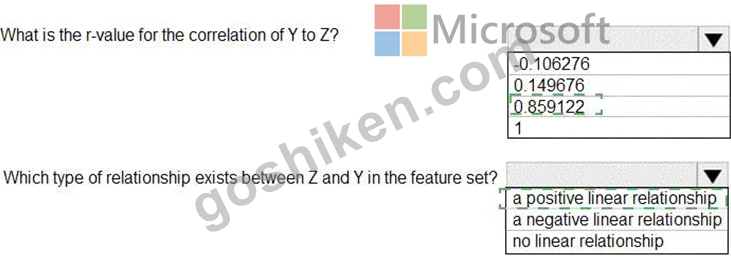
Explanation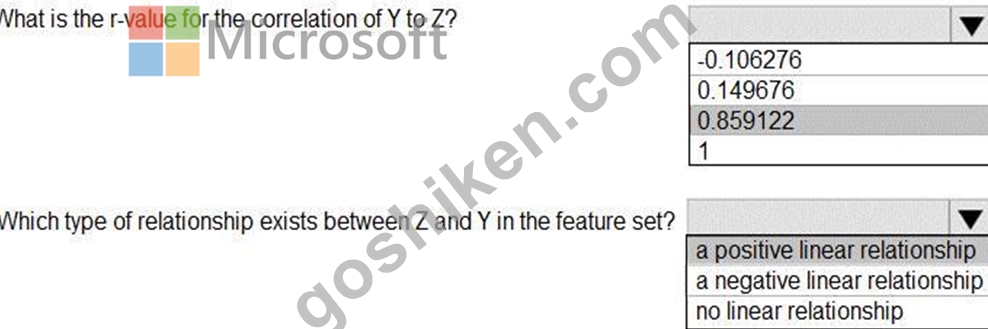
Box 1: 0.859122
Box 2: a positively linear relationship
+1 indicates a strong positive linear relationship
-1 indicates a strong negative linear correlation
0 denotes no linear relationship between the two variables.
References:
https://docs.microsoft.com/en-us/azure/machine-learning/studio-module-reference/compute-linear-correlation
質問 139
You register a model that you plan to use in a batch inference pipeline.
The batch inference pipeline must use a ParallelRunStep step to process files in a file dataset. The script has the ParallelRunStep step runs must process six input files each time the inferencing function is called.
You need to configure the pipeline.
Which configuration setting should you specify in the ParallelRunConfig object for the PrallelRunStep step?
- A. mini_batch_size= "6"
- B. process_count_per_node= "6"
- C. node_count= "6"
- D. error_threshold= "6"
正解: C
解説:
node_count is the number of nodes in the compute target used for running the ParallelRunStep.
Incorrect Answers:
A: process_count_per_node
Number of processes executed on each node. (optional, default value is number of cores on node.) C: mini_batch_size For FileDataset input, this field is the number of files user script can process in one run() call. For TabularDataset input, this field is the approximate size of data the user script can process in one run() call.
Example values are 1024, 1024KB, 10MB, and 1GB.
D: error_threshold
The number of record failures for TabularDataset and file failures for FileDataset that should be ignored during processing. If the error count goes above this value, then the job will be aborted.
Reference:
https://docs.microsoft.com/en-us/python/api/azureml-contrib-pipeline-steps/ azureml.contrib.pipeline.steps.parallelrunconfig?view=azure-ml-py
質問 140
......
Microsoft DP-100 認定試験の出題範囲:
| トピック | 出題範囲 |
|---|---|
| トピック 1 |
|
| トピック 2 |
|
| トピック 3 |
|
| トピック 4 |
|
| トピック 5 |
|
| トピック 6 |
|
| トピック 7 |
|
| トピック 8 |
|
DP-100問題集最新の練習テストと266独特な解答:https://www.goshiken.com/Microsoft/DP-100-mondaishu.html
最新Microsoft Azure DP-100実際の無料試験解答:https://drive.google.com/open?id=1SulNREeSzkkpbUFjQuVFpjMRA0sFOpnx